
I met Ray Lawler once. I was working for Currency Press when he came to visit, probably to talk to our managing editor, theatre critic Katharine Brisbane, about his play The Man Who Shot the Albatross. I have only the vaguest memory of him. I was probably introduced, then sat quietly in the corner or went back to my work in the adjoining room. He was soft-spoken and unassuming, a far cry from some of the more flamboyant visitors to our offices.
But my most memorable encounter with him happened much earlier, when I saw his most famous play, Summer of the Seventeenth Doll.
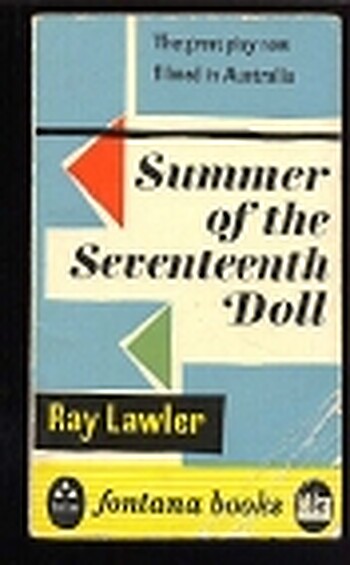
If Wikipedia gives correct dates for the New South Wales and Queensland tour, I saw the play in early 1956. It was in Innisfail’s Johnstone Shire Hall (now the Cassowary Coast Shire Hall), and I was almost exactly nine years old. My parents used to take me to every piece of live theatre that came to town – amateur productions by the Repertory Societies of Cairns and Innisfail, and the Cairns and Atherton Choral Societies. They included an annual Gilbert and Sullivan, Franz Lehar operettas, Die Fledermaus, The White Horse Inn, Harvey (source of the James Stewart movie of the same name), Arsenic and Old Lace, and a comedy about ants called Under the Sycamore Tree. The auditorium was a vast dance hall with unraked seats, so eye lines weren’t all that good. Sometimes the performers’ voices had to compete with the rustling of fans as audience members dealt with the tropical heat. It was all magic to me.
Summer of the Seventeenth Doll, a play in which a couple of men who cut cane in North Queensland come to Melbourne to spend the off-season with their regular summer girlfriends, took things to a different level. This was my first experience of professional theatre, and the actors commanded the stage in a way that was beyond magic.
Two moments stand out clearly in my memory. (‘Clearly’ doesn’t mean ‘accurately’. I haven’t checked the text.)
When Pearl, the new woman, says to Barney, ‘I didn’t know you had a family’, he says, ‘Oh, I haven’t got a family, just kids in three states.’ This got a big laugh from the audience, and from me, in a classic case of a joke working at different levels for adults and children: I thought Barney had uttered a delightful absurdity. Later, I overheard my father telling someone that he knew I knew ‘the facts of life’ because I had understood the jokes in The Doll. That may have been the beginning of my quest to discover what those facts were. A further follow-up: at the end of that year, or the following year, when invited to choose a book as a prize on the school’s Speech Night, I picked a paperback of Summer of the Seventeenth Doll, and was astonished when the teacher told me it was inappropriate for my age.
The second moment comes at the play’s climax. The men have given the women a kewpie doll each year, and the dolls have come to represent the enduring nature of their relationships. At the climax (spoiler alert), Roo, enraged by the way this summer has played out, throws the vase of dolls to the ground, smashing it and their relationships to pieces. I remember vividly how the huge bulk of a man hurled the object into the centre of the stage with tremendous physical and emotional force. I was definitely on the same page as everyone else in that moment of shock and grief. It may well be that whenever I’ve gone to the theatre since then I’ve been hoping to re-experience such a moment.
One other thing. It’s often said that this play brought Australian language and experience to the stage. (Not true, of course: but Louis Esson’s The Time Is Not Yet Ripe (1912) and Betty Roland’s A Touch of Silk (1928) were pretty much forgotten by 1956.) But Melbourne was as foreign to me then as, say, New York. What the play did for me was acknowledge the existence of North Queensland and the sugar industry. It was the first time I saw the realities of my place reflected back to me in a piece of art.
As a small child I would sometimes bring smoko to the paddock for my father and a gang of cane-cutters. I remember thinking the play had it wrong – cane-cutters in my experience were generally Italian or Maltese, not Anglo like Roo and Barney. But there was something else that I couldn’t have articulated at the time. Roo and Barney as cane-cutters are seen by the character Olive as models of heroic masculinity, flying down to Melbourne like eagles out of the sun, and I’m pretty sure there’s a description somewhere of the actual work of cutting cane as noble. I have no idea if Ray Lawler actually knew any cane-cutters, or if he’d ever been to a canefield. But, to me as a nine-year-old, this version of the work of the cane-fields offered a different perspective, an outsider’s view. It allowed me to see my world in a different light.
I’m immensely grateful for that gift, and though it would have been beyond awkward to try to say any of that to the man I met in the 1980s, I hope he knew something of the impact his work had on so many lives like mine. He died on Saturday, aged 103.
This post was written in Gadigal Wangal land, where the days are getting gradually longer, and the wind is bitter. I acknowledge the Elders past present and emerging who have care for this country for millennia, including during at least one major ice age.


 Me fail? I fly!