Category Archives: Diary

Lukewarm turkey

Schopenhauer and Richard Flanagan staged a virtual intervention and made me realise I have a problem. I don’t know about acknowledging a higher power and all that, but I’ve decided to Cut. Down. On. My. Reading. Habit.

So, I resolved, there’ll be no more reading before the sun is over the yardarm. I’ll take the dog on her morning walk bookless.

Yesterday was the first day of this desolate new regime. I left American Rust beside my bed. As I was packing the plastic bags, I caught my addictive brain thinking, ‘Maybe I could just slip the anthology of Chinese poems in as well.’ Resisting that temptation, I then had to stop my hand from picking up the Asia Literary Quarterly of its own volition, and then the Monthly. But I got out the door with no printed matter about my person, had a very pleasant walk and on my return actually managed to engage with my current writing project sufficiently to get some words on paper.

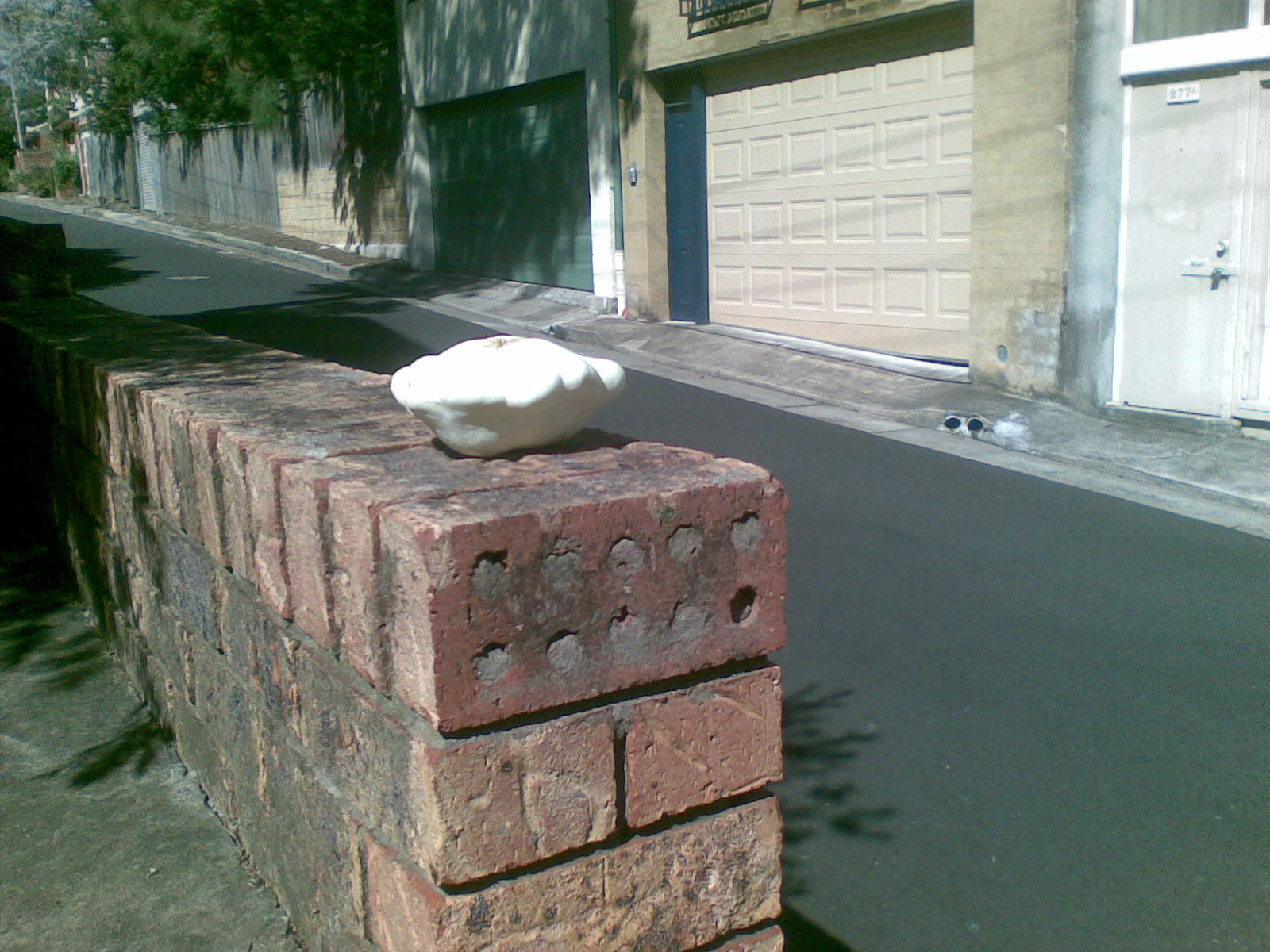
And I got to notice odd things around the suburb, like this big button squash put out to ripen in a back lane, for all the world like a pumpkin in a French village:

I still allow myself to read on the afternoon dog-walk. Yesterday we went on a 30-page excursion.

Our baskets and Awaye

Almost exactly a year ago I mentioned that we’d acquired three beautiful woven baskets. The artist, whose name I omitted to mention then, was Jim Walliss, a white man from down Nowra way. Yesterday onABC’s Awaye he received an honorable mention in a program about Boolarng Nangamai Aboriginal Art and Culture Studio in Gerringong, near Nowra. The Awaye link in the last sentence gets you the audio. Here’s the relevant bit, where Steven Russell, weaver, painter and print-maker is talking to Nicole Steinke from the ABC:

Nicole Steinke: How did you start with the weaving, because you’ve said you really love the weaving?
Steven Russell: It started back in TAFE, in 2000, when I first started TAFE. We were taught by this old fella, a whitefella –
NS: Is that Jim Walliss?
SR: Jim Walliss, yeah. He’s a pretty good weaver himself, and he told us stories about the Aboriginals and what they did. He showed us a lot, and we just took off from there and ran with it and haven’t looked back since. I’m just thankful for Jim, for knowing him, and teaching us something that should have been passed down by our ancestors, and which wasn’t.
NS: So was there a sharing there that went on?
SR: Yes, it was sharing, and he was honoured to teach us. He taught us a lot of things about weaving and styles of weaving. He taught us our traditional weaving and that’s something that we’ll cherish for the rest of our lives, and we’ll pass it on to our kids.

So our beautiful little baskets have some sweet connections.

Fourmillante Sydney …

… Sydney of dreams …

Last night we spent a couple of hours in the city for the first night of the Festival of Sydney. We saw:

  • thousands of people in a good mood, many sporting little electric fans that somehow lit up with an ad telling us to switch to a sponsoring bank
  • the fig trees in Hyde Park sporting ornate trunk wraps
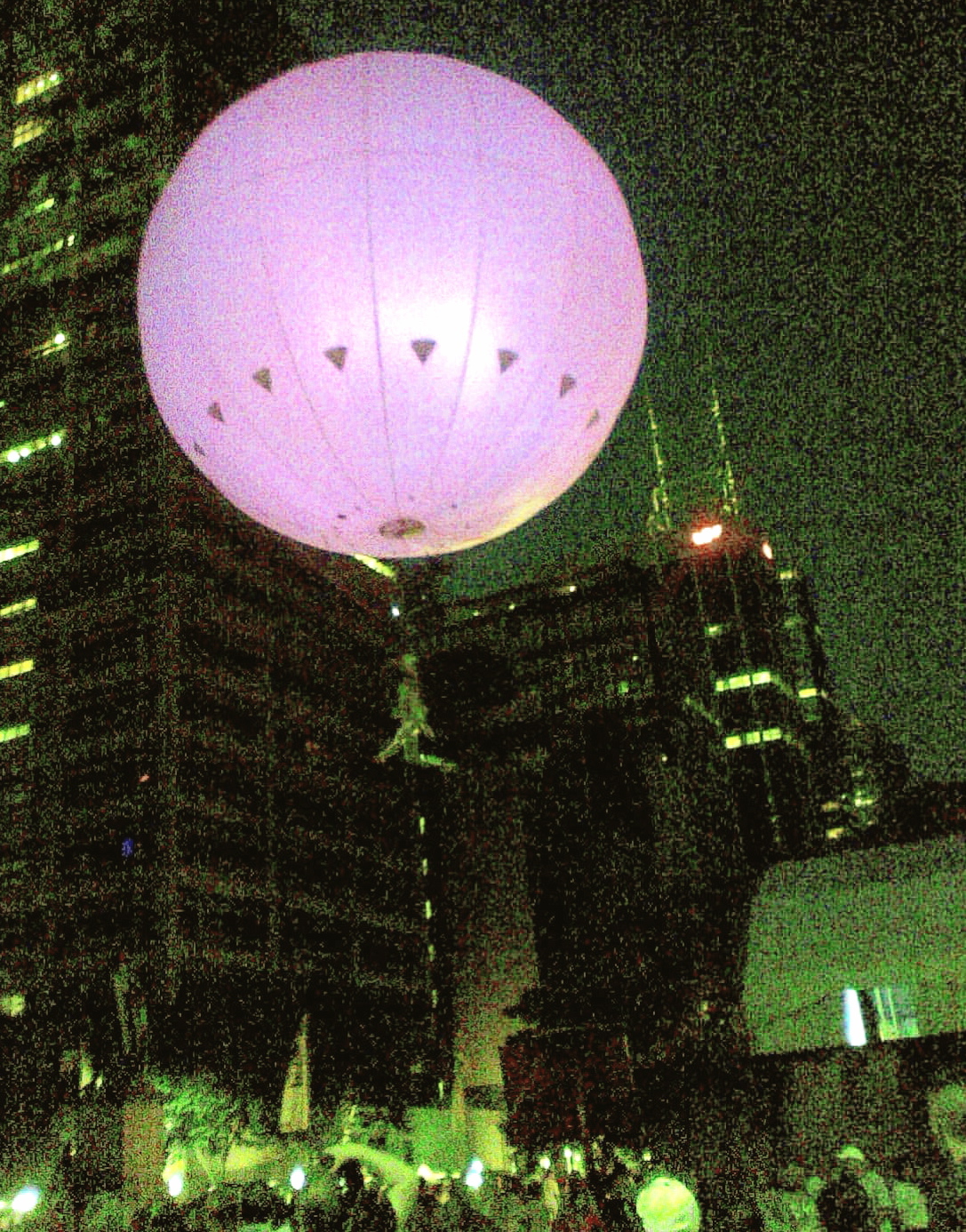
  • a spangled woman floating beneath a giant balloon outside the Barracks Museum, who dived in slow motion to touch fingers with a little girl sitting on her father’s shoulders

  • kaleidoscopic images lighting up the wall of the law courts building
  • a hundred saxophone players belting out a tune from the upper and lower verandahs of the Mint Museum
  • twenty bagpipers playing ‘Amazing Grace’ from the front of Parliament Building
  • Black Arm Band singing ‘Treaty’ in the Domain, and even though we were half a kilometre away from the stage they really did the business (Al Green, the main act, didn’t reach as far back as us in quite the same way)
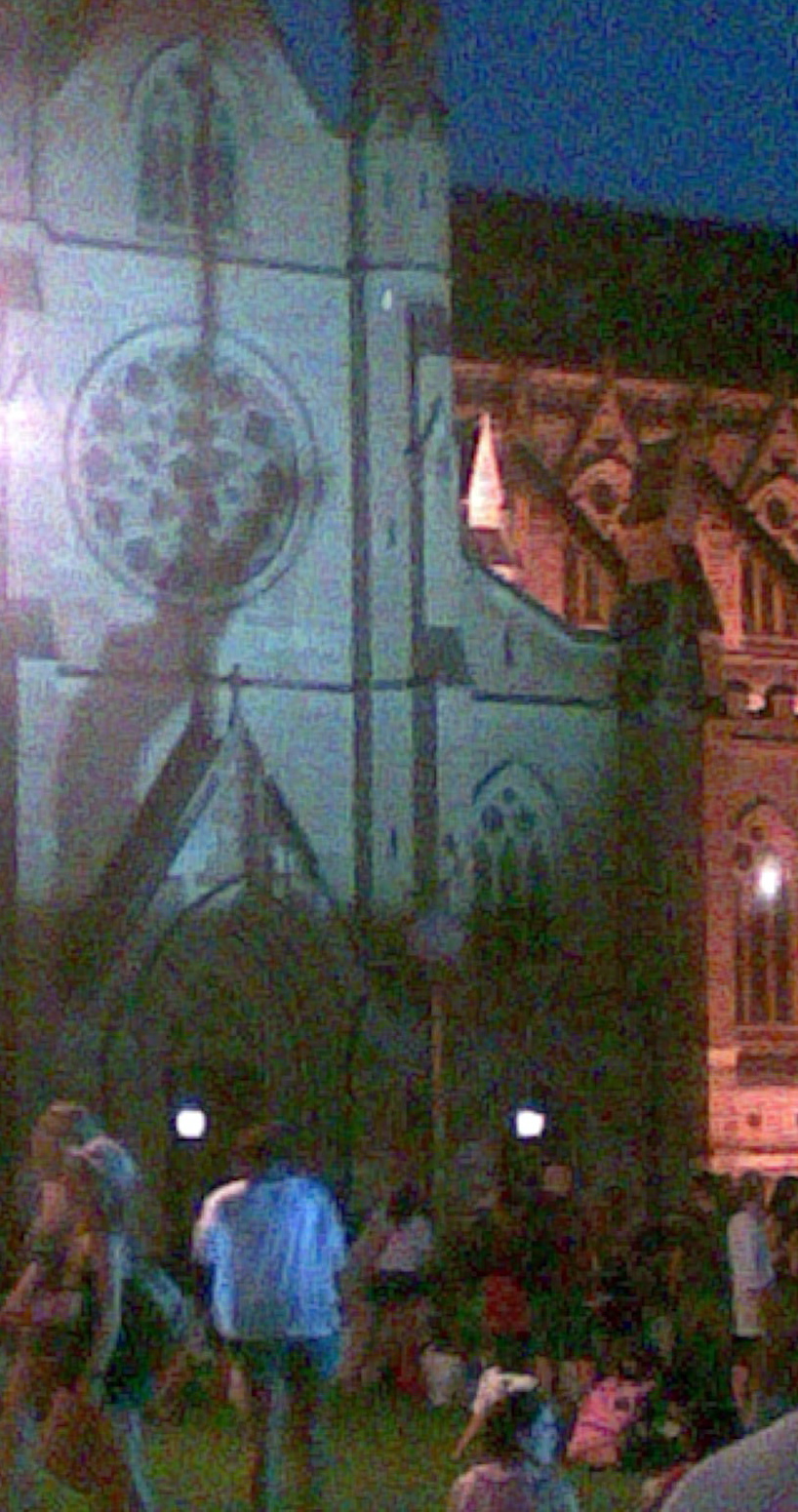
  • aerialists throwing weird shadows onto the western façade of St Mary’s Cathedral

  • A fabulous band called (I’ve just looked them up on the Festival web site) Big Bad Voodoo Daddy doing ‘Minnie the Moocher’ in Martin Place, which was packed even tighter than the Domain

I don’t have high expectations of these kinds of giant parties, particularly since being vomited on by a stranger at Darling Harbour one New Year’s Eve 25 years or so ago. Last night was like a good dream, or a dozen of them at once.

Eliasson’s Lights at the MCA

We visited the MCA again yesterday, this time to see the Olafur Eliasson exhibition. The most interesting things there – apart from the room where we were invited to build things in white Lego and to admire the extraordinary creations of those who had come before us – were his pieces made with light. I was probably a bit spoiled for them by having seen James Turrell’s work in Naoshima (blogged about here and here), where the thoughtfully reverential treatment allows the work to become almost numinous. In the MCA, for example, the 360º Room for All Colours, in which a circular wall becomes something like a domestic-sized Aurora Borealis (Eliasson is from Iceland) might have had that effect, but the chatter from the Lego room, the attendant’s helpful explanation of technical matters, and the intrusive detail of the floor and the room beyond the ‘room’ (unlike the polished blankness of the floor in the photo on the MCA site) allowed in too much mundanity, and the room felt to me like a clever novelty. ‘Take your time’ was the title of the exhibition, but there was little in the presentation to enforce that injunction.

Except in the piece entitled ‘Beauty’. In a black-lined room a fine spray of water fell from the ceiling, in light from a single directed bulb. In a very slight breeze, perhaps caused by our movements, the water fell in gentle arcs, catching and refracting the light like a shimmering, almost mother-of-pearl curtain. As I was standing in the dark at the back of the room, three women walked in. Something about their manner emboldened me, and I said, ‘Walk into it.’ And they did. It looked great – the curtain completely vanished for a moment, then reformed. Then I discovered for myself that when you walked into the mist, a circular rainbow formed around you.

There were other lovely things in the exhibition, but I wanted to make sure I told you about that.

2009

By way of quick and dirty retrospective, here are the first sentences from my blog (or really blogs, as I changed platforms and name in May) for each month of the year. It’s a meme, picked up from The Couch Trip.

1 January:
I just found out from the nice people at Wikipedia that the Catholic Church no longer celebrates 1 January as the Feast of the Circumcision of Our Lord, and hasn’t done since 1960.

1 February:
Penny said I had to blog this, even though I was so bowled over by it that I lost track of how I came upon it, so can’t give proper credit. [It’s a lovely bit of Obamiana.]

3 March:
Yesterday was a big one for the Shaw family. [My niece Paula’s book launch.]

1 April:
Last October I posted a little entry about Nicolas José’s address at the NSW Premier’s History Awards, in which he spoke of the Macquarie PEN Anthology of Australian Literature, due for publication in August this year, and mentioned Taam Sze Puy’s bilingual memoir, My Life and Work, published in Innisfail in 1925.

4 May:
A couple of nights ago I had a hugely reassuring phone call from one of the editors of a literary magazine that has accepted a couple of my poems.

1 June:
L K Holt’s man wolf man won the Kenneth Slessor Award this year.

1 July:
I’ve been slack in my self-imposed duty to be a blog of record – that is, to keep you informed about what I get up to by way of going out to stuff in the evenings, often stuff you won’t hear about from the newspapers.

4 August:
Last night my men’s group book group met to talk about Anna Karenina (Anna Karenin, as she’s called in the secondhand copy I bought on Monday), and an excellent evening it was.

3 September:
I haven’t exactly managed a daily post as we walked through the Loire Valley: points d’internet aren’t exactly common and those I have found, when they functioned at all, have had keyboards that drive me crazy.

2 October:
I was on a bus in Connecticut in August when Penny texted me from the airport in Sydney to tell me Yasmin Ahmad had died.

1 November:
This afternoon we visited the White Rabbit Gallery in Chippendale, and then went on to Object Gallery to see their part of the exhibition Menagerie.

1 December:
I don’t suppose many people would see an item about youth suicide in Queensland as a good news story, but this story in today’s Sydney Morning Herald marks my niece Kym’s first byline in a major newspaper.

So this year, I’ve been published, and so have my nieces. I’ve travelled, with Penny and without her. People have died. I joined an all-male book group. I’ve tried to blog about all my reading, gallery-going, lecture-attending, and my reading has been, um eclectic –100 books by my count, including comics like Watchmen and revisited children’s books. Obama and Rudd have continued to inspire and disappoint. The past has continued to surprise.

I’m setting this to upload at a minute after midnight. I intend to be sound asleep in a single bed by then, with Penny, sick and infectious with the flu, sleeping in our bed a room away.

Happy 2010!

Arty sunny afternoon

Confounding the predictions, yesterday gave us deep blue skies all day. Two loads of washing dried on the line, the goldfish glowed in the murk of our little pond, and P and I took the light rail to Pyrmont and walked to the MCA.

There was a charge for Danish–Icelandic artist Olafur Eliasson on the third floor, and a friend had been pretty lukewarm about him, so we decided to save our money (unusual for this time of year, I know) and visit it some other day. But the first, second and fourth floors fabulous enough.

The first and second are exhibiting a recent gift from Ann Lewis, an art collector so famous that even I had heard of her. It was wonderful to see shimmering works by Utopian ladies Emily Kame Kngwarreye and Gloria Petyarre, among other Aboriginal artists, displayed in the company of US big names Rauschenberg and Klippel  – Gloria Petyarre’s canvas filled with shimmering silver leaves is the single image that most grabbed me. There’s a little room of lovely photographs by Jon Lewis. Any relation? Well, yes, if the handwritten ‘For Annie (Grannie)’ written in the bottom border of one image means what it appears to.

Half of the fourth floor is given over to Forbidden, ‘the first in-depth solo exhibition’ of Fiona Foley’s work . Now, I am often impressed, bemused, amused or depressed by contemporary art, but I don’t often have a strong head-and-heart response. I did have to this exhibition. For example, the word Dispersal in big, chunky shiny aluminium letters, of which the initial D bristles with .303 bullets is a lot more than a clever reminder of the hideous use of that word in our colonial history. It stands next to a spiral of flour about three metres across, that needs constant attention from an attendant to maintain its crisp shape; the flour turns out to be part of an installation ‘Land Deal’, in which other objects representing those John Batman used to ‘buy’ the land where Melbourne was built hang on the wall. Nearby hangs a row of blankets, each inscribed with a single word, that conjure the experiences of Aboriginal women under colonialism. Elsewhere Foley places herself in photographs with titles like ‘Native Blood’ and ‘Modern Nomad’, that refer strongly to nineteenth century anthropological images. Evidently, earlier exhibitions have had titles like ‘Lick my black art’. Ok, lick it and weep.

The rest of the floor showcases new acquisitions. There’s a cute hologram that was popular with the very young (and others, including me), which could have been titled ‘Ghost Train’, but instead is called ‘You’re not thinking fourth dimensionally’. Danie Mellor made the cut with a sculpture that includes a shiny, mosaic kangaroo and a lifelike sulphur-crested cockatoo. I loved a video piece by Grant Stevens, in which an account of a dream is projected onto a wall in a way that controls the speed at which the viewer reads (or fails to read, because the pace picks up enormously in the middle).

Then we walked back to Pyrmont along the Hungry Mile, trying to figure out Paul Keating’s proposal for Barangaroo, and home to find the washing dry on the line.

Agitator and Regurgitator

Weeks ago we left Nessie alone in the house longer than she was happy about, and her good leather lead that had cost us $75 or so to buy and another $20 or so to repair when she’s bitten through it on a previous occasion, was reachable. We came home to find an awful lot of the lead had vanished. This time it was beyond repair, and we now have a cheaper and we hope less edible replacement. Yesterday – after 17 days in which I had marvelled at the efficiency of the canine digestive system as Nessie filled plastic bag after plastic bag with rich, unleathery fecal matter – we found on side path half a dozen inch-long pieces of leather in a shallow pool of digestive foam, back from a place where it’s too dark to read. The foam had dried off by the time I took this photo, for your edification:

But storing strips of leather somewhere inside them isn’t the only cute trick dogs are capable of. Nessie’s little friend Oscar has discovered our back yard pond and has had a marvellous time swimming round in it, churning up the sediment, totally disrupting the irises’ equilibrium, and possibly even scaring the living daylights out of our incredibly self-reliant fish. Here he is, turning what had been a pleasant pool into a wallow.

See! Dogs are so much more fun than cats.

After AFTRS

On Friday at Luna Park, AFTRS had its first whole-school graduation ceremony. As you’d expect, there was plenty of multimedia, and also as you’d expect it was beset by technical SNAFUs – but came through in the end. It was a nice touch to have a new cohort of media professionals being released on the world in a large room with the Harbour resplendent outside one set of windows and fairground machinery spinning outside the other. Peter Garrett gave a ministerial speech and left. Sandra Levy gave a CEO speech and shook the hand or kissed the cheek of every graduate, except one or two who accepted their testamurs and walked past her, oblivious.

Then yesterday we spent the afternoon at the Entertainment Quarter watching the fabulous AFTRS graduate screenings: five hours, 17 directors, 17 short movies. We would have stayed on for the Graduate documentaries (1 hour, 24 even shorter films) but we hadn’t checked out the program thoroughly enough in advance and had made other plans. What we did get was terrific. Here are some of my favourites, so when they turn up at a festival near you you’ll be able to say you read about them somewhere ages ago.

  • Craig Boreham, Ostia – La Notte Finale: the death of Pasolini, in subtitled Italian neo-realism, presumably shot around Sydney
  • Lucy Gaffy, The Lovesong of Iskra Prufrock: a radiographer dares to love in spite of the shadow
  • Martha Goddard, The Bridge: extraordinarily economic (and funny and suspenseful) evocation of a young woman’s complex life as artist, cynical media employee, family member, tenant, receiver of kindness.
  • C J Johnson, The Bris: a comedy involving old age, death, genital mutilation, religious inflexibility, and finally tender celebration, from a short story by Eileen Pollack.
  • Maziar Lahooti, Loveless: of the many offerings about young people dealing with love, sexism, drugs, despair, etc., I liked this best, perhaps because it incorporated elements of the heist genre.
  • Tresa Ponnor, Sosefina: I wouldn’t be surprised to see this turn up on ABC3 – a Pacific Islander schoolgirl in a colour saturated world tries to join the’popular’ group, but finds home is best.
  • Alex Ryan, Valhalla: I’m the director’s father and make a brief appearance in the background of one shot, so feel free to discount my opinion, but I loved this grainy glimpse of a dystopian future, playing an elusive adventure story off against the tentative beginnings of a relationship.

Added later: Alex told me that some of his fellow graduates already have established bodies of work. I’ve added links.

Bankstown Cooks with Grace Under Pressure

Bankstown Pressure Cooks final cook-off was today. You may have seen some publicity during the week, even heard Shaista Khan talking to Deb Cameron on 702 Mornings.

I was drawn into the vortex, ferrying chairs and other equipment yesterday as well as providing amateur tech help, then today acting as marshal (because the Centro shopping centre insisted that there be marshals lest the fifty or so people who turned up disrupt the Saturday morning shoppers), getting the Powerpoint program to run, and generally being helpful.

It was a terrific event. The competing teams had to cook a salmon dish in a cuisine that was outside their own heritage. In earlier rounds, Lebanese entrants had cooked Thai, Chinese had cooked European pastries. Today, the stretch wasn’t so great: ‘Hot and Spicy’, a Chinese couple cooked Thai, and the Maltese ‘Crazy Daisies’ cooked Italian. But it was far enough to satisfy the judges, and a fabulous nailbiting time was had by all. The local member and the mayor were there. The specially and expensively installed electricity didn’t work, so someone rushed out to buy electric frying pans. The four cooks didn’t seem to miss a beat. ‘Hot and Spicy’ won by a whisker.

The mood was great. Lots of hijabs were in evidence, though it’s the second day of Eid l-‘Aḍḥā and presumably the hijab wearers had plenty of cooking of their own to do at home. Apart from the inadequate electricity, the only thing approaching a sour note was the two tables of elderly Greek men who evidently meet in that particular spot every Saturday morning to drink coffee, read the newspapers, gossip, argue, finger their beads. They paid casual attention to our goings-on, but clearly weren’t going to budge from their routine: if it could survive transplanting from the Aegean to western Sydney, then no fuss about cooking was going to cause it to falter.

My recent reading prompted me to reflect that this is the utter catastrophe that White Australia was desperately trying to protect us from.

Dejan/Ludwig

Disclaimer: I don’t know anything at all about music. I don’t even know what I like.

Last night we went to an Australian Chamber Orchestra Beethoven 4 concert at Angel Place. I went mostly for the company, I confess, but I ended up enjoying myself hugely. The first piece was Testament by Brett Dean, a Brisbane born composer: I’d had transport troubles so slipped into my seat without a chance to read the program, so the first whisper on the snare drum (I think) caught me off guard, and I stayed of guard for the whole exhilarating tinnitus-dominated piece. I didn’t have the tinnitus thought until I read the program notes, where we’re told this was the intention, but I certainly got the effect, so that when sweet melodies emerged from the ‘glassy noise that seems to be losing its grip on sound’ is fabulously moving. After interval, we had Beethoven’s  fourth symphony, which was wonderful.

But it was the second part of the pre-interval program that thrilled me – Beethoven’s fourth piano concerto, with Croatian Dejan Lazic on the piano. He was a complete revelation: flamboyant as you’ve never seen unless in a Warner Brothers caricature of a concert pianist, he had vampirish pallor and sleeked back hair, at times hunched Igor-like over the keyboard, or mouthing the notes like a genius baboon. He looked as if he was making it up as he went along, playing back-and-forth with the orchestra, leaping from intricate exhibitionism to sweet contemplation in a moment, raising his left hand in limp-wristed command to the orchestra, turning to the leader (Richard Tognetti – not exactly a bland presence himself) as if to ask permission to stop for a moment. He inhabited the music. Or maybe he inhabited the ghost of Beethoven. At one stage in the first movement, I laughed out loud, which I only realised because the woman in front of me turned around and – thank God! – smiled with broad fellow feeling. At the end, when he thanked us for the applause, I was almost surprised that he was capable of human speech.

I found this on YouTube, where he’s playing some Beethoven with cellist Pieter Wispelwey. You get at least some idea of his style.