Monthly Archives: May 2010

Stop the presses: Inner city house has surplus cockroaches

If you don’t know about Freecycle, you’re missing out on a very good thing. It’s a transnational ‘grassroots movement’ of people giving stuff away (and getting stuff). Instead of putting useful bibs and bobs  you no longer need out on the verge to be collected by canny passers-by, or canvassing friends to see if anyone wants the chair that doesn’t fit in your living room any more, or selling the superseded TV on eBay for a nugatory sum, you advertise them on your local Freecycle list and someone interesting comes and takes them off your hands. It costs nothing, and is remarkably undemanding. When a small business I know was closing down an office, it gave away book cases, a television set, large pieces of furniture, computers, to recipients including a family whose house had burned down and a school that was struggling to  make ends meet. Someone put up a message saying they needed compost: we happily gave them a couple of buckets from our plentiful supply (and the recipient turned out to be someone I last saw when she was two years old, the daughter of a close friend’s partner at the time). The Freecycle website’s catchphrase is, ‘Changing the world, one gift at a time.’

Today must be some kind of landmark case of one person’s junk being another’s treasure. I received an email with the subject line ‘[freecycle_sc] OFFER: Annandale – Live cockroaches.’ He wasn’t kidding:

Anyone who keeps a pet lizard knows that roaches are expensive to buy at petshops, and that many you might catch yourself are likely to be contaminated with insecticide and harm your reptile.
My house has not had insecticides used in it for at least a dozen years, and my roaches are healthy and safe. I’m offering to catch them on a weekly basis and have them available for collection.
best phone to catch me on is xxxx xxxx Thurs Friday or Monday.

See, you don’t know what you’re missing.

Greg Weight and Western Desert Artists

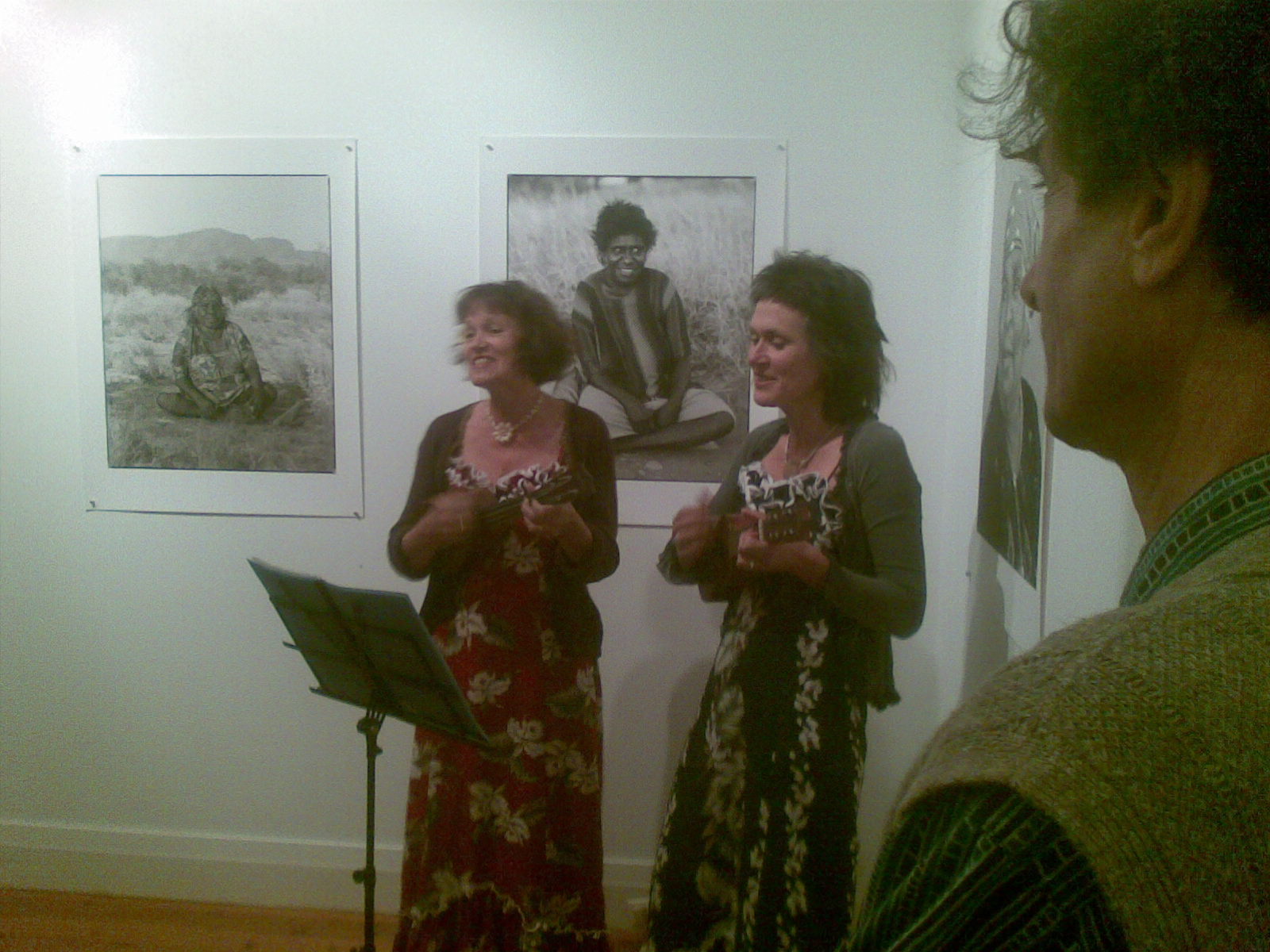
At least one of my regular readers would have loved to be at the Gallery East opening this evening [All turn and look at Will]. Greg Weight’s ‘Artists of the Western Desert’ comprises eleven portraits of Western Desert artists – from Kintore, Haast Bluff, Yuendumu and Alice Springs. The opening was a small, even intimate gathering. I recognised a number of stars of the art world, but someone explained that they were there as neighbours and old friends of Greg and Carol Ruff, his partner and the owner of the gallery, rather than as A-listers.

Long Jack Philipus Tjakamara dominates the gallery’s front window.

In lieu of speeches, Carol Ruff and friend played ukulele and sang – among other things, Carol’s own song ‘Finding Love in CLOVElly’ – and were joined on the bongos by the artist photographer, seen here in the right foreground. The Indigenous artist beaming down from the wall is Yukultjii Napangati, a Pintipu woman who came in out of the desert in 1984 when she was about 14 years old.

The exhibition lasts until 23 May.  If you miss it at Clovelly, you may be able to catch it at the Musée Branly in Paris in the next year or so.

Bill Murray reads Emily Dickinson

Remember Paul Robeson singing to workers in the Sydney Opera House under construction? New York’s Poets’ House isn’t quite on that scale, but this coming together of Bill Murray, Emily Dickinson and a group of construction workers is beautiful to behold.

I usually tend not to like actors’ readings of poetry, but this is masterly, especially his apparently casual use of props and the way he modulates degrees of seriousness. Even the little bit of ‘New Yorkers are special’ rhetoric isn’t too vomitous.

Thanks to Harriet the Blog.

Ordinary Affects

Kathleen Stewart, Ordinary Affects (Duke University Press 2007)

This starts most inauspiciously:

Ordinary Affects is an experiment, not a judgement. Committed not to the demystification and uncovered truths that support a well-known picture of the world, but rather to speculation, curiosity and the concrete, it tries to provoke attention to the forces that come into view as habit or shock, resonance or impact. Something throws itself together in a moment as an event and a sensation; a something both animated and inhabitable.

Whooee! It’s going to be a rough ride, with tortured syntax, unconventional semicolons and words that don’t seem quite to mean what one would expect. It doesn’t get any more comfortable, but I persisted because it was a Book Club book, and Book Club books are meant to take me places I wouldn’t necessarily go if I just followed my nose.

A couple of pages in, I decided that even though this is a scholarly work, probably belonging to the discipline of postmodern anthropology, I lack the background to be able to read it in a scholarly manner. Instead, I let it kind of break over me. I read it as if it was poetry. And I enjoyed it. I can’t tell you what it’s about, mind you. It abounds in anecdotes, ranging from a pleasant but odd encounter in a check-out queue to horrific violence, bizarre plane travel incidents to odd things seen from the car. It offers fascinating reflections on public responses to big events – the OJ trials, the Columbine shootings, child care sex abuse scandals, nuclear waste disposal, 11 September 2001. It positively bristles with gnomic utterances that would make great epigraphs for poems (‘The ordinary can turn on you,’ or ‘Dream meets nightmare in the flick of an eye’) or citations in other scholarly works (‘Like a live wire, the subject [which I think here means a person] channels what’s going on around it in a the process of its own self-composition. Formed by the coagulation of intensities, surfaces, sensations, perceptions and expressions, it’s a thing composed of encounters and the spaces and events it traverses or inhabits’).

By chance, the first thing I read after finishing this book was Raewyn Connell’s characteristically incisive essay in the current issue of Overland, in which she says:

Any system of doctrine, any powerful concept, becomes in time an excuse for not thinking: Marxism, radical feminism, deconstructionism, post-colonialism, the lot. … We need harder thinking, not fluffier thinking, about social reality – and that includes rethinking the ideas earlier generations of socialists worked with.

I think Kathleen Stewart would agree with that (even while, being from the US, she might flinch at the word ‘socialists’), but Ordinary Affects deals in something that precedes thought: ‘The ordinary can happen before the mind can think.’ (Let me share with you the pleasure I felt in using that limp word ‘something’ here. It’s a word that Stewart uses often and interestingly, usually in the phrase ‘or something’, as if to insist on the provisional nature of her thinking.) Before we can rethink, we need to re-see, and re-feel, re-attend, and at least part of what Stewart means by ‘ordinary affect’ is what happens when we pay attention, how we integrate, or not, the many influences on our perception, our emotional responses, our unreflective thoughts.

I found myself remembering the only lines I know from the US poet Muriel Rukeyser:

PAY ATTENTION TO WHAT THEY TELL YOU TO FORGET

The capitals are hers.

If I get a chance I’ll re-read this book, though I expect it will be a matter of letting it break over my head again.

Luke Carman audio

One of my highlights of last year’s Sydney Writers Festival was Alleyway Honour in the Bankstown Town Hall. Some of the same people who made it so brilliant will be in the prosaically named Inside the Westside Writers Group this year at Bankstown on 18 May. I hope Michael Mohammed Ahmad will read again. And Alexis Wright will be there as a special guest.

But my reason for blogging is to let you know that Luke Carman, whose readings at Alleyway Honour were a thrill and a delight, having had a couple of pieces in the latest Heat, has now, thanks to Penguin Plays Rough and FBi Radio, turned up in audio on the internet. You can hear him with just one click.