Monthly Archives: Mar 2016

Jeremy Massey’s Last Four Days of Paddy Buckley

Jeremy Massey, The Last Four Days of Paddy Buckley (Riverhead Books 2015)

last4days.jpg

Seven years his junior, Donal had been Vincent’s partner in crime since they were teenagers.

Now someone had plowed Donal in the dead of night and robbed him in the bargain.
—-
… forty girls from as many different countries who were quite literally real-life fantasies for the top-end clientele.

Those are all quotes from page 78 of The Last Four Days of Paddy Buckley. If, as E M Forster said, a novel is a prose narrative of some length with something wrong with it, then it’s completely fine that the maths doesn’t work: boys who are seven years apart can’t be teenagers at the same time. It’s fine that literally is quite meaningless in that context. And it would be weirdly churlish to object to US spelling in a novel set in Dublin that is, after all, published in New York. But the fact that I noticed these things is a sign that something wasn’t working.

Sex and death, out of body experiences, an evil crime boss and a sadistic ambitious underling, a scary hybrid canine: plenty of elements that should be interesting and just aren’t. However, I did read on, and and was rewarded 12 pages later by a shockingly objective account of embalming a body, which was enough to propel me through Paddy’s remaining two and a half days.

The back cover of the paperback tells us that Jeremy Massy is ‘a third-generation undertaker who worked with his father for many years at the family firm in Dublin’. He is now, the cover blurb continues, ‘a screenwriter by training’. Paddy Buckley of the book’s title is also a Dublin undertaker, and I’ll happily believe that his professional crises and dilemmas are drawn from Dublin undertaking folklore: a body arriving from another undertaker in a coffin with someone else’s name on it, a scam involving coffins and customs, the tensions of juggling multiple funerals with limited staff and vehicles, the details of what ‘ashes’ actually consist of, the effects of tissue gas setting in, even the professional jargon (I like remains, always singular when it signifies a dead body). These bits of lore are what make the novel live. The rest of it, which fails to amuse or excite on the page, may be a novelisation of a film script, and indeed it might work  well as a black comedy thriller on screen, though I doubt if Paddy’s out of body skills would be any less unconvincing when seen than when read. Maybe a producer with money will take it up.
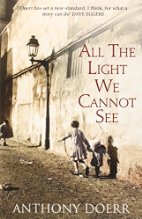
The book group has Anthony Doerr’s All the Light We Cannot See

Anthony Doerr, All the Light We Cannot See (Fourth Estate 2014)

0007548672.jpg Before the group: In short chapters that for the most part alternate between their two stories, this novel of the Second World War tells of a German orphan boy with a gift for radio technology (a geek before the word) and a blind French girl who flees Paris with her father when the Germans invade.

They finally meet in the aftermath of the Allied bombing of St Malo on the French coast in the last days of the war.  The two young people’s war experiences are vividly realised. The account of the making of dedicated Hitler Youth is chilling. The story telling is masterful, and motifs of light and darkness, touch and sound, snails and gems are woven intricately into the novel’s fabric.

But it didn’t really touch the sides. At the centre of the plot is a brilliant diamond with a fire at its heart, sought after by the Nazis and guarded unawares by the blind girl. Some readers may respond to the talk of curses and other magic that surround this jewel so that it resonates with rich symbolism, but for me it’s just a maguffin, and the novel as a whole a beautifully crafted, enjoyable diversion set in a period that has been done, and done, and done. If it has fire at its heart, the fire remained invisible to me. Soon there may well be a Spielberg movie, as flawless as Bridge of Spies.

Actually I just told a lie. There is one paragraph that snagged me. Young Werner is deeply into his work with the German armed forces when he hears on his radio receiver some music that he and his sister Jutta used to listen to back on the orphanage:

Now the piano makes a long, familiar run, the pianist playing different scales with each hand – what sounds like three hands, four – the harmonies like steadily thickening pearls on a strand, and Werner sees six-year-old Jutta lean toward him, Frau Elena kneading bread in the background, a crystal radio on his lap, the cords of his soul not yet severed.

That last phrase encapsulates brilliantly the long, corrosive years of Werner’s training to serve the Reich, and strikes a note of deep pathos. It made me glad I’d read the book.

At the meeting: Given that the book won a Pulitzer Prize and received extravagant critical praise, I was prepared to be a minority voice. But we had extraordinarily similar responses to it. Unusually though, we spent most of the evening – over a delicious tuna salad in a room with the walls folded back so we had full benefit of the warm autumn night – actually talking about the book. Spouses’ illnesses, the state of Sydney theatre, advice on how to approach local council all took a back seat.

One man had recently been to St Malo, and the book was a revelation – evidently the old town  has been restored and all signs of the WW2 devastation erased. Another had researched the school young Werner was sent to, and verified that there were many like it. Yet another wondered if the Nazis did search Europe’s natural history museums as well as its art museums. So it did stir our minds. We all agreed that the short chapters made it very easy to read, that with one or two exceptions the characters were well drawn and engaging, that the plot moved along. We all agreed that it was beautifully written: one chap said he reread some chapters just for the pleasure of it, ignoring the onward pull of the narrative. No one was keen on the fiery jewel – only one chap thought we were supposed to take its magical powers seriously.

So we kept coming back to the question: why, if it’s so good in so many ways, does it leave us largely untouched? Perhaps the short alternating chapters worked against immersion in the story. Perhaps telling the story from children’s point of view limited the possibilities for adult engagement. Perhaps the book is overworked, leaving no Leonard Cohenish cracks to let the light come in. Perhaps the relentless action means there’s too little breathing space where a reader could find an emotional way into the story? Perhaps it’s that there is no thesis, no moment where the story comes together in a revelation of some sort, or if there is it’s too subtle for us. Perhaps we’ve all just read too many novels set in the Second World War. All those possibilities were canvassed, none were agreed on.