Yearly Archives: 2021

500 people: Week Seven

Continuing with the challenge to talk to 500 new people this year. See this post for the brief description of the challenge. Two comments on last week’s post inspired me to aim for more sustained conversations. Or maybe it just happened that way, because I’m not sure I can take a lot of credit for some of this week’s encounters. On the other hand, while I’ve spent quite a lot of time talking to people I see roughly once a year, there hasn’t been a lot of chance to meet actual strangers over Easter. There haS been plenty of ‘Good morning, good morning‘ while out and about, but I’m not counting them.

  1. Saturday 27 March, in Murray Art Museum Albury. (Actually this happened before I posted about the challenge last week.) The upstairs gallery invigilator asked us as we entered if we knew about the exhibition. We politely declined the implied offer of an explanation. A couple of minutes later, in the rooms full of the photos of Olive Rose Odewahn (1928–1960), taken as snapshots and now digitally captured and enlarged to show them as she never saw them herself, the invigilator turned up and engaged us in conversation. I don’t know that she learned anything about us beyond that we came from Sydney, but we learned a lot about her biography: migration from England deceived by Australia House propaganda, back to England disappointed, then back again to this backward country, to marry (biggest mistake of her life), have children (not a mistake), have a multifaceted nursing career. She wasn’t white, and I wondered how much of her unhappiness about Australia when she first came here was because of racism – but didn’t get to ask.
  2. Sunday afternoon, after we’d checked in at our Melbourne Air B’n’B on the dizzying 44th floor of a residential building, there were two thirty-somethings in our lift back to the ground. I asked them if they lived in the building. ‘Yes.’ ‘How is it?’ A twist of the lips from both of them. ‘How long have you been here?’ ‘Just about two months.’
  3. Sunday, at dinner in Carlton with the Emerging Artist and a friend. Somehow the conversation turned to the unpleasantness of ageing. Striking a contrary note, our almost-70 friend stood up in that post-Covid crowded restaurant and touched her toes with straight knees. Not to be outdone, the EA, fully 70, stood and placed her palms on the floor. Our friendly young male waiter stopped by and demonstrated that he couldn’t do it. I stood and showed that I could manage even less than him. It was a joyous moment of connection, all about bodies young and old, male and female.
  4. Later Monday afternoon in Swanston Street, a man in an Afghan-type turban went down on his knees as I walked past, then prostrated himself on the footpath. It looked deliberate, but I stopped to check that he was OK. An older, slightly dishevelled woman, seeing me stopped and looking, tapped me on the arm and said, ‘I’ve been following him all the way from Melbourne Central and this is the third time he’s done that. After a while he stands up and raises a fist and shouts. It’s a war cry, like those terrorists did just before the attack on the bridge in London.’ ‘I don’t think he’s a terrorist,’ I said. ‘I don’t know what to do,’ she said. ‘The army or the police won’t listen to me. It’s happened to me before, you know.’ She had once seen men with machine guns on Melbourne rooftops, and when she told her doctor he made a note that she was prone to psychotic episodes, even though just as he was about to have her taken away by ‘the men in white coats’ they heard on the news that there had been a security drill in preparation for the Commonwealth Games, in which men with machine guns were all over rooftops on the Melbourne CBD. We were now walking back the way she had come (she had decided to change course to avoid any terrorist action). She told me she comes out to draw on the footpath, because it gets her out of the house, and showed me a phone photo of one of her beautiful drawings. We swapped names, and said goodbye when she stopped to talk to the man begging with his dog at a station entrance. ‘I hope we don’t see ourselves on the news,’ she called out in parting.
  5. Wednesday morning, descending from the 44th floor with our bags, we shared the lift with a young woman. Again, I decided to break the Silence of the Lifts. ‘Do you live here?’ ‘Yes.’ The EA: ‘Have you thought about what you’d do if there was a fire?’ (This had been the subject of some discussion during our stay.) ‘No, I haven’t. And I won’t in future either.’ Pause. ‘Do you live here?’ ‘No, we’ve just been staying for a couple of days.’ ‘I was wondering when I saw your bags. Can you stay here like a hotel?’ ‘No, we’ve done it on Air B’n’B.’ ‘Ah!’ Somewhere in there she mentioned that she actually lives nn Geelong, and stays here a couple of days a week.
  6. Sunday afternoon, at Airey’s Inlet, where huge waves are breaking on the beach and there’s a steady flow from the ocean over the sand barrier into the inlet, we meet a man in budgie smugglers with ‘DUBROVNIK‘ blazoned across his bum. ‘I was going in but it’s too rough,’ he said. ‘High too,’ I said. We communed, more or less wordlessly, in our sense of the sublime, and went our separate ways

Running total is now 64. I’m falling well behind my goal of roughly 10 a week.

Jeff Lemire’s Ascender Vol Three

Jeff Lemire & Dustin Nguyen (storytellers), Steve Wands (lettering and design), Will Dennis (editor), and Tyler Jennes (assistant editor on issues 13 and 14), Ascender Volume Three: The Digital Mage (Image Comics 2020, from issues 11–14 of the comic)

A quick Duck Duck Go reveals that Volume 3 was published in December, so it may well arrive in Sydney in time to be a March birthday gift.

That was my January wish. In March it was granted.

I don’t have a lot to say about Volume Three of this space saga that wouldn’t be simply repeating what I said about the first two volumes (here, if you’re interested).

Suffice it to say the forces of evil become more formidable, and close in our fugitive bands; more of the original group of bickering good guys are reunited; new good guys turn up and spill a lot of vampire blood; the quest that has animated these three volumes is completed; and at the heart of it all is a vulnerable little girl. What’s not to like?

Among many good things, Jeff Lemire and Dustin Nguyen have a great gift for final moments. At the end of this volume, the little girl and her companions arrive in a new place, and one they have recognised the people they find there, this dialogue happens in the last three panels:

You're just in time?

Time? Time for what?

Time to save the universe

It will probably be at least six months until Volume 4 appears. Maybe I can wait until Christmas.

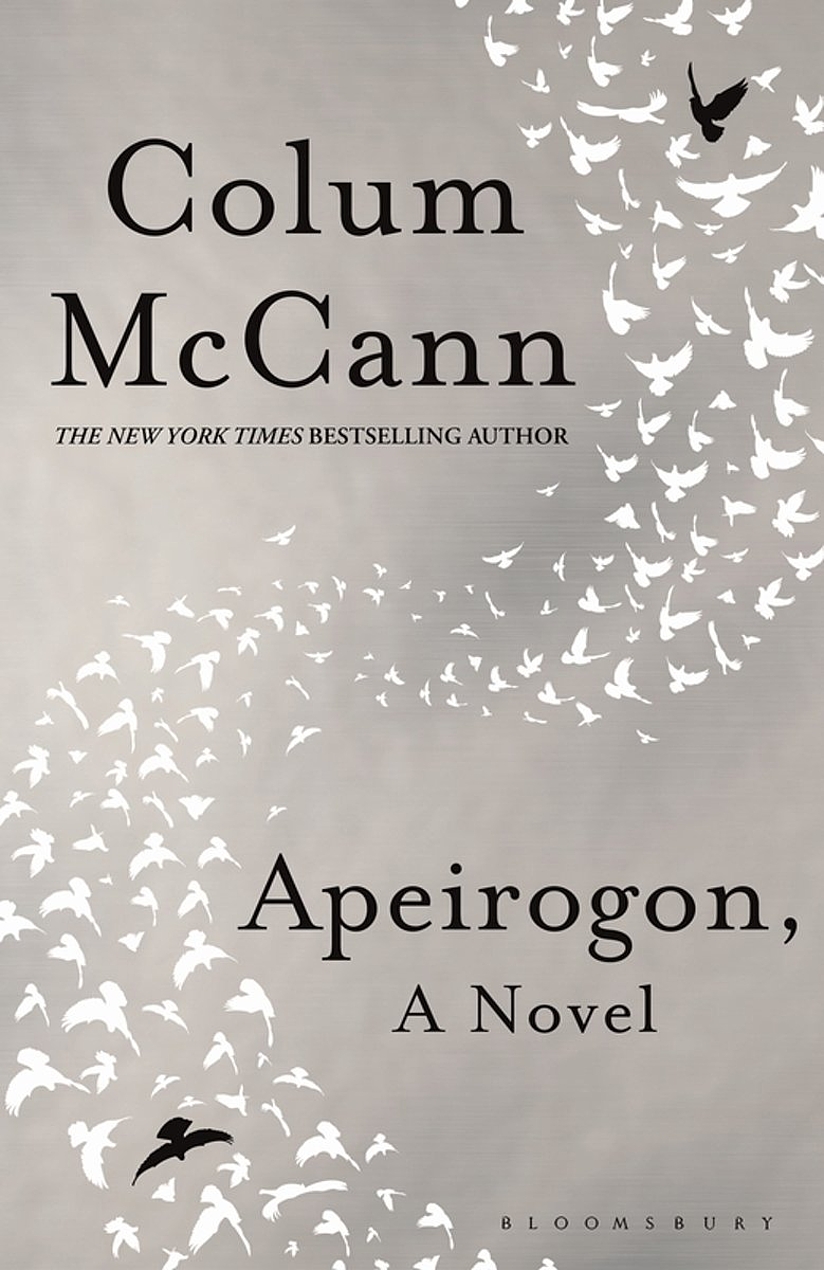
Colum McCann’s Apeirogon

Colum McCann, Apeirogon (Random House 2020)

Apeirogon is not a meal but a table littered with ingredients: a paw of garlic, a frozen lamb shank, two potatoes, a big knob of celeriac, three peas. (Dwight Garner in the New York Times)

It’s a masterpiece, a novel that will change the world, and you don’t hear that very often. (Alex Preston in The Guardian)

I tend to agree with both critics. On the one hand, by design, Apeirogon is made up of numbered fragments, ranging from just a few words to several pages, but most a single paragraph. It takes a while to get one’s bearings, and once you’ve got them you might still be irritated by fragments like the one that explains why the sugar dextrose got its name, or the many that describe bird life. On the other hand, the central story is a compelling account of two men, an Israeli and a Palestinian, whose young daughters were killed, one by a suicide bomber and the other by a callous exercise of state-sanctioned violence, who now travel the world telling their stories and arguing for peace between Israel and Palestine. They are real men, members of real organisations (Combatants for Peace and Parents Circle – Families Forum) that promote this form of activism.

The irritation almost got the upper hand for me in the early pages. It’s always a bad sign when I slip into proofreader mode, and that happened here when some birds are ‘held by their feet over a vat of pure Armagnac, dipped head first and drowned alive’. My mental blue pencil scribbled in the margin: ‘Delete “alive”. If something is drowned, by definition it’s alive before dipping.’ Happily, apart from one section that simply lists without comment 36 species of birds that are seen over the West Bank (a list that’s repeated in the final sections), irritation soon gave way to full engagement.

A structure emerges. First, there are 500 fragments numbered in ascending order, in which the Israeli man, Rami Elhanan, rides a motorbike to a gathering in an ancient monastery in the Left Bank, culminating in a version of his ‘talk’: his life story, the murder of his daughter, his peace advocacy. At the centre is a fragment numbered 1001, a single, beautifully Proustian sentence that describes the location, purpose and participants of the gathering, with an implicit descriptionj of the nature of the book we are reading. The audience in the monastery, ‘you and me’,

sit for hours, eager, hopeless, buoyed confused, cynical, complicit, silent, our memories imploding, our synapses skipping, in the gathering dark, remembering, while listening, all of those stories that are yet to be told.

(Page 229)

A second fragment 500 follows, in which the Palestinian man, Bassam Aramin, gives his talk, and we count down back to 1, as Bassam drives home to where his wife is waiting for him.

That’s the underlying structure. But a reader opening the book at random would mostly be hard pressed to tell where they were along that arc if not for the identifying numbers. The stories of the deaths of both girls and their aftermaths are told in fragments throughout both parts. The stories of their parents lives and post-tragedy activism likewise. The frustrating and often humiliating experience of passing through an Israeli checkpoint. The history of Combatants for Peace and the Parents Circle, as well as both men’s tentative first joining them. And in what I now take to be an enactment of a listener’s mind – synapses skipping, remembering ‘all of those stories’ – there are shiny fragments: François Mitterand’s last meal, observations of bird life, mathematical curiosities, a performance of Verdi’s Requiem in the Nazi camp in Theresienstadt, facts about birdlife, Christopher Costigan’s ill-fated exploration of the Dead Sea, the discovery of the Dead Sea Scrolls, Philippe Petit’s highwire walk over Jerusalem in 1987, Peter Brook’s performances of The Conference of Birds in Saharan villages … the list could go on, and on. There are two Australian connections: an Australian tourist set fire to the Al-Aqsa mosque in 1969, and an Australian artist, Janet Venn-Brown, was effectively widowed by Mossad agents’ assassination in 1972 of Palestinian poet and translator Wael Zuaiter. [Added 5 September 2021: Janet Venn-Brown died in Sydney in August this year.]

An apeirogon is a polygon with a countably infinite number of sides. I don’t even know what that means. I suppose as a title for this book it suggests the futility of trying to understand the situation in Israel and Palestine as simply two-sided, though the book isn’t so much an infinite sided shape as a piling up of fragments along a barely discernible straight line. Not that there’s anything wrong with that.

Why not just tell the story straight? It’s a question I asked, especially when I got irritated – as by the short explanation of how the sugar dextrose got its name. I do think it works, this piling up of detail, ranging from incidents immediately relevant to the main story, to things the writer has retrieved from his personal rabbit-holes. At least, I was completely absorbed. I’d heard of Bassam Aramin and Rami Elhanan, now I feel that I know about them, have a better grasp of what they’re up against and what they are doing, and am invested in it. So when the author’s acknowledgements end with contact details of organisations one can send contributions to, it feels as if it’s anticipating the reader’s desire rather than tacking on a plea for funds.

Also, apart from those birds who are drowned alive, it’s beautifully written.

500 people: Week Six

Continuing with the challenge to talk to 500 new people this year. See this post for the brief description of the challenge.

This week:

  1. Sunday 21 March in Sydney the sustained heavy rain had strangers talking to each other, especially in the crowded supermarket.
    When the Emerging Artist said to me, ‘You stand in line while I get the rest of our stuff,’ a woman with a strong southern European accent burst out laughing. We had been unwittingly blocking her path to the end of a checkout line. I let her in front of me, and a conversation followed. Was there a new Covid panic that none of us (a couple of other people joined the conversation) knew about? A young woman in a mask and a stylish tattoo on the nape of her neck searched her phone for news.
    The conversation kept up, among strangers thrown together by the weather, until my load was rung up and paid for, and I headed off to the fish shop. A quarter of an hour later at the greengrocer’s, the masked young woman and I passed by each other like total strangers.
  2. Tuesday morning at the pool, as I finished my eight laps in the slow lane, one of the attendants was fiddling with the lane-dividing ropes. I said something banal like, ‘Tightening the ropes?’ She said, ‘You’re all swimming too fast.’ I laughed: ‘It’s a long time since anyone said that to me.’ She only had one line: ‘You’re all swimming too fast,’ she said again, and gestured vaguely to the adjacent gentle exercise area. [Incidentally this is an example of a tiny exchange that laid the basis for subsequent ones – on Friday morning, she initiated a brief chat.]
  3. Wednesday evening, unusually, I was in Marrickville Library at 7.15. When the lights were dimmed, I was engrossed with my computer and it took a while to realise it was a signal. Without thinking, I turned to the person next to me, who was also packing up her computer: ‘I could have kept going for another hour.’ She said, ‘Yes, you get into the zone, don’t you?’
  4. Wednesday, a little later, when I stopped to buy a quick meal at a Portuguese place, I decided to go for something beyond strict transactionalism. I asked the young man serving me if he was Portuguese. ‘No,’ he said, ‘are you?’ When I said I was from north Queensland, he looked as if that was surprising, and told me where he was from. I had to ask him to repeat it, but was too embarrassed to ask when I still didn’t catch it.
  5. Thursday morning at GymKidz with Ruby, I was sitting on the sidelines as usual while the Emerging Artist did the hard yards of encouraging and assisting. I turned to the woman sitting –suitably distanced – in the next chair and asked, ‘Are you a grandparent too?’ She smiled and gestured to indicate that she didn’t speak english. A little later her daughter joined her, and she and I laughed together admiringly at our respective young descendants’ skills.
  6. Thursday, later, a beautiful day at the zoo, the three of us were standing at a glass wall staring into a deep, empty pool whose surface was a couple of metres above eye level. A small boy, maybe four years old, approached us and said, ‘My nan told me to tell you that there aren’t any seals in there.’ We thanked him, and acknowledged his nan as we left.
  7. Friday morning at the chemists while waiting for some prescriptions, a little girl was crawling on the carpet. Her mother said something like, ‘Good dog,’ and her slightly older sister just looked mortified. I said softly to the mother, ‘What a beautiful puppy you’ve got.’ ‘Yes,’ she said, isn’t it.’ We chatted, and after a while the older girl picked the younger one up in a big hug.
  8. Friday evening, we checked in at a motel in Albury (this is starting to feel like a personal contact tracing exercise). The tired-looking young man at reception was wearing a colourful T-shirt featuring Kramer from Seinfeld. I said I liked it. We discussed Kramer briefly. I asked if he had a printer so we could print off our permit to enter Victoria. He said having it on the phone was fine, and anyway no one was checking now – he’d travelled to Melbourne and back a couple of days ago and forgot to get a permit: ‘I felt naughty.’
  9. Friday evening, a little later, a family group was walking on the opposite footpath to us. One of the boys – probably about 8 – called out a cheerful greeting to people in a passing car. As we got closer, I saw that he called out and waved to every passing car, and that there was then a discussion with the other, older boys about whether anyone had waved back. I asked if that’s what he was doing, and expressed my approval.
  10. Saturday afternoon, at our accommodation in Carlton, I asked the young man at reception if there was any parking nearby. He said the basement parking was theoretically full but he’d work something for us. Bearing in mind this challenge, I remembered to ask him his name when I thanked him.

Running total is now 58.

2021 NSW Premier’s Literary Awards shortlist

The shortlist for the 2021 NSW Premier’s Literary Awards has been announced. The State Library of NSW has the full list on its website, but you have to do a lot of clicking back back and forth to read it.

Here’s an attempt to make the list accessible in one place, and in the order that the awards are generally announced on the big night. If you click on a title you will be taken to the judges’ comments. I’ve also added links to the very few titles that I’ve read and blogged about. In memory of my youthful enjoyment of betting on roulette, I’ve bolded the titles I’m tipping to win. [Added later: I’ve marked the actual winners with a triple asterisk ***.]

NSW Premier’s Translation Prize

If I remember correctly, in the past this award was given to translators without being tied to a particular book. This year it’s for ‘a translation in book form’.

UTS Glenda Adams Award for New Writing

Multicultural NSW Award

Betty Roland Prize for Scriptwriting

Nick Enright Prize for Playwriting

Patricia Wrightson Prize for Children’s Literature

Ethel Turner Prize for Young People’s Literature

Kenneth Slessor Prize for Poetry

Douglas Stewart Prize for Non-fiction

Christina Stead Prize for Fiction

Awards that don’t have shortlists

  • Residents of New South Wales can vote for any of the titles on the Christina Stead Prize shortlist for the People’s Choice Award (click here to vote)
  • The judges get to choose from among the winners of the other categories for the Book of the Year award
  • The judges can make a Special Award for a) an Australian literary work that is not readily covered by the existing categories; b) a lifetime achievement award for an Australian writer (this is also known as the Kiss of Death Award, though several people have lived on after receiving it); or c) a significant contribution to the literary life of Australia.

The winners will be announced online on Monday 26 April at 7.30 pm (AEST), and on Tuesday 27 April at 11.30 am at the State Library of NSW and online, the winners will do readings, as part of the Sydney Writers’ Festival.

.

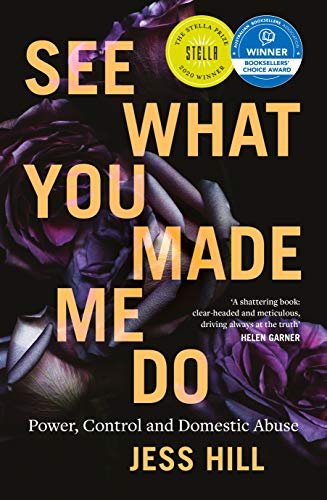
Jess Hill, See What You Made Me Do

Jess Hill, See What You Made Me Do: Power, Control and Domestic Abuse (Black Inc 2019)

As I’m writing this blog post, allegations of men in the Australian Parliament abusing women currently and historically are dominating the news cycle, and the frighteningly inadequate responses of the powerful are on display. It’s a very difficult time for women who have survived abuse, and probably not a good time for them to read this book, which isn’t about the kind of abuse that’s in the news, but, well, I imagine it’s close enough to make the unbearable climate even worse.

I finished reading it a couple of weeks ago, in happier times and without a personal history of abuse, but when I reached the acknowledgements at the end and read Jess Hill’s appreciation for her male soulmate who had backed her in the arduous four years of writing, and her delight in her witty and charismatic two-year-old daughter, I almost wept. It was like emerging from a vision of hell to be reminded that fresh air and sunshine exist, that there are decent men and happy little girls in the world.

But let me say right up front that although it gives many detailed accounts of hideous violence and abusive behaviour, this is not a book that wallows in the horrible. Hard as it is to read – and, I imagine, immeasurably harder to research and write – it’s a serious, level-headed attempt to anatomise the phenomenon of domestic abuse, to understand the perpetrators and the victims, to give an account of the way police, the courts and lawmakers have dealt with the issue, and to cast about for examples of more effective measures. In a prefatory note, Hill explains that she did her best to ‘flip’ the usual journalist–source power imbalance: where she told a survivor’s story (and there are many) as far as possible the subject/source of the story had a chance to read a draft, and suggest changes and, especially, deletions. One chapter begins with a couple of paragraphs acknowledging an extraordinary woman whose story was central to that chapter, but had to be withdrawn at the last minute because of major safety concerns.

The first chapter. ‘The Perpetrator’s Handbook’, describes the remarkable similarity of the techniques used by domestic abusers, across all locations, cultures and social status. ‘It’s like you go to abuse school,’ one reformed abuser told Hill. ‘They all do it.’ Stunningly, the suite of techniques was identified by a scholar seeking to understand how US prisoners of North Korea during the Korean War had their spirits broken. In the 1950s there was talk of ‘brainwashing’, a semi-mystical process. Now it is understood to have been coercive control, a term that is explored at length in this book. The Korean War researcher, Albert Biderman,

established that three primary elements were at the heart of coercive control: dependency, debility and dread. To achieve this effect, the captors used eight techniques: isolation, monopolisation of perception, induced debility or exhaustion, cultivation of anxiety and despair, alternation of punishment and reward, demonstrations of omnipotence, degradation and the enforcement of trivial demands. Biderman’s ‘Chart of Coercion’ showed that acts of cruelty that appeared at first to be isolated were actually intricately connected. It was only when these acts were seen together that the full picture of coercive control became clear.

Physical violence isn’t a necessary part of the system. Hill’s prefatory note says that as she came to understand her subject, she had to go back and change most references to ‘domestic violence’ in her text to ‘domestic abuse’. It’s not uncommon, she says, for an abuser’s first act of physical violence to result in the victim’s death.

The techniques are virtually universal, but perpetrators do exist on a spectrum. ‘It can be hard to pinpoint where garden-variety fighting ends and domestic abuse begins,’ Hill writes, but actual abusers fall into two types: insecure reactors, ‘who don’t completely subordinate their partners, but use emotional or physical violence to gain power in the relationship’; and coercive controllers, who ‘micromanage the lives of their victims, prevent them from seeing friends and family, track their movements and force them to obey a unique set of rules’.

Chapter 2, ‘The Underground’, discusses the dark and extensive world of women who are abused, behind closed doors and hidden in plain sight. It addresses the question, ‘Why do women stay in abusive relationships?’, or rather gives a brief history of victim-blaming answers that have been given given until alarmingly recently, then discusses structural and psychological difficulties in the way of leaving, and many modes of resistance.

Chapter 3 to 5 address the key question: not ‘Why does she choose to stay?’ but ‘Why does he choose to abuse her again?’ In these chapters, Jess Hill never falls into all-men-are-bastards rhetoric. Some men do monstrous things, but it’s important not to simply dismiss them as monsters. To understand everything may not mean to forgive everything. It certainly doesn’t mean anything is to be minimised. But to understand is an important step on the way to putting things right. Hill describes research that categorises coercive controllers as either cold, calculating ‘cobras’ or morbidly jealous, paranoid ‘pit bulls’, with a third type of violent man, the ‘family-only batterer’, who can be just as dangerous but needs different responses. It’s not always easy to tell which category a particular man belongs to, and there’s plenty of slippage between the categories, but the distinctions are useful – there can be no one-size-fits-all response to domestic abuse. Two superb chapters deal respectively with shame, which when linked to a sense of entitlement lies at the base of much male violence, and patriarchy, the overarching system that permeates cultures, and inhabits the minds of perpetrators, victims, responders and bystanders alike.

I’ve lived in a number of all-male environments – boarding schools and religious communities. I’ve participated in many men’s groups and workshops where we grapple with masculinity, sexism and male domination. I love my all-male book group. I don’t know that I’ve ever read a woman writing with such force and clarity, and also compassion, about male conditioning and its potential for disaster. If you’re interested but the prospect of reading all 371 pages of this book is too daunting, I recommend these three chapters.

The bone-chilling chapter 6, ‘Children’, includes a discussion of complex PTSD (which Rick Morton has just written a book about) and the ever-present tragic possibility that a son will follow in his abusive father’s footsteps. Chapter 7, on women who use violence, points to the key difference that without the backing of patriarchy and male conditioning, they are unlikely to have their partners living in fear for their lives. Chapter 8, ‘State of Emergency’, discusses the resources available to a woman trying to escape a dangerously abusive situation:

Women don’t just leave domestic abuse – they journey away from it, step by step. There is no straight path out – it’s a game of snakes and letters, and women can slip back underground just when they’re about to escape. This means that any potential escape route needs attention and support.

Speaking of these resources – police, refuges, the law, the health system – Hill says, ‘Often, the stories with the worst endings are not blockbuster horror stories, but catalogues of negligence, laziness and procedural error.’

Possibly the most distressing chapter of all is Chapter 9, which deals with the Family Court of Australia. Its title, ‘Through the Looking Glass’, tells you a lot about it. Contrary to the much lobbied argument that fathers are badly done by in the family law system, Hill argues that it is the other way around. The use of untrained ‘single experts’ to make judgements about custody, the invocation of the discredited Parental Alienation Syndrome by which a mother is held to be responsible if children are frightened of their father, and a general discounting of women’s and children’s voices make for a hideous mess. If anything the stories here of women and children being betrayed by the law are even more horrifying than the stories of actual abuse.

Since the book was published the Family Court of Australia has been abolished as a freestanding institution, and merged with the Federal Circuit Court. Sadly, it seems likely that this will only make things worse, because it will continue the erosion of resources from family law that has been steadily happening since John Howard’s prime ministership.

The penultimate chapter, ‘Dadirri’, deals with the way intergenerational trauma and grief from colonisation and genocidal policies – including the widespread disruption of families by child removals – put a rocket under issues of domestic abuse for First Nations people. The notion that violence against women is ‘cultural’ is given short and convincing shrift. Hill argues, with evidence, that domestic abuse was more prevalent and tolerated to a greater extent in eighteenth- and nineteenth-century England than in pre-invasion Australia. There are stories of powerful initiatives taken. For example, Indigenous women in the remote community of Yungngora in the central Kimberley made it happen that disruptive behaviour would result in expulsion from the community for three months after three warnings: ‘In twelve months, domestic violence went from six per week to none‘ (page 334).

The final chapter, ‘Fixing It’, manages to be convincingly, if guardedly, upbeat. ‘Social problems often seem insurmountable,’ Hill writes, ‘until they’re not.’ She makes the obvious point that more funding is needed by emergency services, and is scathing about the National Plan to Reduce Violence Against Women and Their Children: it has no clear targets, and tackles domestic violence as an attitude problem’:

The mission to transform attitudes to gender inequality and violence is laudable, and will no doubt produce important cultural changes. But as a primary strategy for reducing domestic abuse, it is horribly inadequate. Why do we accept that it will take decades – possibly generations – to reduce domestic abuse? Why isn’t long-term prevention work paired with a relentless focus on doing everything possible to reduce violence today? Why do successive governments insist that reducing domestic abuse is a matter of changing attitudes – or, at best, parking the ambulance at the bottom of the cliff? How on earth did public officials decide that surveying community attitudes was the best way to measure whether their strategy to reduce violence was working?

There are places where initiatives have had substantial success in reducing domestic abuse. The High Point Initiative in North Carolina, which you can read about here, has been amazingly effective. It has clear goals, and has police cooperating with service providers to call out perpetrators publicly and make public the severe consequences of future offences. And promising things are happening in Bourke in New South Wales, where a community led program brings services together, with daily check-ins, and cooperates with the police, whose commitment to deal with domestic violence has been organised as Operation Solidarity. Without a big government spend, stunning results have been achieved:

Across the Darling River Local Area Command, domestic homicides dropped from seven in 2015–2016 … to zero for the following 18 months. By 2018, the repeat victimisation rate – which was twice the state average – was also down by a third. Victims have greater trust in police: the number who cooperated with police to pursue legal action is up, from an average of 68 per cent in 2016 to 85 per cent in 2018. And even with this increased legal action, at 75 per cent – something which [the Police Superintendent in charge of Bourke police] puts down to the fact that their prosecutor has been trained to properly understand domestic abuse.

See What You Made Me Do won the 2020 Stella Prize and has received a lot of publicity, but my sense is that it hasn’t been widely read. If I’m right, that’s a shame. It’s journalism at its best, bringing people’s stories into the light, making important research available, and demonstrating that it’s possible to think, and to hope, about a seemingly intractable subject.

A TV series his scheduled to be shown on SBS later this year, and there’s a video of Jess Hill talking at an event run by the NSW Agency for Clinical Innovation at this link.


See What You Made Me Do is the fourth book I’ve read for the Australian Women Writers Challenge 2021.


500 people: Week Five

Continuing with the challenge to talk to 500 new people this year. See this post for the brief description of the challenge. As I think I’ve already said, this is partly making notes of the kind of casual encounters that happen almost unnoticed in the normal run of things, and partly recording moments when I step out of my habitual civic disregard (a sociological term I learned from a clever niece).

This week:

  1. Saturday 13 March. In a shop in Gerrigong (a small coastal town south of Sydney), the young man behind the counter had already activated the eftpos device by the time I extracted a couple of notes from my wallet to pay in cash. I said something about being old-fashioned. ‘No,’ he said. ‘Since Covid arrived people have been using cash much more. We used to get a lot of complaints that we didn’t accept cards for less than $10. Now the same people insist on paying cash no matter how big the bill.’ His hypothesis is that because Covid meant that most holiday rental properties were idle, many owners took the opportunity to have work done, which meant that tradies in the area had a lot more cash than usual.
  2. Monday. My computer was showing signs of imminent explosion, so the Emerging Artist and I went shopping. Covid is still around, so I was interviewed outside the shop before I could go in and do the actual buying. My interviewer was a charming 20-year-old from Western Sydney. While we were waiting for a necessary SMS, we had a great conversation: her career ambitions (the EA gave her career advice, which was cheerfully noted and probably filed under ‘To Be Ignored’), and some highlights of belonging to an immigrant community (I particularly loved the way she gestured to her face as a way of saying she encountered racism, and could be seen mentally sifting through possible terms before lighting on ‘person of colour’). We swapped fragments of life stories. All three of us laughed a lot.
  3. Wednesday morning at the pool. I’m a slow swimmer, used to being overtaken, and I often wait at the end of a lap to give way to slightly faster swimmers. This usually happens with minimal or no verbal or facial communication. Today I was faster than the only other person in my lane. He waited for me to pass him at the end of a lap. I stopped to check that that’s what he was doing, said, ‘G’day,’ and we exchanged friendly smiles as between to ageing, slow males.
  4. Also Wednesday morning, on the way home from the pool I passed a woman sitting on the grass flanked by two boxer-type dogs, with four slices of bread on a cloth in front of her. She placed a slice of ham on each slice while the dogs watched patiently. I would normally have smiled quietly to myself, but I stopped and commented: ‘What well-behaved dogs!’ She gave the standard reply: ‘Sometimes.’ ‘No,’ I said, ‘ they’re both being incredibly restrained.’ ‘They know their turn’s coming,’ she said. [This was a slightly scary encounter. How many tweets have I seen complaining about men feeling entitled to conversation with women just going about their lives alone in a public place? If she’d told me to f*** off, I would have understood … but there were dogs.]
  5. Still Wednesday morning, at the dentist for major repairs, I introduced myself to the dental assistant, who is relatively new to the practice and completely new to me. Like her predecessor, she hardly spoke during the rest of my time there, but at least we had each acknowledged that the other had a name.
  6. Friday morning, back at the dentist, there was a different dental assistant. I was a bit preoccupied with having a tooth crowned and didn’t do more than nod on arrival. But after about half an hour of unpleasantness, while we were all waiting for something to set, I seized the moment. ‘You’re W–, is that right?’ (The dentist had called her by her name once in his stream of soft-spoken requests and instructions.) ‘Yes,’ she said. ‘I’m Jonathan.’ ‘Nice to meet you.’ Then she stuck a suction hose in my mouth and we both went back to our non-speaking roles.
  7. Saturday evening, at the movies, the first time the EA and I have been in a fairly full theatre for a year (and yes, this is deemed safe in Sydney now). A couple of minutes before the lights went down the man in the seat in front of me asked if I minded if he tilted his seat back. Of course not, but I didn’t let it go quite at that. ‘I didn’t know you could do that,’ and I asked how to do it: ‘It’s like travelling first class.’ He laughed, and several people in our row tilted theirs back along with me. It was the Alliance Française French Film Festival, but the polite man had no trace of a French accent.

Running total is now 48.

Ruby Reads 24: Visiting the library

All but the first of these books were read during two visits to the wonderful Marrickville Library. The first was a gift from a friend.


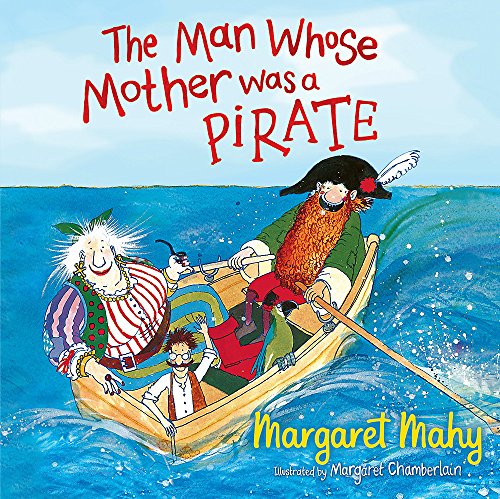
Margaret Mahy, The Man Whose Mother Was a Pirate (Puffin 1996)

This is one of the great picture books. A drab little man who works in a soul-destroyingly dull job has a large, exuberant mother who used to be a pirate. He has never even seen the sea until, at her request, he wheels her over a long distance down to the coast. On the way, in spite of the discouraging comments from a philosopher and others they encounter, he becomes increasingly enraptured by the idea of the sea. When they arrive, the reality is overwhelmingly more impressive than his imaginings. (The opposite of Proust, you could say.) In Margaret Chamberlain’s illustrations, the little man’s transformation is wonderful to behold, as iss the mother’s exuberance and the stunning beauty of the sea.

A Catholic priest once told me he used this book as the basis for sermons. Ruby quite likes it, asked for it more than once, but it’s not a great favourite (yet, he added hopefully).


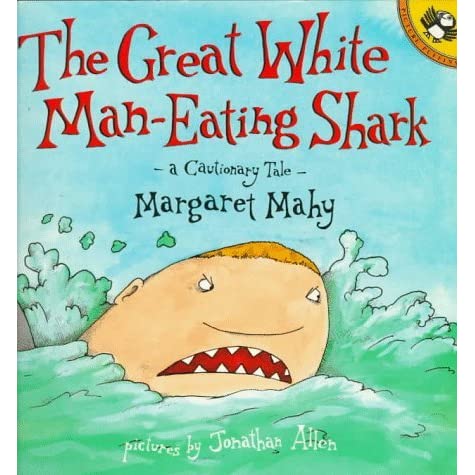
Margaret Mahy (words) and Jonathan Allen (pictures), The Great White Man Eating Shark (Puffin 1989)

This is another of my favourite picture books. Norvin is an unprepossessing boy and failed actor. He loves to swim, ‘to cut through the water like a silver arrow’, but other people at the beach always get in the way. He decides to capitalise on his appearance and his acting skills and disguises himself as a shark. When the other bathers panic, he has the beach all to himself … until a lady shark comes along and is beguiled by his gorgeous sharkiness. Jonathan Allen’s illustrations strike a perfect note that combines silliness and threat.

In spite of Ruby’s love of ‘Baby Shark‘ (if you don’t know about that song, click on the link), her current love of swimming, and her enduring love of pretend games, this book sadly failed to hit the spot (yet, I say again).


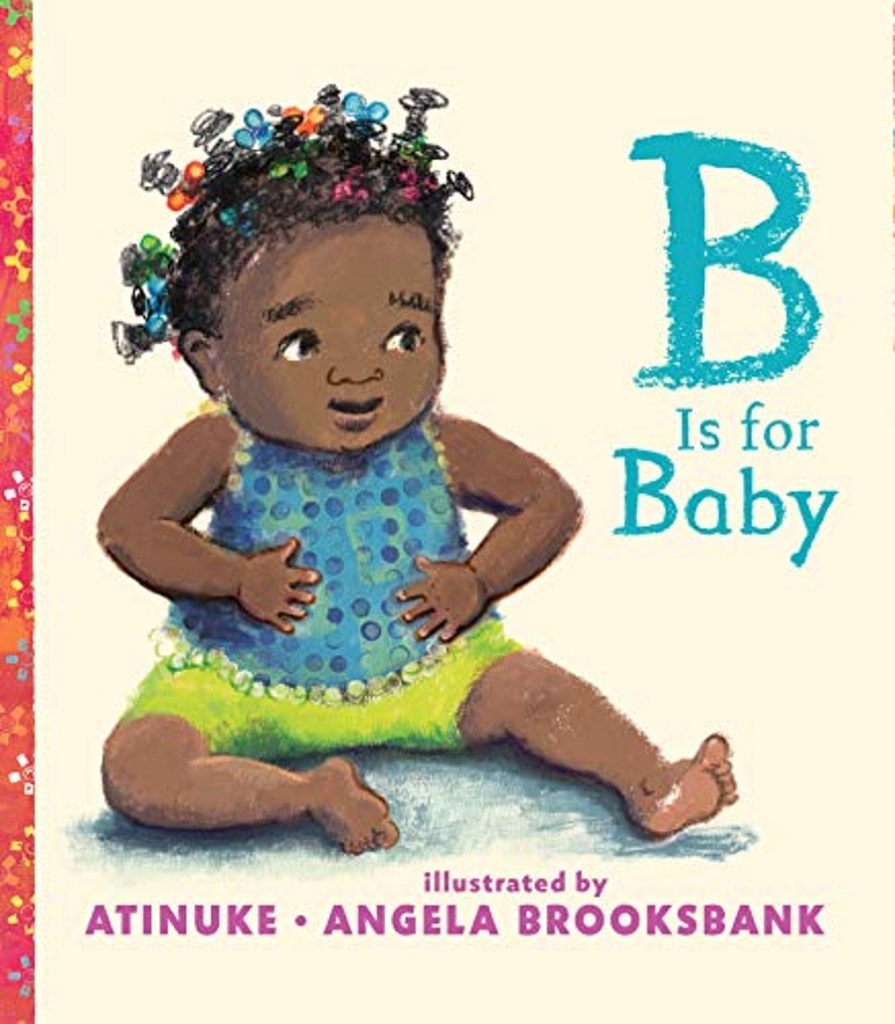
Atinuke (words) and Angela Brooksbank (images) B Is for Baby (Walker Books 2019)

This is not an alphabet book. It’s entirely about the letter B. And somehow that’s perfect for Ruby just now. She can recognise all the letters of the alphabet, and having one of them have a whole book to itself appeals to her. Especially when it’s identified with a brilliant little baby.

Evidently Atinuke, originally from Nigeria and currently living in Wales, has written a number of books featuring this baby. I don’t know if Angela Brooksbank has illustrated them all. I hope so, because the warmth and sheer life of these images is a tonic for the heart.


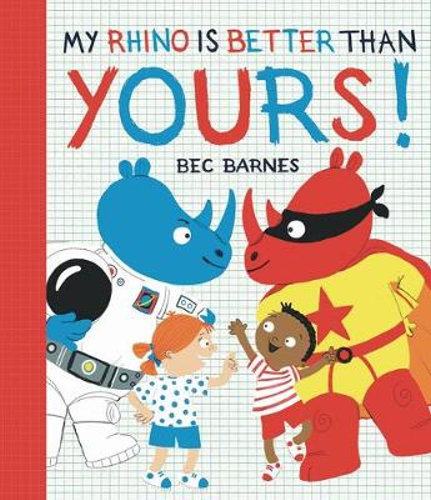
Bec Barnes, My Rhino Is Better Than Yours (David Fickling 2020)

The recurrent phrase, ‘The rhino that I know is better than yours,’ works like a charm. Two children, a boy and a girl, compete for the title of best rhino owner, their claims for their respective toys becoming more and more hyperbolical, and incidentally transgressing all sorts of gender-specific boundaries. Not just the rhyme, but the concept and the final resolution, in which a real rhino turns up and threatens to eat both children, work a treat. I approached this book with dread, but came very quickly to share Ruby’s love of it.


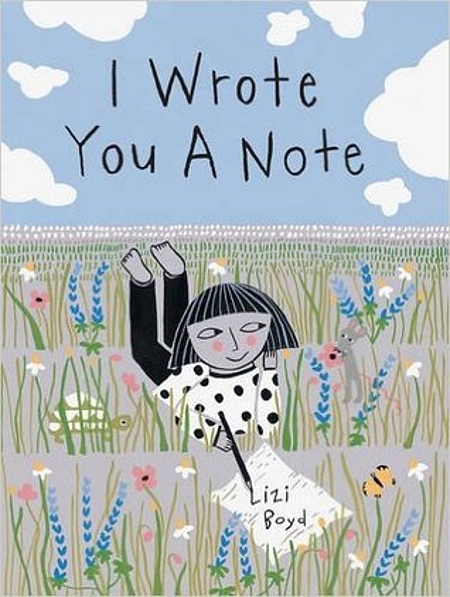
Lizi Boyd, I Wrote You a Note (Chronicle Books 2017)

As with the rhino book, the rhyme of this title, which I would barely have noticed, appeal hugely to this three-and-a-quarter-year-old. She chanted it over and over in the car on the way home from the library.

A young person’s note is found by a series of creatures who miraculously don’t chew it, or rip it, or soak it, and in the end it finds it way to its intended reader. Ruby loves to draw pictures for (and of) absent loved ones. This book is right up her alley.

The cover gives a good idea of the subtle style of illustration.


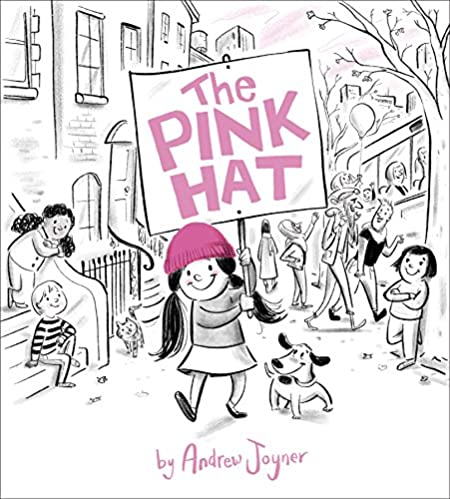
Andrew Joyner, The Pink Hat (Schwartz and Wade 2017)

Like I Wrote You a Note, this picture book follows the vicissitudes of an inanimate object – in this case a pink knitted hat – as it is claimed by one creature or person after another and then escapes them. This time, the the hat doesn’t just end up with the young person it is intended for, but with her it joins a sea of pink knitted hats at the great Women’s March of 2017. It’s a brilliant example of a book that is deeply satisfying on a number of levels. Andrew Joyner, an Australian who has illustrated for my beloved School Magazine, says on his website:

Inspired by the 5 million people (many of them children) in 82 countries who participated in the 2017 Women’s March, this is a book that celebrates girls and women and equal rights for all! 

I’ll keep an eye out for his Stand Up! Speak Up!, a story inspired by the Climate Change Revolution, which may be a little old for Ruby for another year or so.

Proust Progress Report 19: Mentioning the War

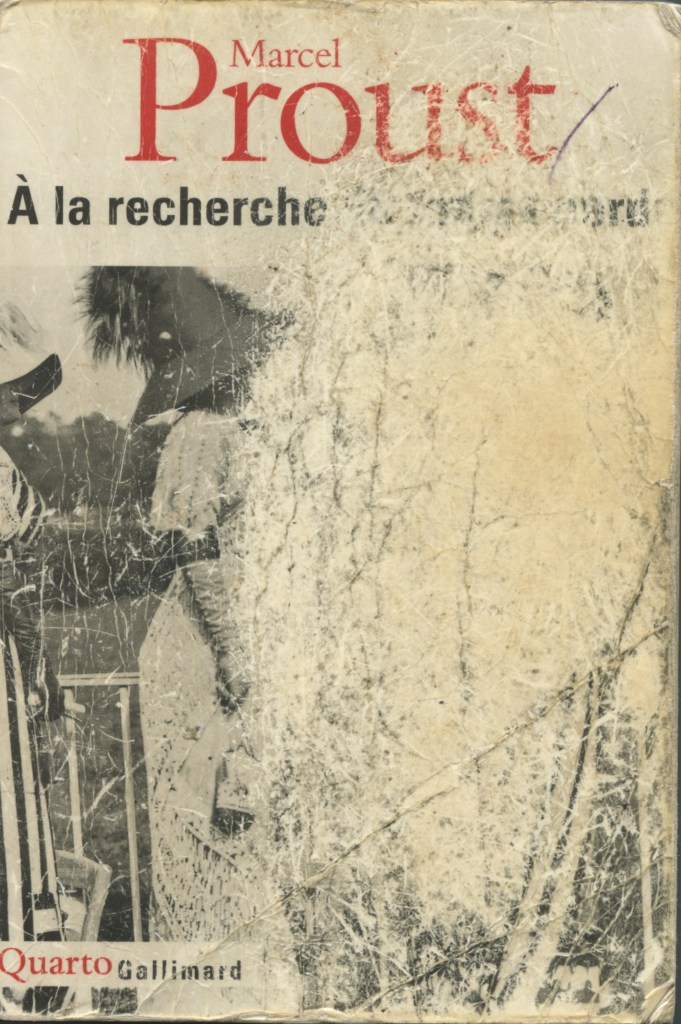
Marcel Proust, À la recherche du temps perdu (text established under the direction of Jean-Yves Tadié ©1987–1992): Book 7, Le temps retrouvé, pp 2151–2215

This month’s whole reading has been preoccupied with the War: how it has affected Parisian fashion and the salons, especially Mme Verdurin’s little band of fidèles; how different kinds of masculinity respond to the ardures of combat (the French equivalent of stiff upper lips as opposed to the transmutation of homosexual desire into praise for gallantry; the ridiculousness of people having strong opinions of things they know nothing about; the persistence of Napoleonic strategies in a world that has changed; the hypocrisy of ‘experts’ …). Robert is becoming more like a version of M. De Charlus, and M. De Charlus himself buttonholes the narrator to express his disdain for unthinking patriotism and his sympathy for the Kaiser (whom he confesses he hasn’t written to since the War started, except perhaps once). In the last couple of pages, we are given a flashforward to a shocking revelation about M. De Charlus and Morel, and hopefully an indication that the story is to progress.

I photographed two passages on my way. In the first, the narrator notes that Gilberte’s butler believed what he reads in the newspapers when he must have known from experience that reality was otherwise:

Mais on lit les journaux comme on aime, un bandeau sur les yeux. On ne cherche pas à comprendre les faits. On écoute les douces paroles du rédacteur en chef comme on écoute les paroles de sa maîtresse. On est battu et content parce qu’on ne se croit pas battu mais vainqueur.

(page 2173)

My translation:

But we read the newspapers as we love, with a blindfold over our eyes. We don’t try to understand the facts. We listen to the sweet words of the editor as to the words of our mistress. We are beaten and happy because we believe ourselves not to be beaten but victorious.

So the information bubble was already there in Proust’s time.

In the other passage, M. De Charlus reflects on the way Parisians ignore the war raging a short distance for them, but he could be prophesying about the pandemic and the climate emergency almost exactly a century later:

Les gens vont d’habitude à leurs plaisirs sans penser jamais que, si les influences étiolantes et modératrices venaient à cesser, la prolifération des infusoires atteignant son maximum, c’est-à-dire faisant en quelques jours un bond de plusieurs millions de lieues, passerait d’un millimètre cube à une masse un million de fois plus grande que le soleil, ayant en même temps détruit tout l’oxygène, toutes les substances dont nous vivons ; et qu’il n’y aurait plus ni humanité, ni animaux, ni terre, ou sans songer qu’une irrémédiable et fort vraisemblable catastrophe pourra être déterminée dans l’éther par l’activité incessante et frénétique que cache l’apparente immutabilité du soleil: ils s’occupent de leurs affaires sans penser à ces deux mondes, l’un trop petit, l’autre trop grand pour qu’ils aperçoivent les menaces cosmiques qu’ils font planer autour de nous.

(p 2189)

My translation (taking quite a few liberties):

People go about their habitual pleasures without ever thinking that, if etiolating and moderating influences were to cease, microscopic organisms would proliferate to their maximum, that is to say, make a leap of many millions of leagues in a few days, and so expand from cubic millimetres to a mass a million times larger than the sun, in the process destroying all the oxygen, all the substances that we need in order to live; without ever thinking that if that were to happen there would no longer be any humanity, or animals, or earth. They don’t dream that an irremediable and quite realistic catastrophe could be set off in the ether by the incessant and frantic energy that lies behind the apparent immutability of the sun. They go about their business without a thought for these two worlds, one too small and the other too large for them to perceive the cosmic threats that hover around us. 

Both Proust and his main translator Charles Scott Moncrieff died before this book could be published. (It was translated by Scott Moncrieff’s friend Sydney Schiff, under the pseudonym Stephen Hudson.) I’m still hopeful that Proust managed to get things resolved to his satisfaction, leaving just some polishing undone. According to the IMDB a movie has been made of this book – either it’s a monumentally tedious movie in which people stand on street corners haranguing each other or something is about to change in the next pages.

500 people: Week Four

No one has told me to stop, so here’s another week of the talking-to-strangers challenge. See this post for the brief description of the challenge. Here are some startlingly relevant lines from the title poem of Speak to Strangers (1960) by R D Murphy, the first poet I met in the flesh:

---------------------------- My grandfather's name
was Adam. we may discover a thing or two
In common, tastes the same. This is your place?
I'd not pick your purse or kinsey at the keyhole,
But merely borrow a match to see your face.

And here are the matches I lit this week:

  1. Sunday 7 March, midday. We walked to Addison Road Markets for dumplings. When we ordered the special, the Emerging Artist said she didn’t want the pork bun or the dim sim. The woman serving us had trouble with the English, and the owner stopped cooking to translate. Though we’ve been going there on Sundays for years now, I don’t remember a previous conversation with him. He told us that his dumplings weren’t the North Chinese, but the Hong King kind, made entirely with rice and so gluten free. I asked how the excellent dumplings of Xian fitted his schema. He pointed to a laminated page in the counter offering Xian noodles, but said the weather there was terrible – too much wind and dust. We swapped travellers tales for a minute or so. It turned out he hails from a small village in northern China, and has been in Australia for 18 years. Gesturing to the deep blue early-autumn Sydney sky, he said he didn’t want to go back.
  2. Sunday evening, at a poetry reading. After the first guest poet had read, I approached her with awkward fan-boy effusions, which doesn’t count for this challenge as we already know each other. She introduced me to the other advertised poet and we exchanged a couple of words. I was too embarrassed to be fanboyish all over again, partly because I have only read a handful of his poems (none of the ones he was about to read, it turned out), but mainly because fanboy-times-one is embarrassing enough. Still, contact was made.
  3. Also Sunday evening, during the same break, I went to the closest physically-distanced table and spoke to the man whose female partner, the first open-mic reader, had mentioned that it was his 65th birthday. I asked if he was also a poet. He isn’t. He’s a photographer. He talked about being sidekick to a poet, mentioned one of her greatest hits. I chatted about my own experience as sidekick to the Emerging Artist. We may well run into each other at future poetry readings.
  4. Wednesday. I got on a bus whose driver was maskless, the first time this has happened for a very long time. I was about to say something when he beat me to the conversational initiative. ‘That’s clever,’ he said. ‘I like it.’ It took me a second to realise he meant my T-shirt (photo below, though not of me wearing it). ‘Me too,’ I said. ‘The pen is mightier than the sword.’ I love it that this happened so soon after I’d said on this blog that men don’t comment on each other’s clothes. Evidently it’s allowed if there’s wit involved.
  5. –7.Wednesday evening, We had a small dinner to celebrate a birthday ending in zero for the Emerging Artist, and also a less prominent birthday of mine. One of the guests brought a handful of frangipanis to decorate the table, and I stuck one behind an ear. When I went to pay the bill, the cluster of wait-staff were unusually cheerful, as in someone had just said something funny. If they had, it may have been a remark on my flower, or perhaps on my clumsy attempts to speak Italian earlier. Anyhow, the flower was an excellent conversation starter: the main waiter has a frangipani tree that isn’t in flower yet, also true of the one in our yard; we live in adjoining suburbs, not far from the friend whose tree had produced my ornament; the woman who had waited at our table said she liked my flower; at least one other joined in.
    8. Thursday morning, we went to our regular GymKidz class. The Emerging Artist has made good connections there, and three-year-old Ruby is at intense hugging stage with another girl. I generally hover in the background trying to look benign. I took a tiny initiative today beyond my unusual smiling and nodding at both children and parents. I’d noticed a young couple with a tiny, energetic boy during the unstructured playtime that precedes our class. It turned out I was sitting near their stroller. He came careening towards the stroller, saying’Ba!’ His mother produced a banana. I said something about his ability to say words. She said, almost apologetically, that he only said one syllable – ‘ba’ for banana, ‘ma’ for mother. I said, ‘Give him a couple of weeks.’ When they left a little later we all said a proper goodbye, including waves from the toddler.
    9. Thursday evening. Continuing the birthday, the EA and I ate out at a favourite pizza place. During dinner we noticed the main waiter teaching someone else how to hold more than one plate safely on one arm, and momentarily demonstrating how to hold three or four. This probably shouldn’t count because I’ve had a ‘Hello, it’s good to see you,’ relationship with that waiter for some years, but I presumed to build on that and asked him as we were leaving how many plates he could hold. ‘A lot!’ he said, and gave me a short demonstration of technique. ‘It’s an art,’ I said. ‘Every profession has its arts,’ he said as he waved us off into the night.
    10. Friday afternoon. Continuing the birthday celebrations, we are renting a house in Gerroa. As we unpacked our car, a young man was doing the same at the top of a steep drive opposite. We waved to each other. A little later, as we were heading out for a walk, he came running down the drive, chasing a ball one of his small children had let loose. I said, ‘Is that their way of getting exercise?’ ‘Yep,’ he said, ‘make Daddy chase your ball.’ [On Saturday morning, the three children were playing with smaller balls up and down the drive, but had enough discipline not to chase them out into the street.]

Running total = 41.