
Jennifer Maien, Mandatory Sentence (Quemar Press 2026)
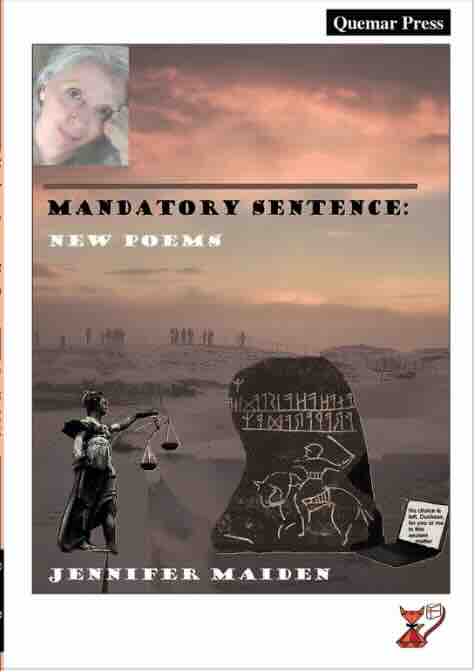
Mandatory Sentence is the latest in Jennifer Maiden’s continuing tightrope act of producing a book of poetry at the start of each year. As in previous years, most of its contents are in effect occasional poems, that is, poems written in response to breaking news – developments in the Gaza genocide, the demolition of the East Wing of the White House, Anthony Albanese’s visit to China, news about AI, and so on. Many of the poems feature fictional or historical characters responding to these events, sometimes in dialogue with current politicians.
If you’re new to Maiden’s poetry, you might need help with the characters who populate the book. George Jeffreys and Clare Collins, familiar from Maiden’s four novels and many poems, appear with their ever-increasing family that includes a son named Corbyn and a number of animals. There’s a weird, cuddly little creature named Brookings – named after the Brookings Institute and originally perhaps emblematic of what Maiden sees as that organisation’s deliberate naivety, but now taking on a life of its own. Dietrich Bonhoeffer, Eleanor Roosevelt and other make brief repeat appearances. Maiden’s daughter Katharine, has appeared in her mother’s poetry since The Winter Baby (1990) – as well as being the book’s publisher in real life.
I read Mandatory Sentence just after my first reading of Evelyn Araluen’s The Rot. They’re very different books, but they both respond with some immediacy to world events from a left / progressive perspective, so it’s not surprising that there are moments when they chime. One such moment is the opening of ‘Brooking Becomes a Bomb Bay Door’, which echoes that of Araluen’s ‘Uplock Actuator System’. For this blog post, I’ll stay there.
Both poems were evidently inspired by the same interview Richard Marles gave on the ABC in August last year – at this link – in which he asserted repeatedly that Australia does not supply weapons to Israel, but is ‘part of the F-35 process’. Neither poem is limited to satirising that assertion – the Shovel does that brilliantly, here. How they each make distinctive poetry from the material is interesting.
‘Uplock Actuator System’ begins:
We aren't sending weapons, they said,
just the only lock for the only door that
opens when they are fired from the air.
The poem progresses in nine three-line stanzas of almost intolerable intensity, evoking the suffering of Gaza and linking it to the ‘parallel occupation’ of Australia and the unwilling complicity of all of us. It ends with a call to engagement .
‘Brooking Becomes a Bomb Bay Door’ is by comparison laid-back and playful, adjectives I wouldn’t easily associate with Maiden’s political poems. You can hear her performing it, pretty much deadpan, at this link. Here’s how it appears in Mandatory Sentence:
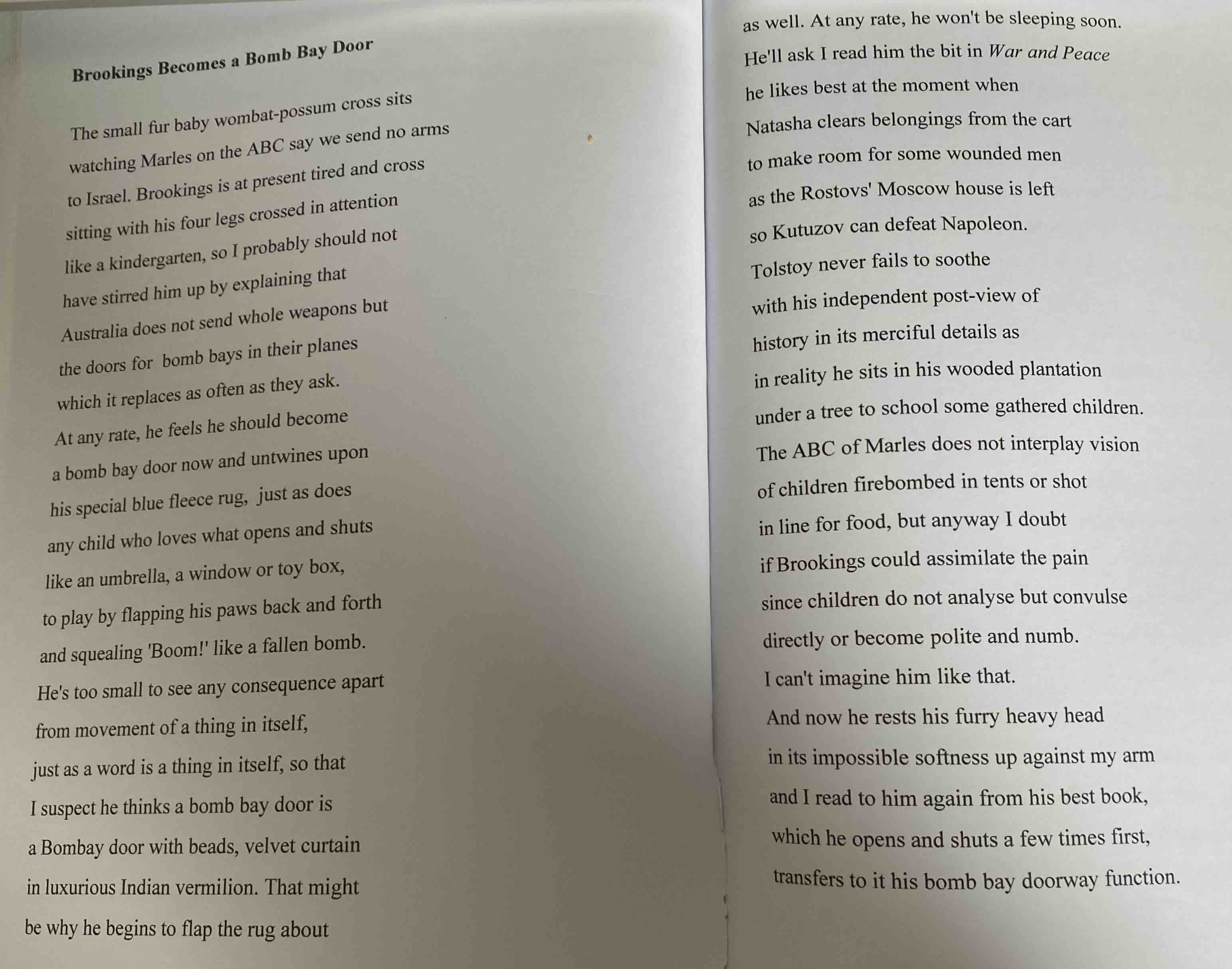
It begins with the titular Brookings – a ‘small fur baby wombat-possum cross’ who could have come from a children’s cartoon – watching the television, cutely ‘like a kindergarten’. And there’s some almost silly play on words – the word ‘cross’ appears three times, each with a different meaning.
The small fur baby wombat-possum cross
sits watching Marles on the ABC say we send no arms
to Israel. Brookings is at present tired and cross
sitting with his four legs crossed in attention
like a kindergarten,
The adult shorthand – ‘Marles on the ABC’ – alerts us that this is not a cute and cuddly poem. Contemporary Australian readers will know that this is Richard Marles, Minister for Defence, and the context is Israel’s genocidal bombing of Gaza (the context has moved on since the book was published – but the poem’s concerns are still sharply relevant). The language of political denial-not-denial is skewered in just three lines.
like a kindergarten, so I probably should not
have stirred him up by explaining that
Australia does not send whole weapons but
the doors for bomb bays in their planes
which it replaces as often as they ask.
The poem’s central tension is set up: on one hand, there’s the innocent, naive, playful fantasy creature and on the other the poem’s speaker who is aware that the Australian government is complicit in terrible things.
For the next 14 lines, the rest of the first page, innocent Brookings plays. In the Brookings poems – this book also includes ‘Brookings Becomes a False Flag’ – it’s clear Maiden’s invented character is not simply a mouthpiece for the poet but has an independent imaginary existence. (This may not be obvious with other Maiden characters, but I think it’s always true – Maiden sets her imagined people/creatures up and is interested to see what they have to say – what, for instance, would Dietrich Bonhoeffer say to Kevin Rudd this time? Do I need to say that Bonhoeffer isn’t as cute as Brookings?)
Brookings’s metaphorical origins may be at work in the background, suggesting that liberal organisations like the Brookings Institution aren’t serious about addressing things like genocide. Nerdily, I went to the Institution’s website to see what it was up to at about the time this poem was published – and while it wasn’t playing at being a bomb bay door (or a Bombay door with beads and velvet curtain), it was hosting a discussion about the future of drone warfare (link here). Make of that what you will.
But the poem doesn’t mount an argument about the Brookings Institution. It just gives a picture of innocent, or at least oblivious, playfulness.
There’s a turn, and in the second part of the poem the narrative moves to bedtime, which is a pretext for introducing Tolstoy’s War and Peace. This might seem a bit forced, but if you can accept a ‘fur baby wombat-possum cross’ then why not also accept War and Peace as its ‘best book’?
Embarrassingly, I haven’t read War and Peace (though I saw the King Vidor movie on Super 8 in 1964 and fell in love with Audrey Hepburn). Other readers will know what specific bearing the scene from the novel has on the rest of the poem:
He’ll ask I read him the bit in War and Peace
he likes best at the moment when
Natasha clears belongings from the cart
to make room for some wounded men
as the Rostovs' Moscow house is left
so Kutuzov can defeat Napoleon.
But those of us who haven’t read the novel can still see/feel how it works in the poem.
The War and Peace moment is juxtaposed with the image of Tolstoy at the time when he wrote it:
Tolstoy never fails to soothe
with his independent post-view of
history in its merciful details as
in reality he sits in his wooded plantation
under a tree to school some gathered children.
As often happens with poems, it seems as if this one has gone wandering, from Marles to Brookings, to War and Peace, to Tolstoy sitting with children under a tree. Then the next couple of lines bring it home:
The ABC of Marles does not interplay vision
of children firebombed in tents or shot
in line for food
The poem has interplayed vision of Tolstoy schooling children in a safe ‘independent post-view of / history’ with a scene from his great novel. If tha ABC was to interplay vision of children with the Marles interview, those children would not be safely ‘post-history’ but concurrent with the interview, victims of atrocity. The tension in the opening lines between child-like naivety and a violent reality comes to a head here.
Incidentally, ‘the ABC of Marles’ seems at first to be a slightly odd way of saying ‘Marles on the Australian Broadcasting Corporation’, but it can also read, less oddly, as ‘the alphabet of Marles’ – that is, the evasive language Marles uses.
The poem doesn’t go to graphic description of the atrocities – it gives enough to let us know the heaviness that sits in the speaker.
But – and it’s an important question – what is a parent or quasi parent to do? The speaker allows Brookings to continue in ignorance, and the poem ends with the peaceful image of mother and not-quite-child at bedtime;
And now he rests his furry heavy head
in its impossible softness up against my arm
and I read to him again from his best book,
which he opens and shuts a few times first,
transfers to it his bomb bay doorway function
Just two things complicate the image and provoke further thought and feeling.
First, the word ‘impossible’ suggests that, just as any soothing Tolstoy has to offer is dubious because he was writing from a safe historical distance, so any comfort afforded by Brookings is illusory because he is after all an invention, an impossibility.
And second, the last line: what does it mean that the ‘bomb bay doorway function’ can be transferred to a book? What is released when a book ‘opens and shuts’? If you’ve read this far, you probably have as good an answer to that question as I have and together we could probably come up with better ones. I’m reminded of a long history of assertions of the power of the word. There’s the proverbial: ‘The Pen is Mightier than the Sword’, ‘You can kill a person but you can’t kill an idea,’ and so on. The idea seems to be everywhere just now that the narratives we tell are crucial: we can believe the story coming from the White House, or commit ouselves to a different story. That final image gestures towards this kind of thinking. Perhaps what is released in those last lines is the possibility of resistence.
It’s not a call to arms like Evelyn Araluen’s poem, but it is a call to think, to reject double-talk, maybe even to hope.
I am a man of settler heritage who has been alive for almost a third of the time that has elapsed since Arthur Phillip claimed this continent for the British crown. I wrote this blog post on the land of Gadigal and Wangal, where the nights are lating longer and small lizards seem to be everywhere. I acknowledge their Elders past and present and welcome any First Nations readers of the blog.
* When blogging about a book, I currently focus on page 79, which is my age. Mandatory Sentence has just 70 pages, so I gave myself permission to go with a whim.


 Me fail? I fly!