
Becky Manawatu, Auē (©2019, Scribe 2022)
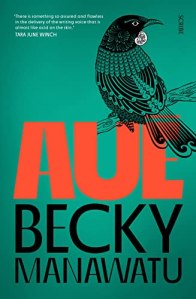
According to the book’s extensive glossary of Māori terms, Auē means ‘to cry, howl, wail’. Alternatively it is an ‘interjection showing distress’. This novel can be read as one long cry of distress for people, both Māori and Pākehā, male and female, young and old, in marginalised communities in New Zealand/Aotearoa. It’s a cry that has been heard around the world. According to Wikipedia, the first edition, published by independent publisher Mākaro Press in 2019, had a print run of 500 copies. It went on to win a number of prizes, was a best seller in New Zealand, and has been translated into several languages. The 2022 Scribe edition, which is what I have read, is published in the UK, the US and Australia.
Like many contemporary novels, Auē has a number of story lines with no obvious connection. It begins with young Ārama (Ari), who has recently lost his parents in an event whose specifics are revealed only in the last pages. Abandoned by his older brother who sets off on a quest of his own, he is left in the care of an aunt and her violently abusive white husband. The glimmer of hope in his new life is the friendship of a girl neighbour, Beth, whose farmer father Tom Aitken is a benevolent adult presence.
In a separate narrative strand, in chapters mainly labelled ‘Jade and Toko’, two young adult Māori women are caught up with thuggish men. Under cover of attending family funeral commitments, they escape to have fun together and have moments of romance – Jade with Toko, a gorgeous, guitar-playing man who is courageous, kind and protective. Things go well for a time, but there’s a terrible violent turn.
As the relationship between the two narratives is revealed, a complex picture emerges of family tragedy. There’s something of the feel of a quality TV series to the book, though it is much better written than that might seem to imply.
Page 79* is in one of Ārama’s chapters. A sleepover at the dairy has been planned.
[For those who don’t know, in New Zealand a dairy is what in Australia would be called a milk bar – a shop that sells sweets and ice creams among other things. Short rant: When I worked in children’s literature it was often remarked that US publishers of Australian and New Zealand books would routinely ask for terms to be Americanised, as if US children had to be protected from knowing that elsewhere people named the world differently. One of the charms of this book is that local idioms have not been removed. There are many Māori words, most of which are included in the glossary at the back of the book, but words like ‘dairy’ and ‘pottle’ are allowed to stand without explanation, and I rejoice. End of rant.]
Aunt Kath has cancelled the sleepover after being beaten by Uncle Stu, her husband. Ari has overheard the violence and is terrified. On page 79 Tom Aitken is stepping into the breach and having Ari at his place for the night.
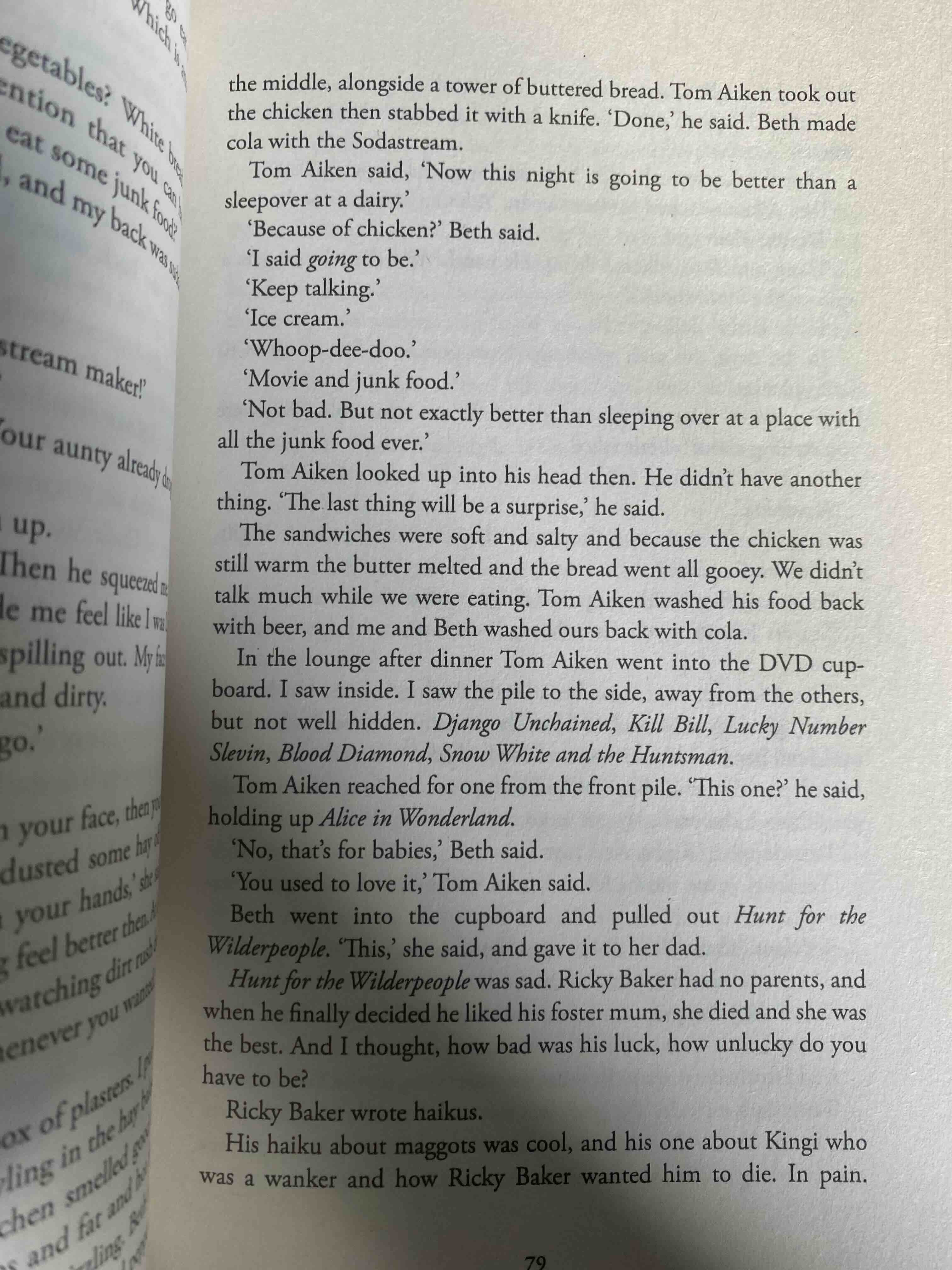
Without my rule of 79, I wouldn’t have chosen this page to illustrate what is most compelling about the book. It’s an uneventful scene of a man and two children having a meal together. All the same it gives an idea of some of the qualities of the writing. In context it’s an oasis of normality, where Beth can be a little bit cheeky, and a little bit self-assertive without bringing disaster on themselves. The only violence here is against a cooked chicken:
Tom Aiken took out the chicken then stabbed it with a knife. ‘Done,’ he said. Beth made cola with the Sodastream.
Tom Aiken said, ‘Now this night is going to be better than a sleepover at a dairy.’
‘Because of chicken?’ Beth said.
‘I said going to be.’
‘Keep talking’
‘Ice cream.’
‘Whoop-dee-doo.’
‘Movie and junk food.’
‘Not bad. But not exactly better than sleeping over at a place with all the junk food ever.’
The wider themes are suggested by what Ari glimpses in the DVD cupboard – perhaps, it’s subliminally suggested, this book has something in common with violent Hollywood.
In the lounge after dinner Tom Aiken went into the DVD cupboard. I saw inside. I saw the pile to the side, away from the others, but not well hidden. Django Unchained, Kill Bill, Lucky Number Slevin, Blood Diamond, Snow White and the Huntsman.
There’s a knowingness as if the author is talking to us over Ari’s shoulder. I confess that while reading this book I thought often about K, a member of my Book Group, who says he dislikes narratives that simulate a child’s voice. Auē is definitely not a book for child readers, but the Ārama chapters are narrated by the 11 years old boy at the heart of the story, and the faux-naïf voice had me understanding irritates K. (I’ve recently reread The God of Small Things, much of which is from the point of view of the girl Rahel, and the contrast couldn’t be starker: children aren’t just adults with less complex syntax.) Ari and Beth are wonderful characters, who play at being Django and Doc from the Tarantino movie. But their complexity doesn’t carry over to Ari’s narrative voice.
Beth went into the cupboard and pulled out Hunt for the Wilderpeople. ‘This,’ she said, and gave it to her dad.
Hunt for the Wilderpeople was sad. Ricky Baker had no parents, and when he finally decided he liked his foster mum, she died and she was the best. And I thought, how bad was his luck, how unlucky do you have to be?
Ricky Baker wrote haikus.
His haiku about maggots was cool, and his one about Kingi who was a wanker and how Ricky Baker wanted him to die. In pain. Which I thought was a pretty bad thing to admit to.
Ari’s simple declarative statements about the movie are other examples of the kind of simplified language I mean. There’s a little more talking over Ari’s shoulder. Taika Waititi’s Hunt for the Wilderpeople isn’t a random choice of a movie for the three of them to watch. It has a slightly laborious meta function – the novel is naming a work that it can be linked to.
Ricky Baker’s haiku in the movie give rise to a nice moment on the next page where elements of the plot are condensed into two haiku. The first, by Beth:
Stu-art John-son you
are the ug-li-est farm-er
hope cows shit on you
After that has evoked pretend disapproval from her father, it’s Ari’s turn:
Tau-ki-ri wrote me
a let-ter and it said he's
on his way home-home.
At this point of the novel, about the one-quarter mark, that’s the two points of suspense: will the little family be reunited? and will violence against women and children be brought to an end? And you know, I wasn’t any doubt about the answers.
I am a man of settler heritage who has been alive for almost a third of the time that has elapsed since Arthur Phillip claimed this continent for the British crown. I wrote this blog post on the land of Gadigal and Wangal, where the nights are lating longer and small lizards seem to be everywhere. I acknowledge their Elders past and present and welcome any First Nations readers of the blog
* My blogging practice is to focus on the page that coincides with my age, currently 79.


 Me fail? I fly!