
Eliot Weinberger, 19 Ways of Looking at Wang Wei, (with more ways) (New Directions 2016)
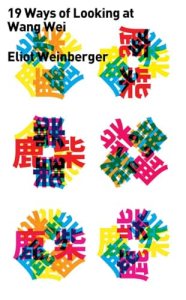
This book must be a classic work on translating poetry. Readers of this blog will know that occasionally I nerd out about translation. Well, Eliot Weinberger does it in spades, only he’s wittier, more erudite and generally much more illuminating.
The book looks at nearly 30 attempts to translate one four-line poem by the classic Chinese poet Wang Wei (c 700–761 CE), mostly into English. The poem is generally but not always, such is the nature of translation, known as ‘The Deer Park’.
Before looking at any of the attempts, there are three short sections presenting and discussing: the original, in Chinese characters, just five on each line; a transliteration into modern pinyin; and a character-by-character translation onto English. To give you some idea of the challenge facing the translator, here is the first line of the character-by-character translation:
Empty_ mountain(s)/hill(s) (negative)_ to see _ person/people
You can see that the possibilities are vast – and in discussing the different solutions, Weinberger has a lot of fun and at the same time gives an impressionistic account of the influence of Chinese and Japanese poetry on English language poetry in the last 100 years. He doesn’t mind taking on the Chinese language specialists who may know about the language but have no ear for poetry, and he doesn’t hold back with either praise or displeasure.
I’d written to this point when I remembered that I blogged about J. P. Seaton’s Shambhala Anthology of Chinese Poetry almost exactly 16 years ago, and did my own timid, partial, uneducated attempt at comparing versions – of a slightly longer poem by Li Po (701–762). If you’re interested, it’s at this link.
In short, I loved this book, and if you’re interested in Chinese poetry and /or translation in general, you will too. I’m very grateful to John Levy for mentioning it in the comments (at this link).
I’ll give the last word to Weinberger. At the end of the original essay – before Octavio Paz had contributed his learned Afterword, and before Weinberger’s account of a Furious Professor’s response – he writes:
The point is that translation is more than a leap from dictionary to dictionary; it is a reimagining of the poem. As such, every reading of every poem, regardless of language, is an act of translation: translation into the reader’s intellectual and emotional life. As no individual reader remains the same, each reading becomes a different – not merely another – reading. The same poem cannot be read twice.
I am an Australian-born man of settler heritage. I wrote this blog post on the land of Gadigal and Wangal of the Eora Nationa. I gratefully acknowledge the Elders past and present who have cared for this beautiful country for millennia, and welcome any First Nations readers of this blog.


 Me fail? I fly!