Category Archives: Diary

Sydney Writers’ Festival 2024: My day three, evening

Saturday 7.30 pm: Sebastian Barry: Old God’s Time

If I’ve realised that Sebastian Barry was appearing by video link I might not have booked for this session, but that would have been a mistake. A tiny Kate Evans sat on the stage in front of a huge Sebastian Barry speaking to us from early morning in Ireland in the room where, he said, he had written the book they were discussing, Old God’s Time (link is to my blog post).

Whether it was because Barry was speaking to us from the safety of his own house, or because of a paradoxical effect of long-distance communicating, or whether it might have happened anyhow, this session had a wonderful intimacy about it. Almost everything he said enriched my understanding and enjoyment of the book.

When Kate Evans asked about the physical setting of the book, Barry answered straightforwardly and then went on to talk about the novel’s seed being planted in a brief period of his childhood when he lived in that building. I don’t know anything of his life story, but he may have been hinting that the book child’s situation – he and his mother are in hiding from his abusive father – in some way echoes his own experience.

My highlight of this session, and of the whole festival, came when Kate Evans, referring to a tirade against the Catholic Church delivered by the character Tom Kettle, asked if Tom’s rage was also Sebastian’s. (Someone read this passage out at my book group meeting – it’s a stunningly passionate piece of writing, and Evans’s question is inevitable.) Barry asked Evans if she would read the passage, and when she apparently didn’t hear his request but read out a couple of isolated phrases, he paused, as if deciding how honestly to respond and then gave a complex answer:

A) The first rule of novel writing, he said, is not to write in anger. He spoke a little about the mysterious nature of novels. The writer sits in a room and puts words on paper. After a number of processes involving many other people, someone sits in their usual reading place and reads the words. The characters who have been imagined by the novelist are imagined all over again by the reader.

B) Though Tom is an imaginary character, his anger is like that of real-life survivors. It gives voice to things that need saying, and when you make the effort of listening to it, you are receiving a gift. Barry felt that he was receiving such a gift from Tom.

C) He didn’t stop there. There was a moment in 1960, he said, when Archbishop McQuaid (a historical personage mentioned in the novel) was given evidence of child sexual abuse committed by a priest in his archdiocese. He consulted an Auxiliary Bishop, Patrick Dunne, asking him if he considered that the crime was a crimen pessimum (a crime of the worst kind). Dunne said he thought it was. McQuaid responded that he would keep it quiet anyway, because it would cause a scandal that would do great harm to the church. That moment of decision ruined the lives of thousands of children, and this was the object of Tom’s rage.

But for Barry, there is another twist: Patrick Dunne was his cousin, closely related to a man who appears honourably in one of Barry’s novels. On realising that this man was present when the decision was made, Barry felt that his own DNA had been in the room. Irrational as it may be, he felt complicit. I understood him to be speaking a difficult personal truth but also – though he didn’t spell this out – making a point about fiction-writing: clickbait outrage is easy but it doesn’t make for great fiction. Tom the character can be outraged, but the person who creates him needs to be wary of claiming the moral high ground.

Astonishingly, but necessarily, Kate Evans then moved on to the next question, and Sebastian Barry moved on with her, leaving me – and surely I wasn’t the only one – in awe at what had just been given me.

The session ended with a reading, in which Barry was transformed into Tom Kettle and his glorious language filled the room. In the passage, Tom is listening to a new friend playing Kol Nidrei, Op. 47 by Max Bruch on the cello (link is to a performance by the Frankfurt Radio Symphony Orchestra). We were then treated to a performance of the piece arranged for cello and piano, performed by Melissa Barnard and Lee Dionne from the Australian Chamber Orchestra.

Sydney Writers’ Festival 2024: My day two

After just one session on Tuesday and nothing on Wednesday or Thursday, Friday was all systems go for me at the SWF, with five sessions, starting at noon and ending just after 7 in the evening. Please excuse the length of this post.


12 pm: The Gift of Greek Myth

I first heard Kate Forsyth talk back in the day when she mainly wrote for children (starting with Dragonclaw in 1997). More recently she has appeared on radio and podcasts as a writer of historical fiction. She has always been good value on fairytales and myth. In this session she chatted with playwright Tom Wright about her most recent book, Psykhe.

If Psykhe is as interesting as this talk, then it’s a brilliant novel. Here are some scraps I gleaned.

Kate Forsyth describes herself as playing in the borderland between myth and history. She is concerned to reclaim ancient stories from their patriarchal interpretations. Fairytales, she says, are myths drained of their sacred meanings, because they are mostly concerned with women’s issues.

In this book, the dividing line between gods and humans is porous. It tells the story of Psyche/Anima and Cupid/Eros/Amor as a historical fiction – Psyche becomes Psykhe and Amor becomes Ambrose.

I’m not sure how much of this is from the original myth and how much from the novel, but here’s a broad plot outline: Venus’ son Ambrose falls in love with Psykhe, a human woman; he keeps her in luxury in his palace, but as a prisoner; he comes to her bed every night, where she is not permitted to see his face. One night as he is sleeping, she looks at him by the light of a candle, and spills wax on him. For the first time he feels pain, and flees. Having broken free of her imprisoned state, she now can love him, and goes searching for him.

Forsyth says this is the only ancient myth that is gynocentric – woman-centred. Whereas in androcentric myths the hero breaks, kills, and conquers (and, I’d add, rescues), in gynocentric myths the female protagonist sets about healing, repair and recovery. This story is about the importance of consent, the transformative potential of pain, the need for love to be more than physical (the reductiveness of that is mine, not Kate Forsyth’s or Tom Wright’s).

Kate Forsyth has a lovely phrase for her creative process. She says she spends a lot of time ‘daydreaming a story to life’. In this talk, she allowed us to witness part of that daydreaming.  


2 pm: Abdulrazak Gurnah: Afterlives

I’ve read and loved two of Abdulrazak Gurnah’s ten novels, Gravel Heart and Afterlives.

This urbane and amiable session focused on Afterlives. Gurnah kicked it off with a reading. Though he read beautifully, it was a strange passage for the occasion as very little happens in it: there is a boat and a harbour town, the sun sets, the main character has trouble sleeping because of unspecified pain. This from a book where there is so much wonderfully dramatic or tender writing he could have picked (see my blog post for an example).

Sisonke Msimang, his interlocutor, asked the pertinent question: why this passage? He said it was the first part of the book that he actually wrote. He knew that Hamza had been wounded and was returning to his childhood home after fighting for the Germans in World War One: what came before and after that was yet to be imagined.

After that insight into the book’s origins, we learned that Gurnah had wanted to write about the German schutztruppe for a long time. (Not quite right to call them ‘the German schutztruppe‘, he said, as only the officers were German, the troops were African.) He had known from his childhood about the ferocity of these soldiers, who fought for the colonisers – his grandfather (or more precisely his mother’s uncle) had been one of them. But when he got to the UK and had access to books, he found that there was nothing written about the way Africans were drawn into the wars between the colonising European nations. He had intended his fourth novel, Paradise (1994), to be on the subject, but he realised then that he didn’t know enough to write about it. It was nearly two decades before the time was right.

A question animating the book is: Why did people join a force that was going to end up dominating them/Why fight in a war that will determining who will be your coloniser? ‘That’s how we put the question now,’ he said. The book offers no simple answer, but a lot of what the two speakers had to say echoed what I have heard and read about the Queensland Native Police: apart from the attraction of being part of a new, powerful force, or various kinds of of coercion, it’s important to remember that people didn’t think of themselves as African, any more than the Germans and French identified each other primarily as fellow-Europeans: many of the African nations had been at war with one another for centuries.

The conversation roamed over the more personal elements of the book. These are the things that Gurnah says he likes writing about most – the everyday, the interior, the domestic, the intimate – and it’s them that gives the book its power as it tackles broader issues. All of this brought the pleasures of the book back to me – I hope it inspires people who haven’t read it to pick it up.

One final question from Sisonke Msimang: Was he expecting the Nobel Prize? Writers don’t work with the hope of winning the Nobel Prize, he said. They’re in for a hard time it they do. And he did a quick impersonation of someone responding to the phone from the Nobel Committee by exclaiming, ‘Well, at last!’


3 pm: Nam Le: 36 Ways of Writing a Vietnamese Poem

This wasn’t a session for the faint-hearted. Felicity Plunkett, herself a poet, set the ball rolling with an opaque quote from ‘On the line’, an essay by Kasim Ali, and things only got more erudite, recondite, convoluted and polysyllabic from there.

When someone at a session later in the day half apologised for the comparatively straightforward terms ‘methodological’ and ‘epistemological’ by adding ‘as we’d say in the academy’, I realised retrospectively that this conversation was being conducted as if in a specialist academic context.

For instance: ‘The line can put things into differences of ordinality … You can have a chiasm … ‘ I managed to note down terms like ‘autofictive’, ‘metafictive’, ‘preambular’, ‘the trauma plot’ (which is ‘too easy’). All of this has meaning, but I found it impossible to keep up.

What emerged is that Nam Le’s poems are ‘destabilising, elliptical, constantly questioning’. ‘How is it possible to say anything at all,’ he asked at one stage,’without being undermined by your own self-consciousness?’

There was a lot of talk of violence, which may or may not have a technical meaning. I think Nam Le was joking when he asked, ‘What is more violent than meiosis?’ (Meiosis is the process by which cells split.)

As a counterbalance, Le read four poems to us – or more accurately he read four parts of what Plunkett said is the long poem that constitutes the book 30 Ways of Writing a Vietnamese Poem. It was wonderful to hear his performances. The one with which he wound up the session, a lullaby with the title ‘Matri-Immigral’, was all anyone could have hoped for.

That broke through my exasperation with the session’s obscurity and recursiveness and convinced me to buy a copy of the book.


4 pm: Feminist Firebrands

Each of the day’s earlier sessions featured one author talking to one other person about one book. This session was a panel of three plus a facilitator.

A panel is a hard gig: you run the risk of only half-hearing each of the participants, and hearing no one’s thinking in depth. If the subject is books, you can get some idea of whose writing you might want to follow up, but this panel barely mentioned the participants’ books. All the same, it worked.

Hannah Ferguson, who is in her late 20s, abandoned her law career soon after graduating and is now a podcaster and person in charge of something on the internet called Cheek. Sisonke Msimang, among other things, writes a regular column in the Guardian offering wisdom about racism and related issues. Jennifer Robinson has offered legal advice in high profile cases of alleged sexual abuse. Jo Dyer, among other things former CEO of the SWF, facilitated.

The conversation revolved around issues raised by the Brittany Higgins and Bruce Lehrmann court cases, the allegations of historic rape against Christian Porter, Grace Tame’s advocacy, a little of Amber Heard’s case against Johnny Depp, and a sulphurous whiff of Donald Trump. That is, the way the criminal justice system here, but also in the USA and Britain, treats women, specifically when they allege sexual abuse or rape. And not just the criminal justice system, but the media and the culture generally.

The first thing that struck me was the stark contrast with Nam Le’s approach. Here there was no uncertainty, no self-undermining, no painful self-consciousness. Everyone spoke forcefully, definitely, and – alas for my note-taking – fast. I couldn’t possibly give a decent summary, but here are some gems:

Jo Dyer on recent news about the Queensland police force: ‘How many bad apples do you have to have before you cut down the f*ing orchard?’

Hannah Ferguson (I think): ‘Men are 230 times more likely to be raped than to be falsely accused of rape.’

Hanna again, on the ‘If you don’t know, say no’ slogan: ‘Everything I do is to fight the notion that you should back off if something is hard.’

Jennifer Robinson: Only 2% of rape cases arrive at a guilty verdict, but the current defamation laws in Australia mean that only those 2% of survivors can talk about their experience without being sued. A not guilty verdict in a rape case does not mean that the woman lied.

All the panellists agreed that it is important to have conversation about these issues. I think it’s right to say they all felt that it was a mistake to pile on Scott Morrison for framing his empathy for sexual assault victims as resulting from his wife asking how he would feel if it was his daughter. The conversation is important, and it doesn’t move things forward to attack imperfect contributions that are still in a good direction.

I learned about the ‘Man or Bear’ meme on Tik-Tok. Women are asked if they would rather be alone in a cave with a man or a bear. A typical witty answer is: ‘The bear, because at least I know what it would do.’ There was some dark humour about how some men have responded – one teenage boy asked (the question I’m embarrassed to say came immediately to my mind), ‘What kind of bear?’


An hour’s break to attend to bodily needs and get from Newtown to the City, and then off to:

6pm: Richard Flanagan and Anna Funder on Writing

Given that Richard Flanagan was scathing about writers’ festivals in Question 7 (a book I didn’t warm to), it’s interesting that he still agrees to appear at them. I came to this session mainly for Anna Funder. The Emerging Artist read quite a lot of Wifedom to me last year.

Clare Wright was in the chair. As a historian, she was interested in the way both books move around in genres, part history, part novel, part memoir, part autofiction. Both writers resisted any attempt to classify, saying they had followed where the books took them. Funder, for example, said she wasn’t writing autofiction in the parts of Wifedom when she wrote about her own life: it was a device to bring the questions about how women were seen in her subject’s time into focus.

Richard Flanagan was entertaining. My impression is that he came armed with a number of set pieces. He told us, for instance, that the history of publishing in Australia differs from the history in Britain and the USA in that key roles have been played by strong, intelligent women. He didn’t mention the fabled Bea Davis, but he named others, including the woman who had edited both books featured in the session: he asked her to stand up to take a round of applause, and though I couldn’t see her from my seat up in the gods she apparently complied, I can only imagine how reluctantly. Later he told his version of the story of being mistaken for a different writer in a signing queue – he duly signed the proffered book as Bryce Courtney.

In the long and interesting conversation, Clare Wright asked Flanagan two questions about Question 7 that touched directly on my issues with the book. Did he introduce Rebecca West as a way of countering the all-male patriarchal narrative of the origins of the atom bomb? Nothing so programmatic, he said, and went on to talk about how remarkable Rebecca West was. Then he reminded us that for the last 20 years or so women’s writing has been front and centre in western literature, so our collective sense of history has changed – so not programmatic, but responding to the zeitgeist. Wright framed the other question by asking him to read a short passage (sadly, this was the only reading in the session) describing the bomb being dropped on Hiroshima. As a historian, she was not interested, as he first thought, in whether he had got the number of people killed right, but the origins of his image of survivors walking the streets calling for their mothers, juxtaposed poignantly with the fact that plane that dropped the bomb, Enola Gay, had been named after a crew member’s mother. He was able to say that both those images came from historical records.

Wifedom has 400 endnotes: ‘If you want to destroy patriarchy you have to have endnotes.’

The patriarchal manifestation she attacks in the book is the erasure from history of George Orwell’s wife, Eileen O’Shaughnessy by Orwell’s many biographers. She had a number of Eileen’s letters and some few other sources, so she had to resort to ‘making shit up’, to use the words Clare Wright put in her mouth. The made-up bits are clearly indicated in the book, being set to a narrower width. Before she made this controversial decision, the writing was flat and dead on the page. Her writing about her own status as wife played a similar role.


And so out into the crowds in George Street, possibly there for the Vivid Festival, to dinner and eventually home.

Sydney Writers’ Festival 2024: My day three, afternoon

Sue from Whispering Gums respectfully suggested that I not try to squeeze a whole day of the SWF into one blog post. Day Two’s post was a marathon to write but hadn’t realised it was imposing a burden on readers as well. So, even though none of my subsequent days were as loaded as Friday, I’m taking her advice. Here are the first two of Saturday’s three sessions.


Saturday 25 May

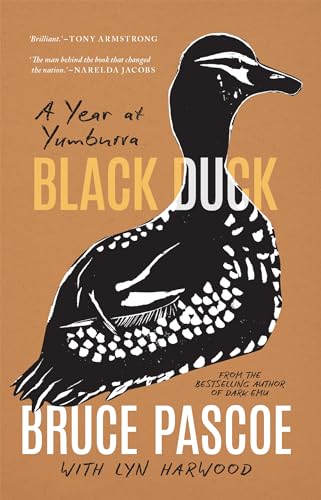
1 pm: Bruce Pascoe and Lyn Harwood: Black Duck: A Year at Yumburra

This session is a variation on my standard session: two people talking about one book with one other person.

Bruce Pascoe’s most recent book, Black Duck: A Year at Yumburra, shares authorship with his wife, Lyn Harwood. They chatted with veteran journalist Kerry O’Brien about their project at Yumburra, their relationship, the devastating bushfires of 2019–2020, the impact of Pascoe’s book Dark Emu (my blog post here) and the subsequent backlash, and related matters.

After Dark Emu‘s success, Pascoe decided to put his newfound wealth to good use. Aware of a new enthusiasm for native foods –  he didn’t use the phrase ‘bush tucker’ – he was concerned that there was little consideration for benefit to Aboriginal people. So he bought the farm at Yumburra to grow food, employ Aboriginal people and make a declaration of Aboriginal sovereignty.

I didn’t get a clear sense of the book Black Duck, but I gather it’s in effect a diary of a year spent at the farm. Lyn Harwood spoke eloquently about the effect of writing things down. You spend most of the time dealing with things as they arise, just doing the work. it’s not until you stop to write it down that life, ‘especially the sensuousness of life’, is properly imprinted. The process of writing the diaries was a way of attending to what was happening on the land – not just the work, but the effects of the changing seasons.

Kerry O’Brien, excellent journalist that he is, gave Pascoe opportunities to address the various fronts on which he has been attacked.

On this subject of his Aboriginal identity, he described some of the cultural work he had to do. There was an occasion when he said something stupid and an Aunty said, ‘You know nothing. You know nothing. You go back to the library.’ She may have been speaking metaphorically, but he took her literally and went back to the library to research the history he had got wrong. His Aboriginal identity is contentious among some people, but not among his local mob. ‘I have a very small connection and I admit to it,’ he said. But I identify with it.’ These questions of identity, he said, are a distraction from what matters: when he offered a non-Aboriginal shopkeeper some vanilla lily bulbs he had grown on the farm, her first response was not to consider the possibilities being offered to her but to as, ‘What proportion Aboriginal are you?’ The gasps from the audience demonstrated that he had made his point.

On the validity of the argument of Black Emu, he cited the work of archaeologist Michael Westaway: with the assistance of the Gorringe family, he set out to test Dark Emu‘s hypothesis about pre-settlement history in Mithaka country in Queensland, and found ample evidence that here had been substantial ‘town life’ there.

My main takeaway from the session was the reiteration of the key message of Dark Emu: Aboriginal and non-Aboriginal people have a shared history. One of Pascoe’s mentors, commenting on Dark Emu, said: ‘If I’m going to keep my culture, I have to give it away.’ If non-Aboriginal people aren’t invited in, they (we) remain angry, unsettled spirits. Over millennia, Aboriginal people had a continent where there were no wars over land: each group has responsibility for their own Country. If your neighbour is weak or in trouble, you can help them out, but you cannot take their land.

Pascoe says that, in spite of the Referendum result, he thinks there’s a big change coming, as people come to realise that the future of Aboriginal people is the future of all Australians. Just as his work at Yuburra is offering possibilities for agriculture, a future is being offered to us in many ways as a gift with an embrace.


3 pm: Bringing the Past to Life

Ah! A proper panel: three people talking about one book each to one other person. The writers were Francesca de Tores (Saltblood), Mirandi Riwoe (Sunbirds) and Abraham Verghese (The Covenant of Water). Abraham Verghese had Covid, so appeared on a giant screen behind the others. The fourth person was Kate Evans of the ABC’s Bookshelf. The session was most satisfactory.

I hadn’t read any of the books, though I had read Mirandi Riwoe’s earlier novel Stone Sky Gold Mountain (link is to my blog post).

Kate Evans ruled with a rod of iron, asking a series of questions, and making sure that the writers had roughly equal amount of time in response to each question: setting, characters, plots, dark matter. No butting in or dominating. (I’m embarrassed to say it, but perhaps it helped that the only man was a person of colour.) As a result, even without being read to, we got a good sense of each of the novels.

Saltblood is set in the Caribbean in the 1720s, towards the end of the golden age of piracy, and is based on the historical women Mary Read and Anne Bonny. De Tores said that she was happy to call Mary Read a woman, although her gender identity was complex – she was raised as a boy and spent most of her life as a pirate dressed as a man. There’s an early book about pirates – I didn’t catch its name but it is evidently the main if not the only source of everything we think we know about pirates from that time. In that book, the lurid potential of women pirates was played up, and in its second edition the illustrations showed them swashbuckling with breasts exposed. Saltblood sounds like fun, but focuses on more interesting things than bare boobs.

Sunbirds features an Indonesian family in Western Java in 1941. The family and their servants deal with issues related to Dutch colonisation and nationalist resistance, and imminent invasion by Japan. A Dutch pilot is wooing the daughter of the family, who is torn between loyalty to her family and the attractions of life in the Netherlands. Meanwhile a servant of the family has a brother who is part of the resistance. Miranda Riwoe described herself as Eurasian, and so drawn to the plight of the daughter.

The Covenant of Water draws on Abraham Verghese’s own family background in Kerala (he was born and raised in South Arica, but Kerala was always in the background). The story covers three generations in the first half of the 20th century. There is a child bride. Verghese said he was playing against stereotype by giving her a happy marriage. He is a doctor specialising in infectious disease (he pointed out the irony that he was attending on screen because of a coronavirus), and the novel pays attention to advances made in medical science in the period it covers.

So, three interesting books for the TBR shelf.

SWF 2023: My fifth day

12–1 pm: Crime and Justice

This session demonstrated the strengths of a two-person panel. It was progressing quite nicely, as Sarah Krasnostein (my blog post about her Quarterly Essay Not Waving, Drowning here) introduced the talent, Helen Garner (my relevant blog post here) and Hedley Thomas (creator of the podcast Teacher’s Pet), and asked about their writing process.

When Helen Garner is embarking on a long project, she buys a spiral bound A4 notebook and keeps a kind of diary of everything related to the project: not transcripts of interviews, but odd details, what she did, and thought, and felt. When it came time to marshal the material she had accumulated for Joe Cinque’s Consolations she was at a loss where to start, looked to the notebooks for inspiration and discovered that they contained the skeleton of the book.

Hedley Thomas was in the middle of answering a similar procedural question, when Garner was visibly excited by something he said. With a quick look at Sarah Krasnostein, half asking permission and half apologising, she interrupted to take the conversation off in a whole new direction: the way footballers tend to have a degree of immunity from police investigation because of their almost hallowed status in Australian society. From then on we were treated to a lively conversation between two people who had deep appreciation for each other’s work and were swapping stories and genuine compliments.

Sarah Krasnosteiin made a couple of attempts to restore order, but I think she could tell things were going swimmingly. This session is sure to appear on the SWF podcast during the year.


5–6 pm Alexis Wright: Praiseworthy

Alexis Wright’s third massive novel, Praiseworthy, was published just a couple of months ago. Ivor Indyk, director of Giramondo Publishing, stepped in at short notice to discuss it with her, replacing Sisonke Msimang, who had been called home to Western Australia unexpectedly. So, in this session, an author discussed her novel with her publisher and editor – that is to say, with a reader who had some influence on how the book turned out.

I was one of the few people in the room to have read the book. I was keen to lap up any guidance from either Ivor or Alexis on how to make sense of the experience. I’m glad to report that I got plenty.

For a start, it was reassuring that Alexis mentioned some of the more bizarre plot developments with a wicked smile, and the audience laughed quite a lot as the two of them named odd characters and moments. Ivor said towards the end of the conversation that the comedy of her work was often overshadowed by its epic qualities. For me, the issue was more how seriously to take the epic qualities when, as summarised by their author in this conversation, they had such absurd qualities.

Asked about the original idea for the book, Alexis Wright said she didn’t remember – she’d have to look up her notebooks. Perhaps it had to do asking what Aboriginal people are to in the new era of global warming and climate change. She started writing it when she was working on her multivocal biography of Tracker Tilmouth in 2017 (my blog post here), and the visionary at the heart of the novel ‘Cause Man Steel, Widespread or Planet, whatever you want to call him’) is in part based on Tracker. Widespread’s plan for a global transport conglomerate using Australia’s five million feral donkeys, though, is all hers: it’s absurd to the point of surrealism, but there’s something true in the way it leads to a cycle of vision and disappointment.

The book is in part a celebration of Aboriginal people’s will to survive, manifested in many ways, tainted by 240 years of living in the coloniser’s world. The enemy in this book is the project of assimilation.

Perhaps most interesting to me was the exchange about music. Referring to the Ice Queens – grotesque, larger-than-life women who appear toward the end of the book – Ivor wondered about the influence of opera. Alexis agreed that she loved opera, but seemed nonplussed at Ivor’s suggestion that these characters are operatic. The music she listens to most while writing is classical Indian music and yidaki (didgeridoo). She tries to capture the tone and rhythm of that music – the pulse, the heartbeat: ‘We say that we’re of one heartbeat with the country.’

‘You hear what you’re writing,’ Wright said. ‘Then it gets recorded and you want it to be the voice you heard, but it can’t be that voice.’

There was a lot more. Ivor touched on the way Wright defies conventions, at times inventing words that look like mistakes, but which are anything but.

I’ll be attempting my own blog post about Praiseworthy in the next couple of days. Wish me luck!


We made a quick dash to a smaller venue for 6–7 pm State of the Art

Kate Evans of ABC’s The Bookshelf presided over another panel. This time it was Eleanor Catton, Richard Flanagan, Tracey Lien and Colson Whitehead invited to discuss the state of the novel and the future of fiction.

I haven’t read anything books by any of these authors, apart from one novel that I hated, which I’m told is completely unrepresentative of their work. I enjoyed the ebb and flow of conversation, but didn’t have anything to ground myself in.

Kate Evans asked if ChatGPT and other AI content producers spelled the end of novelists. Tracey Lien, the youngest on the panel and the only one without a string of awards to her name (and not at all intimidated by that, she said smiling bravely), said she used ChatGPT as a research assistant, but it couldn’t do the writing. On the one hand, it doesn’t have a brain, but produces word after word by complex algorithms, and the act of reading is a back-and-forth between minds. On the other hand, ChatGPT lies.

Richard Flanagan, whose scowl occasionally gave to an appreciative grimace at another panellist’s point well made, said he didn’t care about AI. He’d just keep writing.

The subject of decent recompense for the work of writing, and of all creative work generally, provoked more interest. Digital publishing changes the landscape significantly. They all agreed they weren’t in it for the money, but money would be nice. Eleanor Catton said that working as a scriptwriter was hugely more remunerative. Responding to a question at the end about how to become a writer and also earn a living, Flanagan said he had decided to be a writer when he was very young and in order to achieve it he lived in poverty for years. There was no other way. Colson Whitehead said something similar: after a significant number of successful novels he was at least temporarily able to live on his earnings as a writer. He implied that this is precarious.

Whitehead, Flanagan and Catton spoke interestingly about not repeating themselves, each new novel being a whole new challenge.


SWF 2023: My fourth day

Friday was my day for poetry, starting early:

10–11am In Conversation: Anthony Joseph

Anthony Joseph comes from Trinidad and is currently based in the UK. He was in conversation with Felicity Plunkett, one of the few Australian poets to appear on the program. Though his most recent book of poetry, Sonnets for Albert, won the 2022 T S Eliot Prize for Poetry, Felicity Plunkett assumed, correctly in my case, that the audience was unfamiliar with it, and filled us in: it’s a book, mainly in sonnets, about the poet’s father.

The conversation covered two main subjects, both engrossing: the story of Joseph’s father and his use of the sonnet form.

A young friend of mine once said of her father, with obvious affection, ‘He was a terrible dad.’ Joseph could go further: ‘He was my father, but he wasn’t a dad.’ He married very young, and left the marriage after just enough time for two sons to be born, then in the rest of his life had ten more children by a number of women. Joseph’s brother remained bitter about being abandoned until, at the very end, he was at his dying father’s bedside. Joseph himself lived with his paternal grandmother as a small boy and her affection for her son rubbed off on him. The poems, as I understand it, explore this emotional complexity. I’ve bought a copy of the book.

The sonnet – which Felicity Plunkett described as being an inheritance just as much as family experience is – is more than a poem. In the English-speaking world, it’s a feeling, a thing you recognise in many places: in the shape of a pop song, even in the shape of the human body. It’s a way of thinking. For Caribbean/Black poets, it’s interesting to find ways of using the form and making it fit their experience. When he was writing the book, Joseph started out adhering strictly to the rules, but then began taking all sorts of liberties. His father’s voice said to him: ‘You can’t put me in this box.’

He quoted two Caribbean poets. Kamau Braithwaite: ‘The hurricane does not roar in pentameter.’ Derek Walcott: ‘The English language is nobody’s special property. It is the property of the imagination.’

Speaking of himself, he said that luckily he has access not only to standard English but to Trinidadian Creole, which (I’m almost certainly getting this wrong) uses English words with African-derived grammar. To illustrate, he read us sonnets from the book in standard English and in Trinidadian.

There were some good questions. I loved his description of his process for writing a poem: ‘You write it. You leave it. You come back and edit it, and hope the original resonance is still there.


After grabbing a late breakfast, it was off to join a much larger audience for:

12-1 pm Eleanor Catton: Birnam Wood

Eleanor Catton was in conversation with Beejay Silcox who I know mainly as a critic in the Australian Book Review. Everyone keeps saying that Eleanor Catton’s new book, Birnam Wood, is her second, the first being the award-winning The Luminaries. Catton was careful to let us know it was actually her third, and that she didn’t disown her first, The Rehearsal, about a theatrical production in a girls’ school.

She talked about her venture in screen writing – for the 2020 movie Emma. (full stop is part of the title), directed by Autumn de Wilde. She learned a lot from her immersion in Jane Austen’s novel, and from the way film requires character to be revealed through action. She learned the dictum that every story had to have a beginning, a middle and an end was important for drawing attention to the transitions between those elements, the turning points of structure.

She and Beejay Silcox agreed that Emma is one of the great monsters of English literature, but she said that the genius of Jane Austen is to beguile the reader into committing the same mistake as Emma makes, in thinking ourselves morally superior to her, and then turning it back on us. (I do love a bit of Jane-Austen-ophilia.)

As for Birnam Wood, it sounds interesting, a satire that sets out to unsettle readers of all political stripes. I’ll wait for recommendations or otherwise from the Emerging Artist and others. Maybe I’m unsettled enough already.


Then scurry scurry scurry (I’m sure in the olden days when everything was better there was a bigger time gap between sessions) to:

1–2 pm ABC RN: The Bookshelf

The Bookshelf is an ABC Radio National program where hosts Kate Evans and Cassie McCullagh chat with guest writers about their books and the books they cherish. Each episode of the program adds a number of books to an imagined bookshelf. Their guests on stage for this session were Shehan Karunatilaka (I was glad to see more of him after Wednesday evening), Jason Reynolds (interested to hear him more discursive than on Thursday evening) and speculative fiction writer Grace Chan (yay for genre!).

One of the pleasures of this panel was the way it embodied Anthony Joseph’s quote from Derek Walcott: ‘The English language is nobody’s special property. It is the property of the imagination.’ An African-American YA writer, a Malaysian-born spec-fic writer, a Sri Lankan novelist, all own the language and its literatures. I did make notes of the books they mentioned, but I’ll just mention a couple of moments that gave me joy.

I loved it when someone mentioned a book I love. Jason Reynolds mentioned Sharon Creech’s Love That Dog, a tiny book about a boy who writes poetry that I had forgotten until he reminded me of it. Grace Chan recommended Spirits Abroad by Zen Cho, saying that it had magic, and boarding school etc, and then referred, not to the obvious inspiration but to the late, great, beloved of me, Diana Wynne Jones. Shehan Karunatilaka was cajoled into confessing his love for the Choose Your Own Adventure books – it’s not that I loved them so much as that they were a feature of my early parenthood, and somehow it was a thrill to realise these formidable people were young enough to be my children.

Drums got a mention. Jason Reynolds quoted James Brown (I don’t remember the context): ‘Every instrument is a drum.’ Shehan Karunatilaka said he loved to play the drums: ‘I bang the drum, read some Yeats, and I’m ready to go.’

The most interesting moment was when one of the facilitators suggested that these writers of non-Anglo background were redefining the canon. ‘No,’ said Jason Reynolds. ‘We have different canons to start with.’ He listed a number of great African American writers, not as favourite authors of his, but as the eminences who defined the literary landscape. He suggested that each of the others on the panel had a similar lineage behind them. We’ve come a very long way since my days studying Eng Lit under the shadow of F R Leavis (even though that shadow was fading in my time), when there was The Great Tradition – a very short list of The Writers Who Matter. I for one am very happy for that distance.


7.30–8.30 pm The Rhythm of the Word

The thing I love most about the Sydney Writers’ Festival is being read to. The Big Read, when half a dozen writers would read to a packed Town Hall is now apparently a thing of the past, but moments like Sebastian Barry bursting into song at the beginning of his reading are still with me years after the event.

So I was happy to venture back out from my warm home for this poetry reading. Poetry readings at the SWF used to have a home-town feel, and when the festival was beside the Harbour poetry had a base in small, often crowded, sometimes glare-filled room at the end of the wharf. The Carriageworks doesn’t allow for such nooks and crannies, and poetry events have somehow become rarer.

Not that there was anything unattractive about this event.

Western Sydney poet Omar Sakr was the host. He used his platform as MC to slip in a poem of his own (the only poem I heard at the festival by a Australian living east of the WA border!). It was ‘Diary of a non-essential worker’ a Covid poem, and I wrote down two lines that struck me. I can’t read my own writing, but I think the lines are:

Everything is a miracle when you're alive
I'm learning that reluctantly

Madison Godfrey did a reprise of ‘When I grow up I want to be the merch girl’, which they read on the opening night. Their other poems were ‘Harry Styles was [illegible] on a beach and the horizon was aligned with his thighs’, ‘Utopia translates as no place’ (a heartbreak poem), and ‘Impulse’ (named for a brand of deodorant).

Joshua Whitehead, Canadian First Nations scholar and poet (a different person from novelist Colson Whitehead who is also a guest at the festival) did a stunning performance of a medley of poems from his two books, including Making Love with the Land (2022). If you heard his astonishingly rapidfire stuttering delivery on a recording you could easily assume his effects were achieved by electronic feedback but he did it all.

Nguyễn Phan Quế Mai read three poems, first in Vietnamese and then in English. At the end, she gave us a short lesson in the importance of diacritical marks in Vietnamese (‘those funny little marks above the letters’). She had us all pronounce Quế , and explained it means ‘cinnamon’. Then she taught us Que (which is how her English-language publishers) wanted to print it). It sounds quite different and means ‘snake’. Point made.

Anthony Joseph read two poems, quite different from the sonnets of this morning’s session. They were ‘On the Move’ and ‘The Ark’ He introduced the latter saying it was an elegy for a London hip hop performer whose name I didn’t write down. It’s a list poem, or a litany: name after name of African-heritage writer or singer or performer with the recurring phrase ‘is on the Ark’. The cumulative effect is powerful – for me, partly by making me aware of how few of the names I recognised (making me think back to Jason Lester’s observation this morning about different canons), and partly by invoking the force of those I do recognise (from Langston Hughes to Maya Angelou). At the end his friend’s name was added to the list, and Omar Sakr came onstage wiping his cheeks and saying his face had melted.


After the reading I looked around and saw just one face I recognised. We had a chat, and were soon commiserating over the absence of Sydney’s usual poetry audience from the event, and the near absence of Sydney or even eastern Australian poets from the Festival program. We happened to walk past Ann Mossop, Artistic Director, and buttonholed her briefly on the subject. She said that it’s hard to find an audience for poetry. I wonder what would happen if the Festival commissioned someone like Magdalena Ball of Compulsive Reader or Toby Fitch, poetry editor of Overland and organiser of Avant Gaga, a monthly poetry reading in Glebe, to curate a poetry stream in a tiny room somewhere at Carriageworks. If such a curator needs t be someone who’s not white, what about Eileen Chong, or Sara Mansour of the Bankstown Poetry Slam? Just wonderin’.

SWF 2023: My second day

After a day on grandparent duty, we made our weary, head-cold-heavy but cheerfully expectant way to Carriageworks for:

8 pm: Shehan Karunatilaka: The Seven Moons of Maali Almeida

The Emerging Artist loved The Seven Moons of Maali Almeida, which won the 2022 Booker Prize and which the Festival program describes as an ‘epic, searing and darkly funny satire’. Shehan Karunatilaka was in conversation with Michael Williams, former acting director of the Festival, current editor of Melbourne’s The Monthly, and one of my favourite SWF interlocutors.

Michael Williams kicked the session off with a joke about the smell of a room full of book people. When that fell a little flat – very flat, actually – he followed it up by saying the SWF was Nerd Christmas, which went over much better, all the more because this was a Melbourne person who didn’t indulge in tiresome inter-city comparisons.

The session was everything I could have hoped for. Shehan Karunatilaka was urbane, witty, serious about his work but not at all self important.

The book, I gather, is about a recently dead war photographer at the end of the Sri Lankan conflict in the 1980s. It’s a ghost story, in which the ghost investigates his own death while dealing with the bureaucratic system of the afterlife.

Karunatilaka gave a number of different origin stories for the book. He wanted to write about something other than cricket (he mentioned his cricket novel, Chinaman, quite a bit), and thought that the complex ‘squabbling’ and blame-laying at the end of Sri Lanka’s long and devastating civil war was a good subject. A good way of resolving the squabbles would be to ask the ghosts of those who had died in the war.

On the other hand, he just wanted to write a ghost story, not something political. In fact, an early draft was a horror-slasher set on a bus. The book is genre rather than magical realism.

‘Why does this beautiful island go from catastrophe to catastrophe?’ The malign presence of ghosts seemed a plausible explanation.

There was much more: the rules for ghosts; the reason for making his protagonist a war photographer; the book’s relationship to a real-life journalist who disappeared during the war; whether as a ‘cis het normative man’ he would write a gay character if he were starting the novel today.

I have to mention the audience questions. There were five, all of them interesting.

  • Asked about his influences, he named a number of South Asian writers as well as westerners including Kurt Vonnegut, then told us about Carl Muller
  • The questioner said that Shehan’s identifying as heterosexual was a great disappointment to the gay men in the audience, and asked how much of himself was in the character. He said that one of the joys of fiction is that it lets you inhabit different people, but of course you also draw on yourself
  • Asked about the book’s reception by religious people in Sri Lanka, he said it hadn’t been an issue. His afterlife was sufficiently nonspecific not to offend, but the earlier questioner’s mention of The Satanic Verses had him worried
  • A young woman who sad she was a writer passionately concerned about Sri Lanka asked him how he did it. His reply began, ‘I wake up at 4 o’clock every morning.’
  • The final question could have been a classic of the genre. Told we needed her to be very brief, the questioner read from her phone a brief essay explaining that she’d only just started reading the book but saw it as an obituary for the casualties of war. A question followed but I didn’t make a note

Oh, I should mention that had been allocated excellent seats, four rows from the front, in the middle of the row

Sydney Writers’ Festival 2023: My first day

At the end of one of the cool, cloudless autumn days that makes you love Gadigal-Wangal land in the Sydney Basin, we headed to the Carriageworks for the Sydney Writer’s Festival. We took our seats in Bay 17 and remembered too late that if you allow the booking office to give you the ‘best available seats’, they’ll put you right up the front on the very end of a row, so you risk a stiff neck from watching everything in profile. Next year I’ll remember! My grumpiness evaporated when the show started.

6.30 Opening Night Address
(link is to the SWF website blurb on the event, as I plan to link event titles for the rest of the Festival)

After a huge, loud ad for the City of Sydney, Uncle Michael West did an eloquent welcome to Country, pointing out that the Carriageworks was once an important source of employment for Aboriginal people who came to Redfern from far and wide.

Then we had a number of necessary speakers, who all managed their curtain-raiser status with grace. Brooke Webb, the festival’s CEO, thanked its many partners. John Graham, the NSW Minister for the Arts, by his mere presence demonstrated that the ALP values art and literature more than the other side of politics, and in a well crafted speech managed to quote appositely from Frank Moorhouse, Sarah Holland-Batt, and Shehan Karunatilaka (who we’re going to hear tomorrow night). Edward Federman, Executive Chair of ARA, the construction company that is the festival’s principal partner, won my heart by talking about bringing his granddaughter to Children’s Day ten years ago, and every year since. Ann Mossop, Artistic Director, was mercifully brief and introduced the speakers.

As has been the custom recently, the address was a multivocal affair. Four writers were invited to address the theme, ‘How the Past Shapes the Future’.

Bernadine Evaristo, author of Girl, Woman, Other and Mr Loverman (links to my blog posts), began with a quote from Oscar Wilde: ‘The one duty we owe to history is to rewrite it.’ She then said a lot of things that need to be said again and again – about the way the ruling class and the dominant culture tell a narrative, inculcate a timeline that negates the experience of women, conquered peoples, etc. She spoke mainly of England, and had fun with the notion that Cheddar Man, the earliest human remains found in England, has recently been discovered to have black skin: the great grandfather of England and possibly of Europe was Black. Now, she said, the marginalised are moving the centre towards them. We need to know and honour multiple timelines.

Alexis Wright currently looms large in my reading life with her mammoth novel Praiseworthy. I won’t try to summarise her talk. She began by saying that she has tried to write about living in the all times. Aboriginal culture doesn’t have linear time in the way western culture does. ‘We live in the eternal clock of country.’ ‘We cannot step out of or apart from the pulse of country.’ She spoke with wonderful gravitas, sometimes stumbling over her words, as she tried to communicate across a great cultural divide. My companion observed on the way home that not so long ago when white people spoke as allies to Aboriginal people the discourse was about alleviating the harshness with which these oppressed people were treated. Now, thanks to Alexis Wright and other people doing this mammoth labour, we white people are coming to understand that we have a lot to learn from First Nations people – a lot we need to learn.

Benjamin Law, creator of The Family Law and author of the Quarterly Essay Moral Panic 101, had a hard act to follow. He managed it with wit and charm and intelligence. Ten years ago he was thrilled to be invited to his first Sydney Writers’ Festival. When a volunteer asked him how he was enjoying the festival, he said how delighted he was. The volunteer said, ‘Enjoy it while it lasts. It won’t last forever.’ Ten years later, he knows he belongs here, knows he belongs in writers’ rooms for TV shows, and when he encounters shocking (to me) dismissiveness of his presence as a token non-white, he takes comfort from that volunteer’s words. Things are changing. This stuff won’t last forever.

Madison Godfrey (pronouns they/them) put a similarly personal spin on the Past-Future theme. They read a medley of poems from their second book, Dress Rehearsal, asking us to imagine them as a young emo in the first poems, and as an older emo (not so old from my perspective) in the later ones. There was a memorable image of wanting to press one’s face into the tattoo on a loved one’s back like an old woman smelling a mango before putting it in her shopping basket. And they finished up with a glorious ode to their kneecaps – at one stage inviting the audience to join in on a kind of refrain.

The place was buzzing as we all headed out into the brisk night air.

My kind of activism

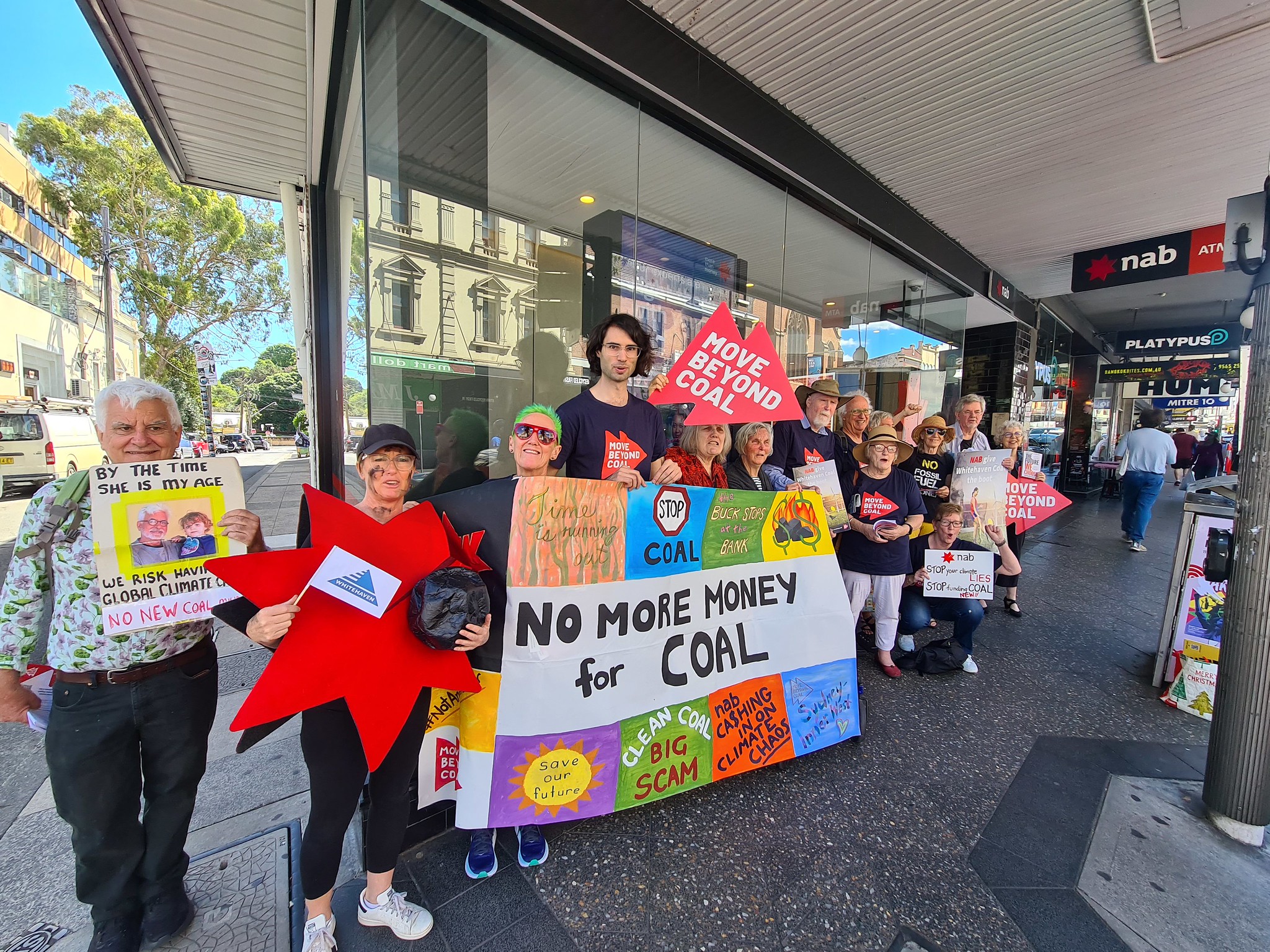
Like most of us, I fail daily to do enough about the climate emergency. My little effort revolves around Move Beyond Coal. This is an Australia-wide network of local community groups who are currently targeting the National Australia Bank which, in spite of talking a good talk about climate responsibility and taking some excellent initiatives, continues to fund fossil fuel extraction corporations. Notably, it funds Whitehaven Coal, with a massive new funding to them in the pipeline, which, if it goes ahead, would lead to major climate vandalism for short term profit.

Move Beyond Coal is currently in the middle of an Australia-wide Ten Days of Action, in which small groups turn up at local branches of the NAB aiming to draw attention to the bank’s contribution of the climate emergency. We hope to lead NAB to change course. Failing that, we will at least have kept the conversation alive, poked some holes in the prevailing silence.

On Thursday this week, our local group staged an action at the Newtown branch of NAB. Outside the branch, a number of people handed out leaflets in front of a beautiful hand-painted banner, one member wearing an excellent giant NAB logo she’d made from felt. Inside, we sat in the comfortable chairs provided, and read – to each other – from Greta Thunberg (who writes brilliantly), Saul Griffith (whose The Big Switch and The Wires that Bind are on my TBR list), Antonio Guterres (‘Our world needs climate action on all fronts – everything, everywhere, all at once’), and other relevant sources. One person said it reminded her o the teach-ins from the 70s (and yes, we were mostly from silver-haired generations).

The few customers who came in paid us at best cursory attention.

The manager didn’t want us inside, and when we politely disobeyed, he sent for the police. After some polite back and forth, we agreed to leave. Our disruption had lasted about 40 minutes. You can see more, with pics and a video, on facebook at this link. Here’s part of our reading group:

Three women on a couch, a man on a high stool, part of a fourth person in the right foreground. All are listening as the woman in the middle readds
Photo (probably) by Mary Regan

And here we all are after we readers walked out chanting, ‘Hey hey, ho ho, Whitehaven Coal has got to go!’:

Fourteen people lined up outside the Newtown branch of NAB, with a prominent banner reading 'No More Money for Coal'
Photo by Josh Creaser

Added later: There’s a fabulous reel on Instagram with suitably dramatic music at this link.

500 people: It’s a wrap

Early last year I announced that, partly as a counter to Covid/lockdown isolation, I was taking on a challenge to engage warmly with 500 strangers in the year (blog post here). I started out with a very low bar: an exchange of smiles could count. So I was confident that I’d easily make the goal. Alas, it turns out I’m much more stranger-shy than I thought, and I managed only 270 encounters (blog post for week 44 here). I could plead that, especially towards the end of the year, I didn’t keep track of every encounter, but I have to face the fact that I didn’t get anywhere near 500. I could, of course, grant myself an extension, but I’m declaring that time’s up, and I’m acknowledging failure.

Though, it’s not really a failure, of course. I’ve had hundreds of interesting encounters, paid attention to moments that otherwise would have gone unnoticed, made a handful of new connections, learned about my neighbourhood, and understood a little better the negative social impact of smart phones. I’ve remembered encounters with strangers in my youth: conversations on trains and long-distance buses, with hitchhikers I’ve picked up and drivers who have picked me up when hitching, with chatty older people in parks and in the street (a man once buttonholed me to tell a version of the history of Sydney’s settlement; a woman explained to 14-year-old me the miracle of chiropractics), with people at parties and seminars and workshops. I’ve realised with a bit of a shock that with age I’ve become less open to encounters of that sort – more wary, more judgemental, less sure of my welcome, maybe just less interested. A couple of years ago, someone in my local park said to me, ‘Oh, you’re the guy who reads a book while he walks his dog and doesn’t talk to anyone.’ The many occasions in the last 11 months when I’ve made a clear decision to connect have demonstrated – to me at least – that this decline is reversible.

Thanks to Jim Kable’s recommendation, I have read Joe Keohane’s The Power of Strangers (my blog post here), which makes me realise that this challenge could just be the start of something much bigger and more challenging. I probably won’t blog about it, but I expect, and intend, that something has shifted permanently in my attitude, and probably behaviour, towards strangers

500 people: Week 44

See this post for a brief description of my 500 People challenge, and also my post on Joe Keohane’s The Power of Strangers for an ex-post-facto rationale.

1. Saturday 11 December. I’m not sure if this counts as a warm encounter. I was waiting on the platform at Town Hall Station when I saw a young man in the train about to leave the station throw a piece of rubbish on the floor of his carriage. I somehow caught his eye and gestured my dismay. Beneath my mask, I muttered, ‘Pick it up, you little [expletive],’ but he couldn’t hear or even read my lips. He gave me the finger, removed his mask, took a puff on his vape and blew it in my general direction. I made a number of gestures in his direction that could have meant anything. I got out my phone and took a photo, threatening (inaudibly) to post it on TikTok. He cocked his fingers like a pistol and shot me a few times. Then the train left. I choose to believe all this was in fun, that we were each entertaining himself with these little performances.

2. Sunday. I was in my favourite bookshop, Gleebooks, buying gifts for, it turned out, eight greatnieces/nephews. A silver-haired woman commented as she passed me, ‘You’re doing well!’ A niece had given her a list of books her children might like, but without authors’ names or other helpful details. We had a pleasant little chat as we attempted to sort out whether it was great-great-nieces we were buying for, or just one great, and swapped book anecdotes. (She got help from a staff member and was delighted to find what she was looking for. I did well too.)

3. Monday morning at the swimming pool, we were greeted at reception by a woman who I’ve seen around but never in that role. As I was leaving I decided to have an actual conversation with her: ‘I’ve seen you around,’ I said, ‘but not here. Have you been working here long?’ She has worked at the pool for a long time, she said, but in the office (vague upward gesture). Covid lockdown meant that everyone had to take a turn at reception. So of course I asked after the three sisters who worked there for years before Covid, and got some of the story of how they got trapped in Queensland.

4. Tuesday. The other person in the sauna was a young woman. I made a small opening gambit – something about the wall clock having stopped – and we chatted for close to half an hour, the kind of chat that Joe Keohane says increases the wellbeing of participants. She’s a musician. I asked if I should have heard of her. ‘Not yet,’ she said modestly. But she told me her professional name and I visited her website later. When she’s famous I’ll be able to say I knew her when.

5–7. Saturday, middle of the day. An in-person birthday party for a four-year-old. I didn’t keep track of how many new people I engaged with, but I estimate at least three. Most memorably were two young parents who left Australia a bit over three years ago for one of them to work in Dublin. They got caught there by Covid–19, and returned just a couple of weeks ago, now with two young Irish-born children. I initiated the contact by advocating for their three-year-old daughter who was too shy to assert herself in the rush for a slice of the teddy-bear cake (a splendid creation of the Emerging Artist).

8. Later on Saturday. I was in the local bottle-shop’s coolroom looking for my preferred non-alcoholic drink. Two young men sauntered in, one of them lifted two cartons from the top of a pile of beer cartons, and the other picked up the two cartons below them , and they both walked out, all done smoothly and wordlessly as if they shared a brain. As I left the coolroom after them, one said to me, ‘Pretty smooth, eh?’ I said, ‘You must have done it once or twice before.’ I added, ‘I have one criticism, though. You should have taken the [brand name of top two cartons redacted].’ He was momentarily shocked. The cartons they took were also [redacted], but a different colour logo: ‘It’s a good drop, eh?’ ‘I don’t drink,’ I said, ‘but my old next-door neighbour is the brewer.’ ‘You don’t drink! You’re in the wrong place then.’ I laughed and said, ‘I can still look, can’t I?’

Running total is now 270.