Category Archives: Diary

Wa modern

As the Japan Foundation web site says:

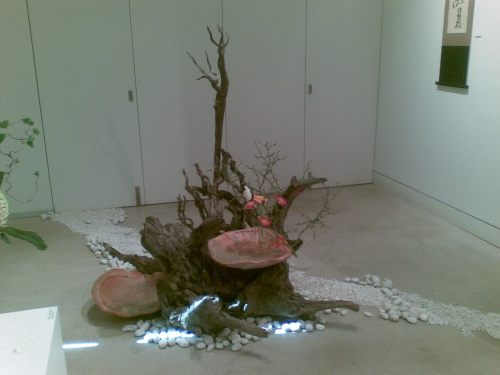
Wa Modern is a blend of cherished traditional Japanese crafts (floral arrangement, ceramics and calligraphy) presented as one. For a limited time only from 9–16 October, floral artist Setsuko Yanagisawa, ceramist Malcolm Greenwood and calligraphy artist Ren Yano come together in their first mixed media collaboration at the Japan Foundation Gallery.

We trotted off to Chifley Square this afternoon. Really, it’s a brilliant exhibition, and exactly as advertised the three crafts speak to each other and with each other in wonderful harmony. The flower arrangements are based in ikebana and use Australian plants. The pottery could have been created for these arrangements. The calligraphy, to my completely uneducated eye, seemed to have taken liberties with tradition, to be looser, more relaxed, more – possibly – Australianish.

As we were leaving the young woman at the front desk asked if I’d taken any photos, and when I said I hadn’t told me I should come back with a camera. So I whipped out my phone for a couple of parting snaps.

Some dramatic waratahs:

Waratahs

A big arrangement. You can’t really see it in the photo, but those poppies appear to be standing in a shallow pool of water on the shell-like pottery dish, defying gravity. Looking closer, one sees that the poppy stems are actually supported by being pierced by thorns on the branch that lies across the dish

alcove

The exhibition is open all week. I recommend it.

Small talk

I’ve mentioned before here that I like to read while walking around my suburb – actually, while walking round whatever suburb, or urbs, I happen to be in. One of the incidental pleasures of this practice is the micro-conversations it engenders.

The most common opening gambit is, ‘Must be a good book.’ Sometimes there’s an edge of reprimand in this, as in, ‘It would have to be a bloody good book to make me – or any normal person – read it like that.’ Other times, it’s quite benign: if Bob Thiele and George Weiss were right that friends shaking hands saying, ‘How do you do,’ are really saying ‘I love you,’ then people making this comment are really saying, ‘I notice you’re doing something unusual/making the environment slightly more interesting.’

The other common remark, though it trails a long way behind the first, is, ‘Careful you don’t walk into a post/tree/branch.’

I try to respond with something friendly and amusing, an equivalent of ‘Thank you for commenting’. My fallback is something like, ‘Have to get the reading done some time.’

A very few people scope out the book as we approach each other and make a book-specific comment: ‘Is that any good? I’ve had it beside my bed for a while.’  ‘Has he done that well?’ ‘You must be an academic, reading Heat.’

Yesterday, a friend coming up Booth Street laughed when she saw me, and said, by way of explaining her laughter: ‘You look so ancient. So untechnological.’ I had no comeback.

Opening

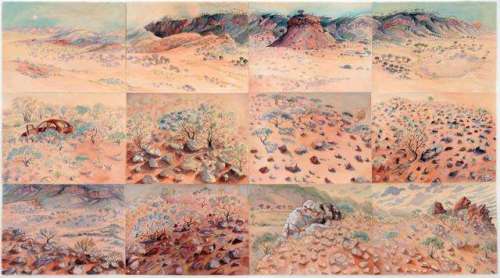
We own a painting by Sydney artist Carol Ruff – a landscape, featuring a single almost symmetrical, almost bare hill. It’s hard to say why, but I just love it. I can sit and look at it for a long time and not be bored. Some time ago we were invited to an opening of Desert Air, an exhibition of Carol’s work alongside that of her partner Greg Weight, but when we got there the crowd spilling out onto the footpath outside the gallery was so thick we turned around and went straight home. Tonight another dual exhibition was opening, Love Creek Bitter Springs, made up like the other of work created during trips to the MacDonnell Ranges in the Northern Territory. Learning from past experience, we turned up at the Australian Galleries in Paddington an hour early and left before the first glass of anything was poured.

It’s a fabulous exhibition. Both Penny and I fell in love with one landscape in particular, much bigger and more elaborate than our little hill, but with the same mesmeric power:

img3505

There is much else that’s stunningly beautiful. I want to mention a set of photographs, described in the gallery’s list as created jointly by Carol and Greg, but most of them featuring Carol, indoors and out, in the same country that features in the paintings and photographs elsewhere in the exhibition, presumably with Greg behind the camera. The list introduces the set with a quote from Barry Lopez: ‘In the end, there’s little difference between growing into the love of a place and growing into the love of a person.’ Somehow this sharply personal note brought home to me the obvious fact that the whole exhibition is a work of love.

Artsy weekend

It’s a long weekend in New South Wales, the Rugby League Grand Final, and a busy, artsy time for our household.

After the Orange Grove Market on Saturday morning, we went to the Australian Centre for Photography in Paddington where there’s an excellent exhibition of students’ work as well as The Lake, in which ‘ten artists explore the exquisite strangeness of the Australian landscape through photography, video and interactive work’, and where I got unreasonable pleasure from making waves swell and crash in one of the interactive video pieces, as well as very reasonable pleasure from the many spectacularly beautiful photos, both digitally manipulated and not obviously so.

Then on to the Roslyn Oxley Gallery where we were puzzled by half a dozen large, rough drawings on butcher’s paper by Tatzu Nishi of equestrian statues that appeared to have been  wholly or partly transported into domestic settings. If these huge drawings, with much Japanese notation on them, weren’t enigmatic enough, there was the added mystery that much of the wall space in that room were bare. Deciding that both the sketches and the blank walls would remain among art’s little mysteries, we stopped on our way back to the car to look at a slide show of the artist’s installations, in which he builds domestic spaces around public objects – the spire of a European church, a street light, a large graffitied sphere in a park somewhere … The mystery of the half bare room was part way to being cleared up.

The mystery was cleared up completely the next afternoon when we visited the Art Gallery of New South Wales to see something that had been mentioned in the small print of a Roslyn Oxley hand-out, the John Kaldor exhibition (a revelation in its own right, but I’ll skip over that). As a Tatzu Nishi project, the equestrian statues that flank the main entrance of the gallery are enclosed in bright blue cladding, with ramps leading to doors that give us access into the blue rectabgular shapes. And inside, we see what those blank walls in Paddington are waiting for. No doubt the photos that appear there over the next couple of days will be better – and much bigger – than these, but here’s a look. Go and see the installation yourself if you can – no photo can convey the exhilaration of walking into those rooms, especially the bedroom. (The John Kaldor site has a slide show of the construction.)

The Spoils of War as seen from the ground:

IMG_3827 IMG_3825

and from inside the blue cladding (the fruit on the table is real):

IMG_3828

The Offerings of Peace in the elevated bedroom:

IMG_3829 IMG_3830 IMG_3832 IMG_3831

But back to Saturday. After dinner we were off to the Opera House to hear Christopher Hitchens at the Festival of Dangerous Ideas. (Just so you know, I think such a festival is a pretty lame idea. What’s the point of giving a huge platform to people who want to argue against legislation protecting workers from exploitation?  Is any useful purpose served by Germaine Greer once again expressing her contempt for Steve Irwin? Indeed, once you’ve read the title of Christopher Hitchens’s address, do you need to pay good money to hear it?)

achitchBut we’d seen Christopher on Q&A on Thursday night, and he was impressive: abrasive and pugnacious but brilliant and, actually, civil. So we decided to make him our Saturday night’s entertainment. We managed to get late-bookers’ seats in the choir behind the stage. Here’s a phone shot taken 10 minutes before the show started from our pozzie in the middle of the front back row. In those ten minutes, the whole hall, including most of the choir, filled. It seems that many people in Sydney are hungry for atheism, or maybe just like a good smackdown, whoever is being smacked.

empty

After the preliminaries – a fabulous Welcome to Country, a speech from the Opera House’s CEO (who hinted that he was heading off to the Sleaze Ball after the talk), an excellent two-minute speech on the right to die from Sarah Taylor (who had won a soapbox-rant competition in the forecourt that afternoon), an introduction by ABC journalist Tony Jones (who called Hitchens, insultingly I thought,  a contrarian) – he gave a forty minute talk, then conversed with Tony Jones for another half hour or so. The audience applauded frequently, which was only right and proper, but at times created an uneasy sense that he was preaching to the choir. Sadly, I mean that only metaphorically – the acoustics in the actual physical choir were terrible, so we missed an awful lot of what was said in the Hitchens’ upper-class mumble. When he started quoting from the Monty Python Philosophy Song what should have been a delight was just an irritation.

I won’t try to summarise his talk – it will be all over the internet soon, on ABC Fora or Slow TV or who knows where else. I loved it that he started out with a personal connection to Australia: he read a lot of Neville Shute as a teenager, and gave us the evangelicals’ banner ‘There is still time, Brother’ flapping in the breeze after the end of the human race in On the Beach as an epigraph for his talk. I loved his response to Cardinal George Pell’s then-yet-to-be-given address, ‘Without God we are nothing‘: ‘Don’t you take that tone with me.’ I wonder how the scattering of women in hijabs and other people of faith in the audience responded: presumably they abstained from applauding at least the cheaper shots (calling Moses a schizophrenic comes to mind). I had a sense, though, that for all his seriousness and erudition, Hitchens somehow was missing the point of religion. When Tony Jones asked him if he would consider the pervasive religious practice of Bali as poisonous, I think he said (remember, my hearing was impaired) that that wasn’t really religion because it wasn’t poisonous. And he replied similarly to a question about a Salvation Army Officer who has devoted his life to demonstrably effective good works. I’m in the atheist camp myself, but came away unconvinced that religion is the enemy of all that is good. I did, however, come away thinking, and that can’t be bad.

gethAfter our visit to the AGNSW yesterday afternoon we went to David Hare’s Gethsemane at Belvoir Street. The play started out with what might have been a quote from Christopher Hitchens, a statement that some people put their faith in a book, some in one book some in another, but the book gives them certainly, and a further statement that the play we were about to see was full of people with a book. The second act started with a similar Hitchy address to the audience about how religious people are incomprehensible. Those two moments, however, had no discernible connection to the rest of the play. There were two very watchable performances, from Hugh Keays-Byrne as a political fixer and Emily Barclay as a troubled teenager. Sadly, whether it was the performances, the direction or the writing, I found the play as a whole pretty much an incoherent mess. And what’s more the Gethsemane reference was irritatingly illiterate: the whole point of the Agony in the Garden, according to these characters, was that Jesus doubted his mission. I would have thought he was doing something a little less cerebral, like experiencing wretched miserable terror and unhappiness about it, without a shadow of doubt. ‘Father if it be thy will, let this chalice pass from me’ is surely a far cry from ‘I don’t want to be a teacher any more because there’s too much paperwork and not enough actual teaching.’ According to Time Out (as quoted on the Belvoir web page), the play provides ‘an insight into why we are in such a mess today’. Not to me, it doesn’t.

Dust in my feed

We woke to a weird light in Sydney this morning. As I emptied out kitchen compost into the backyard bin I looked back into the kitchen and it looked astonishingly white and crisp in a tawny world. The car looks as if it’s been on a trip to Bourke. I didn’t take a photo myself, but I’ve just found these in my RSS feed:

7.08 am: Welcome to planet Vulcan (Have phaser will travel)

7.14 am: Obligatory Sydney dust storm photo (Hoyden about town)

8.02 am: Life on Mars (The witty knitter)

8.20 am: Sydney at dawn (Larvatus Prodeo)

Added later: Someone in San Francisco has got a Flickr gallery up already.

Ma rentrée

Having witnessed the cultural phenomenon of la rentrée in France, in which the populace returns en masse from their vacances, shops open, streets and markets come alive, Paris is reinhabited by  fabulously arrogant Parisien(ne)s, and posters and TV commercials abound recommending ways to make the great return douce or moins chère, having felt just a little of the excitement of all that, I’m facing my own pale shadow, my re-entry. But before girding my loins, here’s a blog post of snippets.

• In Manhattan you can buy eyelash extensions.

• There’s a hamburger place opposite the Port Authority Terminal in New York that boasts that it’s the only one with its name, that it was founded in 2008, and it has served fewer than a billion burgers (so far).

• In Lyon, I was approached in the street by an unkempt man speaking in rapid (and therefore incomprehensible to me) French, holding up a euro coin in one hand and extending his other palm empty to the passers-by. I dipped into my pocket and gave him a couple of coins – it could have been anything from 50 centimes to 2 euro – and walked on. He called after me: ‘Monsieur! C’est pour manger ou pour boire?’ It sounded like a serious question: he was asking me to tell him whether the money was for food or drink. I called back, ‘Pour manger!’ ‘Pas d’alcool?’ he called back, like a little boy making sure his papa was really forbidding something he knew he shouldn’t have. ‘Pas d’alcool, oui,’ I said, then added by way of mitigating this sternness something that probably translates as ‘Me no myself drink any alcohol.’

• I know everyone goes on about the different light in Europe, but when I walked the dog this morning I kept wondering why everything looked so clear, the greens so brilliant and the sky such a sharp blue. Then I realised I was back in Sydney, in spring and this light that the first settlers thought so harsh and unforgiving is for me the light of home.

• A visit to Paris at the end of summer makes it much clearer what all the fuss is about than a visit in March, when all the trees are like dark, mutilated skeletons.

• The Eiffel Tower sparkles all over at 10 o’clock at night.

• M Eiffel built a kilometre long bridge to carry a canal over the Loire at Briare, and it’s a very pretty thing.

• It’s illegal to sell cheese made with unpasteurised milk in Australia, which means we miss out on some fabulous, richly stinky delights.

• In certain lights, the power lines to the southeast of Saint-Gervais (Gard) appear to be supported by an army of Hello Kitty silhouettes coming over the hills.

• One of the main delights of travel for me is being in an environment where the language is different from at home. I get far too much pleasure from deciphering untranslatable puns in shop names, like the bookshops Mona Lisait, or the restaurant (or resto) in Rue Mouffetard that’s called the Mouffe’tôt Mouffe’tard. This delight is just as strong in places where the language is English. In Brooklyn, for instance, a car full of young dreadlocked men drew alongside my taxi with its radio turned up loud, and instead of the undifferentiated bass beat I expected I was treated to a crystal-clear rendition of ‘No Woman No Cry’, and the next day, a car pulled into the street where I was staying and the whole small block was filed with Aretha Franklin. I know that’s not strictly language, but it’s communication.

• The prayer ‘Give us this day our daily bread’ must feel completely different in a place where the custom is to go out each morning and buy just enough fresh bread for that day, from where you buy a sliced loaf on the weekend and eat slightly mouldy toast on Friday.

Jet lag has been intense this time, but I’m feeling almost human this morning after two nights’ sleep. Normal broadcasting may resume shortly.

NY Post geography

On page 14 of today’s New York Post, Jane Campion is quoted: ‘I have a two-room hut in a remote part of New Zealand, the south island, an hour’s drive outside Queensland.’ She clearly drives a very fast amphibian vehicle.
Right! No more painful pseudo tweets from my phone. I get my fixed computer back any hour now.

4.30 am NYC

Because of frequent flier stuff I’m flying home from Paris via New York, while Penny is doing the sensible thing, flying via Hong Kong and getting home 36 hours before me. At least that was the plan. She’s just texted that her Air France plane was leaking oil and has been diverted to Manila. I’m wide awake in the city that never sleeps posting to my clog from my not-an-iPhone. 24 channels, nothing worth watching except a senate enquiry into contractors (ie for profit armies) and moron Girls Gone Wild

Near les Halles

12092009004

Déjeuner sous les épines

10092009001

Pain de campagne, tomate, St Marcellin, tomate, des poires et – hors d’image – un pacquet de tranches de dinde plastique.