Sydney Writers’ Festival: My Day 1

By one count, the Sydney Writers’ Festival has been going since the weekend. The opening address, by all accounts brilliant, was on Tuesday night. My festival started yesterday.

My first event – a poetry reading in the English Department’s Common Room at the University of Sydney – wasn’t strictly part of the Festival, but two of the poets were in Sydney for the Festival, so I’m counting it. I had to leave early to catch a bus to the Opera House so I only got to hear one and a half poets, all of Fiona Hile and half of Kate Lilley. Sadly, I missed out on Louis Armand from Prague, and Pam Brown.

The room was full of poets. Overheard pre-reading conversations (there were nibbles and drinks) included happy reports of ‘having something accepted ‘ in a coming anthology. John Tranter recorded proceedings for the Penn Sound Archive. Vagabond Press was selling in a back corner.

I enjoyed Fiona Hile’s reading but I wouldn’t say I understood much of the poetry. Partly this was because she read fast, the room was a bit echoey, and I’m a bit deaf. Mainly, though, I expect it was because she’s what the Spoken Word people call a page poet, and even more an experimental poet, which tends to mean that meaning isn’t easy to grasp. There were lots of striking lines. I managed to jot down:

The lilliputian threads of the old ways make me want to lose a limb

and in a context to do with sheep:

That wolf you’re wearing goes with everything.

In introducing Kate Lilley, Fiona Hile conjured up a fabulous image. She said she used to think it was uncool to have heroes, but when she began writing her own poetry, she had four horsewomen: Kate Lilley, Pam Brown, Gig Ryan and Jennifer Maiden. I’d love to see the movie that has those four poets charging into battle.

Kate Lilley read from Ladylike, and was about to read from Realia when I reluctantly tore myself away to catch a bus to the Quay, have dinner and then climb the stairs to the Joan Sutherland Hall of the Opera House for:

7.30 pm: The Life and Times of Alice Walker, in which Alice Walker was interviewed by Caroline Baum and joined by Archie Roach. The SWF blog already has a report.

As is customary at the Sydney Writers’ Festival, the session bore little relation to its title. Alice Walker was in no mood to tell her life story, or to discuss her ‘times’ with any specificity. The tone was set right at the start when Caroline Baum asked, ‘Are you nervous at the start of events like this?’ and Alice Walker replied, ‘No,’ and waited serenely for the next question. CB bounced back by asking her to read us a poem, and she obliged with ‘You Should Grow Old Like the Carters’, which she read beautifully, giving each word its full weight, conveying the music , treating herself and the poem as worthy of our full, serious attention. That mix of awkwardness, resilience on Caroline Baum’s part, and weight on Alice Walker’s kept up for the whole session.

Part of the awkwardness came from the level of unaware racism in the room, or at least a reasonable expectation of it on Alice Walker’s part. She didn’t give her interlocutor the benefit of any doubt. For example (from memory, so probably missing a lot of nuance):

CB: So you grew up in a house without books and were part of an oral, story-telling culture.
AW: Oh, no, we had books. My parents got hold of old books that people had thrown out. But yes, there were lots of stories that everyone told, wonderful stories. [End of reply.]
….
CB: You read a lot when you were young. I believe your favourite books were … and Jane Eyre. What was it like the first time you read a book with black characters you could identify with?
AW: Oh, I identified completely with Jane. White people seem to think they can’t identify with black characters, but when we read it’s not about these divisions. It’s the spirit we identify with.’ [Applause]

Fortunately, Caroline Baum has a wonderful capacity for putting herself out there, and then bouncing back when she has her knuckles ever so serenely rapped.

Another reason the session seemed such hard work is possibly a problem of definition. Is Alice Walker at the festival as a writer, an activist, or a vague kind of celebrity?

Well, obviously, she’s a writer. But The Color Purple was published roughly 30 years ago, and I wonder how many people in that huge hall had read Possessing the Secret of Joy, or made it all the way through The Temple of My Familiar. As a poet she would draw a crowd, but not this big a one. Many of her essays are absolutely brilliant: ‘In Search of Our Mothers’ Gardens’, ‘Only Justice Can Remove a Curse’, her essays on Zora Neale Hurston and Bessie Smith, on olive oil, the scar in her eye … I can rattle those off without googling. And a new collection of essays – Cushion in the Road: Meditation and Wandering as the Whole World Awakens to Being in Harm’s Way – has just been published. But how many essayists can fill the Opera House?

As an activist, she has an impressive record. She campaigned very visibly against female circumcision a while back, and was part of the flotilla that was intercepted so dramatically on its way to Gaza. But as far as I know she’s not part of any activist organisation and her activist philosophy boils down to stressing the importance of having friends (a ‘circle’) you can be completely honest with, and meditation seems to fit there.

Celebrity seems to be the key. So although the conversation touched on many things, and Caroline Baum kept pulling the conversation back to the recently published book, my overwhelming impression was that we were in the presence of celebrity, who was dispensing her wisdom for our benefit. The most telling celebrity moment was when she was asked about her daughter’s very public statements that her activism had made her a neglectful mother. Her reply included no whiff of self doubt, no hint that her daughter might have had a legitimate point (as the children of many activists surely would). The problem was that her daughter suffered from ‘mental instability’, from which she had now mercifully recovered. This dismissiveness was cloaked in serious and valid reflections on the legacy of slavery on her family, but it was dismissive all the same. We were to make no mistake who was the important person in this conversation.

I’m sorry if that’s jaundiced. I’m still a fan. I will buy the new book of essays, and probably her new book of poetry as well. I’m seeing another session with her on my second day, and hoping I’ll have a change of perspective.

Linda Cowgill’s Art of Plotting

Linda J. Cowgill, The Art of Plotting: Add Emotion, Suspense, and Depth to your Screenplay (Lone Eagle 2007)

20140518-223632.jpg It’s been quite a while since I’ve blogged about my reading, and this book is a partial explanation. (The rest of the explanation lies in small matters like a nephew’s wedding, paid work, dense bedside reading, too much television.)

The person sometimes known in the blog as the Film Director has been at me to write a feature film script to build on our modest success with Ngurrumbang (which incidentally just screened at the Human Rights Arts and Film Festival in Melbourne and is scheduled for the St Kilda Film Festival on Saturday week). I don’t share his confidence in my ability but I’m up for the challenge, so I’ve just done an online course in Screenwriting for Film through AFTRS, and am well on the way to the beginnings of a first draft – though not the one the FD wants. The course was brilliant. Anne Brooksbank, the teacher, led 15 or so of us in two chat sessions a week for 10 weeks and commented on weekly assignments, managing to be both encouraging and challenging, collegial and inspirational. She made us watch some awful films as well as some brilliant ones, and we learned from both kinds.

One of the lesser things I learned was how to read a book like this one. You have to ignore the occasional motivational-speaker language (too many sentences starting ‘Great screen writers …’), and not get too snooty about the movies used as examples (I didn’t care much for American Beauty, and hadn’t seen Se7en – which I have now watched because of this book, and on the whole wish I could unwatch). You have to realise that the way things like structure, character or theme used to be discussed in Eng Lit courses (and probably still are, only more so) may be more fun, but is very different from the way you talk about building them. This isn’t a manual, but it’s immensely practical. It assumes knowledge of the established wisdom about structure – assumes the equivalent of the course I’ve just done. I don’t know how it stacks up against the myriad similar books out there, but I found it clear and helpful. I imagine it works best if, like me, you have a project more or less under way, so when Linda Cowgill talks about, say, having a logical progression from one scene to the next, or informing the audience about a character not by telling, or by showing, but by dramatising, you have examples of your own work fresh in your mind and can immediately see how the advice can be applied.

NSW Premier’s Literary Awards night

Last year I didn’t attend the New South Wales Premier’s Literary Awards Dinner because it cost too much. Tonight’s presentation was a lot cheaper, being not a dinner but a cocktail event. But for the first time in many years I had read almost none of the short-listed books, so decided it didn’t make sense to attend.

However, I’m loath to let the occasion go completely unremarked in this blog, so here I am, reporting from afar.

For a moment it looked as if the event itself was superfluous. This tweet appeared almost two hours before the doors of the Library opened:

Was it a hoax, or a leak? The link was dead. I stayed tuned to Twitter. Once Ross Grayson Bell had delivered the address and a couple of tweeters had found each other, the announcements came thick and fast.

Hakan Harman announced the joint winners of the Community Relations Commission for a Multicultural NSW Award as The Secret River, Andrew Bovell’s play based on Kate Grenville’s book, and Questions of Travel by Michelle de Kretser. I’ve wanted to see/read both.

Of the Nick Enright Prize for Playwriting shortlist I’d only seen Medea, Anne-Louise Sarks and Kate Mulvany, but didn’t expect it to win, though glad it was shortlisted. Van Badham’s Muff won. I haven’t seen it, but if the play is as good as her MCing of the March in May in Belmore Park yesterday it definitely deserves the prize.

I’d seen four of the six shows on the Betty Roland Prize for Scriptwriting list. My money was on Kim Mordaunt’s The Rocket, though it would have been nice to see A Moody Christmas score a victory for comic writing. Devil’s Dust by Kris Mrksa won, completely appropriate for a prize named after old Com Betty Roland.

The Patricia Wrightson Prize for Children’s Literature list included some familiar names. It was won by The Girl Who Brought Mischief by Katrina Nannestad, which I haven’t read.

The Ethel Turner Prize for Young People’s Literature went to Zac and Mia by Amanda Betts.

The Kenneth Slessor Prize for Poetry went to Novelties by Fiona Hile, who will be reading at Sydney University on Wednesday.

None of the subjects addressed in the Douglas Stewart Prize for Non-Fiction list grabbed me by the throat: a 50 year old mystery death, a larrikin cricketer, an actor’s memoir, a ‘horrible history’ for grown-ups, a bit of war history, and – the one I would have chosen on the basis of the subject alone – the excavation of a dark family past. So I was glad when Boy, Lost: A Family Memoir by Kristina Olsson shared the award with Rendezvous with Destiny (the one about war and diplomacy) by Michael Fullilove.

UTS Glenda Adams Award for New Writing: Though I’d read none of the listed books, I had extra-literary reasons to cheer for one of them. It didn’t win. The Night Guest by Fiona McFarlane took home the bacon. I look forward to reading it, as well as the other.

The pre-emptive tweet had taken much of the suspense out of the next couple of awards (whatever wins the novel prize is generally reported as having scooped the pool, even if it’s not book of the year).

Michelle de Kretser’s Questions of Travel, which has been beckoning from my bedroom bookshelf for months, won the Christina Stead Prize for Fiction, but not the People’s Choice, which went to The Railwayman’s Wife by Ashley Hay. It did win Book of the Year, so Michelle de Kretser took home three prizes. It couldn’t happen to a nicer person.

The special award went to Rodney Hall. I love this award, because every year someone who has worked long and hard and generously in literature is honoured. This one continues that tradition. According to the tweeters he gave a rousing and topical speech in defence of funding for the arts.

And in less than two hours it was all over till next year.

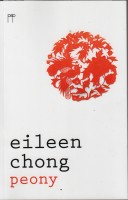
Eileen Chong’s Peony

Eileen Chong, Peony (Pitt Street Poetry 2014)

1peonyThis is Eileen Chong’s second book of poetry. It’s bigger and more varied than her first, Burning Rice, but is just as lucid, friendly, and resonant.

Between reading it and writing this blog post, I made the mistake of reading comments by other poets on Eileen Chong’s page at Pitt Street Poetry. It was a mistake because, well, what can I say here beyond ‘Go and read what they said’ and then ‘Go and read the poems’?

This is from Rhyll McMaster (the phrases in quotes are, obviously, from the poems):

Displacement, attachment, sweat, warmth and food, communion, aloneness, disquiet and longing – these poems coax shadows out of dark recesses, ‘layered like memory, like grief.’ Their strength lies not in their settings but in their familiarity with the human spirit, ‘at our true selves, so far, yet so close to home’.

Then I read Kim Cheng Boey’s review in Mascara of Chong’s first book, Burning Rice:

The poems here are informed by what James Clifford calls ‘the empowering paradox of diaspora’, which is ‘that dwelling here assumes solidarity and connection there.’ They ride the creative tension between countries, cultures and languages. …

At the heart of Burning Rice are delicately and meticulously crafted meditations on the complex web of attachments, loss and longing, so rich with imagery and narrative that they transcend the poet’s own ethnic, cultural and regional background.

So yes, what they said, it’s still true of this book – diaspora, familiarity, meticulousness, complex web of attachments – though they don’t mention the pleasure these poems bring to the reader.

Eileen Chong came to Australia from her native Singapore in 2007, and her poems are shot through with the experience of migration, with a sense of displacement. To use Kim Cheng Boey/James Clifford’s terms, some look back to there; some burrow into the intimacy of here; others go elsewhere (it’s interesting, the way traveller’s tales, traveller’s poems, have a different weight when written by someone with a history of migration).

The book is divided into four untitled sections. The first deals largely with grandparents, parents and childhood memories. The second, which includes most of the travel poems, is largely addressed to a spouse – and who could resist the comic vision of terror and intimacy in ‘Mid-Air Disaster’? The third section turns to other friends and family, celebrating births and birthdays, reminiscing, cooking together. (Food and cooking loom large all through the book.)

The fourth section is a miscellany – ekphrasis (a word my iPad’s autocorrect doesn’t like, and nor do I much, a hi-falutin way of saying poetry about artworks), history, dreams, Sydney scenes and more. This section sent me off to read Adrienne Rich’s fabulous ‘Love Poems’ and to rediscover Robert Wiles’s famous photograph of Evelyn McHale taken just after she suicided by jumping off the Empire State Building. The book ends with the title poem, whose last lines may be the only place where the notion of diasporic identity is raised in the abstract, only to be challenged, with characteristic equanimity:

——————One lady nods and smiles:
China’s national flower. Is it? Am I? I’ve forgotten.

Here’s a video of Eileen (pronounced Ee-leen, by the way) reading three of her poems.

awwbadge_2014Peony is the fifth book I’ve read as part of the 2014 Australian Women Writers Challenge. Pitt Street Poetry sent me a complimentary copy with a personal – and accurate – note saying it was for my reading pleasure.

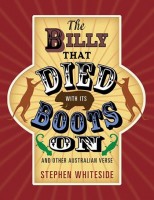
Stephen Whiteside’s Billy that Died with its Boots On

Stephen Whiteside, The Billy that Died with its Boots On and other Australian verse, illustrated by Lauren Merrick (Walker Books 2014)

coverDiane Bates, children’s writer and tireless children’s literature activist, recently set up the Australian Children’s Poetry web site. Its aim, she said,

is to, for the first time, give a national and international ‘face’ to Australian children’s poetry.

The website, which is well worth a look, may change things, but until now poetry written for children in Australia has struggled to have a public face. The School Magazine, published by the NSW Department of Education, has been a dependable outlet just short of 100 years, but its index fairly bristles with lovely poems that appeared there and then were seen no more (except in readers’ memories: in my time at the magazine we received regular phone calls from people trying to track down a poem they had read in the magazine 70 or so years earlier).

It’s always heartening, then, when a children’s publisher like Walker Books brings out a new book of poetry, especially one by a single author.* It would quickly become disheartening, of course, if the poetry wasn’t any good, but The Billy That Died with its Boots On delivers the goods.

The poet’s Introduction proclaims his life-long love of rhyme, and encourages readers to ‘find a brother or sister, or mother or father, or cousin, or aunt or uncle, or grandfather or grandmother, or simply a friend, and read a poem to them’. So be warned, if you give this to a young person as a gift, be prepared to sit still and be read to.

Not that you will suffer if that happens. The book is bursting with gleeful love of rhyme and bush-ballad rhythms. There’s nonsense, fantasy, word play, jokes (some laugh-aloud, some groan-worthy), historical narrative; the beach, the bush, the snow, the sports field; dogs and cats, cormorants and spotted quolls; dinosaurs and flying whales. It’s not hard to imagine a young reader becoming permanently addicted to rhyme if exposed to this book.

If I have a favourite poem, it’s probably ‘We Headed for the Beach Today’. I’d love to give you the whole poem, but it’s long and I don’t want to breach anyone’s copyright: suffice to say it lists all the things that could have gone wrong on a day at the beach but didn’t, mixing the all too common with the extremely unlikely, all in impeccably scanned, rhyming couplets, as for example:

No one grizzled. No one snarled. No one yelled or jeered.
We didn’t see a baby grab his daddy by the beard.
A change did not arrive to make the water dark and wild.
A shiny flying saucer did not steal a little child.

It’s perfect for learning off by heart and performing for your brother or sister, etc.

By way of full disclosure: Roughly half of these poems were first published in The School Magazine, many of them when I was editor. Stephen graciously mentions me in the acknowledgements, and also in his account of the book’s long gestation on the Australian Children’s Poetry site. I received a complimentary copy from Walker Books.
—–
* I wouldn’t want to give the impression that this is the only such book Walker have published. Far from it. The last page advertises Guinea Pig Town and Note on the Door, both books by Lorraine Marwood, another fine poet who has graced the pages of The School Magazine.

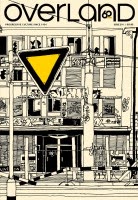
Overland 214

Jeff Sparrow (editor), Overland 214 Autumn 2014

Overland-214

There’s something irresistible about triplets: faith, hope and charity / birth, copulation and death / the three Graces / thesis, antithesis, synthesis / silence, exile, cunning … they’re everywhere. Overland‘s deputy editor Jacinda Woodhead invokes a nice one in this issue’s Editorial: for 60 years, she says, the journal has been encouraging dissent, interrogation and craft. It’s not just a pretty phrase: there’s plenty of all three in this issue, including in the first essay, Welcome to Curtin by Avan Judd Stallard, which comes craftily at Australia’s treatment of asylum seekers. It’s a memoir of working in the Curtin detention centre: prevented by the threat of seven years in prison from talking about the treatment of detainees, he describes instead the relationships and attitudes of the workers, with a short story writer’s eye for structure and significant detail.

Jennifer Mills, the fiction editor, introduces a 60th anniversary year feature, Fancy cuts, in which contemporary writers are invited to revisit short stories from the archives, invokes mother triplet: Overland has always been committed to the urgent, emerging or marginalised voices of its day. To kick off the feature, Josephine Rowe’s A small cleared space riffs surprisingly on Roma O’Brien’s When the bough breaks, a story of a hospital stillbirth that must have been harrowing when it was published in 1965, but now reads as a tale from an era of almost unbelievable callousness.

B J Thomason’s A slippery bastard deftly interrogates the myth of poet, horseman and Boer-murderer Breaker Morant, and in passing links him with two other mythologised slippery bastards. So we have triplet of Australian anti-heroes: Breaker Morant, Ned Kelly and Chopper Reed.

‘Cats are out, sloths are in’ by Jeff Sparrow is positively bursting with triplets. Subtitled Truth, politics and non-fiction, it looks at the fact-checking practice or otherwise of clickbait sites like Gawker, Buzzfeed, and Upworthy and more ‘serious’ liberal news sources like Crikey, the Conversation, the ABC. Current fact checking differs from the famous rigour of, say the New Yorker, in three significant ways (for which you’ll need to read the article). But checking facts has a limited usefulness, unless you realise they are part of a triplet: ‘facts’, theory and political practice.

There are three short stories in the Fiction section, including Anthony Panegyres’ Submerging, a parable about global warming embedded in a genuinely distressing tale of adolescent misery.

Up the back, are the three finalists in the 2013 Overland Judith Wright Poetry Prize. Peter Minter, the judge, says he looks for poems in which every line ’embodies perception, ideation and the breath‘. That’s a lovely triplet. I’m sorry that I didn’t warm to any of the poems.

There are other triplets, including the three mysteries in Stanley Kubrick’s 2001: A Space Odyssey in The last space waltz? by Claire Corbett, but not everything comes in threes. Four columnists are entertaining and intelligent: Alison Croggon reflects on how literacy and orality affect memory and perception (a subject Ross Gibson tackles at length in his book about William Dawes’s notebooks,  26 Views of the Starburst World); Giovanni Tiso ponders gloomily on our changing concept of the future; Mel Campbell challenges habit of thinking of writing in terms of productivity; Stephen Wright managed to make me laugh a number of times in a column devoted to wishing he was funnier. I missed Rurijk Davidson, another regular columnist – on leave perhaps?

There are two excellent pieces that I couldn’t shoehorn into my numerical scheme. Brendan Keogh’s On video game criticism, cast as a letter to Susan Sontag, manages to communicate the intellectual excitement in its eponymous field, even to someone whose video game experience doesn’t go much beyond Space Invaders, Pacman and Tetris. Jill Jolliffe’s A new thalidomide? tells you more than you wish was true about hospital use of DES and other drugs, often without consent, on single mothers from the 1940s all through the 1960s in Australia, with health consequences still being discovered, including in the grandchildren of the women given the drug.

Sixty years of dissent, interrogation and craft! May the road rise to meet you, Overland, and the wind be at your back for at least 60 more.

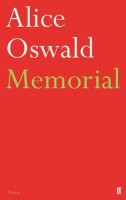
Alice Oswald’s Memorial

Alice Oswald, Memorial: An excavation of the Iliad (Faber & Faber 2011)

0571274161

Introducing his translation of The Divine Comedy, Clive James reminded us that it wasn’t just a story, but a poem. In creating her ‘excavation’ of the Iliad, Alice Oswald leaves the story out altogether. In a way, that makes the book a perfect companion to the Marvel comics Iliad (though I may be unfair in assuming that Marvel just tells the story: comics have come a long way since I was an avid reader of Classics Illustrated comics).

So what is left of Homer’s epic of the Trojan War if you take out the narrative? The short answer is: a powerful lament / memorial for the slain, interspersed with lyrical evocations of the natural world, Homer’s similes cut loose from the things they refer to. The whole poem is presented here, the author tells us in her introduction, as ‘a kind of oral cemetery’: where you would expect to find a table of contents there are eight pages of single names, in capital letters, one name to a page, so by the time you reach the first poem, which begins

The first to die was PROTESILAUS
A focused man who hurried to darkness
With forty black ships leaving the land behind
Men sailed with him from those flower-lit cliffs
Where the grass gives growth to everything
Pyrasus __Iton __Peteleus __Antron
He died in mid-air jumping to be first ashore
There was his house half-built
His wife rushing out clawing her face

it’s as if you’ve already been strolling among the tombs. What follows, page after page, is heartbreaking and beautiful, like the AIDS quilt. Every war should have its narrative stripped away like this.

Actually, that’s all I want to say.

Alice Oswald won the 2013 Popescu Prize for Memorial. She read from the book at the award presentation. You can see her reading below or at this link. You don’t have to worry about spoilers: everyone named in capital letters dies.

Clive’s Dante’s Heaven

Dante Alighieri, The Divine Comedy, Book Three: Heaven, translated by Clive James (Picador 2013)

1447244214I was about 12 when I first met the notion that heaven might be boring. I sneaked the Collected Plays of  George Bernard Shaw from the good china cabinet1 to read Pygmalion, and progressed by way of Saint Joan (including its wonderful Preface) to Man and Superman before it occurred to my parents that Shaw might not be terribly age-appropriate. When a character in that last play (Don Juan, maybe?) argued that hell was preferable to heaven, my orthodox Catholic faith was robust enough to dismiss him as silly, but the fact that I remember it indicates that the idea struck a chord.

I mention this early adventure in transgressive reading because I suspect that if I’d read Dante’s Heaven at that age I wouldn’t have dismissed the idea so easily: Dante’s heaven, at least in Clive James’s translation, is boring. It’s like a prison where the lights are never turned off, except the inhabitants won’t shut up about how happy they are.

In an exhilarating passage at the end of Canto 22, Dante looks down from his vantage point near Gemini in the zodiac and sees the earth:

______ And this paltry world we prize,
This little threshing floor where we have been
Always so fierce, was made plain from its hills
To river mouths, while I was wheeling there
With those eternal Twins. They turn like mills,
And I with them, the universe laid bare.

The thing is, quite a bit of Heaven is preoccupied with just the kind of paltry fierceness that is put in perspective here, and I confess to not finding the subjects of that fierceness all that interesting. I can appreciate Dante’s magisterial erudition and his brilliant poetic skill (as filtered through Clive James’s translation). I have some grasp of the magnitude of his task – creating a literary Italian language, combining classical and Christian frames of reference, wrestling mediaeval scholastic philosophy and theology into elegant verse, exploring the relationship of earthly and divine love, inveighing against corruption in his contemporary church, giving lessons in church and secular history (some of which, impressive though it is, I wouldn’t want unleashed on the young without health warnings), writing fierce political polemic (and putting it in the mouths of blissful souls in heaven), combining elaborate doctrine with ecstatic visionary experience (though it looks to me as if the visionary experience is a laborious, almost geometric construct rather than the report of an actual vision, as in mystics like Julian of Norwich), all while spinning a yarn with enough fantastical invention to keep the less committed punters happy. The book would obviously reward extended study, but reading it as I did with minimal recourse to commentary was all too often like visiting a museum.

Beatrice has replaced Virgil as Dante’s guide. She’s a lot prettier (her eyes become more ineffably beautiful with each new level of heaven, culminating in Canto 30 in a breathtakingly wonderful declaration of the inadequacy of Dante’s words to describe them) but she’s also much more long-winded, and claims God’s authority for everything she says, not exactly a recipe for lively conversation. I imagine her lectures – and those of other garrulous blissful souls – were serious fun for Dante’s contemporaries, as poetic renderings of cool philosophy or science are these days; off the top of my head I think of Kathryn Lomer on sunflowers or Jennifer Maiden on the uses of liquid nitrogen. But 700 years later, these lectures are mostly to be endured rather than enjoyed, and where they are not politically barbed they are almost unbearably abstract.

Clive James’s introduction anticipates this response: ‘What kind of story,’ he asks, ‘has all the action in the first third [that is, in Hell], and then settles back to stage a discussion of obscure spiritual matters?’ He answers his own question:

But the Divine Comedy isn’t just a story, it’s a poem: one of the biggest, most varied and most accomplished poems in all the world. Appreciated at the level of its verse, the thing never stops getting steadily more beautiful as it goes on.

If that’s so, this translation is – perhaps inevitably – an honourable failure. I’m grateful to James for opting for readability, I love his mastery of the quatrain form, and I read whole passages aloud to my dog as we walked around Marrickville, just for the pleasure of hearing them, but suspect his awareness of his own mortality may have led him to rush things at times. I’m probably not the first to note that at 10:188-189 he has Christ adoring the Church, an error that wouldn’t have survived a Beta reader process.2

I did attempt to deal with my general discontent by paying close attention to a couple of the annoying passages. Here’s one (James 13:69–84; Dante 13:52–66):

———————————Of all truths, this is chief:
That which dies not and that which dies are there
As nothing but the splendour of our Sire’s
Idea, which, loving, he begets. Because
That living light – which, streaming from the fires
Of its bright source, is never, as it pours,
Detached from its first well, nor from the love
Which, with those two, makes three – collects its beams
Through its own goodness, mirrored there above
In nine angelic orders, without seams
Stitched into one forever, it descends
To earthly potencies from act to act,
Becoming such that all things have their ends
In brief contingency, the fleeting fact –
Things generated with, or without, seed –
Produced by movements of the heavens.

If that takes some untangling, it’s partly because Clive James has twisted the language a little to make it rhyme and scan. I looked up the original, and found that the phrase ‘Of all truths, this is chief’ isn’t in Dante, and seems to be there to rhyme with ‘belief’ a few lines earlier; where James has one long, convoluted sentence, ‘Because … heavens’, Dante has two; the confusing stitching metaphor is James’s. But the difficulty is mainly because (I think) the passage deals in mediaeval theology about the Holy Trinity and the nature of Creation. It may have been demanding on Dante’s contemporaries but for us (and I include people like me who have actually studied a bit of Scholastic philosophy), without serious study it will remain incomprehensible, and frankly I don’t care enough to find out. Whatever pizzazz it once had is pretty dead, at least to me. And that’s true of too much of the book as a whole.

The next book I plan to read is Alice Oswald’s Memorial, a translation of The Iliad that leaves out most of the original. Maybe someone should do something of the kind with Dante.
—–
1 We didn’t have a lot of books in my childhood home, and only one or two were kept in the china cabinet – whether because they were particularly precious or to keep them away from young eyes I don’t know.

2 Clive James: ‘the Church, the Bride of Christ, will sing / Matins to its dear bridegroom, that he may /Adore her’. Dante: ‘la sposa di Dio surge / a mattinar lo sposo perché l’ami’. With my limited Italian, I read that literally as ‘the bride of God rises to sing matins to the groom because she loves him’. James seems to have been momentarily distracted from the meaning by the need to make his lines scan.

Chokoes

When we were in New Caledonia recently, a generous hostess who was an excellent cook sang the praises of a fruit that we eventually figured out was the humble choko. I’m sorry I’ve forgotten the French, and my translating app is no help. We were delighted to tell her we knew a lot about chokoes, that once they had festooned many outside lavatories in suburban Sydney and elsewhere, but now suburban choko vines were largely a thing of the past.

Imagine my pleasure when I was walking the dog in an unfamiliar lane and saw this:

choko vine

Hundreds of them, ripe for the picking. I sent a photo to my New Caledonian friend. The next day in the supermarket a couple of hundred yards from the vine, I saw this:chokos2

It makes you wonder how much else is there for the taking all around us that someone has convinced us to pay good money for.

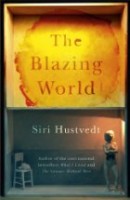
The Book Group and Siri Hustvedt’s Blazing World

Siri Hustvedt, The Blazing World (Sceptre 2014)

144477963X

Before the meeting: I’d missed a number of book group meetings – travelling, and then other evening commitments had got in the way. Alice Munro, The Red Badge of Courage, some Hemingway, The Dinner by Herman Koch – all were discussed without me. I thought I was going to miss out on the Siri Hustvedt dinner as well until Friday, when I realised the evening was wide open. I dashed into Gleebooks on Saturday morning and bought a copy, not actually intending to read the whole thing – I had a lot on my plate and the group’s emails that been less than enticing: ‘I am only up to page 32 and struggling with it!’ ‘I think page 32 is a mammoth effort.’ I planned to read to page 40 or so, enough to have some hope of following the talk when we met.

It was not to be.

The book is presented as a collection of documents – journal entries, art reviews, interviews, transcripts of statements, scholarly essays – by and about a New York artist Harriet Burden, edited by a scholar named I V Hess, whose ponderous introduction accounts for the first 12 pages and no doubt led to the book’s lack of appeal in some quarters. But Harry, as she is known to her friends, transcends the ponderousness. Having been the wife of a successful art dealer, she embarks after his death on a new artistic trajectory. Her work and she herself have been largely ignored or discounted by the art scene, and she comes up with a project to present new works as the creations of a series of three male artists. She’s tackling gender issues with passion born of a lifetime’s struggle, and at the same time exploring questions about the role of the creator’s reputation in how a work of art is seen, and deeper philosophical and psychological issues of identity, creativity, intersubjectivity, perception. I was hooked.

Other pressing demands on my time fell by the wayside and I read the book in three days. I rationalised that it was relevant to the online writing course I’m doing: this was a chance to see if in spite of its fragmentary appearance the book had something like the classic three-act structure. And behold, it does have the nine plot points we have been learning to identify, pretty much where they are suppose to fall. As a result, at any point in the novel you can feel it moving in a clear direction: the scholarly citations, the dissertations on hoaxes (mainly gender based ones such as James Tiptree Jr, but Ern Malley is mentioned in passing), the intellectual arguments, the meta moments such as the reference to ‘an obscure novelist and essayist, Siri Hustvedt’, the detailed descriptions of artworks, the ruminations on art history, the quotes from Whitman, Milton and Emily Dickinson, are all borne on a current leading inexorably towards what we know from near the start is a conclusion with more than one dead body. Novels, of course, don’t have to be tied to the classic three-act structure as tightly as we’re told films do, but I was gobsmacked to see how closely this novel, apparently so all over the place, sticks to the shape. It’s hard to talk about without spoilers, but here – perhaps of interest only to me – are the 9 points (there are 380 pages in the novel):

  1. set-up: We meet all the characters, or at least learn their names; Harry is widowed and in upheaval; she dreams up the Maskings project
  2. inciting incident (10%): page 39–40, she chooses her first ‘mask’
  3. change of plans: page 41–58, three new, widely divergent perspectives are introduced
  4. significant setback (25%): page 117, Harry’s first ‘mask’ having told her he was damaged by the project, she tells her friend Rachel: ‘There’s something in me, Rachel, something I don’t understand. … It’s something horrible inside me.’
  5. midpoint – sometimes called the point of no return (50%): page 213, ‘We have made the pact’
  6. darkest hour (75%): page 301, ‘He said, You look dead, Harry. She said, I feel dead.’
  7. glimmer of hope: page 314 ‘And then I said the right thing for once.’
  8. climax (90%+): Depending on how you read it, the climax is either page 322–324, a description of an artwork (he said, tactfully avoiding any spoliation), or page 351–361, which I don’t know how to characterise without giving too much away
  9. resolution: the very last page, the description of another artwork.

As I drove to the meeting I was prepared to be alone in having been completely absorbed, completely satisfied by the book.

The meeting: There were six of us, of whom two had read the whole book and one other was intending to finish it. A key thing that made the difference seemed to be that the three finishers had an interest in some kind in the art world: thanks to the Art Student, I’ve picked up a smattering over the last few years so I knew of many of the women artists named in the text, and found something almost uncannily familiar some of Harry’s observations about being an older woman in a scene that privileges youth and masculinity; another finisher has recently been an art student at TAFE; and the third has some wonderful art on his walls and is generally interested in it. Without some kind of prior interest, the device of multiple narrators and the general sense of contrivance seem to have stopped people from engaging.

There’s not much more to be said about the discussion of the book: conversation ranged instead over Pesach (last night was the second night), walking out of the theatre, a risqué witticism that Governor Marie Bashir once made to one of our number, the excellent seafood pie we ate, the inequity of raising the pension age, the difference between our current way of taking in most information through seeing and earlier times when it was mainly through hearing. The book, wonderful though it is, was a bit of a fizzer, but the dinner was a great success.

PS added later: I forgot to mention that one of us had started reading the book on his Kindle and found it very frustrating. When he shifted to a hard copy it became a much more manageable and pleasant experience. The difficulty seemed to have something to do with the way footnotes are treated in the ebook. They work better on the page.