Out of the Box

Michael Farrell and Jill Jones (editors), Out of the box: Contemporary Australian gay and lesbian poets (Puncher and Wattmann 2010)
I approached this anthology with suspicion. Does it really make sense, I wondered, to read David Malouf’s or Pam Brown’s poetry in a context that draws attention to the poet’s sexuality? Wouldn’t it skew, and narrow, the reading? My suspicion wasn’t allayed by having recently read editor Michael Farrell’s ultra-skewing assertion in Jacket Magazine 39 that he has ‘always read Judith Wright’s “Woman to Man” as referring to the experience of gender transfer’. But … well, once again the Book Club has dragged me from the path of least resistance.

Of Michael Farrell’s introduction and its use and abuse of the Concise Oxford Dictionary, I can reasonably say I didn’t find it congenial, and his readings of poems strayed too far into hip idiosyncrasy for my taste. Jill Jones, his co-editor, gives a nice potted history of identified gay and lesbian writing in Australia since the late 70s, and provides some useful orientation to the lesbian poems – I mean of course the poems written by identified lesbians, because as the book’s subtitle makes clear it’s the poets, not the poems, that have sexual identitites.

The poems are wonderfully diverse. They belong together not because of shared themes or concerns or formal qualities, but because their creators are contemporary (ie, alive?), Australian and gay or lesbian. A number of the poems are outed by the context – that is, poems I would elsewhere have read as heteroerotic I here read as homoerotic. That’s probably a good thing – my heteronormative mentality is being challenged. Others shrink: Pam Brown’s ’20th Century’ (‘And as we were the tootlers / we tootled along’) here tends to read as referring to the Gay and Lesbian Mardi Gras rather than something more global. I don’t know that that’s so good. At times I caught myself approximating a Beavis and Butthead snigger: ‘Hur hur! He said fist!’ Definitely not cool, though I plead in mitigation that Michael Farrell’s introduction does something of the sort more than once, and a handful of poems seem to be intent on a kind of high-culture gay Beavis-and-Buttheadism.

A good bit of the time while reading these pages, I got to feel very straight – not necessarily in the sexual sense, but in the sense that I prefer my language syntactical, don’t warm to commas at the start of sentences or parentheses that don’t close, and hate it when I can’t tell whether something is a typo or deliberate wordplay (when Javant Biarujia’s ‘MappleTROPE’ gives us Mapplethorpe’s deathbed utterance as, ‘I just hope I live long / enough to see the frame’ – has he inserted that r into the last word as a piece of witty surrealism or is it just bad proofreading? I genuinely don’t know, and it bothers me).

There are wonderful poems by David Malouf (‘A History Lesson’), Dorothy Porter (‘The Ninth Hour’), Pam Brown (‘Peel Me A Zibibo’), Martin Harrison (‘About the Self’), Peter Rose (‘Plague’), Kerry Leves (‘the escape’ – I’ve known Kerry mainly as a children’s writer, and he is definitely not that here) and joanne burns (‘aerial photography’), among others. I was delighted to be introduced to Stephen J Williams (‘Museums of beautiful art’), Andy Quan (‘Oath’, possibly the single poem that touched me most directly) and Tricia Dearborn (‘Life on the Run’) among others.

It probably doesn’t make sense to talk about a book of poetry without quoting any, but every poem I wanted to quote turns out to feel like an all or nothing proposition. I guess if you’re interested you’ll just have to find the book.
An acquisition

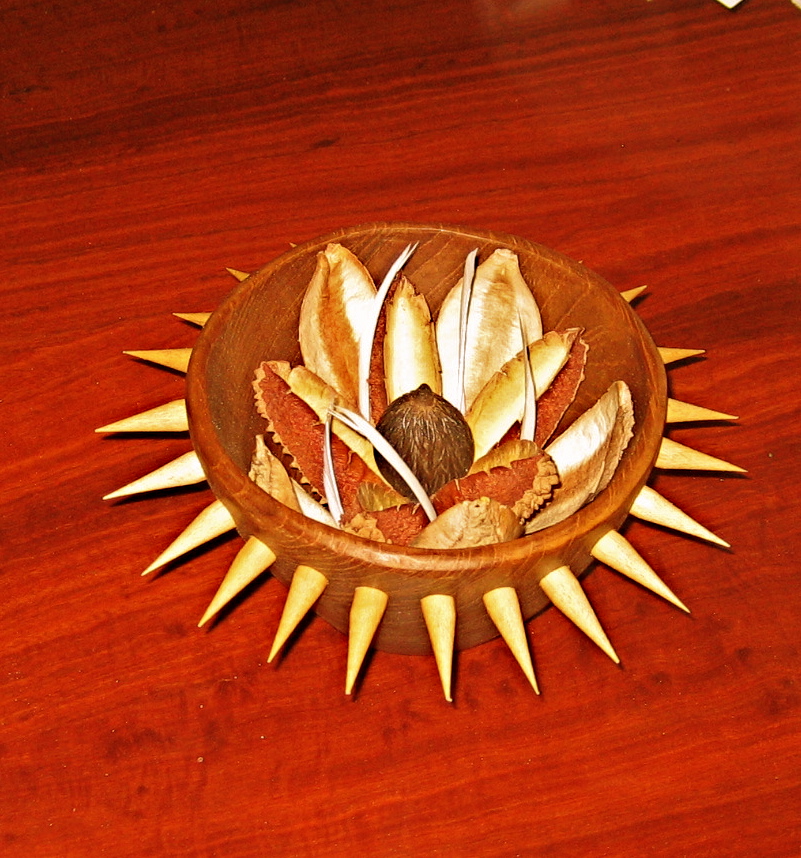
I dropped in at Little Queen Street today to pick up Steven Vella’s small bowl, which we bought a couple of weeks ago.

Here it is nestling in its bed of polystyrene:

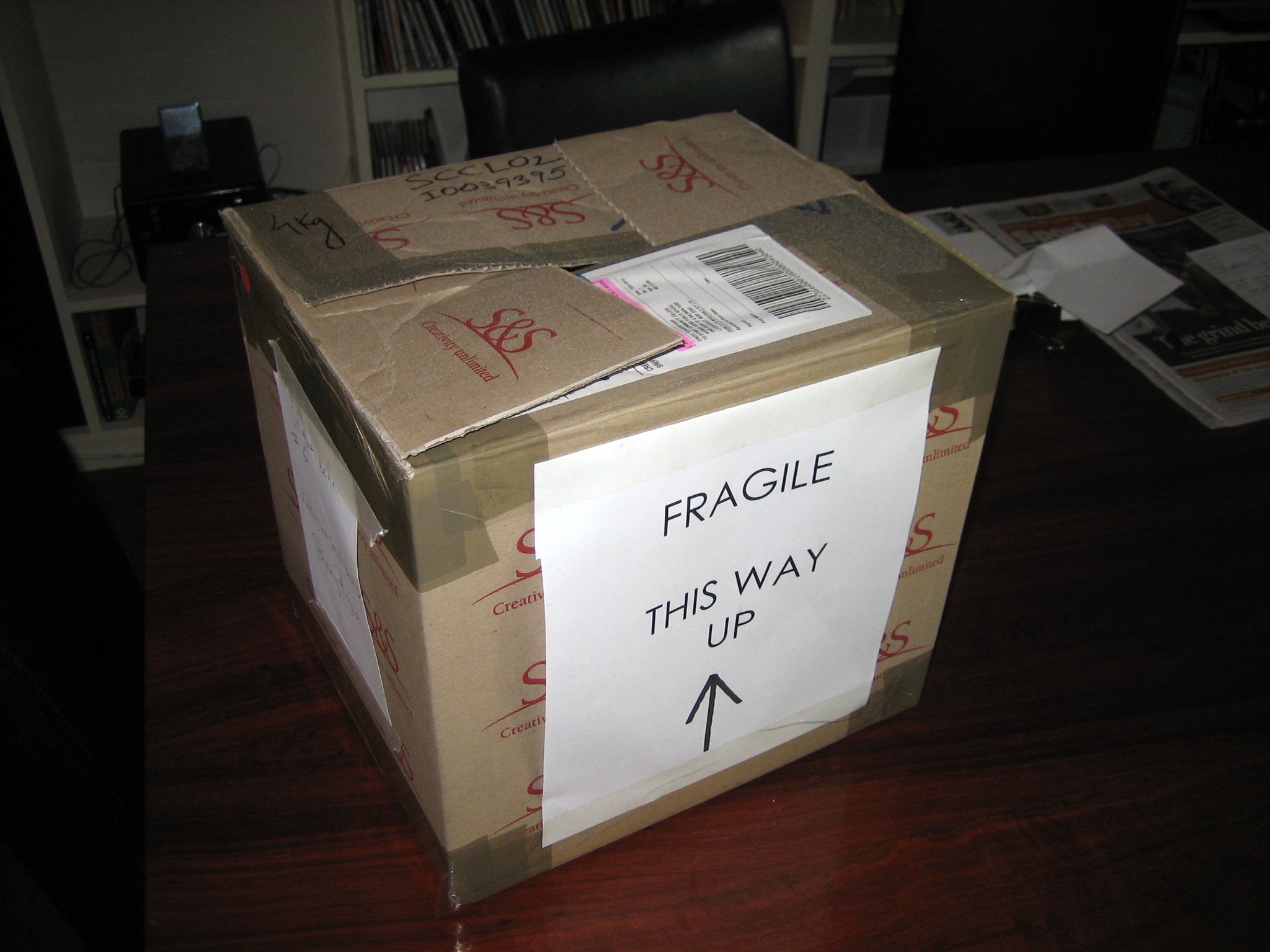
Out of the box:

On the wall, though we have yet to find a place where its shadow is as dramatic as in the gallery:

Stop the presses: Inner city house has surplus cockroaches

If you don’t know about Freecycle, you’re missing out on a very good thing. It’s a transnational ‘grassroots movement’ of people giving stuff away (and getting stuff). Instead of putting useful bibs and bobs  you no longer need out on the verge to be collected by canny passers-by, or canvassing friends to see if anyone wants the chair that doesn’t fit in your living room any more, or selling the superseded TV on eBay for a nugatory sum, you advertise them on your local Freecycle list and someone interesting comes and takes them off your hands. It costs nothing, and is remarkably undemanding. When a small business I know was closing down an office, it gave away book cases, a television set, large pieces of furniture, computers, to recipients including a family whose house had burned down and a school that was struggling to  make ends meet. Someone put up a message saying they needed compost: we happily gave them a couple of buckets from our plentiful supply (and the recipient turned out to be someone I last saw when she was two years old, the daughter of a close friend’s partner at the time). The Freecycle website’s catchphrase is, ‘Changing the world, one gift at a time.’

Today must be some kind of landmark case of one person’s junk being another’s treasure. I received an email with the subject line ‘[freecycle_sc] OFFER: Annandale – Live cockroaches.’ He wasn’t kidding:

Anyone who keeps a pet lizard knows that roaches are expensive to buy at petshops, and that many you might catch yourself are likely to be contaminated with insecticide and harm your reptile.
My house has not had insecticides used in it for at least a dozen years, and my roaches are healthy and safe. I’m offering to catch them on a weekly basis and have them available for collection.
best phone to catch me on is xxxx xxxx Thurs Friday or Monday.

See, you don’t know what you’re missing.

Greg Weight and Western Desert Artists

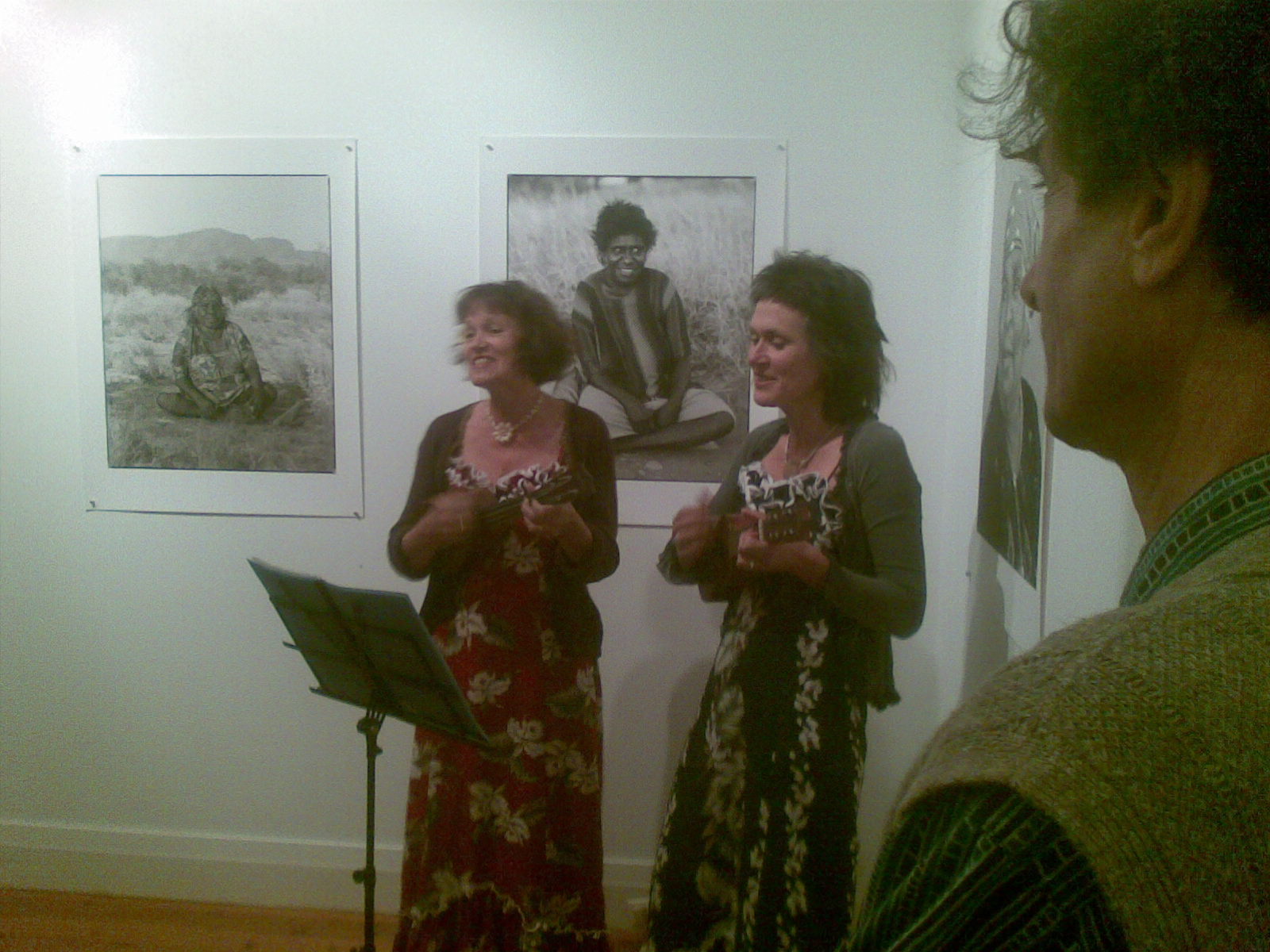
At least one of my regular readers would have loved to be at the Gallery East opening this evening [All turn and look at Will]. Greg Weight’s ‘Artists of the Western Desert’ comprises eleven portraits of Western Desert artists – from Kintore, Haast Bluff, Yuendumu and Alice Springs. The opening was a small, even intimate gathering. I recognised a number of stars of the art world, but someone explained that they were there as neighbours and old friends of Greg and Carol Ruff, his partner and the owner of the gallery, rather than as A-listers.

Long Jack Philipus Tjakamara dominates the gallery’s front window.

In lieu of speeches, Carol Ruff and friend played ukulele and sang – among other things, Carol’s own song ‘Finding Love in CLOVElly’ – and were joined on the bongos by the artist photographer, seen here in the right foreground. The Indigenous artist beaming down from the wall is Yukultjii Napangati, a Pintipu woman who came in out of the desert in 1984 when she was about 14 years old.

The exhibition lasts until 23 May.  If you miss it at Clovelly, you may be able to catch it at the Musée Branly in Paris in the next year or so.

Bill Murray reads Emily Dickinson

Remember Paul Robeson singing to workers in the Sydney Opera House under construction? New York’s Poets’ House isn’t quite on that scale, but this coming together of Bill Murray, Emily Dickinson and a group of construction workers is beautiful to behold.

I usually tend not to like actors’ readings of poetry, but this is masterly, especially his apparently casual use of props and the way he modulates degrees of seriousness. Even the little bit of ‘New Yorkers are special’ rhetoric isn’t too vomitous.

Thanks to Harriet the Blog.

Ordinary Affects

Kathleen Stewart, Ordinary Affects (Duke University Press 2007)

This starts most inauspiciously:

Ordinary Affects is an experiment, not a judgement. Committed not to the demystification and uncovered truths that support a well-known picture of the world, but rather to speculation, curiosity and the concrete, it tries to provoke attention to the forces that come into view as habit or shock, resonance or impact. Something throws itself together in a moment as an event and a sensation; a something both animated and inhabitable.

Whooee! It’s going to be a rough ride, with tortured syntax, unconventional semicolons and words that don’t seem quite to mean what one would expect. It doesn’t get any more comfortable, but I persisted because it was a Book Club book, and Book Club books are meant to take me places I wouldn’t necessarily go if I just followed my nose.

A couple of pages in, I decided that even though this is a scholarly work, probably belonging to the discipline of postmodern anthropology, I lack the background to be able to read it in a scholarly manner. Instead, I let it kind of break over me. I read it as if it was poetry. And I enjoyed it. I can’t tell you what it’s about, mind you. It abounds in anecdotes, ranging from a pleasant but odd encounter in a check-out queue to horrific violence, bizarre plane travel incidents to odd things seen from the car. It offers fascinating reflections on public responses to big events – the OJ trials, the Columbine shootings, child care sex abuse scandals, nuclear waste disposal, 11 September 2001. It positively bristles with gnomic utterances that would make great epigraphs for poems (‘The ordinary can turn on you,’ or ‘Dream meets nightmare in the flick of an eye’) or citations in other scholarly works (‘Like a live wire, the subject [which I think here means a person] channels what’s going on around it in a the process of its own self-composition. Formed by the coagulation of intensities, surfaces, sensations, perceptions and expressions, it’s a thing composed of encounters and the spaces and events it traverses or inhabits’).

By chance, the first thing I read after finishing this book was Raewyn Connell’s characteristically incisive essay in the current issue of Overland, in which she says:

Any system of doctrine, any powerful concept, becomes in time an excuse for not thinking: Marxism, radical feminism, deconstructionism, post-colonialism, the lot. … We need harder thinking, not fluffier thinking, about social reality – and that includes rethinking the ideas earlier generations of socialists worked with.

I think Kathleen Stewart would agree with that (even while, being from the US, she might flinch at the word ‘socialists’), but Ordinary Affects deals in something that precedes thought: ‘The ordinary can happen before the mind can think.’ (Let me share with you the pleasure I felt in using that limp word ‘something’ here. It’s a word that Stewart uses often and interestingly, usually in the phrase ‘or something’, as if to insist on the provisional nature of her thinking.) Before we can rethink, we need to re-see, and re-feel, re-attend, and at least part of what Stewart means by ‘ordinary affect’ is what happens when we pay attention, how we integrate, or not, the many influences on our perception, our emotional responses, our unreflective thoughts.

I found myself remembering the only lines I know from the US poet Muriel Rukeyser:

PAY ATTENTION TO WHAT THEY TELL YOU TO FORGET

The capitals are hers.

If I get a chance I’ll re-read this book, though I expect it will be a matter of letting it break over my head again.

Luke Carman audio

One of my highlights of last year’s Sydney Writers Festival was Alleyway Honour in the Bankstown Town Hall. Some of the same people who made it so brilliant will be in the prosaically named Inside the Westside Writers Group this year at Bankstown on 18 May. I hope Michael Mohammed Ahmad will read again. And Alexis Wright will be there as a special guest.

But my reason for blogging is to let you know that Luke Carman, whose readings at Alleyway Honour were a thrill and a delight, having had a couple of pieces in the latest Heat, has now, thanks to Penguin Plays Rough and FBi Radio, turned up in audio on the internet. You can hear him with just one click.

Open letter to Jennifer Maiden

I think this is a poem, but the chances of anyone else publishing it are very slim, so here it is, blogged.

Open letter to Jennifer Maiden
Dear Jennifer, please write about Kevin
and Julia. The best I could manage
was a clerihew when they won the election:
oooKevin Rudd
ooomay be a bit of a fuddy-dud
ooobut at least we’ll no longer be showered
ooowith the duplicitous spittle of Howard.
But now that he’s backed off
from tackling climate change
and Julia’s refusing
to talk to the teachers’ unions
we need something stronger
and wiser
than my easy rhymes  –
a muddy rabbit, mesmerised by moonlight,
a studied habit, of playing to the polls,
or bloody sabot-age.
Couldn’t you write us something
about the way his top lip tightens
or hers curls,
her pontifical drawl, his parsonical clip?
Something like your George’s
lethal little injections and your Condi’s
costume jewellery, to help us see them
as human?

Jennifer Maiden’s poems that this refers to explicitly are ‘Together We Will a Cheese Achieve‘ and ‘Costume Jewellery‘ both in Friendly Fire.

Philip Larkin, The Whitsun Weddings

Philip Larkin, The Whitsun Weddings (© 1964, Faber & Faber 1977)

This slim volume was published seven years before Philip Larkin’s most famous poem, ‘This Be the Verse‘, and a couple of years before I studied Eng Lit at university. It’s possible we read some of Philip Larkin’s poems in our eminently forgettable third year elective on Post War English Poetry. But in effect I’ve just met what Wikipedia says is one of Britain’s most popular poets for the first time.

According to Wikipedia again, Larkin said that deprivation was for him what daffodils were for Wordsworth. I found that comment illuminating – most of the poems here are performing a kind of wretched isolation, sometimes mocking people who are in relationships, at other times wistfully celebrating the possibilities, or the might-have-beens, of love. The quality of performance stops them from being just plain dispiriting. A paraphrase of ‘This Be the Verse’ would go something like, ‘Parents ruin their children’s lives so we might as well let the human race die out,’ but each time I read the poem it has a weirdly cheering effect, which I think is because its meticulous formality and obvious pleasure in language are so not gloomy. That poem isn’t in this book, but there are others just as gloomy and just as cheering, ‘Mr Bleaney’, say, or ‘Nothing to Be Said’, or … most of them.

Anyhow, I don’t have much to say, except that I enjoyed these poems a lot and expect to enjoy them many times – the sheer formal pleasure of them, but also the complex musings they embody.

The student who left her marks here (and I know it was she because her name, Allison XXXXX,  is on the fly leaf) was more attuned to the poetry than he who annotated my copy of Immigrant Chronicles. (Click the image for a bigger version.)

Mind you, her notes on ‘Afternoons’ seem almost completely wrongheaded: I don’t see why the recreation ground prompts the comment ‘consumerism’, where the idea comes from that the mothers who set their children free are ‘still trapped’, or why it is ‘bleak’ that the women have husbands behind them. But Allison’s pencil seems to grasp ‘An Arundel Tomb’ well enough. At least, I found the poem completely lovely, and felt quite companionable toward her as I read it: ‘Yes, Allison, it is nice the way the word link occurs at the start of the fifth stanza after that big enjambement,’ ‘But is the tomb undated, Allison, or just the snow?’

The final lines of the poem remind me of one of my favourite movie moments, the declaration of love at the end of Ingmar Bergman’s Scenes from a Marriage. I can’t find the Bergman line, but here’s the Larkin:

0000000The stone fidelity
they hardly meant has come to be
Their final blazon, and to prove
Our almost-instinct almost true:
What will survive of us is love.

Footnote on my blog note on Sacco’s Footnotes

I’ve just heard Chris Flynn’s excellent review of Footnotes in Gaza on the ABC’s Book Show of 21 April. It’s preceded by interesting discussions of European comics (‘graphic novels’) in translation and South Korean comics, in a refreshing antidote to the patronising treatment often handed out to comics in the mainstream media. Chris Flynn says in part:

Sacco tries his level best to build up an accurate picture of what might have happened. he comes at the massacres from all angles, presenting eyewitness accounts that sometimes correspond and sometimes conflict. Footnotes in Gaza is thus a fascinating document of ordinary people, but it is disappointing that it lacks an Israeli perspective on what happened. In his introduction  Sacco bemoans that he was stonewalled, and the limited access that he was granted to UN and Israeli Defence Force archives, and he puts out a plea for Israeli soldiers who were present on the days in question to come forward with their versions of events.

As an eye-opening piece of war reportage, Footnotes in Gaza succeeds largely thanks to Sacco’s innovative, fresh approach in presenting a forgotten moment in history in such a modern fashion. As a narrative piece of story-telling, it contains several moments that made me put the book down and hold my head in my hands. As illustrative journalism, it has a huge emotional impact, particularly during the grand vistas of destruction and the final, silent pages that transcend words. There are no answers here, just terribly sad questions.

You can download the whole thing or listen to it streamed.