This is on the White House blog, with no apparent comic intention:
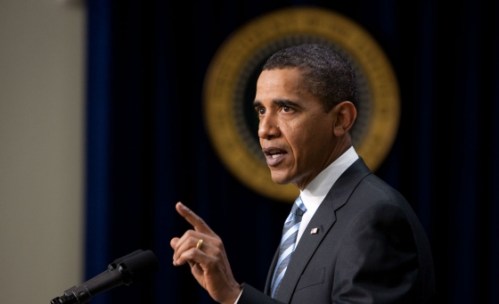

This is on the White House blog, with no apparent comic intention:
John Malone, Big Blue Mouth (johnlmalone at yahoo dot com dot au 2009)
Stephen Whiteside, The Paterson Parodies (self published 2009)
You know how US presidents retain the title of president until it’s prised from their cold stiff hands? Well, it’s not like that for magazine editors, but some of the perks of office do survive long after one loses the right to use the editorial ‘we’. One of these perks is free books. Mind you, in my days of wielding editorial power any free books were for the magazine, not for me personally, so maybe this is a perk of the afterlife. Both these little books arrived in my mail from poets who graced the pages of The School Magazine in my day.
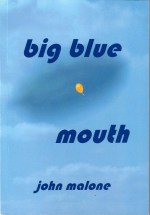 By no means all the poems in Big Blue Mouth were previously published in the magazine, but the collection benefits from monochrome versions of the illustrations that accompanied some of them there – by Kerry Millard, Andrew Joyner, Noela Young and Tohby Riddle on the cover (every one of those links leads to delightful things) [Correction: The cover is not by Tohby but was put together by John Malone and the printer]. They’re mostly short poems from a young boy’s point of view, many featuring a grandfather who must surely resemble the poet himself. If you’ve found this page by googling John’s name, hoping to find a collection of his poems for yourself or a young fan, or if you’re a regular here and ditto, you can buy a copy direct from him – his email address is johnlmalone at yahoo dot com dot au (notice that his second initial is in that address). Stocks, I’m told, are limited.
.
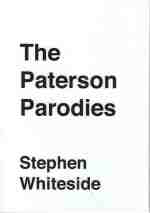 As far as I know, none of the poems in Stephen Whiteside’s book have been previously published, though he has recited them at folk festivals and to other audiences – as you read them you feel a building pressure to give them voice: they’re meant for performance. This is bush verse, not specifically for children, but I imagine that anyone of whatever age who enjoys the ballads of Banjo Paterson will enjoy them. In ‘Clancy of the Undertow’, Clancy is a surfie; the eponymous Son of Mulga Bill has trouble riding a horse, and is at ease on a bicycle; the likewise eponymous Man from Ironbark wreaks revenge in kind on the dapper barber. ‘The True Story of the Man from Snowy River’ isn’t really a parody – it’s a piece of serious revisionism, but it scans as impeccably as the rest. You can buy this book from the BookPOD bookstore. You can find out how to get hold of a copy at http://www.abpa.org.au/bush_poetry_forum/viewtopic.php?t=591.
I do have one complaint about both books. It’s that the economics of publishing are such that the only way for them to see the light of day was through self-publication: single-author Australian collections of children’s poetry are rare as hen’s teeth. Because they are self-published, these boooks are unlikely to reach a four-figure audience. And that’s a shame.
Pamela Freeman, Full Circle (Orbit 2009)
Did I mention in my post about James Tiptree Jr’s Meet Me at Infinity that it’s full of quotable bits? Here’s Tiptree on High Fantasy, in 1975, a year or so before she was outed as a woman:
I’ve been reading a mess of Tolkien, C. S. Lewis, Wm Morris, and T. H. White. And I find extraordinary the unspoken assumption that the greatest boon a people can achieve is – a king. The King Has Returned! Well, perhaps in the feudal state of things one can understand some of that. But I suspect it is largely a male contribution.
It led me on to think that women are supposed to be more dependent, to slide easily into and adjust gratefully to domination. […] But who are the real dependents? Who insist on a captain, a boss, a Great Leader? Who have evolved lunatic systems of authoritarianism in every known activity except maybe solo farming? Who gratefully accept being beaten up and then faithfully follow the bully?
Three guesses. And don’t say guppies.
 I don’t for a minute believe Pamela Freeman intended the Castings Trilogy, of which Full Circle is the final book, as a feminist tract; I’d be mildly surprised if she’s read that bit from Tiptree; I’m sure she shares Tiptree’s bemusement at the persistence of monarchist ideology in fantasy; and there are moments in the narrative where I found myself thinking subliminally of guppies – though some of the characters who inspired that response were able to grow beyond their grateful adjustment to domination.
I ought to declare that Pamela is a friend of mine, in the facebook sense as well as the english-language sense. So I’ll content myself with saying that this is a most satisfactory conclusion to the trilogy: there is an army of the dead, the living world as we know it is under threat of extermination, the web of comradeship and betrayal, love and loss, heroism and cowardice, filial piety well placed and misplaced, vengeance and forgiveness, violence and tenderness, epic sweep and intimate gesture is as complex as anyone could hope for. As an added fillip, things happen in the climactic scenes that make one want to go back to the start and graze one’s way through the whole 1000+ pages.
Satisfied though I am, I’m nevertheless pleased to know that a further, stand-alone novel set in this same world is nearing the end of its first draft.
In my last two years of high school we studied Macbeth. I don’t think we actually saw a performance, but taking the copies of the bowdlerised edition our school had in stock and laboriously reinscribing the rude bits at Brother Claudius’s dictation, we read the text through collectively, stopping for discussion and explication, three times. All three times, when we reached the line about fortune showing ‘like a rebel’s whore’, one of my fellow students, a pious young man named Geoffrey, asked, ‘What’s a whore, Brother?’ and poor Brother Claudius’s answers had to get more explicit each time: a loose woman, a woman of poor morals, a prostitute, and eventually a woman who commit sins of impurity in return for money.
Apart from Geoffrey’s enlightenment about the shocking ways of the world, the main result of this approach to the play was that we got to know slabs of it off by heart — a line here and there, and one or two soliloquies: ‘Is this a dagger I see before me’ and of course ‘Tomorrow and tomorrow and tomorrow’. To this day I love to recite the latter in a singsong rhythm, enjoying the feel of the words and not caring too much at all for the meaning.
Here, as a reward for reading that preamble, is Bob Dylan reciting the soliloquy, lifted from his Theme Time Radio Hour broadcast, number 24 of the first season.
I’m assuming that uploading a small clip like this is OK with those that control the rights.
Sarah Maddison, Black Politics: inside the complexity of Aboriginal political culture (Allen & Unwin 2009)
 Sarah Maddison is a non-Indigenous Australian academic. Over five years, she interviewed 30 Aboriginal leaders, activists and public intellectuals, ‘discussing their life histories, their political views, their worries and their aspirations’. Noel Pearson, Marcia Langton and Michael Mansell declined to be interviewed, but the actual cast of characters is very impressive, ranging over all mainland states and including household names as well as people who work at the community level, far from the limelight.
Starting from these interviews and drawing on very wide reading (the bibliography runs to 30 pages), while ‘privileging’ the voices of the interviewed and other Aboriginal and Torres Strait people (emphatically including the three who declined to be interviewed), Maddison constructs a kind of map, mainly for whitefella readers, of the complexity of Aboriginal politics. A reading-while-walking conversation helped me to think a little more about the idea of the book as a map. A park friend commented knowingly, ‘I would have thought that was more for dipping into than reading straight through.’ She’s partly right: the book could serve as a reference. But it is a map, not a street directory, so it also makes good sense to get the whole picture by reading it straight through.
Maddison gives a lightning-quick survey of the history of government policy (violent dispossession, ‘protection’, ‘assimilation’, ‘self-determination’, ‘intervention’) and Aboriginal responses from the beginnings of the colonies, but the book is about living politics, and so deals mainly with the Howard years and their dark shadow, in which we still live. While there is some attention to personalities – Noel Pearson, for example, emerges as a man most people love to hate, or at least contend with – our attention is drawn to ten ‘key areas of tension’. Here they are, with a little taster from each chapter to give you a clue on how the tension plays out:
Autonomy and dependency
In every country where Indigenous people have been subjected to a colonial regime, precolonial autonomy has been eroded. In its place a range of damaging dependencies have manifested themselves. These postcolonial dependencies add complexity to Aboriginal political culture as individuals, families and communities struggle to regain their autonomy as self-determining peoples and as political actors. These struggles take place in political contexts that tend to necessitate at least some degree of dependence on non-Indigenous structures of government.
Sovereignty and citizenship
Are Aboriginal people citizens of Australia or members of sovereign Indigenous nations? The nation-state of Australia may have sovereign legitimacy in the eyes of the world, but in the eyes of many of its Indigenous inhabitants it remains an illegitimate interloper on their territory, still trying after 220 years to usurp a sovereignty that they have never ceded.
Tradition and development
Without an economic base, Aboriginal people cannot be autonomous. Not surprisingly, however, there are complexities that get in the way of economic development for Aboriginal people. One is […] the tension between need for economic development and the importance of traditional connections to land.
Individualism and collectivism
Aboriginal value systems are often at odds with liberal democratic philosophy, creating tension between those committed to ideas of individual political equality and those who maintain that the foundational unit of society is the Aboriginal group or community.
Indigeneity and hybridity
The idea of “Aboriginal” or “Indigenous” identity is a distinctly postcolonial construct invented to both name and contain the “natives” of terra australis. In light of this, there is immense complexity concerning questions of Aboriginal identity today. […] Both non-Aboriginal politicians and, at times, other Aboriginal people will question an Aboriginal leader’s racial credentials on the suspicion that they may not be “Indigenous enough”.
Unity and regionalism
Attempting to organise political representation at the national level thus risks obscuring the diversity of Aboriginal nations and community groups, leaving many feeling invisible or unrepresented. This emphasis on localism can make national unity seem fragile or even impossible. In the absence of a credible model of national political representation, however, there can be tension between Aboriginal groups and communities who may find themselves competing for recognition and entitlements.
Community and kin
[The] majority of Aboriginal communities are a fiction, or at least a creation, comprising a number of kinship groups that, prior to colonisation, would have occupied different territories and that in many cases still retain different languages and systems of law.
Elders and the next generation:
Aboriginal political culture is still based on a gerontocracy in which elders command the most potent authority and influence. elders are holders of special and sacred cultural knowledge, and it is their responsibility to hand this knowledge down to the younger generations. The breakdown of traditional authority structures, however, means that this transfer of knowledge can no longer be assumed In place of this hierarchy of cultural seniority, younger leaders now emerge from the ranks of political activists fro community organisations, and from the developing class of young, university-educated professionals.
Men, women and customary law:
Colonisation has interrupted the inevitable evolution of Aboriginal custom and belief, instead pushing Aboriginal people to defend their threatened culture. At the same time there has been an extensive but poorly informed public debate about the recognition of customary law that has done much to muddy the water and demonise Aboriginal men.
Mourning and reconciliation:
The traumas of colonisation, including massacre, rape, starvation and introduced diseases through to policies that justified the removal of Aboriginal children from their families, are not resolved.
The author doesn’t keep her own mind out of the telling. She has struggled to do more than simply present the variety of Aboriginal viewpoints, which might have been useful to dip into but very hard to read. In general she has done a hugely impressive job of shaping her vast material into a narrative / argument. Occasionally there’s a sentence that strikes a chill. For example, when one reads, ‘What is almost universally rejected by Aboriginal leaders and activists, however, is the use of customary law to defend violent and abusive behaviour, particularly that directed at women and children,’ one does wonder what unspoken murk hides behind that ‘almost’. And, as the endnotes acknowledge, some complexities are simply not discussed – Torres Strait Islanders are generally not present, for instance. But a book that tackled this subject and didn’t have loose threads or unaddressed areas would be a miracle, and very very big.
I heard Sarah Maddison on Radio National saying that she wrote this book largely because of her love for Australia. Though this statement may have been in part a preemptive defence against imagined attacks from the weirdly patriotic right, on the evidence of the book itself it was also the plain truth. The book is the labour of an engaged, committed mind, and I for one am grateful for it.
This has been up on YouTube for a year, but maybe you haven’t seen it either.
Added later (not very much later): Snopes says it’s rubbish. Sorry!
Several of my younger relatives insist that Larry David and I are lookalikes. You be the judge.


Barry N Malzberg, Herovit’s World (Pocket 1974)
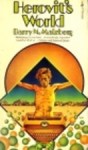 I picked this out from my huge Science-Fiction-Books-To-Be-Read cache because it’s very thin, and because James Tiptree Jr/Alice Sheldon mentioned Malzberg as one of her favourites (though she did characterise him somewhat deterringly as a writer ‘in overt pain’, so that ‘Everybody and everything hurts, for no known reason’).
This is almost certainly not a book that Barry Malzberg reputation rests on. It’s hardly science fiction at all, in fact, rather a grimly comic tale of a hack sf writer’s disintegration after writing 92 novels and 51 pages, plus innumerable magazine stories in little more than 22 years. It’s a prolonged self-hating in-joke, or possibly a prolonged in-joke about self-hatred. After much anguish, the writer, Jonathan Herovit allows his much more practical pseudonym to take over his own life, but when the latter fails miserably to deal with the real world, he is replaced by the even more man-of-action but even less cluey main character from Herovit/Poland’s SF series. It’s a book that has dated severely, as the science fiction world it satirises is (I imagine) no longer with us, and because its sexual politics are repulsive. Even allowing for irony, the portrayal of sex/sexism is strikingly unreconstructed. Herovit rapes his sleeping wife at one point; waking up, she makes it clear that she’s not a willing participant and that he’s hurting her. No one ever calls it rape: it seems to be just one of a series of terrible sexual experiences all round. A couple of days later Herovit’s wife leaves him. It’s not the rape that was the final straw, however, but an episode of impotence. Clearly, for the staunchly feminist Tiptree to have seen Malzberg as a favourite, his writing elsewhere must offer something extraordinary to offset this horror. It’s true, though, that in this book everybody and everything hurts, including the reader.
There is a lighter note. I’m notorious for failing to respect books as physical objects (Hi Judy!). But considered as an artifact, this cheap US paperback from the early 1970s is a thing that even I could appreciate. Look at this spread:
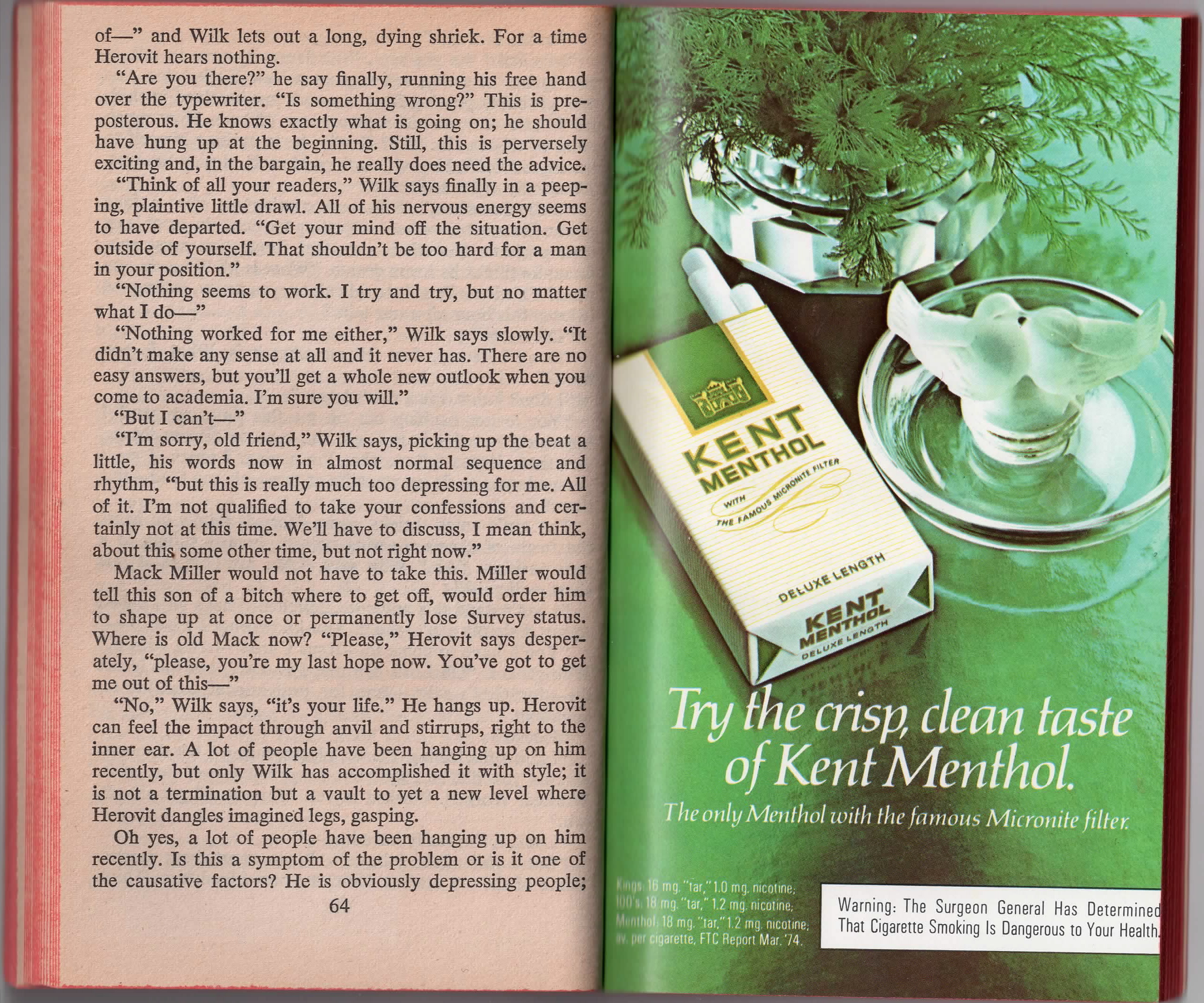
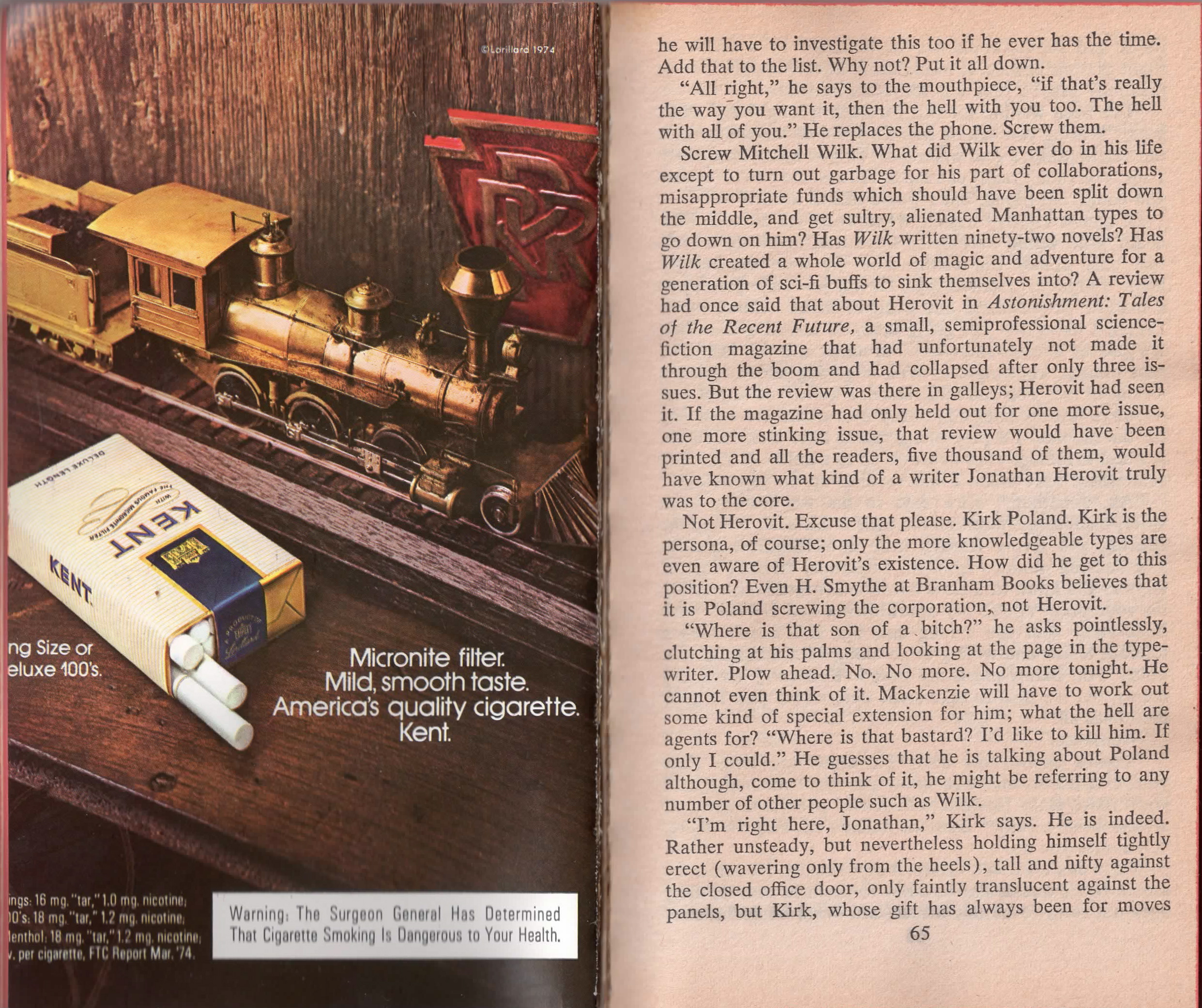
The narrow margins suggest that the publishers really want to give you maximum wordage for your dollar, and then the ad takes even less of the burden of cost from the reader’s shoulders. I’m grateful that there are only two ads altogether, both for the same brand of cigarettes. This one is clearly for the romantic, the one on the reverse page features an elegant model steam train, clearly for the man’s man.
Added later by request, the other ad:
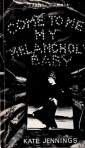
Kate Jennings, Come to Me My Melancholy Baby (Outback Press 1975)
 I’ve mentioned Kate Jennings once or twice in my blogs, mainly because her New York based writing has given me much pleasure. I don’t think I’ve mentioned that she won a place in my heart nearly (gasp!) forty years ago with a speech she gave at a Vietnam Moratorium meeting on the Front Lawn at Sydney University. On that day, after a number of rousing speeches from various anti-war organisations, a number of women, perhaps there were ten of them, came to the front of the speaking area and fanned out across its full width, standing with legs apart and arms folded. I was off at one side near the front of the thousand-strong crowd, and was impressed by the deliberate drama of the moment. I noticed that the woman closest to me was trembling, and realised that they were doing something that terrified them. Kate stepped to the microphone – the painfully thin designated speaker – and delivered her speech in a voice that shook but didn’t break. The speech was intemperate, overblown, bitter, profane and inelegant. It changed my life.
The speech was printed five years later as ‘Moratorium: Front Lawn: 1970’ in Kate’s first book, Come to Me My Melancholy Baby. It’s a slim vol of poetry, plus the speech and one other short prose piece. I lost my copy decades ago, and was delighted when a slightly battered arrived in the mail last week from a friend who was culling her bookshelves. The poems, it turns out, haven’t generally aged well, though the pain in some of them fairly leaps off the page. When Kate was interviewed on the ABC by Julie McCrossin a couple of years ago (published in Hecate Vol 14 Nº 1), Julie asked her about this book, and in particular about that speech. Here’s a relevant bit:
KJ: I think you’d call that speech ‘in your face’. They were wild, rackety outrageous days and we were not getting the attention of the men at that point. We were a very small group that started meeting and that was the speech I gave. I’m not sure that we can actually say it out loud on radio. It was that outrageous.
JM: But what was the core content, the cry from the heart?
KJ: The cry from the heart was that we were all Vietnam activists and the men were all gung-ho about fighting that cause, and nobody cared about women, and at that stage women could not have legal abortions.
JM: And when you look back are you amazed at the courage you had, that was a new voice then, the voice of women saying: ‘Look out over here, something’s happening, or not happening?’
KJ: When I look back at all my life I am amazed, I do keep walking a plank. I thought those days were terrific.
JM: Why?
KJ: We were very inventive. We weren’t as earnest as people are making us out to be now. I don’t think of course those tactics are necessary now.
The bit of the speech that made me sit up and listen wasn’t the vile man-hating rhetoric. What made it possible to listen to that and hear what was being said was the opening lines, printed in the book as an epigraph:
you’ll say I’m a manhating braburning
lesbian member of the castration
penisenvy brigade, which I am
I’d remembered the last three words as ‘Well, I am.’ The thing that so affected me was that Kate and the women who flanked her were proclaiming that they would no longer be silenced or kept in their places by even the most vicious putdowns anyone could throw at them. If need be they would claim the putdowns as badges of honour. It made my young, impressionable, male heart sing.
The poems that precede and follow the speech recount some of the personal cost behind that stand:
If it’s not booze, it’s drugs
if it’s not drugs, it’s poetry,
if it’s not poetry, it’s feminism,
if it’s not feminism, it’s love
if it’s not love,
well, you’re just plain crazy.
When you are crying like that
how long before you stop?
I’ve stopped.
Part of the pleasure of her more recent books is in their sheer urbane poise, a great relief to the reader who followed her through the derangement, rage and ‘racketiness’ of this book.
Posted in Books
Tagged 1970s, feminism, Kate Jennings, Outback Press, poetry, reminiscence, Vietnam Moratorium
Noel Pearson, Radical Hope: Education and equality in Australia (Quarterly Essay Nº 35, Black Inc 2009)
 Our household is the kind where people yell at the television. When Noel Pearson came on screen recently to talk about the subject of this essay, there was yelling. The aroma he acquired from cosying up to John w Howard in a previous era hasn’t yet dissipated, so them that yelled weren’t about to give him the benefit of the doubt when he seemed to be denying the effect of, say, foetal alcohol syndrome of school results. And Pearson’s regular attribution of a multitude of Aboriginal ills to what he calls the middle-class Left isn’t designed to win friends.
It’s harder, though not impossible, to yell at the printed page, and a sustained piece of writing stands a chance of being more carefully reasoned than a TV sound bite, so I approached this Quarterly Essay with cautious optimism. And indeed, there’s a lot of very good stuff in it. There’s quite a bit of deliberate provocation as well, such as:
Over the years I have often told people that there is a rough rule of thumb when it comes to examining the nostrums and prescriptions of the middle-class Left (black and white): whatever they say our people should do, we should look at approximately the opposite, because that will usually be the right thing to do.
I’ve always found it hard to read straw-man arguments, and surely that’s what this is. Coming to the essay pretty much ignorant of current educational debates, I am in no position to evaluate the detailed heart of its argument about what is to be done about Aboriginal inequality in education. I hope that beneath the occasional pugnacity, it plays a useful role. I know nothing, for instance, about Siegfried Engelmann’s Direct Instruction approach to education of young people from disadvantaged backgrounds, in which Pearson places great theoretical and practical store. Pearson portrays him as a lone, successful evidence-based educationalist crying in the wilderness of vested (middle-class Left) interests that constitutes the educational establishment. He may be right. How would I know? Yet Pearson’s account of the DI approach sounds awfully like the explicit and systematic approach to literacy of the National Literacy Strategy., which as far as I know is being assiduously promulgated, even prescribed, by that same educational establishment. It makes me wonder if the lone voice strategy might not be counter-productive, as well as a little disingenuous. As Pearson writes, on page 77:
Many debates about reality and its characterisation are relatively healthy and rational and we can readily agree that they should submit to scientific resolution. It is when interests are strong that irrationality and ideology come to hold an awesome sway, and science, even when it offers illumination, is gamely denied.
Pearson’s interests are strong, and it would be weird if they weren’t. His concern to transform the hideous circumstances facing Aboriginal people on Cape York and throughout Australia is palpable. This essay’s faults come at least in part from that passionate concern. It’s confrontational, demanding and sarcastic, as well as erudite, personal and engaged. While its main thrust is practical, it often broadens out in surprising ways. I love this, from the final paragraphs:
The Enlightenment was not and is not at its core a European illumination: it is a human illumination. Its origins in Europe should not blind us to its human meaning and implications. The Enlightenment forced the Europeans to change their societies and cultures in fundamental ways. It forced societies and cultures beyond Europe to make the same change. The Enlightenment never mandated deracination or ethnic or religious assimilation or cleansing – all societies that have made this change have left space enough for religion and social and cultural diversity. […] Radical hope for the future of Aboriginal Australia … will require the bringing together of the Enlightenment and Aboriginal culture. This reconciliation is not of necessity assimilation: just ask the Jews.
Posted in Books
Tagged Direct Instruction, First Nations, Maria Lane, Noel Pearson, Quarterly Essay, Siegfried Engelmann
 Currently reading & watching


 Me fail? I fly!