Tag Archives: art

Fun with the Crowds

We went this morning to what we’re told these days is even more popular with Australians than the beach or the footie – the art gallery. Specifically, we went to the Art Gallery of New South Wales for the equivalent of a Grand Final, The Archibald Prize. We bought our concession tickets (I’m a senior, my companion a student) and joined the milling crowd. I liked the winning portrait of Tim Minchin (Penny didn’t). I lay on the floor to get a proper look at the distorted figure in The Alternative Ambassadors (which really ought to have been hung at the top of a staircase, or at least had a comfortable cloth on the floor beside it): ‘It’s a baby,’ I said to those who were too restrained to emulate me, ‘or perhaps a foetus.’ ‘A foetus, definitely,’ said a young woman who was flexible enough to have had a proper look without actually lying down.

In the People’s Choice I voted for Apple Yin’s ‘Previous Life‘, a portrait of a Melbourne personality as a beggar on the Silk Road in a past life. I wondered how Robert Hannaford’s magisterial portrait of Malcolm Fraser would have turned out if give a past life treatment? A Renaissance cardinal, perhaps, or a noble prisoner in the Tower of London?

There were lots of lovely things in the Wynne, including some austere Aboriginal works. I liked the winner, and was glad that among all those huge canvases it was the three smallest works that won the Archibald, the Wynne and the watercolour prizes. The Sulman mostly left me bemused, as it often does. If a work of art is supposed to be something you can look at for a long time and over a long period and still find fresh (and I know that’s a big ‘if’), how come a one-note joke won the Sulman? (You understand I speak as one who knows very little about art, and would generally recommend you listen to the brilliant Imants Tillers, this year’s Sulman judge, rather than me, on such matters, but I really don’t get it.)

We walked the length of the city, chatting happily, arguing with John McDonald in his absence, to Haymarket where we had a most satisfactory yum cha in the vast Marigold, apparently in the company of everyone who wasn’t actually at an art gallery.

Easter, the festival of the changing season, and this year also of putting the clocks back, draws to a close. I hope you’ve had a good one too.

Imants Tillers and watercolour

It’s Art Month in Sydney, and because I now live with an art student (yes, I’ve ditched the anxious Consultant and now cohabit with a cheerful Arty Type), we thought we’d better squeeze an art excursion into our busy schedule before the month was over. So yesterday we set out to hear Imants Tillers in conversation with Edmund Capon at the Roslyn Oxley Gallery.

We arrived nearly an hour early, so went for a stroll up the hill looking for diversion. We found it in spades, in the form of an exhibition at the Wagner Gallery of watercolours from the Australian, English and Scottish Watercolour Institutes. We were just in time for a talk and demonstration by Rob Candy, who it turns out leads tours to China for watercolourists (just $4925 for 16 days all included). Sadly we had to leave as he was beginning to pencil in his composition, but we were there long enough to get a delightful glimpse of the international siblinghood of watercolour devotees.

Back at the bottom of the hill, Tillers and Capon’s conversation had already started when we arrived. It was an animated forty minutes or so, ranging over Tillers’ reading (Heidegger, Thomas Bernhard, etc), artists he admired (De Chirico, and many Australian artists none of whom I’d heard of except Emily Kame Kngwarreye), and the work on display. Each of his works comprises a number of small abutting canvases – he doesn’t sign them, but every small canvas has a number on the back, now up to something like 80 000 I think he said. Tillers spoke very interestingly about his use words in his images – quoting Ezra Pound, Tomas Bernhardt, Virgil (though he didn’t mention him, he’s the source of ‘lacrimae rerum / tears of things’, prominent on the canvas next to me). One of the large works is about to be donated to the Art Gallery of NSW, to Capon’s manifest delight: it had been commissioned by a grazier who thought it might help in the protest movement against a wind farm proposed a particularly beautiful part of New South Wales – gifting it to the AGNSW was part of the plan. (Capon: ‘Wind farms are such ugly things.’ Tillers: ‘I think there’s definitely a place for them, but some landscapes should be declared part of the national heritage.’) They discussed the difference that Tillers’ move to Cooma had made to his art – he had discovered that outside the cities Australia has a huge vast landscape. (Capon said that the work had very little sense of place in it, which may be true of Tillers’ earlier work, but I would have thought was dead wrong about these images.) They talked about Appropriation, which apparently was big and shocking in the 80s, though now everyone does it. They wondered why it is so hard for Australian art to take up space in the international arena: Tillers made a bit of a splash in the US in the 80s, he said; Capon lamented that only Indigenous Australians got much of a look-in, not that he begrudged it them. (Tillers: But you have to hand it to Aboriginal artists. Aborigines are 1.5 percent of the population and they have produced this glorious work out of all proportion.)

After the talking we got to look at the work, which is wonderful. Penny said in the car on the way home, apparently a propos of nothing, ‘You don’t hear the word sublime much any more, do you?’ It probably does apply here. The big paintings that most moved me were Blossoming 17 (which quotes Virgil and Pound to great effect)and The Beech Forest. And there are a couple of smaller works that perform breathtaking appropriations from Emily Kame Kngwarreye. The images on the web don’t begin to give an idea of the complex layering, the interplay of text and image, text as image etc, but here’s one of the Emilys.

The text reads:
Around the border in blue: A THROW OF THE DICE / WILL NEVER  / ABOLISH / CHANCE
Bottom right in small yellow letters: FOR YEARS NOW
Scattered over the painting, in large, mostly yellow block letters: I CLOSE MY EYES / THE  PATH OF LUCK  / UTOPIA / ANMATYERRE / ALAWARRE / DELMORE DOWNS / ARRERNTE /ALICE SPRINGS / ENTRY / AS IF

If you get a chance to see this exhibition, whether you live with an art student or not, I recommend you take it. It closes on 1 April.

The Australia Pacific Triennial and other Brisbane things

It can’t be! Two full weeks since I blogged! I must have been busy.

On the weekend Penny and I went to Brisbane for my brother’s seventieth birthday party, and had a fabulous time renewing contact with my family: brother and sisters and their spouses, nieces and nephews, grand nephews and nieces, cousins, sundry dogs, as well as a number of my brother’s old friends I hadn’t seen since I was 13, who have grown astonishingly old. The highlight of the party was a video created by two of my brother’s children, featuring many interviews and greetings from Innisfail, and a performance of ‘Don’t Fence Me In’ (a song that featured in one of my brother’s colourful adolescent brushes with the law escapades) in which an extraordinary range of people each sang a single phrase.

On Saturday we went to the Queensland Art Gallery and the Gallery of Modern Art (Qag and Goma) to have a look at the Australia Pacific Triennial. Unlike the National Art Gallery current blockbuster, this fabulous exhibition was easy to get into and there was no admission charge. I say it was a fabulous exhibition, but in fact I only saw a tiny fraction of it. I spent most of my time in the galleries sitting with pen and pad sweating over a writing task with a tight deadline. This was an astonishingly pleasant experience. The galleries are high-ceilinged and full of natural light, and quiet exuberance of the punters made for a buoyant environment.

Really I only saw three pieces. The first was ‘In Flight‘ by Alfredo and Isabel Aqulizan. The artists are immigrants to Australia from the Philippines, this information may have influenced my response to their work: it’s a huge pile of recycling material, that is to say junk, reminiscent of those vast garbage heaps near Manila, but rising from it are not toxic fumes or scavenging birds but a host of model aeroplanes made by young people in a series of workshops before the exhibition. The planes – zappy little plastic creations, shaggy monsters, a couple of balloons, flappable egg-cartons, brightly coloured paddlepop sticks bound into shapes that might be aerodynamic in another universe – adorn the wall near the garbage pile, hang from the ceiling  above it, and then lead the viewer down the nearby corridor to the exit that leads to the main exhibition in the Goma building. Around the base of the pile the creativity continues, as my phone bears witness:

I also spent time in front of Reuben Paterson’s eight-metre-sqare ‘Whakapapa: Get Down on Your Knees‘. The image at the link give you no idea of the effect of the work, especially its effect on little girls. The whole vast surface of the painting is done with glitter, which clearly hit a significant nerve. One little girl in particular – I’d guess she was five or six years old – tried to take a photo. She laughed with delight for a full minute as she tried to get far enough away to fit the whole image into her viewfinder (unsuccessfully, thanks to a facing wall).

And then there was ‘Lightning for Neda‘  by Iranian artist Monir Shahroudy Farmanfarmaian. Again, the link gives only a faint indication of the work itself. It’s an intricate mosaic – or rather six of them, each three metres tall by two metres wide – made of slivers of mirrored glass, not a piece of art that conceals the amount of work that has gone into its making. As I sat pen in hand, I felt I was beginning to know the work by seeing it interact with scores of people, remarkably free of the solemnity that often prevails in galleries, but there was an awful lot of awe just the same. Only one child couldn’t resist touching, and I wished I was her (at least, I wished I was her until her father moved in on her).

It’s a great way to see art: to sit with it while the world goes by, see it reflected in a dozen faces, watch how people respond with their hands and bodies, hear the words it draws from them. Interestingly each of these works, as well as others I saw more cursorily, was accessible to young people. Children seemed to feel at home in these galleries, or on a fun outing, and that’s surely to everyone’s benefit.

Added later:

Here are a couple more photos, these ones taken by Penny (yes the Qag and the Goma allow photos, though not flashes):

This slideshow requires JavaScript.

How women should live their lives

This piece from yesterday’s Herald includes a fairly shocking glimpse of Kevin Rudd unplugged: ‘Rudd rolled his eyes and in a terse voice lacking any sense of irony remarked that [completing a PhD] is the “excuse” that “all” young women are using nowadays to avoid starting families.’

Penny had a strikingly similar encounter yesterday.

I haven’t mentioned this before, but after 37 or so years in the workforce – as an activist for women’s health, childcare, community health, and a consultant on those and similar fields – Penny is taking a year off to do a Graduate Diploma in Fine Art. Yesterday she ran into an older woman, a feminist public intellectual, whom I will call Lilith. When Penny told Lilith what she was doing, Lilith said (in a striking verbal echo of the Prime Minister): ‘In these gloomy times it’s not surprising that so many people are withdrawing from activism.’ She went on, ‘I’ll keep plugging away.’

Usually I’d follow an anecdote like that with a number of one-line comebacks thought of too late. In this case, though, Penny opened her mouth to talk about the work she’s still doing for asylum seekers etc, but Lilith had actually moved away, her assumptions about the role of art untroubled by the evidence.

Our baskets and Awaye

Almost exactly a year ago I mentioned that we’d acquired three beautiful woven baskets. The artist, whose name I omitted to mention then, was Jim Walliss, a white man from down Nowra way. Yesterday onABC’s Awaye he received an honorable mention in a program about Boolarng Nangamai Aboriginal Art and Culture Studio in Gerringong, near Nowra. The Awaye link in the last sentence gets you the audio. Here’s the relevant bit, where Steven Russell, weaver, painter and print-maker is talking to Nicole Steinke from the ABC:

Nicole Steinke: How did you start with the weaving, because you’ve said you really love the weaving?
Steven Russell: It started back in TAFE, in 2000, when I first started TAFE. We were taught by this old fella, a whitefella –
NS: Is that Jim Walliss?
SR: Jim Walliss, yeah. He’s a pretty good weaver himself, and he told us stories about the Aboriginals and what they did. He showed us a lot, and we just took off from there and ran with it and haven’t looked back since. I’m just thankful for Jim, for knowing him, and teaching us something that should have been passed down by our ancestors, and which wasn’t.
NS: So was there a sharing there that went on?
SR: Yes, it was sharing, and he was honoured to teach us. He taught us a lot of things about weaving and styles of weaving. He taught us our traditional weaving and that’s something that we’ll cherish for the rest of our lives, and we’ll pass it on to our kids.

So our beautiful little baskets have some sweet connections.

White Rabbit revisited

Yesterday we visited The Tao of Now, the new exhibition of contemporary Chinese art at the White Rabbit Gallery in Chippendale, and had a very good time. The wonderful bright red pig car whose tongue soars to the ceiling and has another, golden pig and two other figures hanging from its tip – that and other pieces that were in the foyer previously are still there, but the three upper floors have had a complete makeover and the works are as fresh and surprising as the last lot.

As we were chatting over a display catalogue of Qin Fengling’s work, a tall silverhaired woman with a chihuahua on her arm (‘He will bite,’ she said later) joined our conversation, saying, ‘We have her red piece, though not in this exhibition.’ She flipped through the pages and showed us the piece she meant, and then went on to say that the Guggenheim had been interested in it, but she’d beat them to it because she didn’t have to secure a committee’s approval.

Aware of my solemn responsibility as blogger cum citizen journalist, and sharp as a tack as always, I said, ‘You must be … the owner.’ Those three dots represent the moment in which the name ‘Judith Nielson’ didn’t get past the tip of my tongue. She didn’t seem to mind. ‘Not the building,’ she said. ‘That’s my husband. But yes, I own the artworks.’

We chatted for a couple of minutes (there were five or six of us in the room – that citizen journalist thing was definitely a joke), and she said something that explained part of the appeal of the gallery: ‘I never buy something because of the explanation. If I need to read about a work to be able to enjoy it I’m not interested in acquiring it. But once we’ve bought it and have it back here, we have a whole machinery that swings into action to fill in the background.’ and it’s true: whether it’s the motorbike and sidecar crocheted out of bright blue wire, the interactive screens based on classic Chinese watercolour scrolls, or the giant painting of a headless Mongol archer looking out over Tien an Minh square, the works in this exhibition grab the attention first, ask questions later. It’s a bonus that there are attendants on every floor who are keen to raise and answer the questions.

I don’t suppose Ms Neilson and her tiny, dangerous dog are always there, but clearly they sometimes are, as an extra special bonus.

A short walk

Philip M. Isaacson, A Short Walk Around the Pyramids & Through the World of Art (Knopf 1993)

I don’t do much re-reading of old favourites. Maybe I should. I first read this when it was new, with an eye to possibly publishing an excerpt in the School Magazine. (We had reviewed and excerpted Philip M Isaacson’s marvellous first book, Round Buildings, Square Buildings, & Buildings that Wiggle Like a Fish.) I picked it up again today because Penny had taken it to read to Mollie in the nursing home, and reported that it had been a great success – not just for the photographs of the pyramids, but also for the actual reading-aloud, at least of the first few pages.

It’s a minor miracle of a book. The author is an art critic, writing a general introduction to art for young readers, and he manages to do it without a whiff of the pedagogical. Hayao Myazaki’s motto, ‘Get lost along with us,’ seem to apply. We go from the Egyptian pyramids, by way of the Parthenon and African traditional art, to Jacques Lipchitz, Alexander Calder, painters including Vermeer, Monet and Gauguin, and then on to photography, industrial design, urban design, all at a leisurely stroll. It’s not a lesson, but a lively conversation, with at least colour illustrations.  The imagined reader / interlocutor may be a child, but I can’t see any upper age limit on those who might enjoy it.

One question: If the Step Pyramid, which dates from a little more than 4600 years ago, is ‘among the oldest works of art in the world’, what does that say about the rock paintings in Australia and elsewhere that are closer to 30 000 years old?

Eliasson’s Lights at the MCA

We visited the MCA again yesterday, this time to see the Olafur Eliasson exhibition. The most interesting things there – apart from the room where we were invited to build things in white Lego and to admire the extraordinary creations of those who had come before us – were his pieces made with light. I was probably a bit spoiled for them by having seen James Turrell’s work in Naoshima (blogged about here and here), where the thoughtfully reverential treatment allows the work to become almost numinous. In the MCA, for example, the 360º Room for All Colours, in which a circular wall becomes something like a domestic-sized Aurora Borealis (Eliasson is from Iceland) might have had that effect, but the chatter from the Lego room, the attendant’s helpful explanation of technical matters, and the intrusive detail of the floor and the room beyond the ‘room’ (unlike the polished blankness of the floor in the photo on the MCA site) allowed in too much mundanity, and the room felt to me like a clever novelty. ‘Take your time’ was the title of the exhibition, but there was little in the presentation to enforce that injunction.

Except in the piece entitled ‘Beauty’. In a black-lined room a fine spray of water fell from the ceiling, in light from a single directed bulb. In a very slight breeze, perhaps caused by our movements, the water fell in gentle arcs, catching and refracting the light like a shimmering, almost mother-of-pearl curtain. As I was standing in the dark at the back of the room, three women walked in. Something about their manner emboldened me, and I said, ‘Walk into it.’ And they did. It looked great – the curtain completely vanished for a moment, then reformed. Then I discovered for myself that when you walked into the mist, a circular rainbow formed around you.

There were other lovely things in the exhibition, but I wanted to make sure I told you about that.

Arty sunny afternoon

Confounding the predictions, yesterday gave us deep blue skies all day. Two loads of washing dried on the line, the goldfish glowed in the murk of our little pond, and P and I took the light rail to Pyrmont and walked to the MCA.

There was a charge for Danish–Icelandic artist Olafur Eliasson on the third floor, and a friend had been pretty lukewarm about him, so we decided to save our money (unusual for this time of year, I know) and visit it some other day. But the first, second and fourth floors fabulous enough.

The first and second are exhibiting a recent gift from Ann Lewis, an art collector so famous that even I had heard of her. It was wonderful to see shimmering works by Utopian ladies Emily Kame Kngwarreye and Gloria Petyarre, among other Aboriginal artists, displayed in the company of US big names Rauschenberg and Klippel  – Gloria Petyarre’s canvas filled with shimmering silver leaves is the single image that most grabbed me. There’s a little room of lovely photographs by Jon Lewis. Any relation? Well, yes, if the handwritten ‘For Annie (Grannie)’ written in the bottom border of one image means what it appears to.

Half of the fourth floor is given over to Forbidden, ‘the first in-depth solo exhibition’ of Fiona Foley’s work . Now, I am often impressed, bemused, amused or depressed by contemporary art, but I don’t often have a strong head-and-heart response. I did have to this exhibition. For example, the word Dispersal in big, chunky shiny aluminium letters, of which the initial D bristles with .303 bullets is a lot more than a clever reminder of the hideous use of that word in our colonial history. It stands next to a spiral of flour about three metres across, that needs constant attention from an attendant to maintain its crisp shape; the flour turns out to be part of an installation ‘Land Deal’, in which other objects representing those John Batman used to ‘buy’ the land where Melbourne was built hang on the wall. Nearby hangs a row of blankets, each inscribed with a single word, that conjure the experiences of Aboriginal women under colonialism. Elsewhere Foley places herself in photographs with titles like ‘Native Blood’ and ‘Modern Nomad’, that refer strongly to nineteenth century anthropological images. Evidently, earlier exhibitions have had titles like ‘Lick my black art’. Ok, lick it and weep.

The rest of the floor showcases new acquisitions. There’s a cute hologram that was popular with the very young (and others, including me), which could have been titled ‘Ghost Train’, but instead is called ‘You’re not thinking fourth dimensionally’. Danie Mellor made the cut with a sculpture that includes a shiny, mosaic kangaroo and a lifelike sulphur-crested cockatoo. I loved a video piece by Grant Stevens, in which an account of a dream is projected onto a wall in a way that controls the speed at which the viewer reads (or fails to read, because the pace picks up enormously in the middle).

Then we walked back to Pyrmont along the Hungry Mile, trying to figure out Paul Keating’s proposal for Barangaroo, and home to find the washing dry on the line.

Our new painting

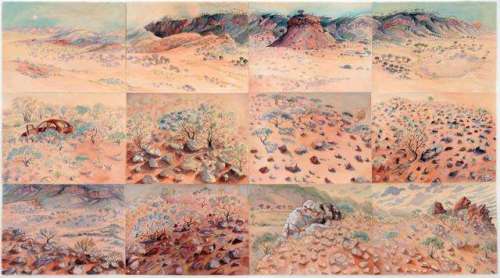
We really really couldn’t afford this. It’s Valley, by Carol Ruff, perhaps it should be rechristened Folie (à deux)

valley

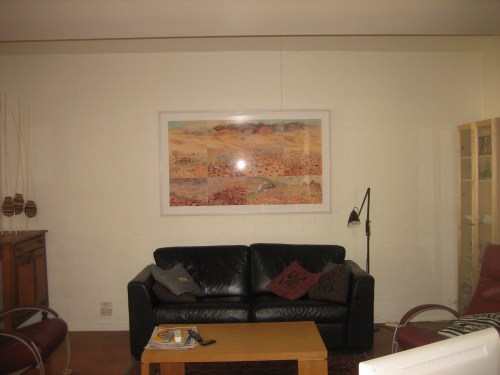
But here it is on our wall, making the endorphins flow:

IN room