Tag Archives: Australian history

David Marr’s Killing for Country at my Book Groups

David Marr, Killing for Country: A Family Story (Black Ink 2023)

I’m a member of two book groups. This month, they both focused on Killing for Country.

Before the meetings: An ‘ancient uncle’ asked journalist David Marr to explore their family history. As Marr complied, he came upon a photograph of one of his ancestors in the fancy uniform of the Native Police, the infamous organisation in which white officers led Indigenous men in extrajudicial killing sprees in lands that are now known as northern New South Wales, Queensland and the Northern Territory. Marr realised that this was a significant project and set about writing the interwoven stories of his forebears and the Native Police.

I imagine most of the book’s readers will know the broad outline of genocidal massacre that was instrumental in taking possession of the land in these parts of Australia, as elsewhere. Most of us now know that the euphemistic language of ‘dispersal’ and ‘punitive expeditions’ covers terrible atrocities. For me, Ross Gibson’s 2002 book Seven Versions of An Australian Badlands was a turning point. Rachel Perkins’s monumental TV series, The Australian Wars (2022), did heroic work in dispelling any residual beliefs that Australia was settled peacefully, and the Native Police featured in the third, heartbreaking episode. Anyone wanting to cling to such beliefs is advised to stay away from Killing for Country.

Marr follows the thread of his own family’s story through the complex history. He doesn’t try to be comprehensive. He makes no mention, for instance, of the punitive expeditions led by Sub-Inspector Robert Johnstone in Mamu country, the part of Australia that I come from. And professional historians will no doubt find fault with his work – he is too concerned to push his agenda, perhaps, and not judicious enough in checking his sources for sensationalist or other motivations, the kind of criticisms made of Robert Hughes’s The Fatal Shore. It certainly won’t please the columnists of Quadrant or commentators on Sky News at Night. But, as Marcia Langston says on the front cover blurb:

If we want the truth, here it is told by David Marr.

Told by David Marr means told well. I attended one of the many public talks Marr has given about the book, and on that occasion I was struck by the heavily ironic way he spoke of the perpetrators and justifiers of colonial violence as profoundly respectable men. It felt wrong, somehow, to praise them, even in mirthless, defensive jest. The book does none of that. In writing it down, evidently, Marr had no need for such defences. But the reader, this one at least, needs to take frequent breaks.

This is a key part of White Australia’s foundation story: brutal mass killings, including breathtakingly callous first-person accounts, followed by pseudo-euphemistic newspaper accounts (‘with the usual results’ is one memorable phrase to indicate many deaths) or political justifications. When I was reading the book, I watched Prosecuting Evil, a TV documentary about Nazi murders of Jews, and some of the horrific footage was an exact match for scenes described in this book.

There were people at the time who named what was happening in terms we can recognise, and many of those voices are also present here.

This isn’t history that can be comfortably consigned to the distant past: Marr is writing about his own family, and about history that constantly chimes with the present, or perhaps has never gone away. ‘Let no one say the past is dead,’ Oodgeroo wrote. ‘The past is all about us and within.’

It’s my custom on this blog to have a close look at Page 76. Weirdly perhaps, that page, chosen arbitrarily because it’s my age, often shows a lot about a book.

In Killing for Country, page 76 is the beginning of Chapter 7, ‘The Creeks’, which deals with two massacres, at Waterloo Creek and Myall Creek, and their aftermaths – the first a whitewash, the second a major scandal and a court case spearheaded by Attorney General John Plunkett, one of the settler heroes of the book, leading to the execution of seven murderers, but also leading, as Marr points out, to secretiveness on the part of later murderers of Indigenous people.

This page is pretty much the full treatment of the Waterloo Creek massacre. The Native Police, the main subject of the book, have yet to be established, but this brief account of a massacre by white troopers is something of a template for much of what is to follow.

Governor Richard Bourke, having tried without success to limit the activities of the squatters in their treatment of convicts and the traditional owners of the land they claimed, resigned and sailed back to England . In December 1837. His successor George Gipps was to take office in February 1838. In the meantime:

Reports had reached Sydney of fresh depredations by the Kamilaroi.

It’s worth noting here that Marr take great care with names. While his sources, such as the quote from the Sydney Herald below, refer to ‘Blacks’, ‘tribes’, and so on, Marr himself always specifies which First Nations are being talked about, in this case the Kamileroi. This simple act has a powerful cumulative effect, as nation after nation comes into conflict with the military, with vigilante convicts, and with the Native Police.

The Herald was baying for blood.

THE POOR BLACKS- Letters have been received from the Northern parts of the Colony, which state, that the Blacks are murdering the shepherds and stockmen with impunity. These letters also inform us, that the same tribe of Blacks are destroying the cattle by hundreds.

‘Baying for blood’ may be the kind of thing that professional historians would steer clear of, but I like the way it spells out what the newspaper leaves unspoken (these people are murderers and mass destroyers of cattle, therefore …). Elsewhere, Marr quotes newspaper correspondence and other contemporary sources pointing out that the ‘murders’ and ‘destruction’ are perpetrated by people defending themselves against an invasion or avenging atrocities committed against them. Such arguments are roundly mocked by the mainstream as sentimental wailers ‘desirous of acquiring a reputation for humanity’ – the tone isn’t so different from some of our current media talking about virtue-signalling latte-sippers.

While waiting for the new Governor to arrive, the Colony had been left in the hands of Colonel Kenneth Snodgrass, a capricious veteran of the Napoleonic Wars, who gave Major James Nunn of the 80th Regiment a free hand to deal with trouble on the plains. ‘You are to act according to your own judgement,’ said Snodgrass, ‘and use your utmost exertion to suppress these outrages.’

The fabulously named Kenneth Snodgrass, deftly characterised and contextualised in seven words, makes no other appearance in this story, but his instructions foreshadow the vague instructions given to officers of the Native Police. Without fail, the politicians giving the orders retain deniability. Their intentions are clear, but they consistently refuse to give explicit instructions to kill. All the Native Police massacres were illegal, and directly counter to general policies emanating from distant Britain, but no one was ever held accountable for them. At Waterloo Creek, the troops and mounted police were white, and so even less likely to face legal consequences.

At Waterloo Creek on 26 January 1838, Nunn’s troops and Mounted Police drove a large number of Kamilaroi into a swamp and slaughtered at least fifty.

One of my difficulties with the book is that I often lose track of dates. For example, I kept waiting for the moment when the narrative would intersect Melissa Lucashenko’s novel Edenglassie, in which the Native Police play a role. But 1854, Edenglassie‘s year, comes and goes without being named. So the explicit dating of this incident stands out. Serendipitously, I’m writing this on 26 January, a public holiday when fewer people each year choose to celebrate Australia Day. I’m guessing that Marr was struck by the significance of the date and left it there as a grim easter egg. The Waterloo Creek massacre happened on the 50th anniversary of Arthur Phillip raising the Union Jack on Gadigal land. A hundred years later, William Cooper declared the date to be a day of mourning. Today there’s a struggle over whether it’s Australia Day or Invasion Day.

Afterwards, Nunn found a few bits and pieces in their camp which convinced him he had punished blacks involved in the murder of Cobb’s shepherds on the Gwydir, a crime for which hundreds had already been killed. Back at Cobb’s head station, Nunn boasted to the appalled squatter of ‘popping off with his holster pistols the Blacks whenever one appeared from behind a tree’.

Again, this foreshadows how things will go. Where killings had to be accounted for, the commanding office would find or fabricate some dubious evidence to justify it. When Gipps presented Nunn’s account of the massacre to his Legislative Council, according to Marr he knew it to be a whitewash, but nothing more seems to have been done about it. Nunn’s boast was reported years later, according to a note, by Lancelot Threlkeld, another of the book’s settler heroes. Again and again, we see private boasting recorded in memoirs or letter, as opposed to public justifications.

I kept thinking of the last line of Bob Dylan’s ‘The Lonesome Death of Hattie Carroll’: ‘Bury the rag deep in your face, for now’s the time for your tears.’

After the first group’s meeting, Friday night: For this group, we had ambitiously agreed to read and discuss two books, Killing for Country and Debra Dank’s We Come with this Place. I wrote about Debra Dank’s book a while ago, here.

There were five of us. Only two had read all of Killing for Country. Of the others one said she gave up after 10 or so pages because she wasn’t interested in the wool industry and early colonial politics, another read about the same and decided she needed to read something more relevant to her life plans, and the third is still reading it, though she’s suspicious of it because she’s also rereading solid works of history like Heather Goodall’s From Invasion to Embassy and Grace Karskens’s The Colony.

All the same, once the slackers had been duly reprimanded (not by me, I hasten to note), we had a terrific conversation. While acknowledging the huge amount of work that went into the book, and that it had opened her eyes to a history that just hasn’t been told, the other completer said she found it unsatisfactory: leaping from place to place with maps that didn’t always help, likewise leaping from character to character, lacking a solid analytical context. She and the history-reader saw as bugs the things that I was content to note as mildly inconvenient features that resulted from the basic decision to follow the careers of particular David-Marr-related individuals.

There was some discussion of David Marr’s decision not to include Indigenous voices. I think he gave a good account of that in his final chapter:

This is a white man’s view of this history. I’ve drawn on rich Indigenous resources to write the bloody tale of Mr Jones and the Uhrs, but I found it was not my place to give the Aboriginal view of this tangled history. I asked Lyndall Ryan, veteran of so many academic battles on the frontier, which Indigenous scholars I should read. Indigenous scholars, she said, research particular incidents in their country. ‘But they don’t work on the frontier wars. The topic is whitefella business.’ An Indigenous colleague I’ve known for years put it this way: ‘You mob wrote down the colonial records, the diaries and newspapers. You do the work. You tell that story. It’s your story.’

(Page 409)

Others still felt that there was a glaring absence in the book.

The non-readers were appropriately contrite and asked productive questions.

We had all read and loved We Come With This Place. The mood lifted as we discussed it. Smiles came back to our faces, and we found ourselves flipping through the book to quote bits.

After the second group’s meeting, Tuesday night: This is my much loved, long-running, all male group (I’m the only man in the other).

I had a runny nose on Saturday night and a positive RAT on Sunday morning, so was stuffed with antivirals on Tuesday and couldn’t be there for this discussion. In the WhatsApp chat ahead of time, one man said he couldn’t read the book: ‘It was too brutal and depressing.’ Another sent us a lnk to The Australia Institute’s webinar with David Marr. After the even the WhatsApp reports said there was at least an hour’s worth of animated discussion.

I guess I’ll watch the webinar when I’ve had a little lie-down.
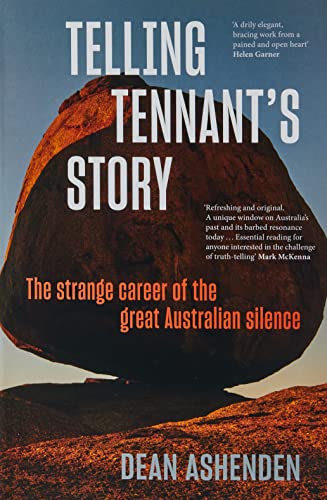
Dean Ashenden’s Telling Tennant’s Story

Dean Ashenden, Telling Tennant’s Story: The Strange Career of the Great Australian Silence (Scribe 2022)

A friend recommended Telling Tennant’s Story as his number one pick for anyone wanting to inform themselves before the Voice referendum.

My own number one pick would be Patrick Dodson’s article, ‘A firelight stick on the hill’ in the Monthly July 2023 (online here), which tells the agonising story of one representative body after another created and then destroyed, and includes this:

We are on the cusp of building a true foundation for our rich and diverse nation, upholding unity, and demonstrating respect for the First Peoples of this country while honouring our Western traditions. These aims are entirely compatible. Australia’s First Peoples are holding a firelight stick on the hill, beckoning us all to build a reconciled, healed and proud nation, where their unique position is recognised and respected.

Dean Ashenden’s book was published before the referendum was announced, but it tells the same story of First Nations voices going largely unheard for more than 200 years. In terms of the Uluru Statement from the Heart, it is about Truth rather than Voice or Treaty, but my friend’s recommendation is right on target. It’s hard to imagine anyone reading this book and then voting No.

Ashenden is a non-Indigenous historian, who spent several years as a child living in Tennant Creek in the Northern Territory. The book is framed as his quest to understand what was going on in the relationships between First Nations and settler people in the town back then. Who were those Aboriginal kids who sat at the side of the picture theatre during the Saturday matinee? Where did they come from? What was this ‘Mission’ that he heard spoken of? He ties this local quest to an account of the Great Australian Silence, anthropologist W E H Stanner’s name for the way Australian mainstream culture – politicians, journalists, historians, novelists, visual artists – ignored First Nations people for so long, relegated them, their concerns and their perspectives to the margins, and turned resolutely away from the terrible violence the settlers have inflicted on them from the earliest days of settlement.

It’s an enormous topic. The book adopts a number of strategies that ease the reader’s path.

First, there’s the personal element. Ashenden begins with his own experience in Tennant Creek, both as a child and on returning as an adult historian. We’re invited to witness him revising the version of the world he was given as a child – a process of revision that all of us settler Australians need to undertake (and incidentally, I’m looking forward to David Marr’s Killing for Country, about his forebears’ involvement in the Queensland Native Police).

Second, the book has a clear structure. Its ten chapters are divided into two parts: ‘Constructing the Silence’ and ‘The Struggle to Dismantle the Silence’. There’s a clear narrative line. Within it, after a prologue placing himself in relation to Tennant Creek, each chapter is organised around a particular year:

  1. 1860: The first contact of non-Indigenous people with the Waramungu of the area now occupied by Tennant Creek John McDouall Stuart’s passing-through was far from benign, but worse it was the harbinger of devastation and violence that was to accompany the building of the overland telegraph line 15 years later.
  2. 1901: This chapter is a nuanced account of anthropologists Frank Gillen and Baldwin Spencer, who visited Tennant Creek to ‘do’ the Waramungu in this year. Ashenden argues that their main contribution to the Great Australian Silence was to ignore the violence suffered by Aboriginal people and call attention to shiny ‘scientific’ studies of their customs and beliefs.
  3. 1933: This is the year that W H Stanner, in some ways the book’s hero, visited Tennant Creek, but the chapter deals mainly with other anthropologists, especially Adolphus Peter Elkin, who proposed the policy of assimilation that in effect meant elimination of First Nations cultures.
  4. 1958: Alongside the story of increasing disruption of the lives of Waramungu people, is the presence of Paul Hasluck in the Federal government, making assimilation official policy. Stanner attacked him with cutting irony in 1958, calling him ‘the Noble Friend of the Aborigines’.
  5. 1967: One of the many surprises of this book is that the 1967 referendum, which many saw at the time as a decisive step forward in Aboriginal affairs, rates barely a paragraph. Instead, the chapter focuses on an equal pay case, which was victorious but which led to widespread unemployment on Aboriginal workers; and Harold Holt’s establishment of the Council for Aboriginal Affairs.
  6. 1971: The first chapter of the second part begins with W H Stanner’s milestone 1968 Boyer lectures, which named the Great Australian Silence. After an excellent, critical account of the lectures, Ashenden moves on to the main subject of the chapter: the courtcase in which Yolngu elders claimed rights over land that the government was about to lease to a mining company. The case was lost, but Yolngu witness appeared alongside ‘expert anthropological opinion’ and their voices were heard. Not much later, Gough Whitlam introduced a bill that was passed by the Fraser government to become the Aboriginal Land Rights (Northern Territory) Act 1976.
  7. 1885: Tennant Creek is again front and centre, ‘on its way to becoming Australia’s most notorious dystopia’. In 1985, the Waramungu won a significant land rights claim.
  8. 1992: This was the year of the Mabo decision. The chapter focuses on the way historians and lawyers replaced anthropologists as the main allies of First Nations people. There’s a terrific account of Eddie Koiko Mabo, including his friendship with Henry Reynolds.
  9. 2000: Three years after the Bringing Them Home report on the stolen generations (whose main author Hal Wootton emerges as a model of someone who was willing to listen and learn), a court case found that a woman who had been taken from her family as a small child was not entitled to compensation. The chapter covers John Howard’s stance on Aboriginal matters and Kevin Rudd’s 2008 apology.
  10. 2005: Ashenden visits Tennant Creek again, sees ‘winners’ history’ on display everywhere, and First Nations stories now at last being told, but in a dauntingly beautiful building that is off the beaten track.

That list barely touches the surface of what the book covers. It’s a terrific read. Then there’s an Afterword, where Ashenden laments the way the heirs of John Howard’s History Wars continue to turn us away from the reality of our history, and argues eloquently for the importance of truth-telling. I’ll finish this blog post with the book’s final words

We might have got away with the silence had Aboriginal people not declined to disappear from history, as they were once expected – in both senses – to do. The past should indeed be ‘put behind us’ but it won’t be until it has been properly acknowledged, not by fessing up, or by telling just those parts of the story that suit particular purposes, but by telling our shared story as fully and truthfully as possible. How to persuade those with control over our institutions of that case? We’re on an offer to make it joint business.

(Page 244–245)

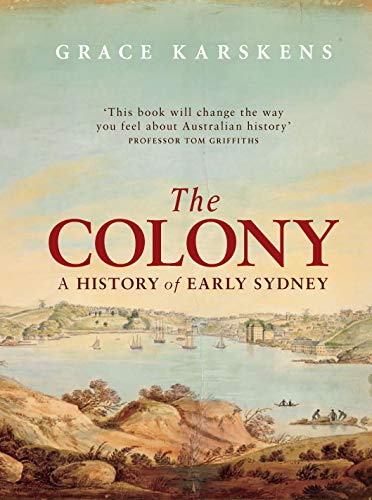
Grace Karskens’ Colony

Grace Karskens, The Colony: A history of early Sydney (Allen & Unwin 2009)

The Colony won the Prime Minister’s Literary Award for non-fiction in 2010. You can read the judges’ comments at this link.

The book is nothing less than a rewriting of the origin story of New South Wales.

It’s been on my TBR shelf ever since I read Tom Griffiths’ account of it in The Art of Time Travel (my review here) four years ago. The delay is probably due to the sense instilled by my primary-school education that Australian history is either boring or hard to face, but if a similar whiff hangs around Australian history for you, I encourage you to plunge through it. The book is a marvel and a delicious treat for the mind. It will probably speak most directly to Sydney dwellers, as it bring to life the rich history of Warrane / Port Jackson / Sydney and the hinterland, but the tale it tells of colonisation and the wars of resistance is a powerful rewriting of received versions that will resonate much more widely.

Karskens engages with other influential writers about the beginning of the Sydney colony. In his hugely popular The Fatal Shore, Robert Hughes failed to recognise that many of his sources were written as polemic, exaggerating and inventing for political purposes, and took them at face value. Inga Clendinnen’s Dancing with Strangers downplays the figure of an armed soldier standing amid the early scenes of apparently friendly dancing. Kate Grenville’s The Secret River cherry picks incidents from different times and places and as a result distorts the historical reality. Keith Windschuttle: well, anyone who accepts official records as the only source of information about the past just isn’t a historian.

A number of the basic, emblematic ‘facts’ of my early education disappear like a magician’s coins. For example, everyone now knows that Blaxland, Lawson and Wentworth (remembered by the mnemonic LBW) weren’t the first to cross the Blue Mountains as we were taught. They followed the tracks made by First Nations people. But it turns out they weren’t even the first settlers to do it. That honour actually belongs to an ‘extraordinary convict explorer’, John Wilson/Bunboee, who lived with Aboriginal people for a couple of years, underwent ritual scarifying, and later – but 14 years before the LBW team – went on a journey over the mountains and reported back in detail to Governor Hunter.

The orgy on the arrival of the second fleet just didn’t happen. The holey dollar, which we loved as nine-year-olds, barely rates a mention; instead, there’s a brief discussion of the consequences of an early decision to have no money in the colony. The Rum Rebellion likewise fades into the background. James Ruse, touted as the colony’s first farmer, is demoted to a minor opportunist. Lachlan and Elizabeth Macquarie emerge as effective self-promoters, and so on.

Instead, we have a portrait of a town where naked First Peoples know everyone’s business and actively negotiate the terms of co-existence; where nowie, the tiny fishing craft of Eora women, dot the harbour for decades after the First fleet’s arrival; where what is now Hyde Park is the site of frequent ‘contests’ among Aboriginal men, probably payback sessions, treated as a spectator sport by settlers; where convicts live in neat cottages from which many ply a trade or conduct a business.

The big difference from the history I was taught is in the account of the First Nations people. Their dispossession and resistance replaces the ‘savage yoke’ borne by the convicts at the centre of the story. Like Inga Clendinnen, Karskens reads settler documents with an eye to what can be divined of Aboriginal perspectives. Her account of the violence and bloodshed on the Cumberland Plain doesn’t shy away from the word war, and she quotes contemporary documents using that word. This book leaves its readers in no doubt that at its heart the settlement of New South Wales was a genocidal project, acknowledged as such at the time in all but the actual word.

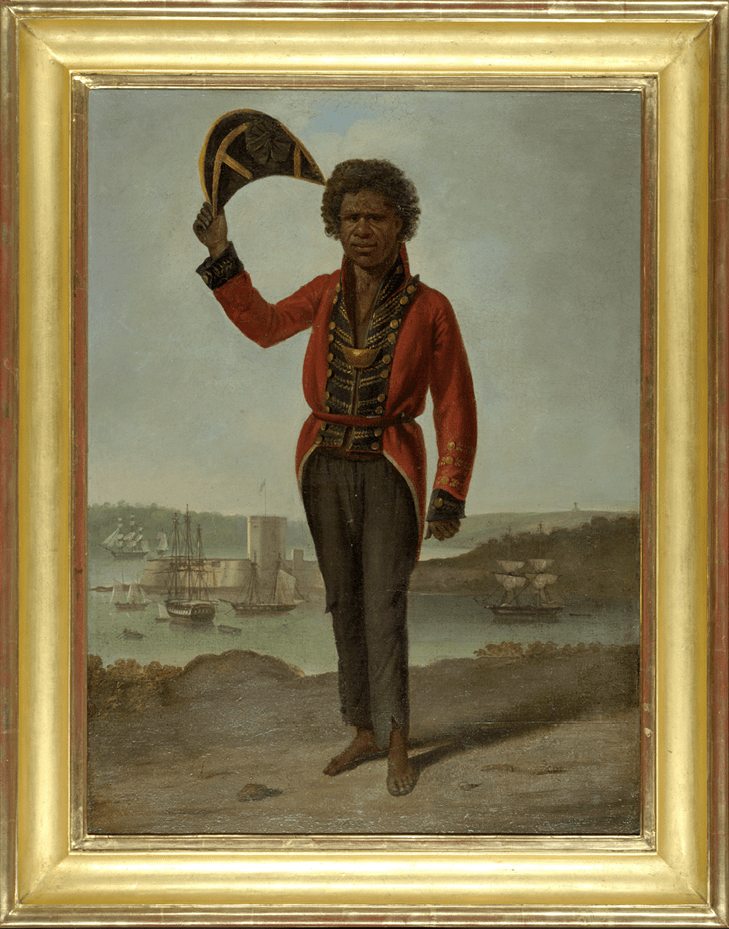
A number of Aboriginal men and women emerge from the pages as individuals, not least visually, in portraits that sit in counterpoint to the images meant to meet the needs of the curiosity-seekers back in England. Partly because I had a small hand in a children’s graphic novel in which he played a part (link here), I was struck by the representation of Bungaree. In the block of colour prints between pages 338 and 339, there’s Augustus Earle’s famous portrait showing him dressed in borrowed military gear, doffing his cap as he welcomes new arrivals to the settlement – an assertion of custodianship of the land that was tolerated because it was seen as vaguely comic (and Bungaree was by many accounts an accomplished comedian and mimic):

Augustus Earle, ‘Portrait of Bungaree, a native of Australia’ (National Library of Australia)

This is often paired with a later painting of him in a similar pose, but surrounded by evidence of his descent into alcoholism and misery. Instead of that painting, Grace Karskens gives us this, painted by a visitor who had less vested interest in the British colonisers’ point of view:

Russian visitor Pavel N Mikhailov’s portrait of Bungaree (Russian State Museum)

This is not a man who can be treated as an ethnographic curio. If he came onto your ship, even barefoot and wearing military cast-offs, and said, as he did regularly, ‘This is my shore,’ it would carry weight.

My copy of the book is bristling with Post-its, but I’ll leave it at that. If you live in Sydney, read it. It will change your sense of the place. I’ll give Grace Karskens the last word. This is from her Acknowledgements:

I hope this book will also be a gateway to the wider world of Sydney writing: it is in part a tribute, a celebration of the restless, exciting spirit of inquiry, the tireless work that Sydney scholars of all stripes and inclinations do, and the joys of discovery and of telling new stories as well as old ones.


The Colony is the 13th book I’ve read for the 2020 Australian Women Writers Challenge.

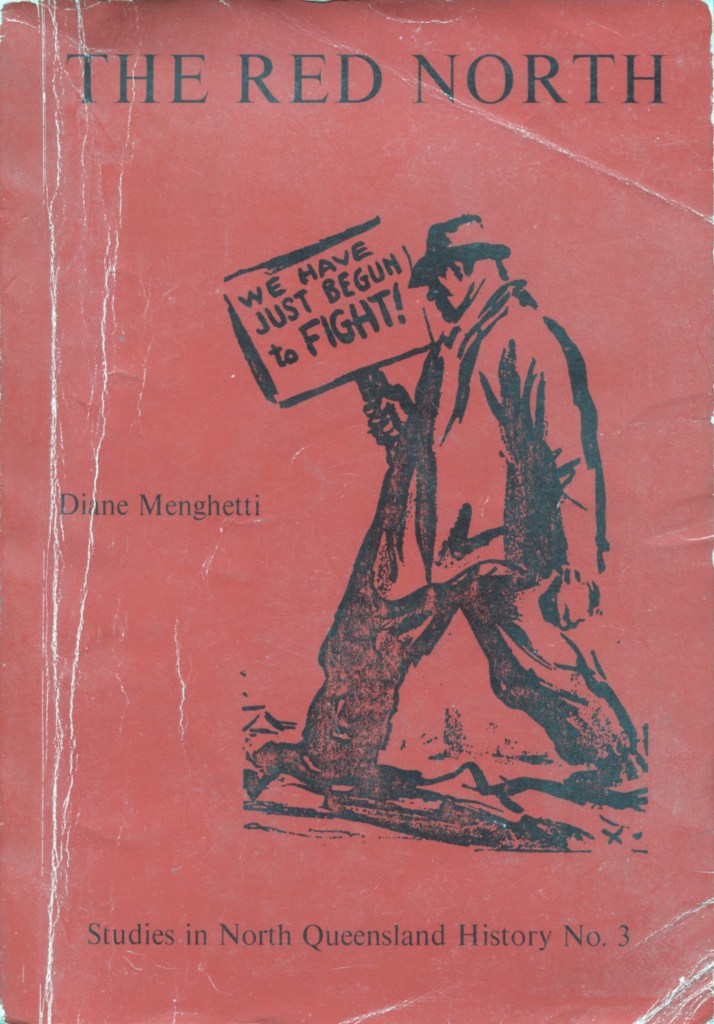
Diane Menghetti’s Red North

Diane Menghetti, The Red North (Studies in North Queensland History No 3, James Cook University of North Queensland 1981)

The student of North Queensland history frequently encounters evidence of widespread political radicalism which is difficult to reconcile with her personal experience of the district.

(The Red North, the beginning of the Introduction)

Indeed! Mention that the only member of the Communist Party of Australia ever to be elected to a parliament was in Queensland, where Fred Paterson was MLA for the seat of Bowen from 1944 to 1950, and the most common reaction is, ‘What happened?’ Diane Menghetti doesn’t set out to answer that question, but her book is a solid account of the second half of the 1930s when the CPA was more of a force in North Queensland than in any other part of Australia.

The Studies in North Queensland History series ran from 1978 to the mid 1990s.* I must have got hold of The Red North, No 3 in the series, soon after it was published and then been daunted by its non-commercial feel. It makes no pretence of being other than an MA thesis, set in courier with a foreword by a professor, footnotes and 60 pages of appendices.

But it turns out to be a fascinating read – for me, and I expect for many people like me who hail from that part of the world, as well as anyone interested in the history of the labour movement and Communism in Australia. With a wealth of detail, Menghetti describes how the CPA became an integral part of the social life of many North Queensland communities, supporting non-British labourers in the face of the British-preference policies of the Australian Workers Union, raising an extraordinary amount of money for the Spanish Civil War, organising social events, providing regular entertainment in the form of public meetings featuring gifted orators such as Fred Paterson.

We didn’t hear much of the history of the North in my childhood: snippets of family lore in a family that wasn’t much given to story-telling, and nothing at all at school that I can remember. When we were taught that Australia was settled in 1788, it wasn’t just tens of thousands of years of prior habitation that were ignored, but also the reality that settlement/ invasion occurred over decades – reaching north Queensland well into the nineteenth century. Even today, people talk as if Australian was mono-culturally Anglo-Celtic during the 1950s, erasing not just Indigenous peoples but also the large number of ethnic Chinese, Koreans, Italians, Maltese, Jugoslavs who I went to school with, many of whom had been around for generations.

So there’s a particular joy for me now to read a whole book about our history, about significant struggles that took place in places from my childhood: not just Innisfail, Cairns and Tully, but Mourilyan, Goondi, South Johnstone, El Arish, Flying Fish Point and Etty Bay. I especially love the moments where this narrative intersects with the little bits of history I had from my parents. I’ll give two examples.

First: in my childhood, the sugarcane was burned before it was harvested. We loved the spectacle of the cane-fires, and were told that their purpose was to kill the rats that infested the cane because the rats carried the deadly Weil’s disease. Burning the cane was necessary to save the lives of the canecutters.

That’s accurate. What it leaves out is one of the main episodes of this book, the bitterly-contested Weil’s disease strike by canecutters and mill hands from August to October 1935. Something of the flavour of the times, and of what we are deprived of when this history is erased, can be gleaned from events in Tully on 24 September 1935. The AWU, which generally opposed the strike, had called a meeting of all canecutters and millhands for that day:

During the previous night [the strike committee] had worked to turn the AWU meeting to the strikers’ advantage, and when the hour of the conference arrived, over a thousand strikers and sympathisers formed up at the top end of Tully’s main street. This street slopes fairly steeply down to where the Plaza Theatre is situated, almost at the end of the main town area. Thus the great procession, led by the Tully Pipe Band, marched right through the business area before the start of the conference. The AWU organiser opened the meeting with a call for nominations for the chair. Eric Driscoll, Communist mill representative, was duly elected and the executive of the strike committee took its place on the platform, reflecting its control over the total strike. The expressed purpose of the meeting was the election of delegates to represent the men at a compulsory conference of millers, farmers, strikers and the AWU. Towards the end of the meeting the ‘scabs’ from the mill arrived to cast their vote. They were escorted by police and their entry was considered by the strikers to be an act of provocation. Nevertheless, at [strike committee leader Jack] Henry’s urging, the election was concluded peacefully. The conference was never held.

(page 40)

Second: When I was in my 30s my mother astonished me by saying that the Depression didn’t happen in Innisfail, that out-of-work people from ‘down south’ used to come to our door asking for work or food. I knew there had been a large unemployed camp in the Cairns showground, so I put this down to my mother’s over-protected life at the time as the fiancee and then bride of a cane farmer.

Two short quotes from The Far North are relevant. First, confirming my view:

In the far north the Depression set in early with a slump in world sugar prices. With economic hardship came xenophobia.

(page 53)

But then this, offering some support to my mother’s account:

In the years preceding World War Two unemployment remained very high. The mildness of the northern climate may have reduced some of the distress among the local unemployed, but it also had the effect of attracting large numbers of men from the south, either looking for work or merely travelling to fulfil unemployment relief conditions. For many the journey terminated in Cairns where a large unemployed camp was established.

(page 109)

After I’d written most of this blog post I discovered that a new edition was published by Resistance Books in 2018 (details here). ‘The Red North,’ they write, ‘is a fascinating episode and one deserving of serious study by all those interested in seeing the development of a serious progressive force in Australian politics.’

The Red North is the fifth book I’ve read for the 2020 Australian Women Writers Challenge.


* Other titles in the series that I’ve been able to find are:

  • 2 Peter Bell, If anything, too safe: the Mount Mulligan disaster of 1921, 1978
  • 4 Christine Doran, Separatism in Townsville, 1884 to 1894: we should govern ourselves, 1984
  • 5 Dawn May, From bush to station: Aboriginal labour in the North Queensland pastoral industry, 1861–1897, c1985
  • 6 Cathie R. May, Topsawyers, the Chinese in Cairns, 1870–1920, c1984
  • 7 Dorothy Gibson–Wilde, Gateway to a golden land: Townsville to 1884, 1985
  • 8 Anne Smith, Roberts Leu and North: a centennial history, c1986
  • 9 Dorothy M. Gibson–Wilde and Bruce C. Gibson–Wilde, A pattern of pubs: hotels of Townsville 1864–1914, 1988
  • 10 Helen Brayshaw, Well beaten paths: Aborigines of the Herbert/Burdekin district, north Queensland: an ethnographic and archaeological study, c1990
  • 11 Marjorie Pagani, T.W. Crawford: politics and the Queensland sugar industry, 1989
  • 12 Bianka Vidonya Balanzategui, Gentlemen of the flashing blade, 1990
  • 13 Janice Wegner, The Etheridge, 1990
  • 14 Christine Doran, Partner in progress: a history of electricity supply in North Queensland from 1897 to 1987, 1990
  • 15 Todd Barr, No swank here? The development of the Whitsundays as a tourist destination to the early 1970s, 1990
  • 16 Ferrando (Freddie) Galassi, Sotto la Croce del Sud = Under the Southern Cross: the Jumna immigrants of 1891, 1991
  • 17 Dawn May, Arctic regions in a torrid zone: the history of the Ross River Meatworks, Townsville, 1892–1992, 1992
  • 18 Bruce Breslin, Exterminate with pride: Aboriginal–European relations in the Townsville–Bowen region to 1869, 1992.
  • 19 Eileen Hennessey, A cup of tea, a Bex and a good lie down, 1993
  • 20 Anne Smith, This El Dorado of Australia: a centennial history of Aramac Shire, 1994
  • 21 Patricia Mercer, White Australia defied: Pacific Islander settlement in North Queensland, 1995

Freeman & Beer’s Amazing Australian Women

Pamela Freeman and Sophie Beer,  Amazing Australian Women: Twelve Women Who Shaped History (Lothian 2018)

When I ran into the lovely Pamela Freeman in an Annandale cafe the other day, just down the road from where I used to live, she insisted on interrupting her lunch to dash off, and returned to present me with a copy of Amazing Australian Women, which she inscribed to my almost-one-year-old granddaughter.

The granddaughter won’t be ready for this book for another couple of years, but I couldn’t just leave it to wait for her. Besides, I’ve been a fan of Pamela’s writing for young readers (and old) for years.

The book is what it says on the lid: twelve spreads, each featuring an amazing Australian woman. It’s a terrific list, presented with a keen eye for the memorable detail, and decorated by Sophie Beer with wit and charm.

I’m willing to bet that none of my readers, asked to draw up a list of twelve Australian women who have changed history, would come up with exactly the twelve women in this book. I’ll bet the lists wouldn’t be identical even if I tightened the brief and asked you to include women who represent ‘warriors, artists, business owners, scientists, singers, politicians, actors, athletes, adventurers activists and innovators’ (to quote the back cover), and then tightened it again to say your list must include at least one Aboriginal or Torres Strait Islander woman, at least one other person from a non-European background, and at least one person with a disability.

The two absences that surprised me were Cathy Freeman and Mary McKillop. At least four of the inclusions are new names to me. Of the ones I knew about, none felt Wikipediated. Did you know for instance that Mary Reibey, when she was thirteen, dressed in boy’s clothes to ride the horse she was then accused of stealing? And did you know who discovered the cause of the Northern and Southern Lights? 

If you want to know who made it onto Pamela’s list, whether for your own enlightenment and entertainment, or to quarrel with her decisions, you probably don’t have to wait for the author to give you a copy. Once you’ve checked it out, you might well consider buying it as a gift for a young girl (or boy, because what boy doesn’t want to know about amazing women?)

Amazing Australian Women is the nineteenth book I’ve read for the 2018 Australian Women Writers Challenge.

Tom Griffiths’ Art of Time Travel

Tom Griffiths, The Art of Time Travel: Historians and their Craft (Black Inc 2016)

For transforming young minds there is probably nothing more powerful than history in the hands of a charismatic teacher.

1863958568.jpg

That’s a quote from Don Watson in the current Quarterly Essay, Enemy Within. It could have been an epigraph for The Art of Time Travel, which tells the stories of fourteen charismatic teachers, practitioners of the craft of history in Australia. Most of them are or were university lecturers; all of them, individually and collectively, have transformed minds both young and old.

From Tom Griffiths’ very readable, richly anecdotal and often personal accounts of these careers, there emerges a fascinating story of how the mainstream understanding of Australia has expanded, deepened and, yes, transformed over the last three quarters of a century. Australian history, which used to be seen as a short, derivative footnote to the history of England, or occasionally as a collection of beautiful lies that happen to be true (as in Mark Twain’s famous quote), is now something quite different. No one could have imagined 75 years ago, for instance, that the Sydney Morning Herald would be reporting on a local Council being called on to defend its refusal to acknowledge that the Council meets on Darug land. Griffiths offers this summary of the changes:

Australians discovered that the New World was actually the Old, and that the true ‘nomads’ were the colonisers. The nation continent was reimagined as a jigsaw of bioregional countries, which had for so long been its state. The biological cringe about ‘monotonous gums’, ‘songless birds’ and ‘fossil animals’ was replaced by a deep historical narrative about the continent’s southern organic genesis. Australian history became as much about ecological, social and technological discontinuities as about the political stability and continuity for which the European settlers first celebrated it. British colonisation was seen as both an invasion and an awesome social experiment; there was dancing with strangers and there was war. Historians ventured to the other side of the frontier and peered back at the ‘white men’s eyes’, and Aboriginal people were compelled – and some chose – to cross the beach in the other direction. In remote parts of Australia, the Indigenous inhabitants became the custodians of white history as well as black, because they stayed on country while the whites moved away. In the coastal cities Aboriginal people were found to have always been part of Australia’s modern urban history. Indigenous scholars studied the nation’s unending frontier and the intense colonial revolution into which they had been thrown.

Most literate Australians will be aware of these changes. This book gives something of the nuts and bolts of how they came about, through the changing concerns of historians, the new resources (such as carbon dating) available to them, and a shake-up of historians’ methods to include sources other than official written records, and to approach their task as an art as well as a science. Among the historians discussed, some are little known outside the academic world and some are household names. Some of the most interesting developments have spread gently, as if by stealth or osmosis, from scholarly specialty to common knowledge; others have been fanned into spectacular controversy.

If you were to draw up a list of 14 key Australian historians of the 20th century, it would be a different list from Griffiths’, as he acknowledges in his Prologue (he mentions that Manning Clark rates only a couple of lines; that’s also true of Russel Ward). But the strong likelihood is that all of your chosen ones are at least mentioned either briefly or extensively in someone else’s chapter. Some of the individuals through whose lives and work Griffiths tells his story aren’t even professional historians. They include a novelist, a poet, and an archaeologist. But – he argues convincingly – they all practise the craft of history.

I won’t attempt to summarise the riches the book offers, but here’s a list of the writers discussed, with a taster from some chapters:

Eleanor Dark‘s 1941 novel The Timeless Land was fiction, yes, but also the product of intensive original research:

Dark was decades ahead of Australia’s historians in realising that the big story about British colonisation at Port Jackson was that of the encounter between settlers and Aborigines.

Keith Hancock, after a lifetime working in Imperial and Commonwealth history, returned to a study of his own country and produced a pioneering work of environmental history, Discovering Monaro (1972):

The rise of environmental politics in the late 1960s brought ecology and history closer together, directly stimulating historical scholarship and giving the new environmental history an occasionally apocalyptic and moralistic tone. Hancock placed Discovering Monaro in this new political and scientific context through his engagement with the insights of ecologists and also his twin invocation of the local and the global, a dialectic that bypassed nationalism, the central concern of Hancock’s earlier work.

John Mulvaney published The Prehistory of Australia in 1969. Among archaeologists in mid twentieth-century Australia, he was known as ‘the scientist’ as, among other ground-shaking deeds, he brought carbon-dating technology to bear on assumptions that Aboriginal people had been in Australia for a comparatively short time.

Geoffrey Blainey, a ‘genuine contrarian’, is deeply suspicious of intellectual fashion, and has repeatedly found himself caught up in controversy whether as a precursor to Hansonism in his 1984 remarks about Asian immigration or in endorsing climate ‘sceptic’ Ian Plimer. His best known book is The Tyranny of Distance (1966), but The Great Seesaw: A New View of the Western World, 1750–2000 (1988) may be his central book.

Judith Wright, one of Australia’s great poets, wrote two works that earned her a place in this company. The Generations of Men (1959 – at last, a book I’ve actually read!) is what Griffiths calls ‘a semi-fictional novel’ about her grandparents, who were settlers in south Queensland. The Cry for the Dead (1981) revisits the same place a couple of decades earlier to tell a story of the frontier:

In The Cry for the Dead, the story of the land is inextricable from the story of its original people and equally revealing of what the invaders were doing, or not doing. It was a double ignorance and silence Wright was dealing with: ‘If the English settlers were contemptuously ignorant of the realities of Aboriginal life, they were equally ignorant of the country itself.’

Greg Dening‘s most famous book was Mr Bligh’s Bad Language: Passion, Power and Theatre on the Bounty (1992). He shines out from these pages as a writer, but even more as an inspiring and much loved teacher:

Greg’s advocacy of the creative imagination was shaped by his engagement with two different worlds … On one side was the academy. His foundation lecture, ‘History as a Social System’, was his challenge to that institutional inheritance, and all his teaching was radical and dangerous in the way it undermined the academic poses of neutrality and dispassion and made explicit the socialisation of disciplinary knowledge. The other world he addressed with the phrase ‘the creative imagination’ was that of public literary culture … He urged his students to be ‘open to those other ethnographers of our living experience’ – our poets, novelists, comics, cartoonists, film-makers and photographers.

Henry Reynolds‘ world-changing book is The Other Side of the Frontier (1981). His books aren’t big on the literary elements encouraged by Greg Dening, but are ’empiricist, rational, highly structured, heavily evidenced, reinforcing and repetitive, professionally conservative, accessible to the courts’. That is to say, they’re not much fun, but they bring Australia’s frontier violence to light in ways that are defy attempts to dismiss them as pure ideology. In the chapter on Reynolds, Griffiths discusses Keith Windschuttle’s much-publicised attack on academic Australian historians as a body. Paradoxically, Windschuttle’s accusations of fabrication led to an upsurge of careful research into the frontier, which demonstrated that violence was even more widespread than had been thought before his attack. Griffith’s discussion is nuanced and respectful, but gives no quarter.

The chapter on Reynolds also includes a discussion of Noel Pearson’s complex take on the history of colonisation as ‘a third-generation legatee of mission protection’.

Eric Rolls, perhaps better known as a poet than as a historian, is another of the non-academics on the list. His A Million Wild Acres (1981), the history of a forest in northern New South Wales, is singled out for high praise:

In my mid-twenties and freshly home from my first trip overseas, I … wrote a brief letter to Eric Rolls, telling him that A Million Wild Acres was one of a handful of books about Australia that I would like to put in the hands of any visitor to help them understand my country. Now I would make greater claims for it. I think it is the best environmental history yet written of Australia, and I would hope it could be read not just by visitors but by all Australians.

Stephen Murray-Smith was the founding editor of Overland. His chapter here focuses on a book written a couple of years before his death, Sitting on Penguins: People and Politics in Australian Antarctica (1988), and places it as a significant intervention in Antarctic politics. The Antarctic experience is also a spur to some elegant reflections – by Griffiths as well as by Murray-Smith – on the importance of history:

Murray-Smith argued forcefully that history is not a luxury in Antarctica, declaring; ‘We shall lack the essential tool to our understanding of Australian Antarctica until those with the interest and capacity to write its history are found. And not just one history. Preferably several, or at least a history that will provoke a debate.’ History down south, he was saying, as in any society, is a practical and spiritual necessity. But especially so in a place without families or normal generations, where no one lives their whole life, and where the coordinates of space and time are warped by extremes. And on a continent claimed by various nations but shared by the world, history carries a special international obligation. It is the fundamental fabric of a common humanity.

Donna Merwick‘s best known book, Death of a Notary (1999), isn’t about Australia at all: the notary of the book’s title lived and died in what is now New York state in the mid-seventeenth century. Her role in this book’s overarching narrative is to illustrate developments in the philosophy of history, in her writing and in her teaching at Melbourne University. It is through her that Griffiths talks about the ‘linguistic turn’, the arrival of postmodernism:

From the 1970s, postmodernist intellectual fashions swept through Western universities, especially amongst literature and anthropology departments, and challenged the reliability of historical knowledge. All ‘facts’, it was suggested, were intellectual constructions; an independent empirical reality would thus be inaccessible. Fact and fiction blurred playfully, dangerously. The discipline of history, with its moral and civic responsibility to insist on that distinction, was challenged to the core … Some historians were angry and defensive; some were concerned about the consequences of extreme relativism and what they saw as an attack on the Enlightenment project of rationality; some were capsized. Donna welcomed the tempest because, as a champion of the literary and artistic dimensions of the writing of history, she saw opportunities in the new wind and harnessed them. Remaining steadfastly at the helm, she tacked tenaciously to new, secure lands she could not otherwise have reached.

Merwick did not regard postmodernism as an optional intellectual fashion, but a historical condition.

Graeme Davison gives Griffiths an opportunity to reflect on the current widespread enthusiasm for family history. Far from dismissing it, as some historians do, Davison brought his professional skill to bear on his own family in Lost Relations: Fortunes of My Family in Australia’s Golden Age (2015):

[The] book was a search for identity, as all family history fundamentally is, but it was also a reflective exploration of family history as a method – and what better case study could there be than one’s own family? But it is more than that. If a historian wants to examine the mystery of the relationship between generations, and he wants to do it in a personal and contextual way, then he has no choice about where he must go.

Inga Clendinnen died when I was reading this book. I hope she knew how much she was loved by many people she’d never met. Her Dancing with Strangers (2003) radically challenged the prevailing version of the early settlement in Port Jackson. Griffiths’ discussion of her technique of interrogating documents, both in that book and in Aztecs and Reading the Holocaust, is fascinating. But the spine of her chapter is his exploration of the different functions of history and historical fiction. He revisits the public tension between Clendinnen and novelist Kate Grenville over the latter’s The Secret River, and opens it out for what it can teach us:

Historians always have at least two stories to tell: what we think happened, and how we know what we think happened. So the ‘non’ in our ‘non-fiction’ signifies an edge that can sharpen our prose and heighten our sense of danger and wonder. It also acknowledges that there are things we don’t and can’t know. Silence, uncertainty and inconclusiveness become central to the narrative.

Grace Karskens rates a substantial mention in Inga Clendinnen’s chapter, because her ‘wonderful’ book The Colony (2009) aimed ‘to continue Clendinnen’s and Grenville’s project of re-examining and rethinking early colonial race relations’. She also has a chapter of her own, as an exemplar of a public historian – that is, a historian who works outside the academy, as a consultant, for example, on archaeological digs or local council history projects.

I sense that some of the power of Grace’s prose and analysis derives from her vocational commitment to pubic history, from her dedicated engagement with history as a human characteristic, from her intellectual curiosity in history as not just a product of the academy but as also the vernacular of our cultural and social systems. Her inquiries have arisen from a public hunger for history, from council commissions, from heritage processes and battles, from environmental threats and assessments, from the stimulus of real places and sensuous things, and from a desire to make sense of how the past is in the present.

Mike Smith ‘is an archaeologist who has revolutionised our understanding of the human history of Central Australia. His main work, The Archaeology of Australia’s Deserts, is possibly as dry as its title suggests, but he engages deeply with the people who have lived in those deserts for many generations, and in his exploration of ‘deep time’ makes some profound discoveries.

When Europeans and North Americans look for cultural beginnings, they tend to assume that humans and their civilisations are products of the Holocene (the period since the last ice age) and that we are all children of this recent spring of creativity in the history of the world … In greater Australia at the last glacial maximum, we did not have an ice age so much as a dust age. And the history of Aboriginal people takes us back, if not into the ice then certainly into the dust, through periods of temperature change of 5ºC and more, such as those we might also face in coming generations. An Australian history of the world includes the experience of people surviving cold droughts in the Central Australian deserts from 30,000 years ago, and the sustaining of human civilisation in the face of massive sea-level rises and temperature changes.

If you’ve stayed with me this far, I hope you can tell that I found this book endlessly stimulating, and have come away from it with a reading list as long as my arm.