This little book is populated by a handful of painfully shy individuals living on the outskirts of a small Australian town in the 1950s. There’s Betty Fletcher and her two children, Michael and Little Hazel. The children were conceived and born elsewhere, but it’s not the kind of town where people pry into one another’s business. Mues, one of their neighbours, is a retired slaughterer and a pretty unsavoury character – he exposes himself to Little Hazel in the first couple of pages, and it’s a sign of things to come that the little girl, far from being traumatised, is profoundly disappointed that his promise to show her a pony was a trick, that adults can’t be counted on: ‘they hold one thing in their hand and call it another.’ the other neighbour is Harry, a dairy farmer, who has become a virtual member of their family, having dinner with them and being called over to help with masculine tasks like removing a dead possum from their roof. And then there’s Harry’s dairy herd, half a dozen kookaburras and sundry other specimens of animal and bird life.
Not a lot happens: Harry takes notes on the kookaburras’ family life, and his milking of the cows is beautifully described; Betty works in an old men’s home, and her warm-hearted management of their needs is not so very different from Harry’s caring for his cows; Hazel keeps a journal about the bird life at school, and it wins second prize; Harry and Betty have an undeclared mutual attraction that builds convincingly over years; Harry decides to take on young Michael’s sex education, which he does in awkwardly comic conversations and in long letters that are a mix of frank personal reminiscence and weirdly detailed accounts of human female anatomy (possible the book’s central tension hinges on these letters – will he actually give them to Michael, and if so what will happen?); Michael embarks on his own sexual experiences; Mues makes an occasional appearance, each less savoury than the last.
It’s not a book to read for the plot. Tension builds and is resolved without insulting the reader’s intelligence, but the main pleasure is in the way we come to know and care about the characters and understand their place and time. They live in a harsh enough world – not exactly nature red in tooth and claw, but death and an uncompromising physicality are everywhere. If you think of kookaburras as slightly comic, benign creatures, Harry’s observations will put you right. Likewise, big-eyed dairy cattle aren’t all sweetness and light, and looking after old men with dementia isn’t work for those of delicate sensibilities. Yet the depiction of this harsh world is suffused with a warm, compassionate affection the way a Drysdale landscape is with light. That is, things may not be pretty, but they’re closely observed with what, if it’s not love, will do till love comes along.
One small note: I was unsettled when I recognised one of Harry’s personal recollections as an episode from Havelock Ellis’s autobiography, relocated from the London Zoo to an Australian country orchard (if you’re curious you can google “Havelock Ellis” “I did not mean you to see that”). This made me wonder about the sources of the sex education passages. Harry does drop in at the town library and, improbably, read a book by Havelock Ellis (not the autobiography), so perhaps that is an implied acknowledgement. A note up the back acknowledges that the novel’s title is pinched from a 1922 book by Alec Chisolm, perhaps implying that the bird descriptions owe a debt to that book. I guess that’s all fodder for scholars.
This is the eighth book I’ve read as part of the Australian Women Writers Challenge 2013.
Jennifer Compton, Parker & Quink (Ginninderra Press 2004)
Jennifer Compton was in her mid 20s when she burst onto the Australian theatre scene with her play No Man’s Land, which shared the 1974 Newcastle Playwriting Competition prize with John Romeril’s The Floating World (distinguished company!), was produced by Ken Horler at the Nimrod Theatre in Belvoir Street and, redubbed Crossfire to avoid confusion with Harold Pinter’s play of the same name, was published by Currency Press.
Parker & Quink came 30 years, 3 plays and at least 3 books of poetry later, and has been followed by other plays, other books of poetry. I came upon it by chance, as one still can in bricks-and-mortar bookshops. Time passes, we grow older, times change: that’s a recurring preoccupation of these poems, from the three-line title poem to the 18 stanzas of ‘During the Power Cut I Read, by Candlelight, “Ballade” by Kenneth Koch’.
Parker & Quink: the young might stare at these words blankly, but for us sexagenarians they have unmistakeable nostalgic power to evoke the sensual feel of a fountain pen, the aroma of quality ink, the dubious joys of blotting and smudging, perhaps even the quiet pleasure of receiving one’s first Parker pen as a reward for doing well in a school exam. The title poem, just three lines, draws on those associations, but its tone is more bemused than nostalgic:
Parker & Quink
To write your email address
with a fountain pen filled with ink
like lighting a candle on the moon.
The past isn’t just another country, it’s a whole other celestial body, with unbelievably limited, even ineffective communication technology. Yet to my way of thinking a lot of the poetry in the rest of he book uses just that technology: the kind that needs the reader to come and sit with it for a while, rather than providing instant hits, instant links. The second poem, ‘Imposing the Chat’, starts out with a chat room report of attending a gallery opening where (the capitals are hers)
ALL THE ARTWORKS HAD BEEN MADE BY
THE PARENTS OF MURDERED CHILDREN
I don’t understand chat room jargon, but I think the speaker is thrown out of the room, presumably because her subject is unacceptable. She is left to write in a form where ‘the words do not evaporate out of the top of the page’, where she can’t just shout in performative horror but goes on to grapple with the complex and disturbing experience of attending that opening, talking with some of those parents, remembering at least one of the murders and driving home wordlessly with her husband to look in at last on her sleeping children. As the first line of the poem puts it, ‘It should be hard to write.’ Sometimes candles and moonlight, however ineffective, are what’s called for.
That’s the first two poems. After them, the book touches on many subjects, speaks in many voices, reflects many moods. There are memories of a New Zealand childhood, private acknowledgement from an eminent theatre critic (though we’re left not knowing if this was real or imagined), a touch of Bildungsroman, the imitation of Kenneth Koch I mentioned earlier (a kind of compressed, fragmentary, cryptic autobiography), dreams, dramatic monologues, and perhaps my favourite, an imitation bird call whose title is, perhaps accidentally, three words from James McAuley’s ‘Magpie‘:
Every Morning, Waking
Out in the zero velvet of the night
swinging deep into left field
the first interrogatory of the aubade.

A startle of – Where was I? What!
Then the anxious, enquiring flex,
– And am I still a magpie? Yes!
This is the seventh book I’ve read as part of the Australian Women Writers Challenge 2013. I undertook to read six and review four, and I’ve now read seven and reviewed six, so I guess I’ve met the challenge, but as a matter of interest and google fu I’ll keep adding a note when I read an AWW title.
I just couldn’t get on this book’s wavelength. I appreciate the cleverness of many of the poems, but very few of them speak to me personally. I’m glad I read it to the end, because the poems I most respond to occurred in the final section: ‘crease’, about enduring tensions between mother and daughter; ‘fifteen kinds of infidelity’, which is what it says on the tin; ‘the moon and the stars were our chandelier’, which lives up to its excellent title.
A number of the poems are self-described ‘responses’ to other poems or works of art. ‘Corner of Glebe Point Road and Broadway’ and ‘the day we almost hung’, for example, play with Gwen Harwood’s ‘Suburban Sonnet’ and Frank O’Hara’s ‘The Day Lady Died’ respectively, each line (with one exception in each case) ending with the same word as that line in the earlier poem. It’s clever, and fun, but the effect each time was to send me back to the earlier poem, in whose light the present poem seemed a pallid, arbitrary thing. Similarly, when I read the poems responding to work by Ron Muecke, Diane Arbus, Cy Twombly, Hans Bellmer and Giorgio Morandi, I went to those works, either in memory or by Google, and felt no particular urge to come back. Maybe that’s a problem inherent to ekphrastic poetry, or – more likely – there’s something I’m not getting.
This is the sixth book I’ve read as part of the Australian Women Writers Challenge 2013, but I won’t add this post to the website, as it’s not really a review – more a note that I’ve read the book.
The Art Student, who professes to hate poetry, recently went to a talk by Julie Chevalier about this book, and was so fascinated by the subject of Henry Darger she bought me a copy.
Darger is a fascinating man. He has a Wikipedia page. There’s a movie. John Ashbery wrote a long poem inspired by his work. Very briefly, he was a reclusive eccentric who lived in poverty and imagined a vast epic in which little girls take on armies and interplanetary beings. Shortly before his death his landlord discovered the bulky volumes of handwritten manuscript, along with the copious illustrations, and recognised a work of weird genius.
This book is an impassioned introduction to his story, or rather Julie Chevalier’s poetic record of her encounter with him. A six page introduction tells Darger’s story, defends him against hypotheses that he was a potential or actual child murderer, and argues that it’s incorrect to think of him as an Outsider Artist. The introduction is exactly the kind of courtesy I often yearn for in poetry books – but paradoxically the prosaic information was so interesting that I sometimes had trouble telling what the poetry was doing beyond reiterating it. Paradoxically again, the single poem that I found most satisfying is ‘an unusual child’, a prose poem made up entirely of phrases taken from Darger’s writing. It’s full of cliché, but generates an enormous emotional, quasi-erotic force:
she seemed for a moment to remind him of his own guardian angel in disguise _ she was smiling up again into his face _ hardened with the desperate struggle he was just then having with himself __ you resemble a guardian angel to me _ when I should be grown _ a man should protect a child _ how come you protect me _ the truth surging over him like the waves of a stormy sea _ breaking down the breakwater upon which he was seeking refuge _ a force mightier than his own will _ a voice in his soul crying out the truth _ that above all else he wanted to reach out his arms to the glorious creature
and so on.
This is the fifth book I’ve read as part of the Australian Women Writers Challenge 2013.
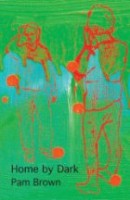
The launch of this book last weekend (link is to a facebook photo gallery) was a convivial affair in an Erskineville pub. Unusually for a literary event, the football played silently on a large colour TV screen throughout, and a warm buzz of conversation echoed from the bar in the next room. Later, I saw myself in one of the facebook photos with a hand cupped behind one ear and a pained expression on my face. The pained look was, of course, nothing to do with the poetry or the company but was the result of my straining against the combined effect of Pam Brown’s quiet delivery, my deafness and the ambient noise.
On the day, Pam commented that the setting was appropriate, given the digressions and distractions of the poetry. As I was reading the book during the week, an alternative metaphor, even a fullblown analogy, occurred to me. For quietness, there’s the poems’ elliptical, almost throwaway quality – no assertive rhyme schemes, often no clear prose syntax, mostly no through narrative line; for deafness, there’s my ignorance of contemporary poetry – of the twenty or so poets mentioned in the acknowledgements or in the poems themselves, the only one I can honestly say I’ve read is Keats*, and L-A-N-G-U-A-G-E poetry and Oulipo (also mentioned) are pretty much closed books to me; for noises off, there’s PB’s daunting reputation as a poet’s poet, possibly even an academic poets’ poet – she’s the kind of person whose cover blurbs speak of precarity and sprezzatura. I realised I was approaching the page with a painful intensity, a virtual hand cupped behind my inner ear.
Well, of course scowling and squinting and feeling stupid is no way to read poetry. So I stopped it – the scowling etc – and read on regardless, going with the flow. And had a much better time. Of course, there are some poems I just didn’t get. There are some I kind of got but didn’t care about. And then there’s a lot that’s funny, thoughtful, sad, memorable … revisitable. I even read bits out to the Art Student, self proclaimed hater of poetry, and she wanted to steal them.
I think what appeals to me most is the sense in a lot of this poetry that it more or less fell out of Pam Brown’s head straight onto the page. (I know that’s an illusion, because I accidentally found an earlier version of one poem online, and got to see some of the careful reworking that went into creating that casual, uncrafted feel.) A number of the poems read as observations made while travelling – whether around town or across the planet, they display the same apparent randomness, the same self-deprecating wit, the same eye for the telling detail, the same play of mind.
From ‘Worldless’:
at the bus stop _____long haired boys –
regenerate fashion, _____retro,
fashions _____arrive & go by _______really quickly –
I had to live through _________the entire decades!
______(peeved)
From ‘Leaving the World’ (I had to look up Jean Tinguely, but I’m glad I did):
along the LA freeway
black derricks
trundle up and down
like
Jean Tinguely sculptures
only__ominous
& witless
in a waterless world
The line that the Art Student wants to steal, the opening of ‘Haywire Here’:
who prepared this future?
and later in the same poem some lines where I enjoyed making my own sense (that may be quite different from Pam Brown’s):
and the barmaid’s __never heard of sarsaparilla
(worse for me _______& you)
Sarsaparilla was the favourite softdrink of my childhood, but it can be hard to find these days, so a barmaid who has never heard of it is a young woman with no sense of history. Worse, for us literary types, she hasn’t heard of Patrick White’s Season at Sarsaparilla, so we’re left feeling doubly invisible. Heh!
I recently came across a quote from 1935 letter by Wallace Stephens (of whose poetry I’ve read almost none and understood less): ‘As soon as people are perfectly sure of a poem they are just as likely as not to have no further interest in it; it loses whatever potency it had.’ And just before that, ‘As a rule, people very much prefer to take the solemn views of poetry.’ I think deciding not to scowl as I was reading this book was going against the preference for the solemn, and opening up to the potency of things I can’t be perfectly sure of.
This is the fourth book I’ve read as part of the Australian Women Writers Challenge 2013.
* I did recognise a couple of lines from Bob Dylan, though he wasn’t acknowledged.
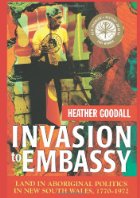
I recently heard a distinguished novelist claim that she grew up believing New South Wales was mostly settled peacefully and that damage to the original inhabitants was largely unintended, caused by infectious diseases and the like. Despite having been correctly described by a commenter on my auxiliary blog as not knowing shit about Aboriginal matters, I was slightly better informed than that in my childhood: I knew there was a lot of frontier violence. But I think I’m like most non-Indigenous Australians in having assumed, complacently enough, that Aboriginal people, at least in this state, were irrevocably dispossessed and driven from their land in the early years of settlement. In other words, all the really bad things were done long long ago, probably by people who were just acting according to the morality of their times. Um, well, mea culpa.
The dispossession of Aboriginal people in Australia has been a long, painful process. It has played out very differently in different states and territories and different regions within states, and been resisted at every phase by Aboriginal people and their allies, using means ranging from armed resistance to eloquent letters to the press. Invasion to Embassy tells the New South Wales history, and although the stories it tells are grim, often heartbreaking, I found it exhilarating: in these dying days of what W H Stanner called the ‘great Australian silence’ – the relegation of Aboriginal experience to footnotes in our history – books like this, where Aboriginal points of view are front and centre, are like doors opening onto the real world. I wish this one could be absorbed into the bloodstream of every non-Indigenous Australian.
Heather Goodall maintains that land has been a key issue in Aboriginal politics from the beginning. ‘There are strong grounds for arguing,’ she writes in the first chapter,
that for Aboriginal people in south-eastern Australia before the invasion, land was the physical and symbolic base for almost every aspect of life. Social relations were expressed, managed and negotiated through relations to land; political standing was legitimated and authority grounded in landholding. Knowledge was structured by its relation to place, and it was taught, held in memory and performed according to this organisational framework. New experiences were analysed by and incorporated into that oral tradition and so they too became organised within it by place.
In the first decades of the colony at Port Jackson and surrounds, then:
Land was seen by its Aboriginal owners as a central factor in their experience of colonialism. Their sense of invasion, of loss and deprivation of land was expressed clearly and unarguably. It was expressed to whites alongside Aboriginal pain at the deaths of their loved ones and offence at the transgression of their laws.
It’s a book that makes you want to read bits out loud to the nearest available listener, and maybe I should have done the blogging equivalent of that by uploading regular progress reports. But that’s an idea for another time, another book. Until you read the book, here’s a string of dot points, which might be familiar to you but were mostly news to me:
Before 1850, owners of the large pastoral properties described Aboriginal men as virtually useless as employees, but after that date, when almost all non-Indigenous workers headed for the Victorian goldfields, those same Aboriginal men, being now necessary, were suddenly transformed into brilliant horsemen, unsurpassed as shepherds and stockmen.
In the second half of the 19th century, reserves were established all over the state where Aboriginal people were promised security of tenure, and where many of them cleared land and worked small farms for decades, only to have their tenancies summarily revoked by the government, with no justification that would make sense in the absence of deeply racist, genocidal assumptions.
The legal doctrine that Australia was terra nullius, land owned by no one, when the first European settlers arrived, was not proclaimed in law until 1889. Goodall comments that such a judgement could not have been made in 1840 ‘when there was such wide acknowledgement of Aboriginal relations to land’.
154 Aboriginal men from New South Wales volunteered and fought overseas in the First World War. Although there were no discriminatory regulations or laws, it turned out in practice that the Soldier Settler scheme was only for white soldiers – just one Aboriginal man was given any land under the scheme.
This kind of thing happened during the Depression (page 185):
By 1933 there was a large camp of Aboriginal people just outside Cumeragunja, refused the dole in Victoria because they were New South Wales residents, but refused the dole in New South Wales because they were ‘too black’, and told they must go to the [Aborigines Protection Board] station for relief. But at Cumeragunja they were met by a manager clinging to the old APB rules, who told them that they were ‘too white’ to receive Aboriginal rations because they were not ‘predominantly of Aboriginal blood’.
The story of the first half of the 20th century is gruelling. When government agencies wanted to move Aboriginal communities from their land, the threat to remove the children was often used to force compliance. Aboriginal children were excluded from public schools in many places because white parents complained and the government gave them what they wanted – and families were again forced to move to places where some form of education, sometimes of a quality that beggars belief, was available. The ‘Dog Act’ – the 1936 amended version of the Aborigines Protection Act – created conditions in which Aboriginal people felt the government could pen them up and shift them around like animals: the reserves, which had been refuges and places where some vestige of traditional connection to land could be maintained, became virtual prisons. Even as benign a project as the creation of National Parks was the occasion of further dispossession and removal – I was shocked to reflect that to speak of wilderness in Australia is to give voice to a genocidal worldview, that is, it denies the existence of the people who lived in that part of the world for millennia.
Here are some more dot points, people and events that in any sane world would be as much part of general Australian lore as Ned Kelly, Phar Lap and the Eureka Stockade:
Pemulwye and Windradyne, the two most famous leaders of armed resistance to colonisation, around Port Jackson and Bathurst respectively
William Cooper – if you haven’t heard of him, and even if you have, read his Wikipedia entry. He was an extraordinary leader, who wrote to his local parliamentarian in his 20s, calling on the government to secure a ‘small portion of a vast territory which is ours by Divine Right’, and in his 70s organised the Day of Mourning on the sesquicentennial Australia Day. He is honoured in the Yad VaShem Holocaust Museum in Israel as the only person in the world to have organised a private protest in response to Kristallnacht. As Goodall says, he ‘had personally experienced the whole process of demanding land and winning it, farming it in relative independence, and then facing the bitter years of dispossession and violent repression on the station [of Cumeragunja]’
The Cumeragunja Walk-Off, in which 200 Aboriginal men, women and children crossed the Murray River into Victoria in protest against conditions at the New South Wales station. Among other things, this is the subject of Deborah Cheetham’s opera Pecan Summer
The Australian Aboriginal Progressive Association – the first Aboriginal political organisation to create formal links between different communities, whose chief spokesperson was Fred Maynard, a Hunter River Koori. It took shape in the early 1920s and found allies in the right-wing nationalists of the day.
The Australian Aboriginal League, formed in the 1930s with a close focus on Cumeragunja (can you tell the Cumeragunja story made a deep impression on me?), but also asserting broader Aboriginal unity: ‘We should nail our colours to the mast, … making our slogan “Full equality for the dark race with the white race, and no differentiation between the full-blood and those of mixed blood”‘
Political alliances between Aboriginal and other organisations – ranging from the Communist Party of Australia, which saw the unjust treatment of Aboriginal people as an extension of class struggle, to PR Stephenson’s right-wing nationalists, for whom Aboriginal issues were emblematic of White Australia’s need for independence from England and English cultural domination. When different Aboriginal groups accepted help from such disparate sources, it caused serious rifts.
I could go on. Read the book! You won’t regret it.
Invasion to Embassy was published in 1996, four years after the Mabo decision had laid to rest the legal fiction of terra nullius, and the same year as John w Howard said, disingenuously, ‘Injustices were done in Australia and no one should obscure or minimise them.’ The book would have to be an example of what Geoffrey Blainey and John Howard labelled black armband history. I’m sure Keith Windschuttle could find, perhaps has found, any number of errors. But those critics miss the point. Telling these stories doesn’t deny or diminish anyone else’s story. And it’s not about handwringing, collective guilt and shame – rage, perhaps, and a profound respect for those who held out for justice and dignity through it all.
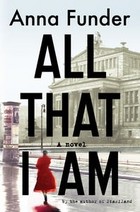
I read the first of this book’s three sections to the Art Student on the car trip from Airey’s Inlet in Victoria to Sydney. Given my proofreader past, this can be a punishing way to encounter a book – few things disrupt a book’s spell more than a reader-aloud complaining about misspellings, malapropisms, mixed metaphors, misquotes, or awkward turns of phrase. Embarrassing sex scenes will do it too (we may never get over The Slap). All That I Am stood up to the ordeal well, and we both enjoyed the trip. Mind you, the reading wasn’t disrupted by tears or cries of joy either. And I couldn’t tell at that stage whether hearing myself reading it all aloud made the different narrators’ voices sound much the same.
As everyone probably knows by now, the novel’s main characters were part of the left opposition to Hitler. Alternate chapters are told by Ernst Toller, a playwright and activist, dictating additions to his memoir in a New York hotel room in 1939, and Ruth Becker, a retired school teacher experiencing vivid memories in Bondi Junction in 2001. As both of them think back over their lives and their relationships, their shared story unfolds. Ruth, we are told in a note at the back, is based on a friend of the author. Ernst Toller was a real person, and so are the other main characters: Hans Wesemann, Berthold Jacob and the woman at the heart of the story, Dora Fabian.
Dora is a brilliant, charismatic, passionate revolutionary. She is Ruth’s adored cousin and intimate friend, and she is Toller’s assistant and the love of his life. Our narrators don’t have much to do with each other, but Dora has been central to both their lives. Through Ruth we see snatches of her childhood and later those parts of her activism that don’t revolve around Toller. Toller is very much the centre of his own world, both as the public figure Dora calls the Great Toller and as the private ma prone to depression and self doubt, but in 1939 he is acknowledging how important Dora has been to him in both spheres.
It’s a gripping yarn that takes us from the immediate aftermath of World War One to the brink of World War Two, with Ruth’s old age as a kind of integrated coda. I learned a lot about the resistance to Hitler in Germany and elsewhere, particularly England. I can’t say that I was swept away by the story itself, but a slow burning emotional truth comes through about the importance of resistance, even in the face of apparently sure defeat: one of the characters says that they will all be forgotten by history, and it’s true that the Germans who opposed the rise of Hitler at huge cost to themselves tend to be ignored in popular versions of that history. The book captures brilliantly the gradual transformation of a group of revolutionaries who see their conflict with the Nazis, not necessarily as evenly matched, but at least on a scale that allows for cheerful derision, to their final condition as a dispossessed, demoralised group crying out from the margins and betrayed by those they held dearest. (I’m not giving you any spoilers there: most people know how that panned out.)
So that’s my second book in the Australian Women Writers’ Challenge. So far, so very good.
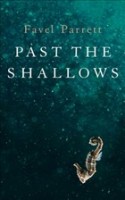
I had three compelling reasons for fast-tracking Past the Shallows to the top of my TBR pile. Favel Parrett is a friend of my novelist niece, Edwina Shaw, and Edwina gave me the book as a Christmas present (‘Read it and weep,’ she said). I met Favel at the NSW Premier’s Literary Awards dinner last year, for this book was shortlisted, and was charmed. And I’ve recently signed up with the Australian Women Writers Challenge to read a certain quota of AWWs in 2013. And there was an additional softener: it’s short.
The book tells the story of three brothers and their father, who makes a marginal living as a dubiously legal abalone fisherman in southern Tasmania. The action unfolds in the long shadow cast by the death of the boys’ mother in a car accident some years earlier, and is seen in alternating chapters through the eyes of the two younger brothers, Miles and Harry. It’s Tim Winton territory: brothers growing up with the splendour and terror of the sea, in a family racked by emotional turmoil. Maybe I shouldn’t put the mockers on a young writer by saying so out loud, but I found the people and the world of this novel more convincing, more demanding of my compassion, than I ever have Winton’s; and the writing is more direct, draws attention to itself less, and allows for broader sympathies. The father is violent, irrational and dangerous, but neither the boys nor we lose sight of the grinding forces and bitter blows that have made him that way. The ocean is a place of pleasure and exhilarating challenge – Miles goes surfing with the eldest brother, Joe, while Harry hunts for treasures in the tidewrack. But it’s also the site of hardship, as in Miles’s exhausting work on his father’s abalone boat, and terror, especially in a climactic storm scene. You could probably read the book as a meditation on the ocean, with the human story there just to keep us reading: Favel Parrett writes about surfing, seamanship and heavy seas with a kind restrained precision that manages to suggest, and – very occasionally – explicitly invoke something like awe.
I haven’t mentioned the boys’ ages. It’s a measure of the book’s fineness that we’re not told how old they are until maybe halfway into the story. Instead, we’re left to work it out for ourselves from their preoccupations, their different strategies or dealing with the poverty and neglect, and their different degrees of vulnerability and protectiveness, innocence and savvy, openness and quiet desperation.
Terrible things happen in this story, and there are a number of revelations about terrible things in the past, but for me the book’s emotional power doesn’t lie there so much as in the brothers’ mutual tenderness, and even then not so much in the big moments – which are operatic in scale, but not overblown in the telling – as in tiny, poignant gestures.
My copy has half a dozen stickers on the cover boasting of prizes and shortlistings. I concur with all those judging panels. It also has pages of notes up the back for book groups. I didn’t read them: does anyone really want to have a questionnaire waiting for them when they emerge back into the shallows from deeps like this?
For the last couple of years I’ve been keeping track of the gender statistics of my reading, and (surprise! surprise!) have realised I read many more books by men than by women. I’ve just discovered the Australian Women Writers’ Challenge and signed up for the Miles level of the challenge, which means I undertake to read six books by Australian women and review four of them (though as I normally review every book I read, defining ‘review’ very loosely, that’s not a big deal). The challenge webpage suggests that I tell you the six books I plan to read, but I’m going to leave it vague. The first one will probably be Favel Parrett’s Past the Shallows, but who knows what might happen before I pick it up.

 This little book is populated by a handful of painfully shy individuals living on the outskirts of a small Australian town in the 1950s. There’s Betty Fletcher and her two children, Michael and Little Hazel. The children were conceived and born elsewhere, but it’s not the kind of town where people pry into one another’s business. Mues, one of their neighbours, is a retired slaughterer and a pretty unsavoury character – he exposes himself to Little Hazel in the first couple of pages, and it’s a sign of things to come that the little girl, far from being traumatised, is profoundly disappointed that his promise to show her a pony was a trick, that adults can’t be counted on: ‘they hold one thing in their hand and call it another.’ the other neighbour is Harry, a dairy farmer, who has become a virtual member of their family, having dinner with them and being called over to help with masculine tasks like removing a dead possum from their roof. And then there’s Harry’s dairy herd, half a dozen kookaburras and sundry other specimens of animal and bird life.
 This is the eighth book I’ve read as part of the Australian Women Writers Challenge 2013.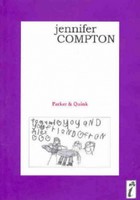




 Me fail? I fly!