
Herta Müller, The Passport (1986, translation by Martin Chalmers 1989, Serpent’s Tail 2009)
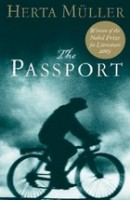
I got hold of this book via BookMooch soon after Herta Müller was awarded the Nobel Prize for Literature in 2009. Possibly because the press response wasn’t exactly encouraging (which of course it won’t be until a US writer wins), the book sat on my bedroom bookshelf for four years as a shining testament to pious intentions. I finally picked it up now because I’d read two books in translation, and decided to make it three of a kind.
It’s a very short book, just 92 pages, and it’s made up of short sentences. Here’s a random paragraph:
The skinner had given the stuffed animals to the town museum as a gift. He didn’t receive any money for them. Two men came. Their car stood in front of the skinner’s house for a whole day. It was white and closed like a room.
Sentence after sentence. Page after page. It proceeds in that staccato way. It doesn’t quite say what it’s saying. People do things, and say things, and see things. There are snippets of folklore, a bawdy song, symbolic objects, similes and metaphors as odd as the white room in that quote. You have to fill in the gaps, decode the descriptions. Only a handful of characters have names, the rest being known only by their professions or relationships. It took me until page 42 to realise I was in the middle of a narrative that I hadn’t been following. I started over. I’m glad I did.
It’s a terrible tale of the German-speaking minority in a village in Ceauçescu’s Romania. Uneducated, superstitious, despised by the Romanian majority, they live lives of quiet desperation and degradation. The village miller sets out to secure from the corrupt system a passport that will enable him, his wife and daughter to leave for West Germany.
I hated a lot of this as I was reading it: I just wanted to be told the story, to have a spade called a spade, rather than a headache being called a grain of sand moving around behind the forehead (at least, I assume that was a headache). But there is something mesmeric about it. I’m amazed that now I intend to immerse myself in that world again – not immediately, but when enough time has passed that I will be revisiting it rather than extending the current visit.
A couple of scrappy notes about the translation:
- The English title draws attention to the plot, such as it is. The original German, taken from something the miller says at his lowest point, translates as ‘A man is nothing but a pheasant in the world’, and signals the sometimes enigmatic narrative mode.
- There is a three-word glossary up the back. I could have done instead with a brief note at the start informing us that the original was written in German, that the action takes place in Romania (something that I’m guessing is obvious in the original but doesn’t become evident in the translation until we’re well under way), that most (all?) of the characters are German-speakers – in other words, filling us in on some things that are almost inevitably lost in translation.
- There are one or two places where I completely didn’t know what was being described, and would love to know if it was because of the translation or the original. In particular, there’s a scene in which a woman is pleasuring herself or discovering she has some terrible disease – I’ll refrain from going into detail of the description here, but my confusion is genuine, and her husband’s comment, ‘So that’s how it is with your bladder, my lady,’ doesn’t make any sense either way. Perhaps this is the kind of thing that people mean when they say Herta Müller writes surrealism.
I suspect that this book is another that was a nightmare to translate, and it’s wonderful what a distinctive voice comes through in the telling.
PS: When I had uploaded all that I went to LibraryThing to post a version of it as a review there. And behold there was a very interesting post by Meisterpfriem, who had loved the book in German and been surprised at its lukewarm reception in Engish translation. I recommend it.



 Me fail? I fly!