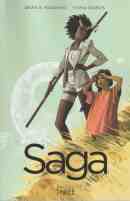
Fiona Staples (artist) and Brian K Vaughan (writer), Saga Volume Five (Image Comics 2015)
Bill Willingham (writer), Mark Buckingham, Lan Medina, Bryan Talbot, Linda Medley and Steve Leialoha (artists), Todd Klein (letterer), Fables Vol. 3: Storybook Love (Vertigo 2004)
Bill Willingham (writer), Mark Buckingham, Craig Hamilton, P. Craig Russell and Steve Leialoha (artists), Todd Klein (letterer), Fables Vol. 4: March of the Wooden Soldiers (Vertigo 2004)
One of my sons kindly went through his comics collection recently and put out a pile that I might be interested in. I passed on Swamp Thing and something about zombies (or they might have been vampires), but carried off a small swag. These are some of them.
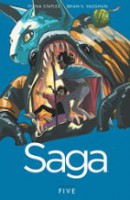
In Saga, Hazel, the child of parents from two different, warring species, has her father’s horns and her mother’s wings, or at least the beginnings of both. Her existence challenges the ideologies of both sides, and the little family has powerful enemies. In previous volumes they have had narrow escapes, acquired a number of bizarre allies and fellow travellers, and dealt with an apparently endless stream of weird, murderous monsters.
Though this instalment, in which Hazel is a toddler, continues to enthral and delight those of us who have the preceding four volumes under our belts, I wouldn’t recommend that you start with it. You’d still have the wit, the wonderful art, the occasional outrageous action, and even the underlying celebration of love and family, but you’d be left wondering if there was any coherent thread at all as the family members are spread across the galaxies. I recommend reading Volumes 1, 2, 3 and 4, in that order, before this one.
The series has a bit too much explicit sex for my taste. Not that it’s pornographic: I can’t, for example, imagine many people would find the sexual behaviour of the dragons in this book anything other than disgusting. I guess I find other people’s sexual activities and fantasies mildly embarrassing. There’s a bit too much graphic violence too, come to think of it. Oh, and there’s some romanticising of drugs, though the realisation that a main character comes to as a result of his stoned dreams is hardly endorsed by the narrative. None of those misgivings stop me from already hungering for Volume 6.
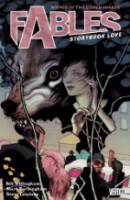 There are no giant dragon’s genitalia in Fables, but there’s enough human-looking sex to ensure that this series about fairy tale characters in exile isn’t for the very young. The tales are dark, though not exactly in the way the original fairy tales were dark: more like childhood noir. The big bad wolf is now Bigby Wolf, a tough-guy operative on the side of good who is – mostly – in human form. Old King Cole is a figurehead mayor of Fable Town while Snow White as his deputy really runs the show. And so on. All in the midst of unsuspecting ‘mundies’ (short for ‘mundanes’). In Volume 3, the love story between Snow White and Bigby Wolf passes a significant milestone (see cover of Volume 4 below for a spoiler), tiny police mounted on talking mice do their bit for law and order, Bluebeard turns out not to have reformed as thoroughly as he claimed, Prince Charming moves back in with one of his ex-wives when he realises there’s more to be gained there than by conning mundy women into supporting him, and a gun wielding Goldilocks does a lot of damage. What’s not to like?
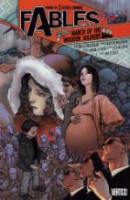 In Volume 4, the framing story comes back to life. The characters are in exile because someone known as the Adversary had mustered a huge army and was murdering everyone in fairyland. Those who escaped set up a clandestine community known as Fable Town in New York City, with a farm upstate for those Fables (as the fairytale characters are known) who don’t look human. These two places have been hard enough to police so far, because as everyone knows, being a fairytale character is no guarantee of decent behaviour. In this issue one of the gates dividing the worlds is breached and, after centuries of believing themselves safe, the Fables face Tarantino-esque violence at an industrial level.
In a long-lasting comic series like this, one of the pleasures is the regular appearance of guest artists. Mark Buckingham is the principal artist, and it’s his gritty vision that dominates. Then for a retelling of an American folktale or an episode involving cute miniature characters, someone else (in these cases Bryan Talbot and Linda Medley respectively) shows us the familiar characters and milieux through a different lens. The lettering, by Todd Klein throughout, almost makes one regret the less labour-intensive digitised process that (I’m assuming) is used in more recent comics such as Saga.
Wikipedia tells me that this series has continued from 2002 almost to the present – issue 150 was released in July. I’m reading it in the trade paperbacks, so far up to issue 27. I have 18 books to look forward to.

 My younger son and I are enjoying Brian K Vaughan and Fiona Staples’ space opera romance comic, Saga, as it appears book by book. So Y: The Last Man, written by Vaughan in an earlier collaboration with artist Pia Guerra, was an excellent gift from him to me on a recent birthday.
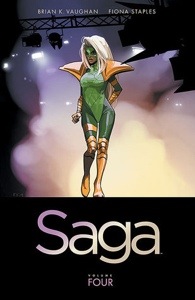




 Me fail? I fly!