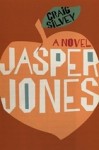
Craig Silvey, Jasper Jones (Allen & Unwin 2009)
The fourth paragraph of Jasper Jones begins:
This is the hottest summer I can remember and the thick heat seems to seep in and keep in my sleepout.
‘Keep in’? That’s awkward, I thought, and it chimes oddly with ‘seep in’ and ‘sleepout’. The paragraph continues:
It’s like the earth’s core in here. The only relief comes from the cooler air that creeps in between the slim slats of my single window. It’s near impossible to sleep …
Seep in, keep in, sleepout, creeps in and sleep, all in five lines: this is definitely odd, but – along with the heat, the relief and those slats, which are slim for no reason other than alliteration – it’s clearly deliberate.
Over the next pages, while the story had my attention from the word go – thirteen year old Charlie Bucktin, the narrator, is woken in the night by the town’s bad boy Jasper Jones and led to a secret place in the bush where he’s faced with a terrible spectacle and an equally terrible dilemma – I had a weather eye out to see if anything would come of this stylistic oddity. Nothing did, in the sense that if you didn’t notice it you weren’t missing a vital clue to the book’s meaning. But Charlie is in love with language, and bursts of assonance and alliteration for their own sake amount to something of a stylistic signature. I did a quick scan before returning the book to the library, and noted, from many examples, ‘a bundle of lonely bones tied to a stone’ (page 123), ‘Pored over it, taking little portions’ (page 128), and this, in one of Charlie’s reflective moments:
Sorry means you feel the pulse of other people’s pain, as well as your own, and saying it means you take a share of it. And so it binds us together, makes us as trodden and sodden as one another. Sorry is a lot of things. It’s a hole refilled. A debt repaid. Sorry is the wake of misdeed. It’s the crippling ripple of consequence. Sorry is sadness, just as knowing is sadness. Sorry is sometimes self-pity. But sorry, really, is not about you. It’s theirs to take or leave.
Like the frequent references to Charlie’s reading – To Kill a Mockingbird, Batman, Breakfast at Tiffany’s (which he hasn’t read, but Eiza, the love interest, has, and seen the film), Huckleberry Finn, The Wizard of Oz – this fascination with words is important in establishing Charlie’s character and the tone of the book. It’s been described as an Australian To Kill a Mocking Bird, but I doubt if Harper Lee’s book was anything like as intertextual as this. The description is OK as a sales pitch but I’m surprised that reviewers have echoed it.
Anyhow, it’s a terrific, fast moving, undemanding read: a coming-of-age romance cum mystery cum homage to Mark Twain cum historical drama (the Vietnam War is on, and the Beaumont children are mentioned towards the end) cum tale of pre-adolescent friendship (with a substantial nod towards the movie Stand By Me). There’s a beautiful description of a cricket match in which Charlie’s best friend, a very short Vietnamese boy (‘Jeffrey Lu on debut’) makes a splash, in a way that reminded me of Ruth Starke’s brilliant book for younger readers, Nips XI.
One thing I don’t understand is what makes the book ‘mainstream’ rather than ‘young adult’. There’s some pretty intense swearing, I guess, but sex is treated with great tact; even when sexual abuse is described explicitly in a letter that’s crucial to the plot, we don’t get to read the letter. The story is told from a thirteen-year-old’s point of view, and there’s no hint that he’s in any way an unreliable narrator: we don’t know any more than he does and we’re not invited to make judgments that differ from his – we learn about the world with him. In fact, Charlie’s angry mother is treated with less adult-sympathy than similar mothers in many a YA title. I’ve heard that the classification was a policy decision on the part of the publishers – that they were invited to submit the book for the Children’s Book Council Awards, but declined. The mainstream classification seems to have paid off in adult readership and award nominations – always assuming that a Miles Franklin shortlisting is more prestigious than one from the Children’s Book Council, and that being on the New South Wales Premier’s Literary Awards shortlist alongside David Malouf’s Ransom and Coetzee’s Summertime is more dignified than being named in the same breath as Justine Larbalestier’s Liar (not a view I share: I’m looking forward to Justine’s book as keenly as I am to David’s, and who in their right mind would want to compete for a prize against Malouf and Coetzee?). I hope this taxonomical decision hasn’t discouraged the young people who are the book’s natural readership. [Since writing that I’ve seen an online trailer that is clearly aimed at teenagers, so it looks as if the pubisher is having two bob each way, and a good thing too.]
I wrote that much a number of weeks ago. The Book Group met last night.
With one exception, we were lukewarm. No one actively hated the book, but different people saw different things as gaping flaws. One man said he found Charlie’s decision at the very start to help conceal a crime highly implausible, and intolerably hackneyed – from then on he read with very little pleasure. Another was irritated by the banter between Charlie and Geoffrey (though one man said he thought that was the best thing in the book). Others found the narrative voice, and the characters’, wildly inconsistent – perhaps especially in beautifully written passages such as the aria on ‘sorry’ I quoted from above. I think we were unanimous in finding the characters’ emotional responses to crises (a grisly death, the acrimonious departure of a parent, the discovery of a grandparent) lamentably one-dimensional. I’m sorry to say that as we talked the book’s charms diminished. I proposed a reading that transcended these concerns for consistency, verisimilitude and psychological realism. Perhaps we ought to see the book as akin to the startlingly discontinuous novelitas of César Aira that I’ve just been reading about in the current Heat. But that didn’t wash. Its one defender said it reminded him vividly of things he had felt when he was an adolescent, and he wasn’t howled down.
Sorry, Craig.
-33.875184
151.172380



 Me fail? I fly!