Tag Archives: Dervla McTiernan

Summer crime audiobooks

Jørn Lier Horst, The Traitor (translated by Anne Bruce, narrated by Steve John Shepherd, Penguin Audio 2024)
Dervla McTiernan, The Unquiet Grave (narrated by Aoife McMahon, HarperAudio 2025)

In the last couple of weeks the Emerging Artist and I have driven from Sydney to the Great Ocean Road and back. Part of the way back our rear vision mirror was filled with great clouds of smoke that made the sun look like a little pink button, and on just one night we arrived in a motel that was without power for a couple of hours because of the extreme heat. But in our journeying we managed to listen to two audiobooks.

The Traitor is part of the Wisting series – the thirteenth instalment or so. Wisting is a scandi detective whom I’ve seen a bit of on television. It’s not one of my favourite shows, but a novel promised a story to keep us alert when driving and awake when passengering. Sadly, in the event I found my thoughts wandering when I was driving and i fell asleep when I was passenger. It may have been Steve John Shepherd’s matter-of-fact narration or Anne Bruce’s translation, but the relentless attention to detail made it almost impossible for me with my clearly feeble power to concentrate to keep track. If anything, listening to this audiobook confirmed me in my long-ago decision not to read any more crime novels.
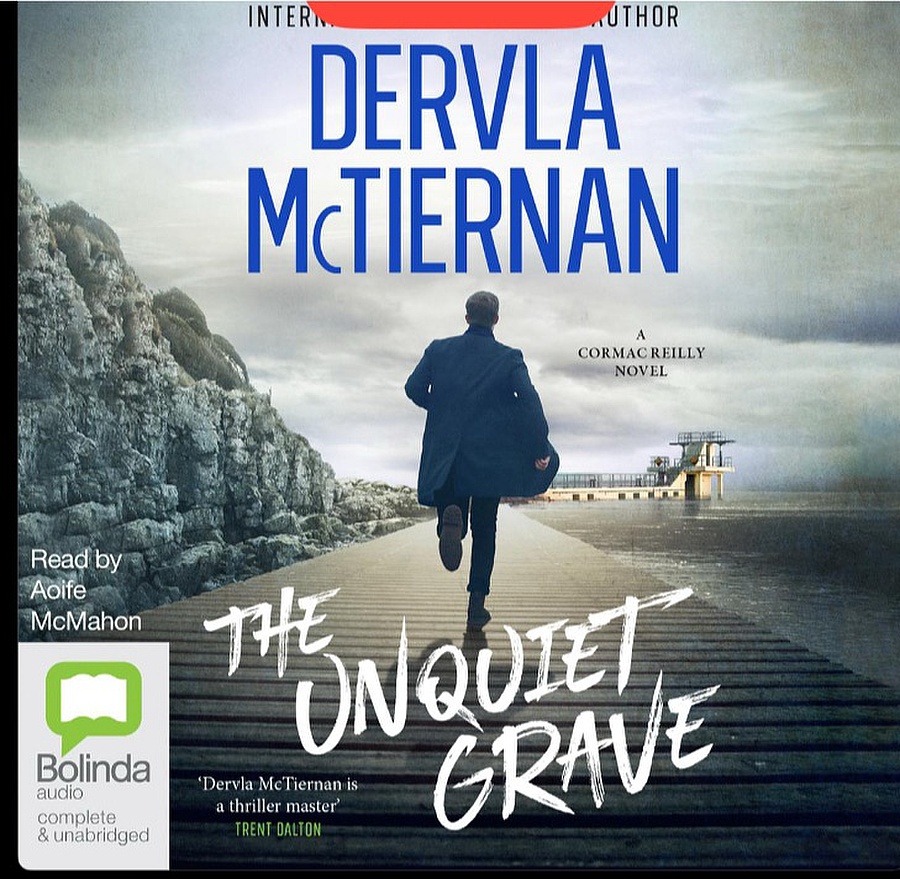
But then on the way home we listened to The Unquiet Grave, and my resolve weakened. It’s the fourth in Dervla McTiernan’s Cormac Reilly series, wonderfully complex with at least four cases on the go at once, plus complex relationships among the detectives.

The main murder plot runs through a series of suspects, and I’m not complaining that the final revelation is a bit of a frost. There are a number of subplots – in particular one that involves major cybercrime in which the main criminal gets his come-uppance in a most satisfactory manner

Aoife McMahon’s narration wonderful. She really does do the police in different voices.

[Full disclosure: I am one of two proofreaders acknowledged at the end of the The Unquiet Grave for ‘going the extra mile’. I wouldn’t have mentioned it as we proofreaders usually go unnamed and it feels like bad form to claim an involvement. It’s nice to be acknowledged!]


I listened to these stories as I travelled through a number of lands, including Wiradjuri, Wadawurrung and Yuim. I wrote the blog post on the land of Gadigal and Wangal of the Eora Nation. I acknowledge Elders past and present of all those peoples, and welcome any First Nations readers.

What happened to Nina, Dervla McTiernan

Dervla McTiernan, What Happened to Nina? (Harper Collins 2024; audiobook by Audible, performed by Kristen Sieh, Stacy Glemboski, Lisa Flanagan, Robert Petkoff, George Newbern, Jenna Lamia and Preston Butler III)

I used to read to the Emerging Artist on long car journeys. Then my voice started failing, and for a couple of years we’ve been trying podcasts and audiobooks, with mixed results.

What Happened to Nina worked like a charm. For a start, each of seven characters narrates at least one chapter, and each character has their own reader, so there is plenty of vocal variation. More significantly, the book reads like a television show: locations are established efficiently, introspection is minimal, dialogue and action are pacy, motivations straightforward. Perfect for listening to when part of your mind is on the passing scene. (I know there are people who do their serious reading this way. I’m not disciplined enough for that.)

I’ve read and enjoyed two of Dervla McTiernan’s previous books, The Rúin (link is to my blog post) and The Good Turn. They’re both police procedurals set in Ireland, and apart from the mystery to be solved in each of them, what I enjoyed was the sense of place, and the Irish ness.

In What Happened to Nina? there is no mystery. Twenty-year-old Nina narrates the first section, and then goes missing. The reader can guess the what, who, why, where, and pretty much how right from the start, and becomes quite sure within a couple of chapters. The novel is interested in how the disappearance is dealt with by the other characters, especially her parents and the parents of her boyfriend, who is also the chief suspect. As they gradually discover the truth, there are two harsh surprises, but no real twists. And though the logistics are carefully plotted, the Vermont environment doesn’t come alive, and the dialogue, while recognisably American, has a generic feel to it. (That’s no criticism of the readers/performers, who are universally excellent.)

So yeah, this is OK. It feels to me that it’s written with a possible US TV adaptation in mind. If that happens, it could be a successful series. I might watch it.

Two quick reads

Ian McPhedran, The Smack Track: Inside the Navy’s war : chasing down drug smugglers, pirates and terrorists (HarperCollinsAustralia 2017)
Dervla McTiernan, The Rúin (HarperCollinsAustralia 2018)

rúinsmackThis blog post is an exercise in completism. I read The Rúin and The Smack Track last year but didn’t blog about them at the time for reasons I won’t go into. I want to make up for that omission, if briefly.

The Rúin is an excellent thriller/detective yarn set in Ireland, the debut novel of Dervla McTiernan, an Ireland-born writer who lives in Perth. An author’s note explains that the book’s title can be read in English, or can be given it’s Irish meaning: ‘In Irish, Rúin means something hidden, a mystery, or a secret, but the word also has a long history as a term of endearment.’  And that pretty much sums up the feel of the book: there’s a mystery to be solved – two murders decades apart – and a story of family love and commitment to be uncovered along with much darker secrets. It’s fast moving, and satisfyingly complex. The Galway setting is vividly real. I’m surprised it hasn’t been snapped up for a television series.

A second book featuring McTiernan’s garda Cormac Reilly is promised for March next year. I expect it will have me breaking once again my general resolution not to read crime novels.

The Smack Track makes me think of Trotsky’s warning: ‘You may not be interested in war, but war is interested in you.’ I was the boy in my primary school class who wasn’t interested in war comics. I was never into model war planes. I was a conscientious objector to the draft at the time of Australia’s military involvement in Vietnam. Ian McPhedran, by contrast, worked as a defence writer for The Australian for nearly twenty years. He has written six books, including this one, about aspects of the Australian armed forces, and has had extensive experience of being embedded with the military. Just the writer to help me out of my comfort zone.

This book isn’t about combat, but about the RAN’s extraordinary work disrupting the drug trade off the east coast of Africa. It includes first hand accounts of intercepts, including dramatic accounts of the dangers faced by the sailors on these missions. McPhedran, writing as an embedded writer, doesn’t swagger. If anything, he mocks his ‘landlubber’ status. His respect and appreciation for the men and women whose work he observes up close is contagious.

As I read The Rúin in 2017 I’m not including it as part of the 2018 Australian Women Writers Challenge. But it’s an excellent addition to the list of books written by Australian women, so I’ll mention it on the AWWC site anyhow.

I’m grateful to HarperCollinsAustralia for my copies of both books.