Tag Archives: Dženana Vucic

Journal Catch-up 25: Overland 253

Evelyn Araluen and Jonathan Dunk (editors), Overland 253 (Summer 2023)
(Some of the content is online at the Overland website – I’ve included links)
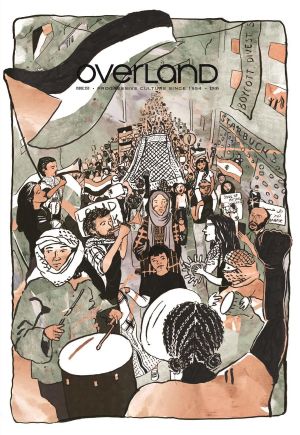
This Overland begins with a trio of generational contrasts.

First, gen x-er Brigid Rooney, Associate Professor of English at Sydney University has an article on the late Professor Elizabeth Webby in which, though she describes herself as a friend of her subject, she maintains a serious academic distance where you can feel a more personal tone struggling to assert itself.

Second, baby-boomer John Docker, also an Associate Professor at Sydney Uni, has a review article on a book about Sydney’s New Theatre. He begins with a convincing account of himself as a non-theatre person, and one, moreover, who is strangely ill at ease when he visits the current site of the New Theatre, which is about ten minutes by car from the suburb where he currently lives. Amusingly self-indulgent, but it might have been better to reject the commission.

In the third item, Dženana Vucic, self-identified as a millennial, has a piece about Sailor Moon, a manga serial that was big in her 1990s childhood and I’m sorry to say of very little more interest to me after reading her article than it was before – though I enjoyed the complex irony in which she pretended to claim a deeply anti-capitalist message in the show.

After that, things get serious with ‘Prison healthcare as punishment‘ by Sarah Schwartz, a gruelling article which begins with the grim statement that an Aboriginal woman ‘passed away on the floor of a prison cell on 2 January 2020, after days of crying out for help.’ It continues, ‘Three years later, a Coroner found that if she had received the healthcare she needed, she would not have died.’ It’s a penetrating look at the way for-profit prison healthcare in Victoria and other Australian states leads to terrible outcomes, especially for First Nations people. A year after the coronial findings mentioned in its first paragraph no one had been held accountable for the neglect.

Of the poetry, curated by Toby Fitch, ‘Water under the bridge‘ by Jeanine Leane stands out. Among other things, it looks at the way different generations of First Nations people have responded to colonisation. The title phrase takes on a telling ambiguity:

that there were names in the river
that were not just water under a white man's
bridge

Fiction editor Claire Corbett has gathered four excellent, diverse short stories. ‘Parliament‘ by Simon Castles is a sketch of young love and protest on the lawns of the new Parliament House in Canberra in 1988. Anna May Samson, currently starring in the dreadful Australian spin-off of Death in Paradise, packs a complex set of relationships into a very few pages in ‘Summer work‘. ‘Hot season‘ by Anna Quercia-Thomas is a post-apocalyptic pastoral vignette. In ‘At first, nobody died‘ by Nasrin Mahoutchi-Hosaini the protagonist, herself an immigrant, is on vacation from her work as a counsellor of ‘boat people’.

It took me a long time to read this journal. It wasn’t for lack of interest.


I wrote this blog post in Gadigal Wangal country, where the weather is swinging back and forth between a nurturing warmth and a chilly wind that murmurs in the casuarinas. I acknowledge Elders past and present for their continuing custodianship of this land.
Journal Catch-up 13

I used to call these posts Journal Blitzes, but there’s nothing very Blitzy about them. Just two journals this time: an Overland from a year ago and a Heat just one issue back.


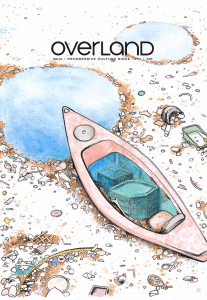
Evelyn Araluen and Jonathan Dunk (editors), Overland 243 (Winter 2021)
(Much of the content is online at overland.org.au, and I’ve included links)

This issue of Overland opens with a suite of excellent articles:

  • Coming through ceremony, a brief insider’s history by Kim Kruger of the Melbourne-based Aboriginal theatre company Ilbijerri, which celebrated its 30th anniversary last year
  • A teleology of folding, and of dying by Dženana Vucic. Don’t be put off by the high-philosophic title. This is a lucid personal account of the complexities of being a white Muslim – a child refugee from Bosnia – who is now atheist and hipster-presenting yet still identifies viscerally with Muslims worldwide who are facing something akin to the Nazi holocaust
  • The bridge and the fire by Robbo Bennetts, published before the terrible floods of 2021–2022, and perhaps written before the terrible fires of 2020–2021, reflects on the effects of two disasters he has been close to: the Westgate Bridge collapse in 1970 and the Black Saturday bushfires in Victoria in 2009
  • Torrey Peters Detransition, Baby, in which trans person Yves Rees reviews a novel that has a Sex and the City frothiness, but whose ‘window onto transfeminine interiority is nothing short of revolutionary’. Recommended reading for anyone struggling with their inner TERF.

In a welcome return to tradition, this issue includes the winner and two runners-up of a literary prize. The inaugural Kuracca Prize for Australian Literature, established by Overland in honour of the late Kerry Reed-Gilbert, is open to all Australian writers for fiction, poetry, essay, memoir, creative non-fiction, cartoon or graphic stories, and digital or audio storytelling. The winner this year is a short story, the runners up are a poem and a personal essay.

There’s a generous eight-page poetry section, and three short fictions, of which the stand-outs are ‘Tight lines’ by Allee Richards, a tale of the collateral pain when the main character’s relationship with a child is brought to an end by the ending of a relationship with the child’s father; and see you later by Zowie Douglas-Kinghorn, a vivid evocation of work on a dairy farm, which most satisfactorily brings up to date the genre of workplace short stories.


Alexandra Christie (editor), Heat Series 3 Nº 1 (Giramondo 2022)

Heat is back from hiatus. Series 2 Nº 24 was published in 2011 (my blog post here) with no promise of a return. Now here is Series 3, slimmer, with a new look and a new editor, promising to appear every two months and – in my opinion – well worth the annual subscription price of $120 (slightly more for individual copies). My sense is that the new, intimate format is better suited than the previous, book-sized issues to the limited attention spans of our image-dominated era – there’s also a deft use of images.

This issue, introducing a minimalist design by Jenny Grigg, kicks off with a one-page linocut by Ben Juers, which works mainly as a reminder that Heat has in the past included substantial sections of visual art. The main body is made up of:

  • ‘Only one refused’ by Mireille Juchau, a Heat veteran. The essay tracks down the story of a family member who survived the Nazi camps, and makes dramatic use of illustrations, including a double page spread of the ‘Hollerith card’ that recorded her relative’s physical features, and a photograph of ghostlike women recuperating in the Mauthausen infirmary soon after liberation (This article is on the Heat web site, at this link)
  • ‘Special Stuff’, a grim short story by Josephine Rowe, featuring a woman, man and baby doing a futuristic equivalent of ‘duck and cover’, seconds before a nuclear explosion
  • Five poems by Sarah Holland-Batt, all dealing with the death of parents. I’m especially glad to have read these so soon after hearing SH-B read at the Sydney Writers’ Festival (my blog post at this link). If these poems, especially ‘Pikes Peak’, are any indication, her latest book, The Jaguar (University of Queensland Press 2022), is definitely something I want to read
  • ‘Brief Lives’ by Brian Castro, a kind of Decameron for readers with short attention spans, blended with a lament about ageing, with raging bushfires as a backdrop
  • Death Takes Me’, fiction by Hispanic USer Cristina Rivera Garza, translated by Sarah Booker and Robin Myers, an esoteric variation on a police procedural that opens with a quote from Renate Saleci to the effect that castration is a prerequisite for sexual relations, and does nothing to allay the scepticism the quote provokes.

Number 2 is waiting on my shelf, and I’m looking forward to reading it.


PS: There’s a word in the Heat that I need help with. In the Brian Castro story, there’s this, speaking of an ageing writer taking refuge in a guesthouse with a number of other people:

He thinks. He thinks too much. Never sleeping. Now that Eros is held in liam in the other room, he fades into ancient tapestries.

(page 69)

What does ‘liam’ mean? Or is it Iiam (that is, does it begin with a capital ‘I’ rather than a lower case ‘l’? Given Heat 2’s propensity for typos and malapropisms, it may be an error. But if so, what is the correct word? All answers welcome, even correct ones.