Tag Archives: Eileen Chong

Eileen Chong’s Peony

Eileen Chong, Peony (Pitt Street Poetry 2014)
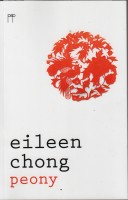
1peonyThis is Eileen Chong’s second book of poetry. It’s bigger and more varied than her first, Burning Rice, but is just as lucid, friendly, and resonant.

Between reading it and writing this blog post, I made the mistake of reading comments by other poets on Eileen Chong’s page at Pitt Street Poetry. It was a mistake because, well, what can I say here beyond ‘Go and read what they said’ and then ‘Go and read the poems’?

This is from Rhyll McMaster (the phrases in quotes are, obviously, from the poems):

Displacement, attachment, sweat, warmth and food, communion, aloneness, disquiet and longing – these poems coax shadows out of dark recesses, ‘layered like memory, like grief.’ Their strength lies not in their settings but in their familiarity with the human spirit, ‘at our true selves, so far, yet so close to home’.

Then I read Kim Cheng Boey’s review in Mascara of Chong’s first book, Burning Rice:

The poems here are informed by what James Clifford calls ‘the empowering paradox of diaspora’, which is ‘that dwelling here assumes solidarity and connection there.’ They ride the creative tension between countries, cultures and languages. …

At the heart of Burning Rice are delicately and meticulously crafted meditations on the complex web of attachments, loss and longing, so rich with imagery and narrative that they transcend the poet’s own ethnic, cultural and regional background.

So yes, what they said, it’s still true of this book – diaspora, familiarity, meticulousness, complex web of attachments – though they don’t mention the pleasure these poems bring to the reader.

Eileen Chong came to Australia from her native Singapore in 2007, and her poems are shot through with the experience of migration, with a sense of displacement. To use Kim Cheng Boey/James Clifford’s terms, some look back to there; some burrow into the intimacy of here; others go elsewhere (it’s interesting, the way traveller’s tales, traveller’s poems, have a different weight when written by someone with a history of migration).

The book is divided into four untitled sections. The first deals largely with grandparents, parents and childhood memories. The second, which includes most of the travel poems, is largely addressed to a spouse – and who could resist the comic vision of terror and intimacy in ‘Mid-Air Disaster’? The third section turns to other friends and family, celebrating births and birthdays, reminiscing, cooking together. (Food and cooking loom large all through the book.)

The fourth section is a miscellany – ekphrasis (a word my iPad’s autocorrect doesn’t like, and nor do I much, a hi-falutin way of saying poetry about artworks), history, dreams, Sydney scenes and more. This section sent me off to read Adrienne Rich’s fabulous ‘Love Poems’ and to rediscover Robert Wiles’s famous photograph of Evelyn McHale taken just after she suicided by jumping off the Empire State Building. The book ends with the title poem, whose last lines may be the only place where the notion of diasporic identity is raised in the abstract, only to be challenged, with characteristic equanimity:

——————One lady nods and smiles:
China’s national flower. Is it? Am I? I’ve forgotten.

Here’s a video of Eileen (pronounced Ee-leen, by the way) reading three of her poems.
awwbadge_2014Peony is the fifth book I’ve read as part of the 2014 Australian Women Writers Challenge. Pitt Street Poetry sent me a complimentary copy with a personal – and accurate – note saying it was for my reading pleasure.
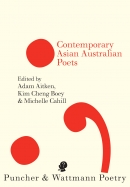
Contemporary Asian Australian Poets

Adam Aitken, Kim Cheng Boey & Michelle Cahill, Contemporary Asian Australian Poets (Puncher & Wattmann 2013)

1caap

This book seems to be part of a current efflorescence of attention to Asian Australian writing, and of Australian attention to Asian writing. The current Southerly focuses on ‘Contemporary Diasporic and Postcolonial Poetries’, with particular attention to Asian Australian (or Asian-Australian, or Asian/Australian etc) work. The recent OzAsia Festival in Adelaide included a two-day OzAsia on Page component which featured ‘significant and contemporary Asian and Australian voices’. Vagabond Press’s Asia Pacific Writing Series is looking formidably good.

It’s hard to imagine a more disparate gathering of poets than those collected between these covers, not just in nationality or ethnicity (‘Asia’ is a big and varied place, and there seems to be someone here from just about every part of it except, interestingly, Japan), but in just about every other conceivable way as well. The poetry ranges from work with the exuberance and directness of Spoken Word to compressed, elliptical, allusive capital-L Literary offerings. It’s the poets who are Asian Australian, not necessarily the poetry, so though there are poems of the pain of loss of home and culture (I was going to say ‘nostalgia’, but that’s a word that no longer conveys any sense of real pain), poems that explicitly deal with or enact cultural duality or hybridity, poems about multicultural relationships, poems that tackle white racism head-on, and poems exploring questions of cultural identity, there are also poems that don’t do any of those things.

There is a brief introductory essay from each of the three editors. Adam Aitken outlines and celebrates the extraordinary range of voices and attitudes in the anthology, and the range of possibilities in the term ‘Asian Australian’ itself. Kim Cheng Boey focuses on the experience of migration:

Home is never a given, for first-generation migrants, and continues to be a complex issue for subsequent generations. Being beneficiaries of two or more cultures, and entangled in a complex web of affiliations and attachments, they are wary of identity politics and monolithic formations.

Michelle Cahill points out the anthology’s significance in bringing greater visibility to Asian Australian women poets, who experience ‘the double exile of migration and mediation of patriarchal terrain, so inimical to the female psyche’. Seventeen of the 37 poets in this collection are women, and very few Asian Australian women have been included in any previous anthologies.

All three introductory essays are worth reading, and they give invaluable guidance to the poetry. But in the end, it’s the poetry you pay for – and I’m happy to report that I was immersed in this book for days, being dragged from one engaged mind to another. Christopher Cyrill, whom I have previously known as the events organiser at Gleebooks who always spoke too softly when introducing people, here turns out to have a clear, strong, brilliantly modulated voice in the extract from his prose poem novella Quaternion (and that’s me saying it who hates extracts and doesn’t much care for prose poems). Andy Quan’s ‘Is This?’ is a brilliant abstraction of the moment of anticipation on meeting a new person. Omar Musa contemplates buying a pair of shoes and redefines the notion of choice. I finally get to read Kim Cheng Boey’s ‘Stamp Collecting’, which I’ve heard him read at festivals and loved, and his ‘Plum Blossom or Quong Tart at the QVB’ – what can I say? Eileen Chong is here, with some of the finest poems from ‘Burning Rice’. I was about to read Debbie Lim’s ‘How to Grow Feet of Golden Lotus’ aloud to a friend and then realised I wouldn’t want to inflict it on anyone who didn’t have plenty of time to recover. Merlinda Bobis’s ‘Covenant’ (‘after you bomb my town / I’ll take you fishing / or kite-flying or both’) conveys the poignancy (another word that has lost its hard meaning) of peace for a defeated people. Jaya Savige’s ‘Circular Breathing’ could hardly be more mainstream Australian, a kind of version of Les Murray’s ‘Perfectly Ordinary Rainbow’ set it in Europe and acknowledging Indigenous Australia (with only the barest allusion to Asia, but who’s counting?). Louise Ho’s ‘A Veteran Talking’ is a killer poem, a chilling, hard, dry killer. I’m glad Adam Aitken included a decent, brilliantly varied selection of his own work.

Please don’t let this book be seen as a marginal anthology of poems by the marginalised. It’s a fabulous collection and belongs at the centre of our culture.

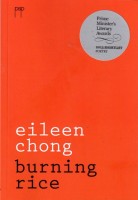
Eileen Chong’s Burning Rice

Eileen Chong, Burning Rice (Australian Poetry 2012, Pitt Street Poetry 2013)

1br

This pocket-sized volume was short-listed for the Prime Minister’s Literary Awards along with giants John Kinsella, Peter Rose and Jennifer Maiden. I approve.

I’ve recently read a bunch of scholarly essays about multiculturalism, postcolonialism, cosmopolitanism, hybridity, transnationalism, diasporic writing and other ways of creating or perceiving poetry that is not contained within a single cultural tradition. In that context, I guess these poems by Eileen Chong would be classed as diasporic: most of them deal one way or another with her Singaporean heritage and her separation from it.

But as it happens, I’ve also been rereading (with a heavy heart) some of Seamus Heaney’s poetry, and it strikes me that Chong’s poems about her parents and grandparents, the family’s food traditions, her childhood memories of Singapore streets, even Chinese history and classic Chinese poets, are part of a similar project to Heaney’s when he writes about his parents and forebears, his childhood memories of Irish fields, his tales of Irish saints and scholars. It would be as big a mistake to fence off this poetry in some semi-ethnographic corral as to do that with Heaney’s. Surely everyone can respond at a deeply human level to poetry in which a mind engages with the relationship between the present world and the world of childhood and heritage?

At least that’s my experience. Take the first poem, which also gives the book its title. It begins:

I did not mean to burn the rice tonight.
'Planting rice is never fun' – generations
of men, women and children ankle-deep
in padi fields, bent double at the waist,
immersing seedlings day after day.

then goes on to evoke the other kinds of work involved in growing and harvesting rice, before coming back at last to the burnt rice with a killer final line (you can read the poem here). At a personal level, this poem works wonderfully for me. It hooks my emotions by stirring into awareness something of my own very different heritage: four generations of my family – great-grandfather, grandfather, father and brother – have been sugar farmers. Substitute marmalade for rice, and there I am in my inner suburban kitchen, trying to get the quantity of sugar right, enough to make the marmalade set but not too sweet, and lurking not so very far in the background the memory of cane paddocks, cane fires, cane knives and all they meant in my childhood. My personal story is very different from Chong’s and the history of sugar in North Queensland has little in common with that of rice in east Asia, but that’s where the poem touches me, brings part of my mind alive.

I don’t know that that says much about the actual poetry. There are other deceptively straightforward poems about Asian food and about Chong’s parents and grandparents, some striking dramatic monologues spoken by women from east Asian history, including a number connected to Lu Xun (considered by many, according to Wikipedia, to be the leading figure of modern Chinese literature), some sweet encounters with other Australian poets. I’m looking forward to more.

awwbadge_2013

This seems to be the tenth book I’ve read as part of the Australian Women Writers’ Challenge.

Sappho & Penguin play rough

Two literary events with the Art Student in the last week: Robert Adamson and Devin Johnston at Sappho’s on Tuesday night, and Tom Cho and others at Penguin Plays Rough on Saturday.

I’ve been to one previous poetry reading at Sappho’s, in May this year. On that occasion Rhyll McMaster and the open-mikers read from just inside the shop, to an audience spread comfortably on the verandah and courtyard in the balmy evening, enjoying warm drinks and tapas. Tuesday night was a bit different, bitterly cold (by Sydney standards) with rain pelting down. We arrived early enough to claim the sole remaining indoor table, opting for dryness and comparative comfort behind the microphone rather than huddling in the chilly and dripping plastic-roofed and -sided balcony with good sight lines. The courtyard was completely out of the question. When the Talent arrived, they were given tables in the semi-exposed area, tables that we had rejected because they were awash.

It speaks volumes for the pulling power of these poets that the space, though small, was crowded. Adamson and Johnston were an excellent double bill, lots of river water and birds from two continents. The two stand-out poems for me were Johnston’s ‘Marco Polo‘ (the link, which needs Flash, has DJ reading this poem and two others) and Adamson’s ‘The Kingfisher’s Soul‘ (this also needs Flash), which he told us he’d written in response to his wife asking why he never wrote any love poems: it is indeed an achingly personal love poem.

Adamson, Johnston and their small entourage departed – presumably to a warmer, drier, better fed place – before the open mic, along with enough others to create the impression that all who were left were the open mikers and their pals: ‘And now, ladies and gentlemen, the Dregs of the Evening’. But we soldiered on, reading one poem each. There was a long piece in terza rima that I couldn’t quite hear, a pantoum, a sharp witty observation on cockatoos, a tribute to Francis Webb, and to conclude the evening next month’s featured poet Eileen Chong gave us Mary Wollstoncraft addressing her unborn daughter, praying that one day her fingers would close around a pen. And somewhere in there I read a sonnet about snoring. To polite applause. Come to think of it, even the most excellent poems of the evening received only polite applause. Given the weather, that was about all that could be expected.

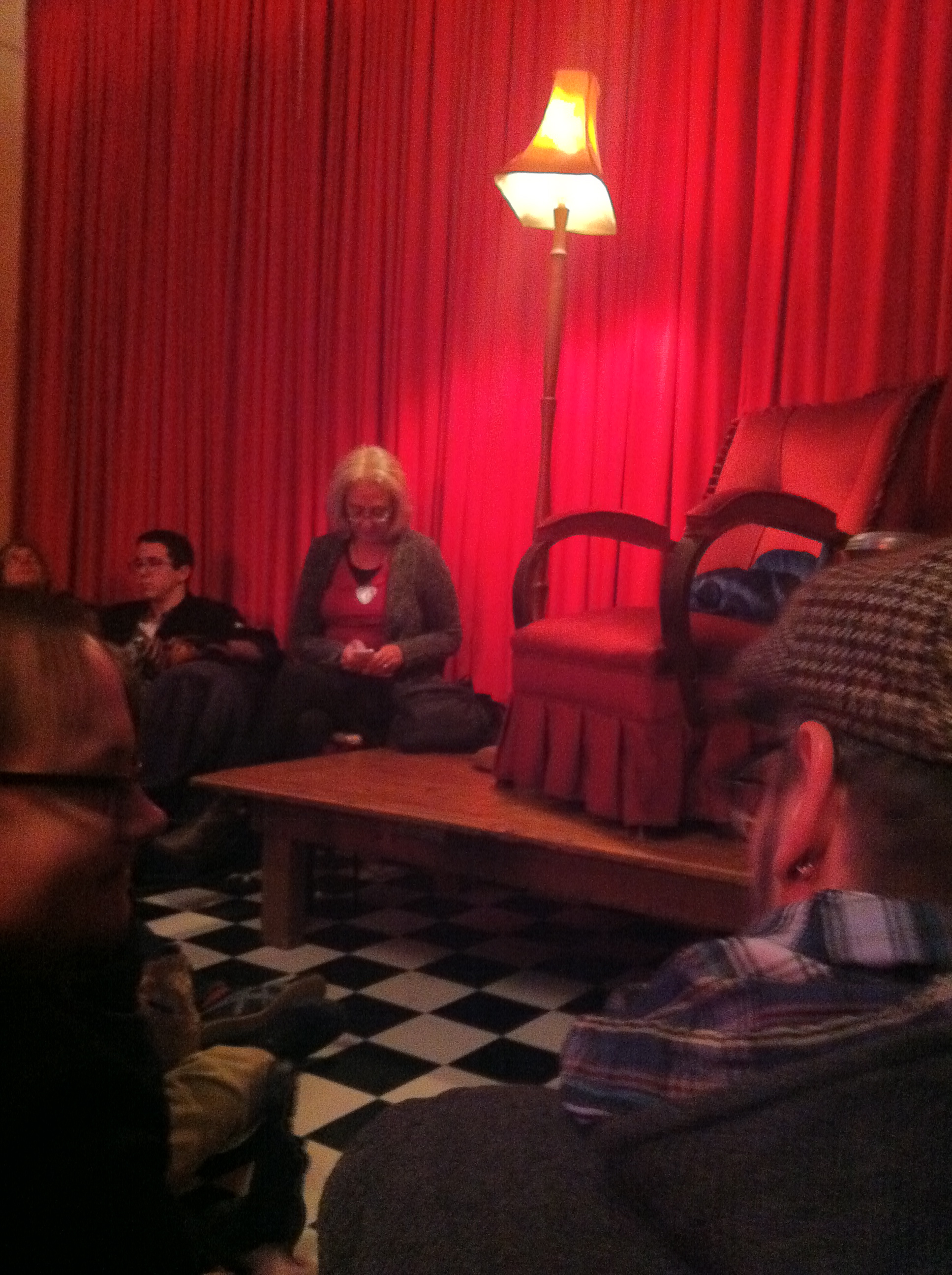
Penguin Plays Rough had a very different feel. It was my second time there as well, but my first at the new venue. The front section of an old warehouse has been curtained off from what I assume is the living space further back. The heavy red curtains lend a suitably theatrical atmosphere to the chequered lino floor, cosily ill-assorted couches and armchairs around the walls, and wooden podium with iconic red chair and standard lamp. By the time we arrived all but one of the sears were taken, and no mercy was shown to our elder status. We found a place on the lino. (At the first break in proceedings when we stood up to stretch our legs, I was shocked to discover a pack of young people moving in to claim the space we were relinquishing – behind us, in the tiny space between the front door and the first heavy curtain, they had been standing three deep, envying us our vantage point.)

We were physically uncomfortable, but we were warm, and we were part of a cheerful crowd. Many people were drinking mulled wine. Those in the know – and they seemed to be many – had brought their own mugs. Pip Smith, who edited and published The Penguin Plays Rough Book Of Short Stories, was a brilliant MC, using words like ‘awesome’ and generally exuding a mi casa es su casa aura. With one possible exception (he said humbly), the readings were terrific. The advertised readers were Emma Dallas (a character sketch of an inner west personality), Ryan O’Neil (a piece about depression that would have been scary if it wasn’t so brilliantly playful), Sam Twyford-Moore (a tale of travel, crosscultural romance and writerly rivalry), Jess Bellamy (letters to celebrities whose dysfunction feeds the tabloids, which became retrospectively more substantial with news of Amy Winehouse’s death yesterday), and the star of the evening Tom Cho. Tom read from ‘The Attributes of God’, a story that will be in a book he describes as being about the meaning of life. I wouldn’t have minded the physical discomfort of the evening anyway, but hearing this story would have been worth even more suffering. ‘God is love’ has taken on new meaning for me. He ended with a YouTube clip of otters that, far from being gratuitously cute, was a perfect accompaniment to his story.

Penguin Plays Rough doesn’t have an open mic. They do have ‘wild cards’: anyone can sign up at the door to read, and a selection of those who sign up are interspersed between the advertised readers. On Saturday we had an essay on relationships between the genders with a focus on schoolyard handball, a piece that Pip Smith described as a theatre review written by James Joyce … and me.

Yes, I put my name in the ring again, which I wouldn’t have done if I’d realised that PPR is actually a short story event and I only had a couple of sonnets and a dog poem in my pocket, and even more definitely not if I’d known I was going to be at the end of the evening – after Tom Cho and the otters. Astonishingly, the whole audience stayed put and even seemed to enjoy what I had to offer.

These are the first two times I’ve ventured to read in public. It’s not so bad.

Added later: I forgot to mention that I met Adrian Wiggins there, the mover behind the Sydney Poetry web site. He has uploaded some wonderfully atmospheric photos to facebook. Mercifully he had to leave before Tom Cho’s and my moments in the chair, so we don’t appear, except in the background of one of the shots.