Tag Archives: Jackie French

Books I read in February [2008]

[This was originally posted in my now defunct blog Family Life, on 1 March 2008. I’m retrieving it today because it includes some comments on Geraldine Brooks’ People of the Book, which recently came in at number 89 in Radio National’s Top 100 Books of the 21st Century.]

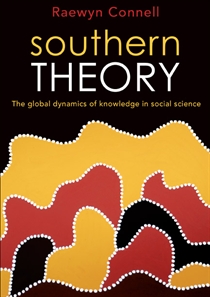
Raewyn Connell, Southern Theory (Allen & Unwin 2007)
Neil Gaiman and Dave McKean, Signal to Noise (Dark Horse Books 1992–2007)
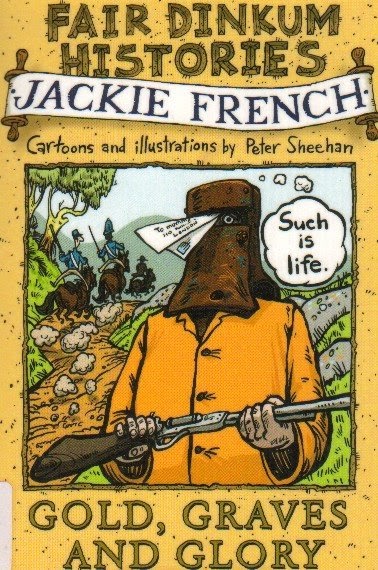
Jackie French & Peter Sheehan, Gold, Graves and Glory (Scholastic 2007)
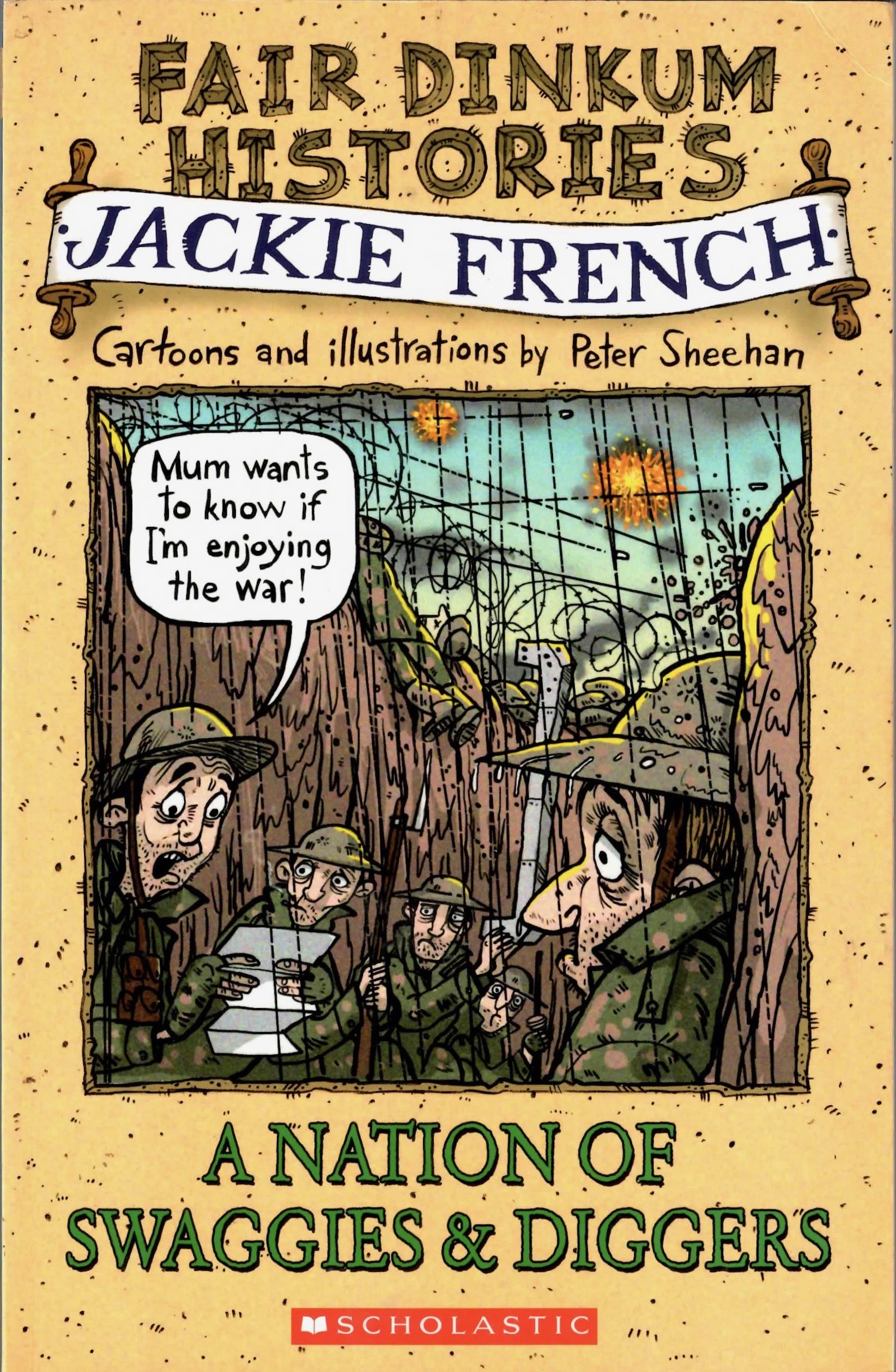
Jackie French & Peter Sheehan, A Nation of Swaggies & Diggers (Scholastic 2007)
Geraldine Brooks, People of the Book  (Fourth Estate 2008)
Michael Ondaatje, The Cinnamon Peeler (Bloomsbury 2004)
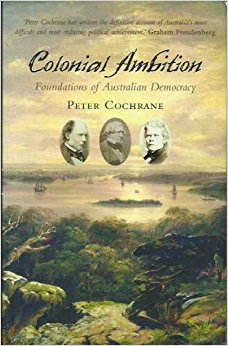
Peter Cochrane, Colonial Ambition (MUP 2006)
9781741753578

To the qualities I attributed last month to Raewyn Connell, author of Southern Theory, add humility. At several points in the book, she acknowledges her difficulty in understanding one of the texts under discussion, even her inability to do so. But this humility is a long way from an admission of inadequacy; in fact, it’s kind of exemplary, as in: This important material has been ignored by social scientists of the West/North/centre/metropole (SSWNCM); we need to approach it knowing that our grasp of it will be imperfect.

When I was about halfway through the book, reading while walking the dog, I met Raewyn down at the corner postbox. ‘You’ve been my walking companion for the last couple of days,’ I said, ‘and you’re excellent company. Of course,’ I went on, ‘given how much I know about social science theory ,,,’ She finished my sentence, ‘… I could be telling a big pile of whoppers.’ Well, if that’s what she’s doing, she’s certainly doing it with gravitas and grace. Having described the way the SSWNCM have generally managed to ignore the East/South/periphery as a source of theory in the social sciences, she discusses a small number of the thinkers who have been ignored or marginalised – from Africa, Muslim Iran, Latin America, India, Indigenous Australia; and drawing the threads together beautifully without claiming to arrive at a synthesis, she outlines key places where the North can learn from the South.

She mentions that one prominent social scientist of the North Atlantic referred to an earlier version of the argument as a ‘guilt trip’, but it reads to me much more as a judicious and impassioned call for a broadening of horizons, or more precisely an acknowledgement of horizons and of other features of particular locations: that is, one of her central points is that social theory of the Metropole takes place in terra nullius, and recognition of the importance of place is something that the theory from elsewhere has to offer. (She has some beautiful paragraphs on the sandstone country where she and I both live.) Though I’m a social scientist only in the sense that we all are – I live in a society, think about it and try to live well in it and/or in struggle with it – I found the book not just accessible (even on pages that were full of references familiar to the book’s ideal reader and completely unknown to me), but exhilarating.
1593077521

I’m pleased to report that, unlike Mr Punch, the collaboration from Neil Gaiman and Dave McKean that I read before this, Signal to Noise isn’t packaged as a children’s book. Perhaps an account of the death of an artist is more obviously adult than tales of the effect on a young boy of witnessing half-understood scenes of sex and violence. It’s a terrific book.

I’m not generally in love with Dave McKean’s art work, except when he’s working for children – The Day I Swapped My Dad for Two Goldfish and The Wolves in the Walls are both brilliant. His grown-up (as opposed to ‘adult’) work tends to be too fractured, dark and postmodern-incoherent for my taste. I started this book with a sinking feeling, as the first couple of pages are given over to a piece written as well as illustrated by McKean. About this piece the less said by me the better. Then there’s a spread of a series of poems about walls by Gaiman, and suddenly the illustrative style works, as it continues to do for main feature: the moody, hard-to-read images combine with the elegant text to spectacular effect, including a couple of sharply poignant moments (if you’ll excuse the tautology). Neil Gaiman, the new Man in Black, has a lot to say about death.
people

Penny and I had a long car drive in the middle of the month, and as is our custom I read to her for a good bit of the trip both ways. It’s a fun way to travel and a sociable way to read, which we’ve done with books as diverse as Lillian Hellman’s Pentimento, Jared Diamond’s Guns, Germs and Steel, and Clive James’s Falling Towards England. This time we chose People of the Book for our driving entertainment. We made it through the first 110 pages, and it was fun, but I’m not sure I’ll read the rest. When you read a book aloud, you tend to notice things that otherwise you might skim over, and then they start to drag at your attention. For instance, when I reached this bit on page 54 I had to stop to vent a little:

Lola had begun to lead an exhausting double life. Hashomer met two nights a week. On those nights she went to bed early, with her little sister. Sometimes, when she had worked very hard, it took an immense effort of will to keep herself awake, listening to the gentle, even breathing of Dora’s little body next to her. But mostly her anticipation made it easy to feign sleep until her parents’ snores told her it was safe to leave. Then she would creep out, scrambling into her clothes on the landing and hoping no neighbours came out of their doors to notice.

There’s nothing bad about that writing, but did the parents snore in unison? wouldn’t one have started first, and one been louder than the other? (Later in the chapter it turns out that the mother wasn’t asleep at all, so surely she wouldn’t have been snoring?). Why did Lola have to feign sleep when her little sister was already asleep and her parents were in another room? If you walked out at night onto your landing where a young woman was getting dressed, would you ‘notice’ it, with the implication that you might somehow have missed it? These nitpicking questions actually arise, I think, from the passage’s lack of imaginative engagement with the situation. It’s as if the story is being hurried along. And that would be fine, if it was being hurried along to a sharply realised scene. But this kind of thing goes on for page after page: in the debates about Israel among the young Jews of Sarajevo in 1942, you can feel the points being ticked off rather than any kind of life in the disputants (compare, say, the political arguments in that Ken Loach movie about the Spanish Civil War); even in the parts where Hanna the book conservator is going about her business, what fascinates is the wealth of material that Geraldine Brooks has found in her research, and the elegance with which she performs her info dump, rather than any engagement with the characters or the action

I was glad when the sex scene in the first chapter happened during a paragraph break, but then I wondered if the fact that it wasn’t described might be symptomatic of the narration’s failure to engage – to show rather than tell. There are poignant and dramatic moments, and Geraldine Brooks turns a beautiful sentence, but life may be too short for me to read any more of this one. If I’m making a serious mistake, please say so in the comments.

0747572615

If a book of poetry is like a forest, I often seem to have trouble seeing any given tree for the woods. Some of the individual poems in The Cinnamon Peeler speak to me, and there are any number of memorable lines and images, but generally I feel as if I’m eavesdropping on a discontinuous commentary on things I know nothing about. Ondaatje is originally from Sri Lanka: knowing that, I can tell that the tropical references have childhood resonances. I can guess that he has a son named Skyler (‘Late Movies with Skyler’ is terrific). But for an awful lot of the book I was struggling to make sense of the scraps I was overhearing. Maybe I need to discover poets one poem at a time (with Langston Hughes, for example, it was ‘Mother to Son’; Hopkins, weirdly enough, the sonnet that starts ‘Earnest, earthless, equal, attuneable, vaulty, voluminous … stupendous’), and I may be getting things barse-ackwards here, wanting to have a sense of a whole book when I should be happy to have a dozen poems that speak to me (which I do) and just allow to pass by those that don’t. For the record, the ones I do get tend to celebrate friendship, and are mostly towards the end of the book.
gggjf

I don’t understand why the Fair Dinkum Histories haven’t been universally greeted with drum rolls and fanfares. These are the fourth and fifth books in the series, and like their predecessors they are lively and unpatronising accounts of parts of Australian history. They provide what the former Prime Minister demanded of history: a narrative thread. I don’t know what he would make of their attention to the dispossession of Aboriginal people, to class and cultural diversity, to the role of women and children, and so on, but they’ll do me.

Gold, Graves and Glory tells the story from 1850 to 1880, and as you’d expect from the title and the cover, is about goldrushes and bushrangers. There’s also quite a bit about explorers. What you might be surprised by are the account of Chinese miners on the goldfields, including the racism they endured, the attention to Aboriginal dispossession, the detail about underpaid ‘Afghan’ camel handlers who accompanied the explorers, and the expansion of the story beyond the south-east of the mainland, including the beginnings of the sugar industry in Queensland. On an idiosyncratically personal note, it was nice to see Edward John Eyre’s Journals of Expeditions of Discovery in the Recommended Reading list – Eyre’s story doesn’t feature in the narrative, so presumably it’s there because Jackie French recognises it’s a good yarn. My aborted MA thesis in the 1970s was to have made that point at great length.
EPSON MFP image

A Nation of Swaggies & Diggers is harder going than any of the others in the series so far: covering the period 1880–1920, it deals with things I remember as being acutely boring in my primary school days – the importance of gold and wool to the developing economy, the conferences leading up to Federation, the Depression of the 90s – and it doesn’t entirely manage to break that childhood curse. The mandatory thumbnail sketches of the first prime ministers don’t help. And even the account of Australians going to war is somehow flat – perhaps because of the unresolved contradiction between horror at what actually happened and the role the glorifying/sentimentalising myth has played.

But even here Jackie French’s text and Peter Sheehan’s cartoons maintain a light tone (the latter mostly with satisfyingly groan-worthy puns) without resorting to bum jokes. The account of how domestic life was changing, complete with recipes, is particularly delightful. And suddenly in the first years of the last century I was recognising things from my own childhood: the mint at the back steps, the lemon tree in the yard, sponge cake and lamingtons, blocks of ice wrapped in hessian for the ice chest. [Full disclosure: my copies of both these books were given to me by Peter Sheehan, who is a friend of mine; and the series was originally commissioned for Scholastic by Margrete Lamond, also a friend.]
cambition

In the Fair Dinkum Histories, the story of the coming of independence and democracy to the Australia colonies is largely a matter of dates, and where the debates can’t be avoided, as in the lead-up to Federation, they are described in a chapter entitled ‘The Great Yack Attack’. And that’s fair enough: compared with exploration, slaughter, discovery of gold, romantic uprisings, and the struggles of Indigenous Australians, Chinese and women, questions of governance don’t obviously rate high on the child-friendly scale. Colonial Ambition was published too late to be useful in Jackie French’s research. Had the timing been different, she might well have found her way to delight child readers with the mid 19th century struggles conducted by a cast of extraordinary characters over the form of government that would prevail in the colonies. Peter Cochrane has certainly achieved that for adult readers.

It’s not bang-bang-kiss-kiss; it’s not bloodshed on a foreign strand; but it’s a great story full of comedy and heroism, big ideas and petty point-scoring, opportunism and integrity, and eloquence, eloquence, eloquence. In those days people didn’t watch sound-bites on the telly after dinner; they wandered up to Macquarie Street to see if here were any good speeches in the Legislative Council. In 1846 more than 3000 people met at Homebush Racecourse to protest against a proposal to reintroduce convict transportation; a year or so later more than 2000 met in the Royal Victoria Theatre in Haymarket to oppose a new constitution being foisted on the colony by Earl Grey. They gathered, they cheered the speakers, they prevailed. In the absence of universal suffrage, the ‘multitude out-of-doors’ did make its voices heard; in the absence of votes for women, a Ladies’ Petition was a significant political event.

The Art Student read this before me, and read great slabs of it aloud. It’s that kind of book: among other characters, it’s got a fiercely eloquent albino dandy, a faux-rustic oligarch with a chip on his shoulder, a dapper Regency blade who is devastated when he kills his wife in a carriage accident, a rocking-horse maker who becomes known as the Father of Federation. The committee advising John w Howard on the inaugural Prime Minister’s History Prize recommended this book for the prize. The then PM only partly accepted the recommendation, and decided the prize should be shared with Les Carlyon’s history of the First World War. One result of this decision is that the two books are placed side by side as alternative foundation narratives: Australia achieved true nationhood when thousands of its young men were slaughtered in a European war (and did some killing of their own), or Australia achieved nationhood through the less glamorous but arduous business of arguing, rallying, orating, lobbying, writing, imagining, organising … thinking. There was very little violence, and though Peter Cochrane uses the metaphor of war and his characters refer frequently to the American War of Independence and the French Revolution, there was no war.

On 30 March 1858 Charles ‘Slippery Charlie’ Cowper introduced a bill to amend the Electoral Law in New South Wales, the bill that was to establish manhood suffrage and make the colony a ‘democracy for men’ (Cochrane’s phrase) and who even remembers that date? ‘The introduction of democracy in New South Wales,’ says Cochrane, ‘ was as matter-of-fact as a handbook for a customs clerk.’ But of course, that quiet moment came as the culmination of years of struggle.

Posted: Sat – March 1, 2008 at 01:00 PM
 

More Ruby reads

So many books in Ruby’s house, so little time. I may be doing a weekly blog post for a while to come. Given that the projected life of a children’s book is alarmingly short, it’s heartening to see so many relatively ancient books here.

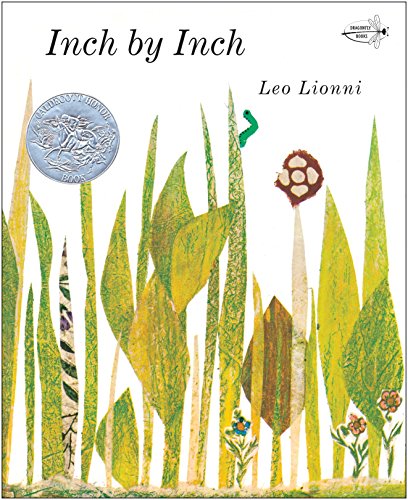
Leo Leonni, Inch by Inch (1962)

This was Leo Lionni’s first picture book. Not as spectacular as Swimmy, perhaps, it’s still splendid. The tiny inch worm saves itself from being eaten by offering to measure parts of various birds, and finally by rising to the challenge of measuring the nightingale’s song. For small readers, there’s a bit of a Where’s Wally thing going on as the tiny worm appears in every spread. For big ones (including grandparents) there are more sophisticated joys in the spare text and elegant paintings.

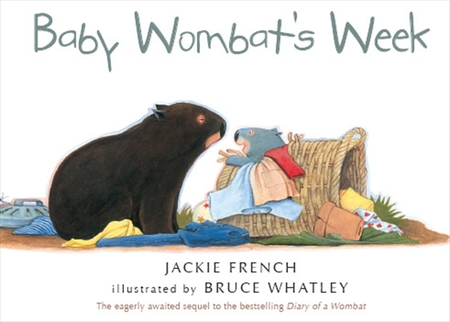
Jackie French and Bruce Whatley, Baby Wombat’s Week (Angus & Robertson 2009)

This is a sequel to Diary of a Wombat that won hearts and prizes all over the place in 2002. Who doesn’t love a wombat? And this one’s a baby. Again, the images are probably too complex and the humour too sly for tiny people. But this is wonderful.

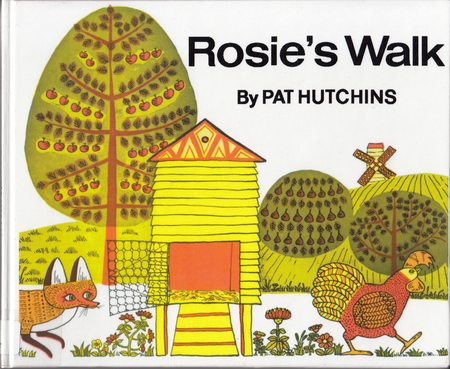
Pat Hutchins, Rosie’s Walk (Macmillan 1967)

This is a board book supplied by us grandparents. Its place in our affections is at least as firmly established as The Very Hungry Caterpillar‘s. It’s a classic example of illustrations telling a story of which the verbal text pretends to be oblivious. The bright, patterned illustrations are, of course, gorgeous.

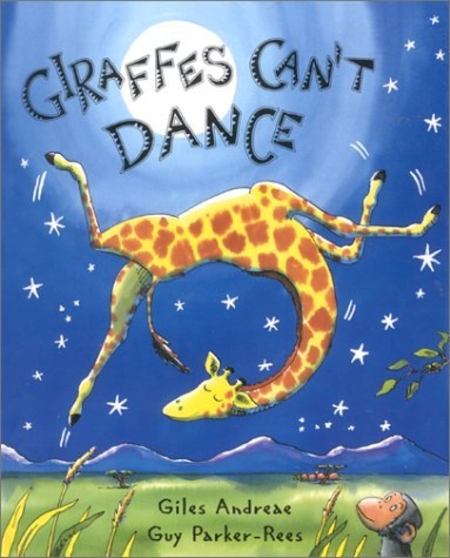
Giles Andreae and Guy Parker-Rees, Giraffes Can’t Dance (2001)

This one doesn’t appeal to me so much, but it’s on high demand in Ruby land, possibly because one of her favourite toys has been a squeaky giraffe named Sophie. The Giraffe in the book is mocked by the other animals because it can’t dance. It wanders off a communes with the moon and the wind, and soon is dancing spectacularly: given how very ungainly the giraffe is in the first part of the boo, there’s something dispiritingly unrealistic in the moral is that everyone can dance if the music is right.

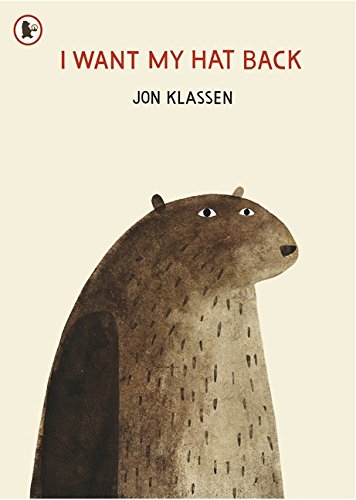
John Klassen, I Want My Hat Back (Walker 2011)

Jon Klassen is a Canadian minimalist picturebook maker. As far as I can tell this is the first of a trilogy about a bear and his beloved hat. The bear, who doesn’t change much from page to page, asks a number of other animals, some of them of indeterminate species, if they’ve seen his hat. We see the hat long before he does (another example of an illustration alerting the reader to something the text is unaware of), and there’s a bloodthirsty and punitive but funny twist in the tale, which I hope young readers generally miss.

Bob Graham, Vanilla Ice Cream (Walker 2014)

Bob Graham! Evidently he’s even more popular in France than in his native Australia. This picture book is the work of an assured master – possibly in his Late Style. A sparrow accidentally hides away in a bag of rice loaded onto a ship in an Indian port. When the ship arrives in a southern land (a non-specific Australian city), the sparrow emerges and flies to a nearby park. There, a dog leaps up towards him and knocks an ice cream out of someone’s hands. The ice cream lands in the lap of a baby in a stroller, and that’s the first time that baby tastes vanilla ice cream. A weird non-plot, you might say. But he pulls it off!

Julia Donaldson and Axel Scheffler, The Snail and the Whale (Puffin 2006)

A strange tail of a snail with an itchy foot who hitches a ride to exotic places on the tail of a whale and comes back to inspire the other snails to go adventuring, having saved the whale’s life by writing a message in slime on a classroom blackboard. Surrealism is alive and well in children’s picture books. This one is way too old for Ruby, but she has two copies, one in the profusion of books and toys in a corner of the living room and one beside her cot.

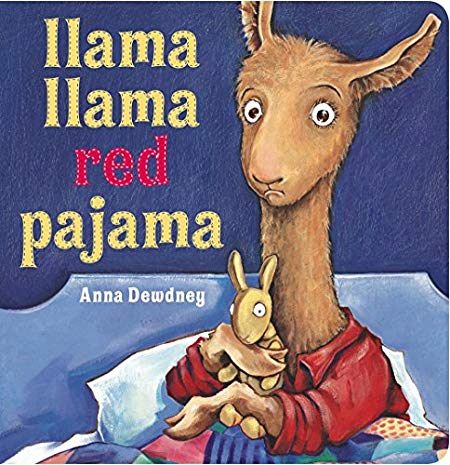
Anna Dewdney, Llama Llama Red Pajama (2005)

A gauge of the success of this book is that Mr Blue Pencil didn’t notice the US spelling in its title until I wrote it for this bog post. It’s a bedtime story with bright colours, bouncy rhymes (as long as you pronounce mama to rhyme with llama). There’s a fear-of-the-dark moment that might be a bit suggestive for some children. But the relationship between ht young llama and the llama mama is warm and loving, even if she does answer the phone when the young one needs her desperately at the bedside.

Baby Wombat’s Week is the seventh book I’ve read for the 2019 Australian Women Writers Challenge.

NSW Premier’s Literary Awards Shortlist announced

A bit late for anyone who wants to read the whole short list before the winners are announced next month, but the (very long) short list for the NSW Premier’s Literary Awards has been announced. You can see the full list with judges’ comments on a pdf press release from the State Library.

Here’s most of it – all except the translator – with links to my blog posts on the few I’ve read, all of which have me nodding my head in agreement with the judges. (Maybe it will take grandchildren to bring me back up to date on children’s lit.)

Christina Stead Prize for Fiction
Only the Animals, Ceridwen Dovey (Penguin Australia)
In Certain Circles, Elizabeth Harrower (Text Publishing)
Golden Boys, Sonya Hartnett (Penguin Australia)
The Snow Kimono, Mark Henshaw (Text Publishing)
The Golden Age, Joan London (Random House Australia)
A Million Windows, Gerald Murnane (Giramondo Publishing)

UTS Glenda Adams Award for New Writing
The Tribe, Michael Mohammed Ahmad (Giramondo Publishing)
Foreign Soil, Maxine Beneba Clarke (Hachette Australia)
The Strays, Emily Bitto (Affirm Press)
An Elegant Young Man, Luke Carman (Giramondo Publishing)
Here Come the Dogs, Omar Musa (Penguin Australia)
Heat and Light, Ellen van Neerven (University of Queensland Press)

Douglas Stewart Prize for Non‐fiction
The Europeans in Australia, Alan Atkinson (NewSouth)
Citizen Emperor: Napoleon in Power 1799‐1815, Philip Dwyer (Bloomsbury)
This House of Grief, Helen Garner (Text Publishing)
The Reef: A Passionate History, Iain McCalman (Penguin Books Australia)
In My Mother’s Hands, Biff Ward (Allen & Unwin)
The Bush, Don Watson (Penguin Books Australia)

Kenneth Slessor Prize for Poetry
A Vicious Example, Michael Aiken (Grand Parade)
Devadetta’s Poems, Judith Beveridge (Giramondo)
Kin, Anne Elvey (Five Islands Press)
Wild, Libby Hart (Pitt Street Poetry)
Unbelievers, or The Moor, John Mateer (Giramondo)
Earth Hour, David Malouf (University of Queensland Press)

Patricia Wrightson Prize for Children’s Literature
The First Voyage, Allan Baillie (Puffin Books)
Rivertime, Trace Balla (Allen & Unwin)
Figgy in the World, Tamsin Janu (Omnibus/Scholastic Australia)
The Duck and the Darklings, Glenda Millard & Stephen Michael King (Allen & Unwin)
Crossing, Catherine Norton (Omnibus/Scholastic Australia)
The Adventures of Sir Roderick the Not‐Very Brave, James O’Loghlin (Pan Macmillan Australia)

Ethel Turner Prize for Young Adult’s Literature
Book of Days, K.A. Barker (Pan Macmillan Australian)
The Road to Gundagai, Jackie French (HarperCollins Publishers)
Are You Seeing Me? Darren Groth (Random House Australia)
Razorhurst, Justine Larbalestier (Allen & Unwin)
The Cracks in the Kingdom, Jaclyn Moriarty (Pan Macmillan Australia)
Cracked, Clare Strahan (Allen & Unwin)

Betty Roland Prize for Scriptwriting
The Code Episode 1, Shelley Birse (Playmaker Media)
Upper Middle Bogan Season 1, Episode 8: The Nationals, Robyn Butler and Wayne Hope (Gristmill)
The Babadook, Jennifer Kent (Causeway)
Fell, Natasha Pincus Story by Kasimir Burgess and Natasha Pincus. (Felix Media)
Please Like Me Season 2, Episode 7: Scroggin, Josh Thomas
Once My Mother, Sophia Turkiewicz (Change Focus Media)

Nick Enright Prize for Playwriting
Brothers Wreck, Jada Alberts (Currency Press)
The Sublime, Brendan Cowell (Melbourne Theatre Company)
Jasper Jones, Kate Mulvany (adapted from a novel by Craig Silvey) (Barking Gecko Theatre Company)
The Trouble with Harry, Lachlan Philpott (TheatreofplucK Belfast/MKA New Writing Theatre)
Kryptonite, Sue Smith (The Sydney Theatre Company)
Black Diggers, Tom Wright (Queensland Theatre Company)

Community Relations Commission for Multicultural NSW
Jump for Jordan, Donna Abela (Griffin Theatre Company)
Black and Proud: The story of an AFL photo, Matthew Klugman and Gary Osmond (NewSouth Publishing)
Refugees, Jane McAdam and Fiona Chong (UNSW Press)
I, Migrant: A Comedian’s Journey from Karachi to the Outback, Sami Shah (Allen & Unwin)
The Tainted Trial of Farah Jama, Julie Szego (Wild Dingo Press)
Once My Mother, Sophia Turkiewicz (Change Focus Media)

Congratulations and good luck to all of them, and may the judges’ eyes and brains enjoy a rest.

Books I read in May [2007]

[Originally published in May 2007 in my now defunct earlier blog, Family Life. I’ve retrieved it because a friend was looking for information on Jeff Sparrow’s book.]

Ivor Indyk (editor), Heat 13: Harper’s Gold (finished)
Jeff Sparrow, Communism, a Love Story (Melbourne University Press 2007)
Jackie French & Peter Sheehan, Rotters and Squatters (Scholastic Press 2007)
Frank O’Hara, Selected Poems (finished)
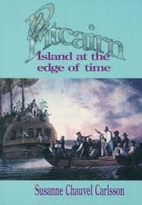
Susanne Chauvel Carlsson, Pitcairn: Island at the edge of time (Central Queensland University Press 2000)
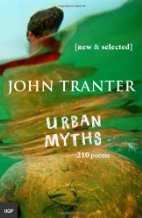
John Tranter, Urban Myths: 210 poems (University of Queensland Press 2007) (started)

heat13

Heat was, as always, a solid read. And as always it’s a bit of a puzzle how the title was arrived at: in this case it’s a phrase from one of the stories, with no obvious overarching thematic relevance. But it doesn’t matter. Even if there is no theme that makes the book hang together, the pieces in this issue, as in others, are free to resonate with, echo and comment on one another, so that the whole is pleasingly more than the accretion of its parts — and I did read and enjoy this issue cover to cover.

Beverley Farmer visits her former husband’s village in Greece in ‘The House on Rebirth Street’ (dropping a few too many untranslated Greek words for my comfort); Greece brings some respite to the heroine of Stephen Edgar‘s pseudo ghost story in verse, ‘The Deppites’. There are a number of nostalgic visits to family homes, and frequent references to migration.

Nostalgia for religious belief bubbles to the surface in a number of pieces. Gillian Mears is visited by the rumtitum rhythms of Edward Lear’s ‘Pelican Chorus‘ as she’s wheeled in, near death, to the operating theatre; Felicity Plunkett‘s wonderful sequence of poems ‘The Negative Cutter: An Introduction to Editing’, also deals with surgery, playing with a cinematic metaphor; Mark Rappaport, documentary film maker, has fun riffing on his connections to Catherine Deneuve, as fan and appalling collaborator. I love all this.

When I edited a literary magazine not so very long ago, it was regularly proposed to us that each issue should be organised around a Theme. Just as regularly, I resisted the proposal, as it seemed to me that it was based in a misunderstanding of what kind of creature a literary magazine is. My pleasure in Heat confirms me in my belief. Instead of corseting, regimentation, control, there is a sense of organic relationship, of many minds independently but harmoniously making story, or seeking truth, or singing, or doing whatever it is that literature does.

communism

In his introduction to Communism: A Love Story, Jeff Sparrow writes:

Communism provided an alternative. It was, in many ways, the alternative, the most important indicator that society could be remade. Between 1917 and 1989, its star shone bright and its star shone dim, but its continuing sparkle in the political firmament allowed millions to believe in a world beyond the free market. Even those who despised communism felt that while it existed, change – whether they wanted it or not – was a possibility.

Today, that feeling is gone.

The book is a biography of Guido Baracchi, a well-heeled, literate bohemian and committed Marxist/Communist who lived from 1887 to 1975, described by Stuart Macintyre as ‘the knight errant of Australian communism’. He’s a terrific subject for biography: he worked for the cause in Weimar Germany and the 1930s Soviet Union; he had intense relationships with a number of poets and playwrights (Lesbia Harford, Katharine Susannah Prichard, Betty Roland), each of whose accounts this biography has drawn on; he was widely read and wrote a lot himself, also supplying a wealth of material to his biographer.

I was telling some friends about the book, and one woman was prompted to talk of her youthful romance with a son of a leading Communist family: when they were about to go out on a date, he would say, ‘Let’s stay home tonight – the old coms are coming around and there’ll be lots of tales.’ I suspect Jeff Sparrow had a background something like that, because while this book meticulously cites its written sources (discreetly, up the back, not interfering with the flow of the narrative), and doesn’t hang back from quoting T S Eliot and James Joyce to good effect, it’s also bursting at the seams with ‘tales’, with the lore of Australian Communism: clever ploys, bastardry, romance, betrayal, nobility (like Guido’s wife Neura’s principled reaction to the news that he had taken up with another woman, from which she seems never to have wavered), tragedy (which is too pallid a word for what Stalin and Stalinism did to the hopes of the world). You can almost hear the stories being told with suitable embellishment at a smoke-wreathed kitchen table far into the night.

As the story unfolds, what today is called the mainstream media is relegated to commenting from the sidelines: for example, during the travails of the tiny Australian Marxist movement of the early 20s, bitterly divided within itself, devoting most of its energies to self-education, and discouraged at the prospect of ever being effective, we learn that Prime Minister Bruce gets headlines by accusing the Labor Party of pandering to Bolshevism, and succeeds at a stroke ‘in elevating communism into a public issue in a way that the communists themselves found impossible’. Sadly, the MSM version has become received wisdom, and a whole dimension of our history has been largely forgotten. Those who deplore ‘black-armband history’ would no doubt equally deplore this, perhaps as ‘red-tie history’. I can’t recommend it enough – for that worthy reason, but also because it is a ripping good read, another example of history written with the verve and imaginative force that some think is the exclusive domain of the novel.

An extra pleasure of the book for me was encountering a number of people I have actually met: Betty Roland, the Currency Methuen edition of whose play The Touch of Silk I edited in 1974; Eric Aarons, ‘the young branch secretary’ who banned Guido from lecturing in 1939, whom I met as a gentle old man, a sculptor and caretaker of a workshop site (and whose own memoir What’s Left sits on my bookshelf unread); Nick Origlass, Trotskyist, who seems to have used the long boring speech as a weapon just as consistently in youth as in age; Bob Gould, shambolic bookshop proprietor, who appears here as a fiery youth; a friend’s mother gets a guernsey as one of two students who defied pressure to reject Guido’s teaching in 1939. And a final personal note: one of my dearest friends and teachers, a US communist in the 30s and 40s, still preserved his hatred for Trotskyism intact 40 years after leaving the party; I wonder what he would make of Jeff Sparrow’s implied contention that it was the Trotskyists who kept the flame of communism burning clearest during Stalin’s era.

rotters

Rotters and Squatters is the third in the Fair Dinkum Histories series, and takes the story of the Australian colonies from 1820 to 1850. I’ve already raved about this series. Consider it raved about again. They’re children’s books, but only a bizarre age-based separatist mentality would prevent an adult from enjoying them. Maybe you need an appreciation of juvenile humour to enjoy the deliberately appalling puns in some of Peter Sheehan’s cartoon illustrations, but this book communicates without condescension or chalk-dust or scatology, and strikes a wholly attractive balance between the general and the particular, the comic and the very serious, the personal and the (discreet cough) political.

Like the previous books in the series, it doesn’t attempt sanitised ‘balance’: no doubt it will irk the haters of black-armband or red-tie history. I reckon the series, and this book as part of it, makes a significant contribution to historical writing about Australia, not least by being a quick read with an occasional laugh-out-loud moment. One of several idiosyncratic reasons for my enjoying it is that its short Recommended Reading list includes just one book by an explorer: Edward John Eyre’s Journals of Expeditions of Discovery, the subject of my aborted MA thesis in the 1970s, which in my opinion richly deserves its recommendation here. (If my thesis supervisor – you know who you are! – is still alive and reads this, I’d like my copy back, please).

0394719735

After a break, I went back to the Frank O’Hara. I still don’t think it’s my cup of tea, but I decided to read the poems as play – instead of puzzling over what he means by an obscurity, I’ll just take it that it’s there because it’s what popped into his head and sounded cool – or in some way captured the emotion of the moment. And I decided not to worry about his name-dropping and hi-falutin’ allusions. In other words, I stopped trying to understand what was going on and just let it flow. No doubt I missed a lot – because of his hurling words at the page like Jackson Pollock creating a painting, and because of the references and allusions that went past me – but I also enjoyed a lot. There are some outright reader-friendly bits like this piece of New-York patriotism from ‘Meditations in an Emergency’:

I can’t even enjoy a blade of grass unless I know there’s a subway handy, or a record store or some other sign that people do not totally regret life.

I gather he’s as hip as ever: people even use phrases from his poems as novel titles.

pitcairn

I read the Pitcairn book in preparation for an editing job (which seems, alas, to have fallen by the wayside – in Pitkern, it es ay los’ bawl). Susanne Chauvel Carlsson is the daughter of Charles and Elsa Chauvel. Her interest in Pitcairn Island grew from her parents’ relationship with the island, beginning with their 1932 visit to film parts of In the Wake of the Bounty. The book is a mix of fascinating potted history, family lore, personal reminiscence and observation, and travel log.

People who read the newspapers more carefully than I do, and that’s probably most people, may already know a lot of the Pitcairn story, but even if I’m coming in late, I’m compelled to say the story is riveting. Pitcairn was settled in 1790 by a party of Bounty mutineers led by Fletcher Christian and accompanied by a number of Polynesians: nine mutineers, six Tahitian men, nine Polynesian women (all but one of them from Tahiti) and one baby girl. The first decade was rough, with quite a bit of drunken rioting and mayhem (ears bitten off and so on), murder, a suspicious suicide. After a failed escape attempt, some of the women murdered the remaining Tahitian men. By 1800 the population comprised one man, the mutineer Aleck Smith (who later changed his name to John Adams); ten women (I don’t know where the extra one came from – the book is plagued with such inconsistencies ); and about 23 children. It was another eight years before the Pitcairners had any contact with the outside world, and isolation has been a major factor in the Island’s cultural, economic, linguistic and political development ever since.

It’s a story that reads like a lost-in-space fiction: the language developed as a mixture of rough English and Tahitian; the religion grew from the one semi-literate man’s determination to read and then communicate to the women and children what he found in the Bounty‘s bible. Susanne Carlsson makes no bones about having fallen in love with the place and the people – it’s one of those unfathomable complexities that the object of her affection has also been the site of a history of sexual assault and of sanctioned sexual practices that in most other places would be condemned as paedophilia.

All that news was bad enough already. It becomes much worse when you’ve read accounts of these people playing a cheerfully innovative version of cricket (you have to innovate when your total population is about 50), sharing out Christmas presents in the town square, praying in their Seventh-day Adventist chapel, rowing longboats out to meet the still infrequent visiting ship. I imagine we’ll never know whether the evidently widespread sexual abuse has been there from the beginning or whether it is a symptom of the recent breakdown of the stern religious glue that held the community together.

Oh, and this book had an excellent addition to the Little Known Facts file: in 1838, when the Pitcairners persuaded a visiting Royal Navy ship’s captain ‘to draw up a constitution and code of laws suitable to their needs’, Pitcairn became the first place where women had the right to vote, 46 years ahead of South Australia.

Baby Boomer Reminiscence Alert. Skip to the end if BBRs drive you nuts.

0702235571

(OK, they’ve gone, but I’ll assume I’m not talking only to myself.) Back in the early 70s there were a lot of poetry readings in Sydney: there were Moratorium readings, Balmain readings, Sydney University Great Hall readings; at the 1972 Aquarius Festival in Canberra, the year before the much more famous Nimbin Aquarius Festival, there were a number of serious group poetry readings. I was a keen poetry-goer in those days. There were dramatic moments: Roland Robinson once shouted something like ‘This is muck!’ during a Chris Wallace Crabbe poem that began ‘To f**k is to move through grooves of time’. The dignified cadences of A D Hope shared the stage with the precision of Dave Malouf, the raffishness of Bob Adamson, the heady intellectualism of Martin Johnston, the drugged waifishness of Michael Dransfield, the hypnotic incantations of Les A. Murray … and so on. If I remember correctly, John Tranter was a regular at these events, but for some reason I’ve never really got his poems: back then, and on my occasional attempts to read him since, I found them intriguing but it felt as if they existed in a thicket of references and allusions and associations that were outside my experience. I thought of him as a poet’s poet.

Afflicted as I am with an indefensible, irrational and unfillable greed to know and read everything, I used one of my 60th birthday vouchers to buy Urban Myths, which includes selections from his previous books dating back to 2000. I’m now about a third of the way through it. Those early poems are still intriguing but almost completely opaque. It’s not just the allusiveness; in some way that’s hard to articulate, I can’t hear a human voice in the poems, even one I don’t understand. I’m pleased to report that we’re getting on much better by page 80: I’ve laughed, I’ve been close to tears, I’ve reread some poems a number of times until I feel I understand them, because they promised to repay the effort. The book won the NSW Premiers Literary Award for poetry a couple of nights ago. John read the poem that opens the book, ‘After Hölderlin’, and I couldn’t remember what my problem was. That poem is dated 2002 in Urban Myths, so I’m expecting the best as I read on.