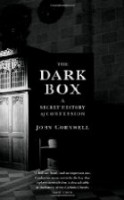
John Cornwell, The Dark Box (Profile Books 2014)
 In Ken Loach’s movie Jimmy’s Hall, the Communist hero visits his arch-enemy the parish priest in the darkness of the confessional and asks for advice on how to deal with the Pharisees who encourage oppression of the Irish poor. The priest, outraged, exclaims: ‘This is sacrilege!’ Jimmy shoots back, ‘I’ll tell you what’s sacrilege. You hate more than you love.’
At the beginning of John Michael McDonagh’s Calvary we see a priest in extreme close up as a voice from the other side of the confessional grille announces the intention to kill him in revenge for sexual abuse committed by another priest.
It’s unlikely that the writers of those scenes, Donal O’Kelly and Paul Laverty for the first and John Michael McDonagh for the second, had read The Dark Box or even knew much of the history it recounts. An Irish Catholic childhood would provide more than enough acquaintance with the confessional box as symbol of pervasive clerical power. But this book could have been written as an explication of these and similar scenes.
It actually was written as an explication of the experiences of generations of Latin Rite Catholic children in the first six decades of last century. (I believe it was different for the Maronite and other rites.)
The practice of frequent sacramental confession was introduced at the Catholic Reformation, in the mid 16th century. Under pain of excommunication and hell all Catholics who had reached the ‘age of discretion’ had to confess at least once a year. In large part this was to strengthen priests’ hold over their parishioners’ inner lives, with the aim of detecting and deterring heretical tendencies. At about the same time the confession box was invented, reputedly by St Charles Borromeo, as a way of preventing priestly abuse of the intimacy of Confession – you could tell your sins without the priest recognising you in the dark or being able to touch you through the separating wall. John Cornwell argues persuasively that it also fostered an approach to morality that was individualistic, introspective and divorced from the narratives of people’s lives – which is pretty much the approach that was taught in the schools of my childhood.
In the 16th century, the age of discretion was generally taken to be somewhere in the late teens. It was Pope (now Saint) Pius X in the early 20th century who decreed that Catholics must make their first Confession at the age of seven. To put it crudely, 17 was too late if you were going to get a solid grip on people’s minds, and steel them against the amorphous threat of ‘Modernism’ – which seems to have been a word for openness to current philosophical and other thinking.
Cornwell spends a lot of time on the link between child sexual abuse and Confession as it existed from the time of Pius X to the Second Vatican Council in the 1960s. First, the ultra private nature of the confessional provided opportunity – though paradoxically it was when priests began hearing confessions in places other than the box that opportunity increased, as his personal recollections attest. More interestingly, though, Cornwell argues that the training that had grown along with the practice of confession created a skewed understanding of human sexuality among priests. He quotes extensively from the text books used in British seminaries for the first half of the 20th century: homosexuality was seen as mortally sinful but rated a very brief mention; rape was a mortal sin but not much discussed; child sexual abuse wasn’t mentioned; masturbation was also a mortal sin, possibly worse than rape for reasons I can’t bear to repeat, and discussed at length.
Through it all, priests were to see themselves as the authorities. As children they had recited laundry lists of sins; now they had more elaborate laundry lists and a host of arguments they could rationalise with. Nowhere was there room for thinking about life as it is lived.
Catholics of my generation sometimes swap stories about childhood confession. The word for ‘sex’ was ‘impurity’, for example, and what was a seven year old boy to make of the information that if he touched his ‘private parts’ except for bathing or peeing purposes he risked burning in hell for eternity? I remember curling up with embarrassment when I went to confession with the Archbishop of Brisbane in the early 60s, when I was perhaps 14. The Archbishop had a deep, loud voice, and when I confessed to impure acts (a term that covered everything from pack rape to a cheerful roll in the hay, but in my case meant touching my own erect penis – and I do mean just touching), he rumbled for the whole cathedral outside the box to hear, ‘Alone or with others? And how frequently did you do it?’
It’s a dark kind of joy, but a joy all the same, to have history’s unforgiving light shone on this part of my childhood. I recommend the book to anyone who has a close relationship with a Pre–Vatican Two Latin-rite Catholic.







 Me fail? I fly!