Tag Archives: Madeleine Watts

Journal Catch-up 15

Here I am once again with two journals, each of which has produced another issue after the one I’m writing about.


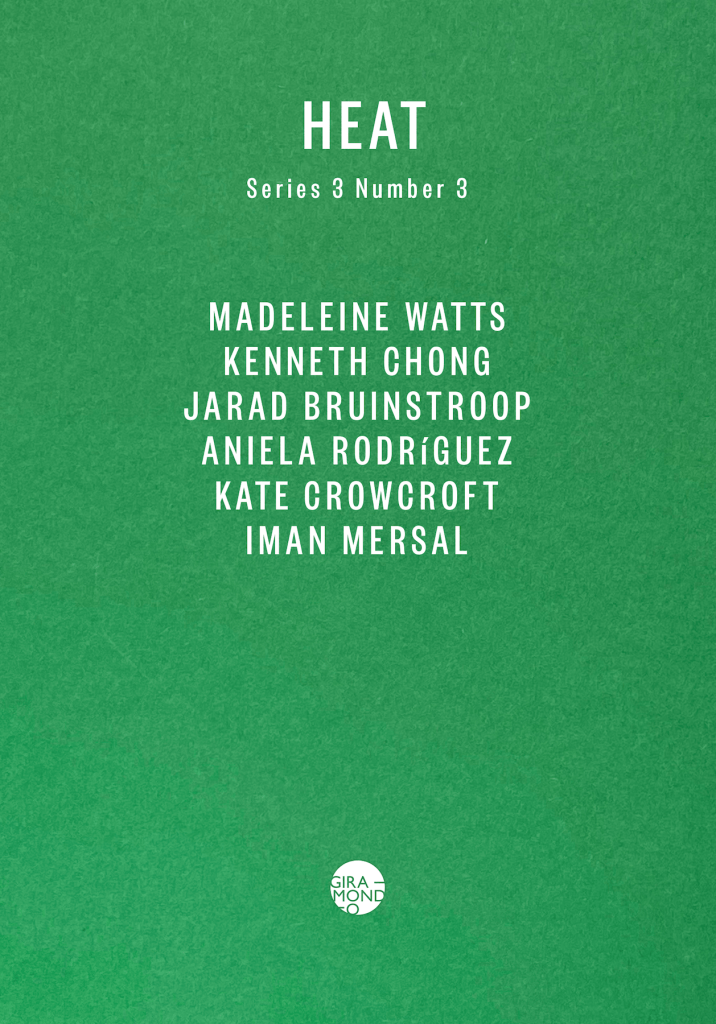
Alexandra Christie (editor), Heat Series 3 Nº 3 (Giramondo 2022)
I’ve just read a tweet quoting Helen Garner about Heat series three:

So slender and elegant, nothing wasted, nothing grandiose – and beautiful work.

Beautifully said!

The third issue is true to Heat‘s original goal to publish culturally diverse voices. It has a bit of a theme going:

  • ‘Australian Capital Territory’, a short story by Madeleine Watts, in which a man and a woman search in and around Canberra for somewhere to have sex, and finally succeed in a manner that is most satisfactory to them, the watching kangaroos and the reader. So, sex.
  • Small Talk’ by Kenneth Chong, a very different short fiction, presented as a kind of abstract memoir, about a young man of faith dealing with troubling issues. So, sex and religion
  • ‘Cain’s Feast’, a short story by Mexican writer Aniela Rodríguez, translated by Elizabeth Bryer, in which a young woman is seduced by a priest and a young man takes revenge. So, sex, religion and violence
  • Tongue Broken‘ by Kate Crowcroft, not so much an essay as a collection of disparate thing connected with the author’s research on the tongue (she has completed a PhD and has a book coming out on the subject). It does one of my least favourite things, presents a word’s etymology as if it offers a kind of magical access to the word’s inner meaning. But the rest is variously lively, unexpected and informative. Also: religion and violence
  • Five terrific poems by each of Jarad Bruinstroop and Iman Mersal, the latter translated from Arabic by Robyn Creswell. Discreet sex, but no violence.
Evelyn Araluen and Jonathan Dunk (editors), Overland 245 (Summer 2021)
(Much of the content is online at overland.org.au, and I’ve included links)

Overland is always so full of interesting things that I can’t possibly name every item. Here are some things that stand out for me in this issue

Of the articles, one or two of which are too academic for my blood, the two that stand out for me are:

  • Perpetrators‘ by Rachael Hambleton, about her complex relationship with her father, who spent much of his life in prison. The essay expands into profound reflections on grief, punishment, the prison system and intergenerational trauma.
  • What lies beyond the vortex‘ by Mauricio Rivera Ramirez, which focuses on the novel La vorágine (1924) by José Eustasio Rivera. Though the subject may seems unpromisingly niche to a general reader, it includes fascinating insights into the colonial rubber trade in Latin America.

I’m often intimidated by the poetry section in Overland, edited by the marvellous Toby Fitch. I mostly enjoy the poetry but have no idea how to talk about it. In this issue, I was delighted to find a poem by Eileen Chong, ‘Dream kitchen’ (sadly not on the Overland website at the time of writing), which narrates a dream of the poet’s grandmother’s kitchen with wonderful surrealist gusto and ends in an echo of classic Chinese poetry:

_______________________-____I knew it was only a dream,
because I was in my bed, alone. I was far from her, and home.

There are three excellent short stories:

  • The first to lose‘ by Hop Dac, a story of Vietnamese-Australian family life
  • Machine works‘ by Jordon Conway, a brilliant sketch of work, class, relationships and integrity in the context of forklifts, lathes and vehicle repair.
  • Fontanelle‘ by Sarah Walker, an excellent companion piece to ‘Machine works’, a semi-futuristic piece about the work conditions of long-distance truck-drivers.

Then, tucked away up the back, there are the 2020 Emerging Older Poets Mentorship (one poem) and the five poems shortlisted for the 2020 Oodgeroo Noonuccal Indigenous Poetry Prize, including Claire G Coleman’s witty ‘Blame Ireland’ and the prize winner, ‘Choice cuts‘ by Mykaela Saunders, a long, fiercely anguished meditation on the commodification of Indigenous culture:

–how to hold onto my integrity
when cold neoliberal logic drills into me
and the colonial vacuum sucks the marrow from me as fodder

Next time: Heat 3, Overland 246, an issue of Australian Poetry, and – if I can overcome my reluctance to read journals online – Southerly 79:3.

SWF 2020, Post 9

From a septuagenarian’s memoir to queer teenage romance, the war on drugs and soundscape ecology, here are the next five sessions from the 2020 Sydney Writers’ Festival that Covid sent into virtuality.Once again, I haven’t read any of the books discussed.

Vicki Laveau-Harvie: The Erratics 31 August

Vicki Laveau-Harvie’s The Erratics won the Stella Prize last year. It’s edging onto my TBR shelf, and I’ve heard and read quite a lot about it, so I almost didn’t listen to this podcast: hearing too much about a book before you read it can completely undermine the experience of reading it for oneself.

But once I’d started listening I was hooked. Ange Lavoipierre (so many excellent interviewers at this Festival that I’ve never heard of) elicited wonderful reflections, on the difference between memoir and autobiography, the astonishing way something that’s peculiarly personal can resonate with many people’s experience, the way writing a memory down is like taking a snapshot which replaces the fluid thing that was there before, and much more.

The conversation made me want to read the book rather than making me feel, as this kind of conversation sometimes does, that I don’t need to.


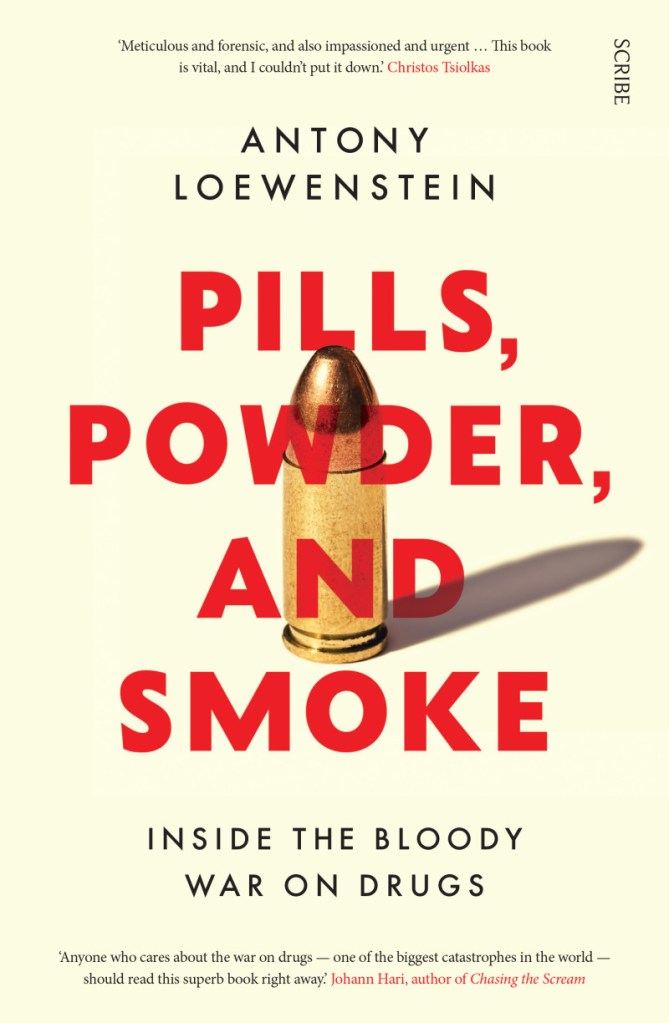
Antony Loewenstein: Pills, Powder, and Smoke 9 September

Antony Loewenstein is back, this time talking about his own book about the war on drugs, Pills, Powder, and Smoke, with George Dertadian. Dertadian introduces himself as an academic who researches aspects of illegal / recreational drug use, who only put Loewenstein’s book down because he had to. So it’s a high-level journalist talking to a scholar, a good combo.

The war on drugs is like the war on terror: neither can ever be won, and both – if I remember correctly – generally make worse the thing they seek to remedy. The war on drugs can become a war on drug users, as experience in the Philippines under Duterte shows. Shockingly but not surprisingly, Loewenstein says, Duterte’s program of extrajudicial killings is generally popular. But the Philippines is an extreme example of what is happening elsewhere:

American administrations have not killed millions of Black people to fight a drug war, not within the US at least. What they’ve done is, they’ve got the world’s largest prison population, which I might add was mostly expanded under Democratic administrations, not Republicans, and Joe Biden, potentially the next US president was the key architect of the War on Drugs rhetoric.

There’s a fascinating discussion of ethical drug use, challenging the mindset, ‘My enjoyment is not connected to other people’s suffering,’ with information about the cost of the drug trade for lower level people in the supply chain in the drugs’ countries of origin. And equally fascinating, though brief, discussion of the safe injecting rooms in Sydney and Melbourne.

My favourite quote: ‘With some notable exceptions politicians on this subject are gutless pricks. I think that’s the correct academic term.’


Text on the Beach 10 September

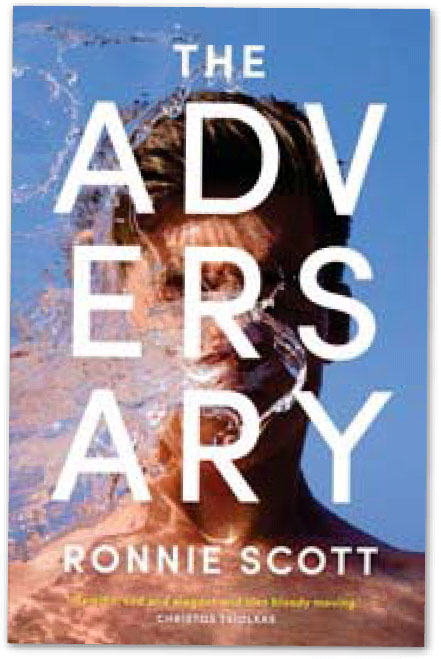
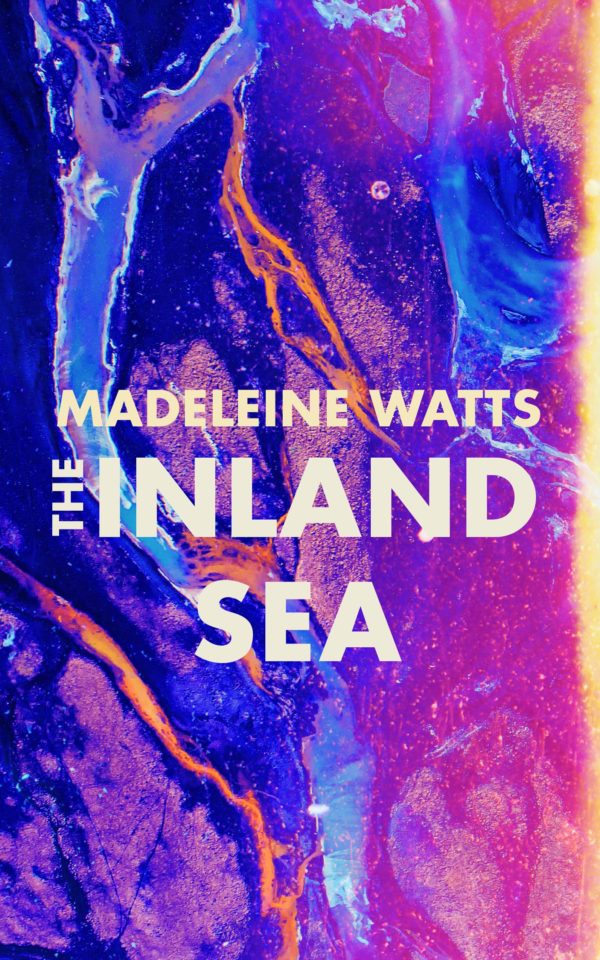
Ronnie Scott and Madeleine Watts, authors of the coming-of-age novels The Adversary (set in Melbourne) and The Inland Sea (set in Sydney) respectively, talk with Rebecca Harkins-Cross, Melbourne-based critic and writer.

They each read from their books, always a good thing in these conversations, and both books sound interesting. The conversation mostly avoids the trap of detailed discussion of the books and instead ranges over the questions of research and the relationship of these books to others. Patrick White, Christina Stead, Sumner Locke Elliott and explorer John Oxley are all mentioned. I learned a little about ‘post-AIDS-crisis’ culture among Gay men, and enjoyed hearing a Sydney-Melbourne conversation that didn’t indulge any of the inane rivalry tropes.


Josephine Rowe: Here Until August 14 September

Josephine Rowe, described on the SWF website as one of Australia’s short-fiction greats, discusses her recent collection, Here Until August, with novelist Stephanie Bishop. Listening to this podcast was like eavesdropping on two smart, likeable strangers taking in spoilerish detail about a book I hadn’t read, a pleasant but pointless activity, until …

…. speaking of the importance of place in her fiction, JR went off piste for a moment to speak about the fascinating work of Bernie Krause, a soundscape ecologist who has been recording the sounds made by particular locations over five decades:

[He has] built up this incredible archive of 1300 biomes, their sonic signatures, and how they change over time … He talks a lot about the ways in which animals communicate and the bandwidths that they use. There’s the geophony, which is the sound of the natural, non-animal, non-sentient world. Then there’s the biophony, which is all non-human creatures, sound-making organisms. And there’s the anthrophony, which is us: our noise interacting or coming in and taking up certain registers means that creatures can’t communicate with each other in the same way and they’re being edged out. So you might be looking at the same patch of forest and it might look completely the same, but when you listen to the sound signature of it you hear how much is missing.

… Of these 1300 environment that he has recorded over the past 50 years, two thirds of them are either unrecognisable or in some cases completely silent, and that’s such a terrifying idea.

The conversation then turns to craft – how writing a novel differed from writing short stories (not necessarily harder!), how building with bricks differs from building with stone … And the session finishes with a reading from one of the stories in Here Until August, which made me want to go out and by the book.


Queerly Beloved 17 September

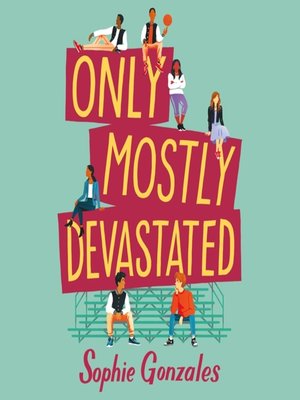
The non-digital SWF was to have an All Day YA event. This panel was to be part of it, featuring YA writers Erin Gough (Amelia Westlake), Sophie Gonzales (Only Mostly Devastated) and Anna Whateley (Peta Lyre’s Rating Normal), all of whom have written queer romance.

Again, I felt I was eavesdropping on smart, likeable people talking about books I haven’t read, and in this case am unlikely too, because my niblings are either out of the YA age group or aren’t much interested in romance, queer or otherwise, and by the time my grandies have reached YA reader age the field will have moved on.

There wasn’t really any YA as such when I was of that age. I searched out the little book where I listed all the books I read 1961 to 1975. Not including the books set for school, the list for 1961, the year I turned 14, which I understand to be peak YA, comprises:

  • 20 books by Agatha Christie
  • 5 by Edgar Wallace
  • 4 by Erle Stanley Gardner
  • 4 racist yarns by Sax Rohmer
  • 2 by Ngaio Marsh
  • a guilty 2 by Carter Brown
  • only 1 by Georgette Heyer, alas
  • 1 by Arthur Conan Doyle
  • 2 detective stories by people I’ve never heard of otherwise
  • 3 historical novels – Ben Hur, The Robe and I Will Repay by Baroness Orczy
  • 1 science fiction: H G Wells, The Invisible Man
  • Cheaper by the Dozen by the Gilbreths
  • Patrick Dennis, Around he World with Aunty Mame
  • Willie Fennel, Dexter’s Court, which I noted was funny by don’t remember
  • Much Ado About Nothing (I don’t know why)

I guess if there’d been YA queer romance, or any YA books at all, I would have been spared that immersion in churned-out detective fiction.