
Jess Hill, The Reckoning: How #MeToo is changing Australia (Quarterly Essay 84)
– plus correspondence in Quarterly Essay 85
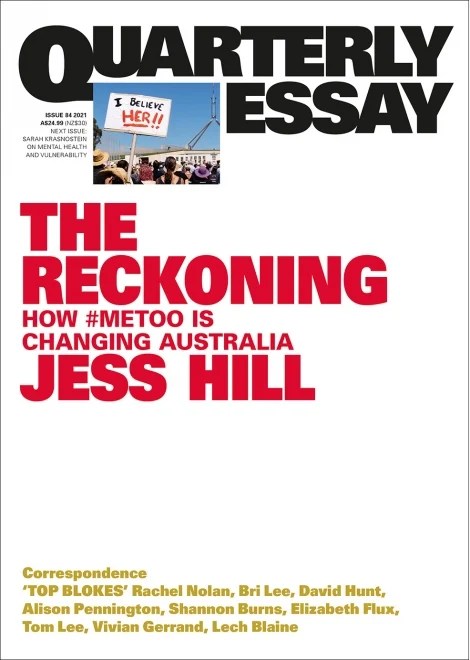
Given the dominance of the 24-hour news cycle and a federal government that seems to expect us not to remember anything that happened before last Tuesday, we can be grateful to the Quarterly Essay team for bringing us a history of the #MeToo movement in Australia. Jess Hill, author of the monumental account of domestic abuse, See What You Made Me Do (my blog post at this link), was an obvious choice to write that history.
She opens with a brief account of Prime Minister Scott Morrison’s press conference in March 2021, at which he began by calling ‘sincerely’ for an end to mistreatment of women in Parliament House, and then quickly descended into veiled and unfounded accusations against a woman journalist who had exposed the things he was deploring. This is an emblematic moment: political spin, Hill says, has no power against the rage unleashed by #MeToo.
The history follows, and it’s more complex and interesting than most of us remember, with a regular interplay between gesture and substance pretty much as foreshadowed in that opening scene.
It begins with Tarana Burke, who started a movement – not a hashtag – called ‘me too.’ in the USA 2005. It was ‘an activist group promoting solidarity, healing, education and community’ among Black women who had been sexually assaulted or harassed. #MeToo the hashtag burst on the world twelve years later on 14 October 2017, when actor and activist Alyssa Milano tweeted: ‘If you’ve been sexually harassed or assaulted, write “me too” as a reply to this tweet.’ The response to the tweet, with the revelations about Harvey Weinstein as background, was explosive. Milano did recognise Burke’s earlier work, but Jess Hill tells us that the distinction between the two movements was obscured:
The cultural revolution triggered by #MeToo was, at least in its initial phase, not in line with Burke’s vision of healing and structural change: it was about rage and retribution.
(Page 10)
The essay reminds us that impetus had been building before the Weinstein case. It goes into some detail about cases ranging from the Boston Globe‘s revelations about child sex abuse in the Catholic Church (as in the movie Spotlight) in the early 2000s to the 2016 case of Chanel Miller, whose rapist received a two month sentence because the judge feared for his career prospects when her victim impact statement, published online, had made it vividly clear that he had damaged much more than career prospects for her. The election of Donald Trump after boasting about sexually assaulting women completed the tinder pile. No wonder #MeToo exploded in 2017 and, as Jess Hill says, ‘powerful men across the United States started dropping like flies’.
In Australia, ‘extraordinary energy and heat [was] generated in the first twenty-four hours of #MeToo’. Here a small number of high-profile predators, most prominently Don Burke, were exposed by painstaking work by journalists including Kate McClymont and Lorna Knowles. But the building momentum was savagely undermined when The Daily Telegraph went public with a complaint against an actor without seeking permission of the complainant. When the actor sued for defamation and won, thanks partly to Australia’s ‘monstrous’ defamation laws, but mainly to the unethical behaviour of the Daily Telegraph, #MeToo faltered.
In 2018, the #MeToo movement rolled on in many parts of the world. In Australia its main front became the organisation NOW Australia, with Tracy Spicer as ‘talking head of choice’. This fizzled out: not only did NOW Australia present as ‘glaringly white and middle class’ (the phrase is from Darug woman and writer Laura La Rosa), but it lacked grassroots consultation, and ‘was wedging a collectivist movement into the prism of corporate feminism’ (that’s Jess Hill’s phrasing). So in spite of the massive impact that #MeToo had, and continues to have, on individual lives, it stalled as an organised movement.
Worse, in Australia most of the women whose stories went public did not give their consent: Hill gives four examples in some detail. In each of these cases the revelation brought unwanted negative attention on the women, described in one case as ‘not only brutalising, but dehumanising’, with the result that they could easily be seen by other women as warnings not to come forward.
Just the same, it seemed that Malcolm Turnbull’s government was responding. In mid 2018, Minister for Women Kelly O’Dwyer, initiated a national enquiry into sexual harassment, headed by sex discrimination commissioner Kate Jenkins. Simon Birmingham, Minister for Education, was preparing to announce a taskforce to oversee how universities responded to complaints of sexual harassment and assault.
Then Scott Morrison became Prime Minister, and Dan Tehan became Minister for Education: the universities task force was shelved. The national enquiry went ahead, but its report, Respect@Work, delivered in March 2020, was shelved by the government. Hill’s discussion of the report ends:
Respect@Work found the safety laws did impose a duty on employers to prevent sexual harassment.
(Page 79)
Clearly, this wasn’t enough. Why shouldn’t employers have a responsibility to protect their workers from it under the Sex Discrimination Act as well? That’s what Respect @Work is asking the government to legislate. It is simple – and it’s revolutionary.
The essay traces the impact of #MeToo in the private sector, the finance services sector, and the legal profession. The latter was racked by The International Bar Association’s report, Us Too?, which named Oceania as the worst region in the world for bullying and sexual harassment. Then former High Court Judge Dyson Heydon was revealed as a serial sexual harasser of young female associates. Instead of speaking of him as a ‘bad apple’, Chief Justice Susan Kiefel did what would have been unlikely a couple of years earlier, and apologised to the complainants on behalf of the High Court.
The movement had a massive resurgence in early 2021 brought about by the rape allegations against Christian Porter (which, Hill is careful to note, he denies), Grace Tame’s time as Australian of the Year, and Brittany Higgins’s story of rape in Parliament House. It’s a masterly telling of all three stories, including the dedicated work of journalists including Nina Funnell, Louise Milligan and Samantha Maiden, and the inadequate-to-hostile response of Scott Morrison, his government, and his allies in the press.
A final section is titled ‘Men’. Hill asks, ‘Is there a backlash against #MeToo fomenting among young men?’ and offers some chilling evidence that it may be so, including the existence of ‘well-oiled grooming machines capitalising on algorithms and social media platforms to radicalise young men into hatred of women’.
She also cites men who are energetic supporters of #MeToo and do powerful educational work among young men. She offers an interesting account of the conditioning that turns ‘those vulnerable, loving little boys’ into perpetrators of sexual violence, abuse and harassment. She revisits some of the analysis in See What You Made Me Do, and acknowledges that her husband, psychotherapist David Hollier, helped in the writing of this chapter. I found it quite wonderful, not least in its discussion of ‘the Australian virtue of mateship’, which includes this:
The thing #MeToo demands we confront is that mateship isn’t just about loyalty: it is also about protection, impunity and, following its perpetration, the erasure of sexual violence.
(Page 114)
Given that sections of the media are currently making much of the ‘mean girls’ trope in federal politics, in a fairly transparent attempt to claim an equivalency with the allegations of sexual misbehaviour and alleged criminality elsewhere in our parliaments, this essay is extremely timely. There is no equivalency.
The correspondents in Quarterly Essay 85, Not Drowning, Waving by Sarah Krasnostein, mostly enlarge on elements of Jess Hill’s essay. Journalists Hannah Ryan and Gina Rushton’s short essay seems to be there mainly to point out that they broke a number of important news stories, and to lend their weight to Hill’s negative account of Tracy Spicer’s moment in the limelight. Amber Schultz, and separately Sara Dowse, pick up on the party-political dimension, easy to do given Hill’s account of the Morrison government’s failure to raise to the occasion. (Sara Dowse has a beautiful paragraph listing the gains women have made since the Whitlam years.) Kieren Pender, who has led the International Bar Association’s efforts to address sexual harassment in the legal profession, picks up on the essay’s implication that focusing on the big-name offenders has limited effectiveness:
In individual workplaces, and in civil and criminal law, clear accountability mechanisms exist for serious forms of sexual harassment (even if too many workplaces still wish to conceal rather than address incidents). But what of the grey areas – the sexual joke in the elevator, the possibly suggestive text from a boss to their staff member, the colleague leaning in for an unreciprocated kiss at after-work drinks? In these contexts, right and wrong are not always as clearly distinguished – subtle cues, power dynamics and subjective interpretation can be everything.
(Quarterly Essay 85, page 137)
It is in these contexts that the million Australian perpetrators can mainly be found – not committing Weinstein-esque behaviour, but making inappropriate comments, or being ‘too friendly’.
Journalist and novelist Malcolm Knox speaks for many men when he says that his ‘instinctive response, in the face of white-hot female rage, is silence and submission’. He rejects that instinct, and joind Jess Hill’s implied challenge to us men to stop being too passive around ‘our Christian Porters’. Nareen Young, Darug woman and writer who is quoted in the essay, stresses the importance of the Respect@Work report, and writes that
there are so many issues we need to track and continue to fight for collectively. And that’s long after the mainstream media band moves on, or white corporate feminists who claim ‘the movement’ as their own, then gate-keep and co-opt it for their own ends (activism is collective, not part of anyone’s ‘brand’), lose interest.
(Quarterly Essay 85, page 144)
Uncharacteristically, there’s a response from a culture warrior. Janet Albrechtsen appreciates the ‘excellent timeline’ and ‘sensible analysis of the need to focus on the long game of embedding cultural change’. She says some stuff that leads Jess Hill in her reply to wonder if she read the whole essay.
And the correspondence ends where the essay began, with Scott Morrison. Some time this year we will see if women are sufficiently disgusted with this government to change their vote. ‘How many women? we’ll have the answer by the time the next Quarterly Essay is published.’


 Me fail? I fly!