
Hugh White, Quarterly Essay 39: Power Shift: Australia’s Future between Washington and Beijing (Black Inc Sept 2010)
As with every Quarterly Essay, I turned first to the back of this issue for correspondence on the previous one. Timing was unusually poignant in this case: QE38, David Marr’s Power Trip, came out just days before its subject Kevin Rudd was ousted from power; the responses to it here were mostly written when the election campaign of Julia (‘the ouster’) Gillard was foundering, and I read them just after hearing that she will be leading a minority government. There are no fireworks in the correspondence: a couple of journalists add corroborating anecdotes about Rudd’s leadership style (David Marr describes these as symptomatic of ‘a new, and welcome, spirit of indiscretion’; I read them as a bit of a pile-on). Kerryn Goldsworthy deftly despatches whole swathes of attack on the essay and dispenses a little relevant information about literary forms while she’s at it. James Boyce corrects and enriches David Marr’s understanding of Dietrich Bonhoeffer and his probable significance for Rudd. In responding, David Marr replies almost entirely to criticisms that were made elsewhere: perhaps it would have been polite to give those critics the right of pre-reply here (he quotes Sylvia Lawson and Allison Broinowski and gives them a one-word reply: rubbish).
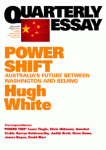
From David Marr’s Power Trip to Hugh White’s Power Shift. Appropriate as the title would have been for an essay on the recent election, we have to wait for QE40 for George Megalogenis to give us that (Power Brakes?). This one is about something other than personalities and politics as horse race:
Our leaders, and by extension the rest of us, are assuming that Asia will be transformed economically over the next few decades, but remain unchanged strategically and politically. It is an appealing assumption because the past forty years have been among the best times in Australia’s history, and it has been easy to believe that American power would continue indefinitely to keep Asia peaceful and Australia safe. That has been a cardinal mistake.
Perhaps the assumption is also appealing because its obvious knee-jerk alternative is a revival of Yellow Peril rhetoric. Tomorrow When the War Began (John Marsden’s series of YA novels and now a film based on the first book) demonstrates, incidentally, that the complacency Hugh White sets out to prick hasn’t been absolute, but it does give strength to his arm in seeking to get people to think about Australia’s relationship to China rather than explore violent fantasies, however earnestly packaged.
While Kerryn Goldsworthy says, quite correctly, on page 85 that an essay can be ‘an expedition into the unverifiable: memories; theories; hitherto unexplored veins of subject matter or uninhabited point of view’, this one proceeds with the logical clarity (though not the soul-destroying aridity) of a PowerPoint demonstration. ‘Since 1788,’ he says, stating the obvious but unsettling truth, ‘Australia has always enjoyed a very close and trusting relationship with the world’s strongest power, and we just take that for granted.’ Well, not for much longer – and we need to think about this. The main history of our times, he proposes, may not be in the place that’s getting the most attention:
The day-to-day management of the [US–China] relationship gets a lot of detailed attention, but presidents and other senior figures avoid substantial analysis of America’s long-term intentions towards China. One reason is 9/11. For almost a decade, America’s political leaders have convinced themselves that a small group of fugitives on the run in Pakistan poses a bigger challenge to America’s place in the world than the transformation of the world’s most populous country. Future historians will find that hard to explain.
To be fair to White’s argument, he goes on immediately after this to acknowledge that Barack Obama signalled that the blinkers were coming off after his visit to China in November last year. All the same, Muriel Rukeyser take a bow.
It’s a very interesting essay, which I recommend as an antidote for the personality-preoccupied, narrative-driven writing that accounts for most political commentary in our newspapers these days.


 Me fail? I fly!