
[This post originally appeared in my previous blog on 16 April 2009. I’m restoring it now because I’m writing about The Mushroom Tapes, of which Chloe Hooper is one of the authors.]
Chloe Hooper, The Tall Man: Death and Life on Palm Island (Hamish Hamilton 2008)
Donald Horne and Myfanwy Horne, Dying: a memoir (2007, Louis Braille Talking Books 2008)
Over the Easter break, Penny and I drove to Airey’s Inlet in Victoria to spend a very pleasant couple of days with her brother. The drive there and back, down on Thursday in ten hours and back on Tuesday in twelve, was remarkably hassle-free. As is our custom, I read a book aloud; in an extension of the custom, we also took a Talking Book, because on our last long car trip my voice needed enough resting to create long bookless stretches. As it turned out, the constant application of eucalyptus and honey lollies meant I had much greater stamina this time, and we read the whole of our read-aloud choice, and then listened to half of the talking book in our last couple of hours on the road.
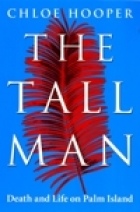
The Tall Man is beautifully written, complex, passionate and about an important topic – so it was a perfect read-aloud. I hadn’t read Chloe Hooper’s article of the same name in the Monthly a while back, and knew only the vague outline of the case: Aboriginal man dies in the cells of horrific injuries; the policeman who arrested him for swearing in the street was the only one alone with him between his arrest in good health and his death a couple of hours later; policeman almost wasn’t even brought to trial, and then was acquitted of any wrongdoing; Aboriginal people who rioted in protest treated to the full force of the law.
A young creative writing student from Melbourne told me that his teacher praised the book for its even-handedness; and I’ve seen it praised elsewhere for not taking sides. In my view such praise is misplaced. Chloe Hooper combines a journalist’s attention to evidence with a novelist’s eye for the telling detail. She is careful to give the process of law its full due and at no stage makes an explicit judgement. Given that Senior Sergeant Hurley, the tall and bulky policeman at the centre of things, wouldn’t talk to her, she does a very good job of conveying a sense of him as a human being – a generous, thoughtful man under incredible pressure of many kinds. But it’s very clear that her sympathies lie with the bereaved Doomadgee family, and it’s very easy for a reader to come to conclusions that are at odds with those of the jury in the final pages.
We stopped reading fairly often to reflect on how the book illuminated or was illuminated by our own recent experiences in Cairns, my niece Paula’s book, my own family’s comparatively tiny brush with the Queensland police force’s culture of violence (I’m talking 50 years ago, when my brother was punched by a policeman who’d arrested him for dangerous driving, and a police enquiry found that it hadn’t happened – that he already had a black eye when he got into the van), the ‘You can’t handle the truth!’ speech by the Jack Nicholson character in A Few Good Men. We noticed the preponderance of Catholics in the story. We ruminated on the validity or otherwise of the north-south divide (northerners dealing with harsh realities, southerners sitting comfortably in judgement) as a way of understanding the world. Terrible subject, terrific book.
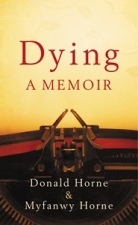
I suppose the same could be said of Dying: terrible subject, terrific book. It’s also a great read-aloud. When Donald Horne knew he was dying of progressive lung disease he decided to keep a journal of his dying, as well as putting together a number of essays on things he wanted to say about cultural matters before he could no longer write. This book is the result, with the addition of an essay by his long-term companion, wife, editor, lover and friend, Myfanwy Horne narrating the time leading up to his death and shortly afterwards. Our journey ended halfway through Myfanwy’s account, so we didn’t hear any of the cultural essays. I intend to get hold of the book and read the rest, because what we did hear was miraculous. The only other of Donald Horne’s books that I’ve read is The Education of Young Donald (1967). I must read more. I hope it’s not too spoilerish to quote the last paragraphs of Donald Horne’s narrative:
When I have done as much as I am physically able on this project, I would like to be allowed to drift off into greater ease. I don’t mean physical ease – that I’m told will come. The kind of ease that I would like would be to drift off into long established habits of contemplation. For example, I can no longer look around the street and look at things, but I can still remember looking. I can’t go for walks, but I can still remember walking. I can’t go into art galleries, but I can still remember paintings. I am almost utterly unable to read seriously, but I can still contemplate the snatches of reading that drift around in my mind.
My final drifting away by a morphine dose, I would want to be among my memories, with Myfanwy, whom I love, holding my hand.


 Me fail? I fly!