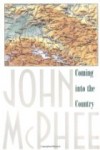
John McPhee, Coming into the Country (Farrar, Straus & Giroux 1977, 1991)
I had no obvious reason to read this book. It’s about Alaska, after all, written more than 30 years ago, originally as three articles spread over eight issues of The New Yorker and dealing with such historical dead ducks as the vote to move the state capital from Juneau to somewhere more accessible1: more than 400 pages of dated journalism about a distant, cold place. But a discerning friend gave it to me a while back with the implication that it was something I’d enjoy. It turns out he was right.
On a recent Book Show, Philip Gourevitch – himself among other things a writer for The New Yorker – described McPhee as having a ‘wonderfully informative, wonderfully vivid way of conveying knowledge as pleasure rather than as sort of eat-your-vegetables data.’ That’s spot-on: history, politics, geology, geography, climatology, anthropology, zoology – these pages offer a a huge diversity of knowledge for pleasurable absorption. The explorer Roald Amundsen rides into the book as naturally as he rode into the town of Eagle in 1905. The ‘winter bear’ phenomenon, in which a bear gains an armour of ice that makes it invulnerable to spears or even guns (shades of Iorek Byrnison) is mentioned almost in passing. There are helpful hints about how to leave a log cabin in the woods so as to minimise any damage by curious bears – not that you or I will ever need such hints, but reason not the need. The third essay in particular, which gives the book its title and accounts for more than half the pages, explores the intricacies of life in and around the tiny ‘city’ of Eagle, on the Yukon River, near the Canadian border, entirely through McPhee’s relationships with people there, interspersed with forays into history and an occasional string of quotes from the judgemental gossip that thrives there as in any small community. Eagle is divisible into the Christians, the bootleggers, the ‘river people’ (who live, illegally, out in the bush) and the Indians (who mostly live in Eagle Village, a couple of miles down the river). There’s plenty of animosity between these groups, but McPhee seems to have developed strong, trusting relationships in all groups – and the reader is invited to sympathise with them all as well.
Gourevitch said on The Book Show:
Coming into the Country remains one of the two or three essential books about the nature of Alaska, and by that I mean its character, the people who are there, why they’re there, what it means to be Alaskan, what the state is in America.
I was surprised to read that only a thousand people voted in the 1974 Alaskan gubernatorial elections. Suddenly Sarah Palin’s governorship looks a lot less impressive. Likewise, having shot a moose is less of a feat when you consider that if you live in one of the larger population centres you have to be very well off to be able to afford to go hunting, and we can be fairly sure that the Palins weren’t among the people who choose the extremes of life ‘in the country’, where moose is a staple food.
McPhee evidently lived in Alaska for months if not years on the way to this book, long enough to get to know some of its people well, to learn the peculiarities of language as spoken there, to develop a deep feel for the country, to amass a vast store of fact and anecdote, to ferret out first-person accounts of incidents that had become legendary. This is journalism that’s not so much embedded as immersed.
There’s some wonderful nature writing, combining lyrical description with other perspectives as in this, from a much longer account of Mt McKinley:
The Alaskan Range elevates with a rapidity rare in the world. Its top is about two-thirds as high as the top of the Himalayas, but the Himalayan uplift is broad and extensive. if you were looking toward Mount Everest from forty miles away, you would lift your gaze only slightly to note the highest in a sea of peaks. Forty miles from McKinley you can stand at a bench mark of three hundred and climb with your eyes the other twenty thousand feet. The difference – between your altitude near sea level and the height of that flying white mountain – is much too great to be merely overwhelming. The mountain is a sky of rock, seemingly all above you, looming. Until it takes itself away, you watch it as you might watch a hearth fire or a show in colour of aurorean light. […] The Athapascans are not much impressed that a young Princeton graduate on a prospecting adventure in the Susitna Valley in 1896 happened to learn, on his way out of the wilderness, that William McKinley had become the Republican nominee for President of the United States. In this haphazard way, the mountain got the name it would carry for at least the better part of a century, notwithstanding that it already had a name, for uncounted centuries had had a name, which in translation had been written, variously as The Great one, The Mighty One, The High One. The Indians in their reverence had called it Denali. Toponymically, that was the mountain’s proper name.
Possibly my single favourite passage is about fifty-five-gallon drums:
A fifty-five-gallon steel drum is thirty-four and three-quarters inches high and twenty-three inches in diameter, and is sometimes called the Alaska State Flower. Hundreds of them lie around wherever people have settled. I once considered them ugly. They seemed disappointing, somehow, and I wished they would go away. There is a change that affects what one sees here. Just as on a wilderness trip a change occurs after a time and you cross a line into another world, a change occurs with these drums. Gradually, they become tolerable, and then more and more attractive. Eventually, they almost bloom. Fifty-five-gallon drums are used as rain barrels, roof jacks, bathtubs. fish smokers, dog pots, doghouses. They are testing basins for outboard motors. They are the honeypots of biffies, the floats of rafts. A threat has been made to use one as a bomb. Dick Cook, who despises aircraft of all types, told a helicopter pilot he would shoot at him if he ever came near his home. The pilot has warned Cook that if he so much as points a rifle at the chopper the pilot will fill a fifty-five-gallon drum with water and drop it on the roof of Cook’s cabin. Fifty-five-gallon drums make heat stoves, cookstoves, flower planters, bearproof caches, wood boxes, well casings, watering troughs, culverts, runway markers, water tanks, solar showers. They are used as rollers for moving cabins, rollers to smooth snow or dirt. Sliced on the diagonal, they are the bodies of wheelbarrows. Scavenged everywhere, they are looked upon as gold.
By the time I reached the end I could almost understand what some people find attractive about living in a place that gets to 40 below zero (Farenheit) and stays there for a good part of the year.
—–
1 When the book was first published, the quest for a new capital was still under way, and supplied the backbone for the second essay, ‘What They Were Hunting For’: I had to look up Wikipedia to discover by what chicanery the vote was overturned.
Later: WordPress’s automatic link to possibly related blog posts went to Wickersham’s Conscience,, in which an Alaskan blogger echoes Philip Gourevich’s evaluation:
If you want to try to understand Alaska, its people, its politics and why I live here, this book is the best place to start. This book is a great writer’s greatest book.





 Me fail? I fly!