
Pádraig Ó Tuama, 44 Poems on Being with Each Other: A Poetry Unbound Collection (Cannongate Books 2025)
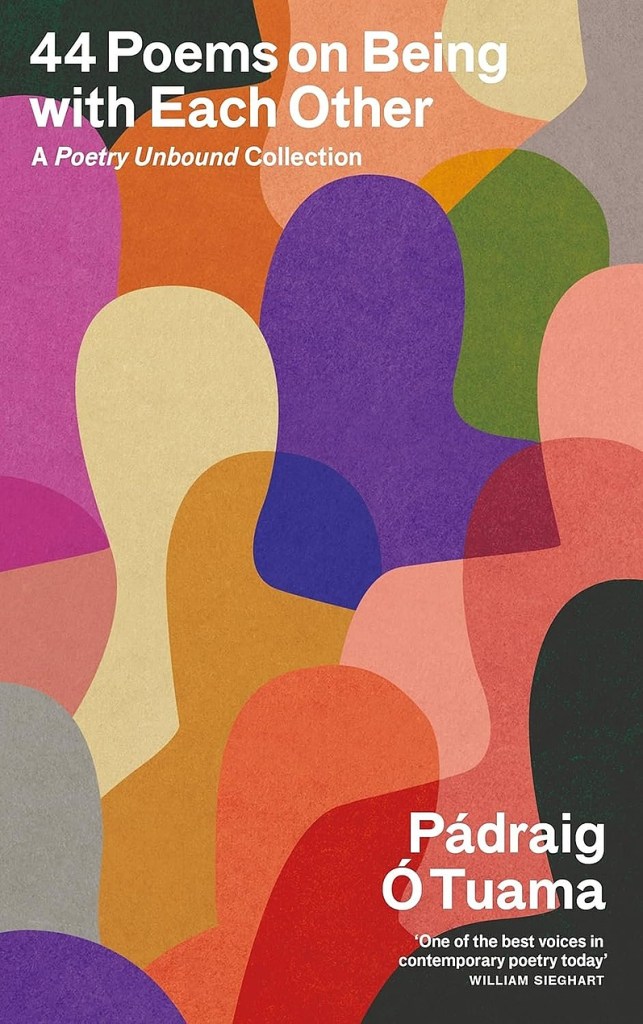
Books are risky gifts. I’m very glad the friend who gave me this one took the plunge.
It’s a collection of 44 poems, with commentary. I stumbled across an online review that said something like, ‘The poems are excellent, but I could have done without the commentary. It would probably be helpful for people who are learning how to read poetry.’
With all due respect, that person needs to have another look. It’s true, all 44 poems in this anthology are excellent, but the commentary isn’t there to help the ignorant (though it might do that): Pádraig Ó Tuama is a warm, charming, reader companion. Rather than assuming his readers are incompetent, needing to be instructed in the art of reading, he tells us how he reads poems himself – bringing to them his own history, knowledge and concerns, and by implication inviting his readers to do likewise. In a time when so much writing about poetry comes from the more esoteric corners of academia, his is fresh, conversational, smart, humble and completely engaging.
The anthology is an offshoot of the podcast, Poetry Unbound, and follows its format. First there’s a single page, printed white on black, in which Ó Tuama sets up a context with a personal anecdote or a reflection on life or literature. Then there’s the poem, followed by several pages of discussion. Ó Tuama finishes each podcast with a second reading of the poem, which readers of the book are of course free to do. I love the podcast, and I love the book.
Ó Tuama isn’t out to create a canon of ‘best’ poems. He may have what Trumpians would call an undeclared DEI agenda. Most of his poets are from non-mainstream groups of one kind or another: LGBTQI+, Native Americans, African heritage and other People of Colour, people with disabilities. A couple of poems are translated from other languages. But it’s far from being an exercise in box-ticking inclusiveness. There’s a clue in the book’s title – these poems are gathered from a wonderfully diverse range of poets, and together they create a sense of what it is to be together on this planet.
If I were to stick to my practice of writing about page 78*, I’d now look at the discussion of the shortest poem in the book, written by its most mainstream poet – ‘The Uses of Sorrow’ by Mary Oliver. But instead, I want to go to pages 310 to 315. The poem is ‘The Change Room’ by Andy Jackson. It’s the book’s only Australian poem, but my reason for focusing on it is that I already know it well, and have discussed it in this blog. Here’s a link where you can read the poem and, if you want, my discussion of it. (For those who don’t click: the poem consists of seven three-line stanzas and a two-liner. The poem’s speaker has three encounters at a swimming pool: a young child asks about his physical shape, a woman admires his tattoos, and a man chats with him in the shower after his swim.)
Ó Tuama’s introductory page, just 11 lines, tells us how the poem is personal to him. ‘Where do you carry shame in your body?’ he begins. And he ends:
The story of my body’s relationship to my own body – and the bodies of others – is a poem that’s asking for my attention.
You wouldn’t know from this that ‘The Change Room’ deals with disability or marked physical difference. Ó Tuama approaches it, as he does all the poems, from the standpoint of a shared humanity – a ‘being together’.
After rereading his discussion just now, I had another look at my blog post (here’s the link again), and I like the conversation we’re having.
We both discuss the rich ambiguity of the title of the book the poem comes from, Human Looking. Ó Tuama adds a reference to the tagline of Andy Jackson’s website, which includes the phrase ‘a body shaped like a question mark’, and relates that to the children’s questions in the poem. He pays close attention to the language:
In ‘The Change Room’ we read of nostrils, skin, tattoos, gaits, swimming, floating, showering, nakedness, proximity, speaking: all parts, functions and experiences of the body, all vehicles for body language, all ways in which the body is in conversation with itself and others.
Both of us puzzled over the poem’s last line, ‘Speaking, our bodies become solid.’ On rereading my blog post I quite like what I wrote about it, even if my reference to the Latin Mass may be a bit idiosyncratic. Here’s what Ó Tuama writes, to give you a taste of his prose:
‘Bodies’ here are held in a plural pronoun ‘our’. Why have they become solid? Were they not before? Were they fluid, or see-through, or gaseous? Perhaps solid is meant as the antonym for unreliable. The final stanza is composed only of two lines, in comparison with the seven tercets that preceded it. The missing third line of the last invites, perhaps, buoyancy, nature, exchange, consideration among all the bodies in, and reading a poem about, ‘The change room’. The poem asserts a shameless body-knowledge it establishes for itself.
I love the way he draws our attention to the precision of the language, and then the way, like Andy Jackson’s missing last line, he opens out to possibilities, rather than closing down on a particular reading.
I recommend this book, for yourself or as a gift to someone who likes a bit of poetry – for the poems, and for the companionship of the editor.
I wrote this blog post on land of Gadigal and Wangal of the Eora Nation, under an almost cloudless sky and feeling the chill from a mildly bitter wind. I acknowledge the Elders past and present of this country, never ceded.
* My blogging practice is focus arbitrarily on the page of a book that coincides with my age, currently page 78.


 Me fail? I fly!