
[This was originally posted in my now defunct blog Family Life, on 1 March 2008. I’m retrieving it today because it includes some comments on Geraldine Brooks’ People of the Book, which recently came in at number 89 in Radio National’s Top 100 Books of the 21st Century.]
Raewyn Connell, Southern Theory (Allen & Unwin 2007)
Neil Gaiman and Dave McKean, Signal to Noise (Dark Horse Books 1992–2007)
Jackie French & Peter Sheehan, Gold, Graves and Glory (Scholastic 2007)
Jackie French & Peter Sheehan, A Nation of Swaggies & Diggers (Scholastic 2007)
Geraldine Brooks, People of the Book (Fourth Estate 2008)
Michael Ondaatje, The Cinnamon Peeler (Bloomsbury 2004)
Peter Cochrane, Colonial Ambition (MUP 2006)
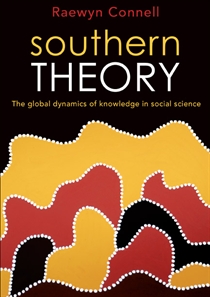
To the qualities I attributed last month to Raewyn Connell, author of Southern Theory, add humility. At several points in the book, she acknowledges her difficulty in understanding one of the texts under discussion, even her inability to do so. But this humility is a long way from an admission of inadequacy; in fact, it’s kind of exemplary, as in: This important material has been ignored by social scientists of the West/North/centre/metropole (SSWNCM); we need to approach it knowing that our grasp of it will be imperfect.
When I was about halfway through the book, reading while walking the dog, I met Raewyn down at the corner postbox. ‘You’ve been my walking companion for the last couple of days,’ I said, ‘and you’re excellent company. Of course,’ I went on, ‘given how much I know about social science theory ,,,’ She finished my sentence, ‘… I could be telling a big pile of whoppers.’ Well, if that’s what she’s doing, she’s certainly doing it with gravitas and grace. Having described the way the SSWNCM have generally managed to ignore the East/South/periphery as a source of theory in the social sciences, she discusses a small number of the thinkers who have been ignored or marginalised – from Africa, Muslim Iran, Latin America, India, Indigenous Australia; and drawing the threads together beautifully without claiming to arrive at a synthesis, she outlines key places where the North can learn from the South.
She mentions that one prominent social scientist of the North Atlantic referred to an earlier version of the argument as a ‘guilt trip’, but it reads to me much more as a judicious and impassioned call for a broadening of horizons, or more precisely an acknowledgement of horizons and of other features of particular locations: that is, one of her central points is that social theory of the Metropole takes place in terra nullius, and recognition of the importance of place is something that the theory from elsewhere has to offer. (She has some beautiful paragraphs on the sandstone country where she and I both live.) Though I’m a social scientist only in the sense that we all are – I live in a society, think about it and try to live well in it and/or in struggle with it – I found the book not just accessible (even on pages that were full of references familiar to the book’s ideal reader and completely unknown to me), but exhilarating.
I’m pleased to report that, unlike Mr Punch, the collaboration from Neil Gaiman and Dave McKean that I read before this, Signal to Noise isn’t packaged as a children’s book. Perhaps an account of the death of an artist is more obviously adult than tales of the effect on a young boy of witnessing half-understood scenes of sex and violence. It’s a terrific book.
I’m not generally in love with Dave McKean’s art work, except when he’s working for children – The Day I Swapped My Dad for Two Goldfish and The Wolves in the Walls are both brilliant. His grown-up (as opposed to ‘adult’) work tends to be too fractured, dark and postmodern-incoherent for my taste. I started this book with a sinking feeling, as the first couple of pages are given over to a piece written as well as illustrated by McKean. About this piece the less said by me the better. Then there’s a spread of a series of poems about walls by Gaiman, and suddenly the illustrative style works, as it continues to do for main feature: the moody, hard-to-read images combine with the elegant text to spectacular effect, including a couple of sharply poignant moments (if you’ll excuse the tautology). Neil Gaiman, the new Man in Black, has a lot to say about death.
Penny and I had a long car drive in the middle of the month, and as is our custom I read to her for a good bit of the trip both ways. It’s a fun way to travel and a sociable way to read, which we’ve done with books as diverse as Lillian Hellman’s Pentimento, Jared Diamond’s Guns, Germs and Steel, and Clive James’s Falling Towards England. This time we chose People of the Book for our driving entertainment. We made it through the first 110 pages, and it was fun, but I’m not sure I’ll read the rest. When you read a book aloud, you tend to notice things that otherwise you might skim over, and then they start to drag at your attention. For instance, when I reached this bit on page 54 I had to stop to vent a little:
Lola had begun to lead an exhausting double life. Hashomer met two nights a week. On those nights she went to bed early, with her little sister. Sometimes, when she had worked very hard, it took an immense effort of will to keep herself awake, listening to the gentle, even breathing of Dora’s little body next to her. But mostly her anticipation made it easy to feign sleep until her parents’ snores told her it was safe to leave. Then she would creep out, scrambling into her clothes on the landing and hoping no neighbours came out of their doors to notice.
There’s nothing bad about that writing, but did the parents snore in unison? wouldn’t one have started first, and one been louder than the other? (Later in the chapter it turns out that the mother wasn’t asleep at all, so surely she wouldn’t have been snoring?). Why did Lola have to feign sleep when her little sister was already asleep and her parents were in another room? If you walked out at night onto your landing where a young woman was getting dressed, would you ‘notice’ it, with the implication that you might somehow have missed it? These nitpicking questions actually arise, I think, from the passage’s lack of imaginative engagement with the situation. It’s as if the story is being hurried along. And that would be fine, if it was being hurried along to a sharply realised scene. But this kind of thing goes on for page after page: in the debates about Israel among the young Jews of Sarajevo in 1942, you can feel the points being ticked off rather than any kind of life in the disputants (compare, say, the political arguments in that Ken Loach movie about the Spanish Civil War); even in the parts where Hanna the book conservator is going about her business, what fascinates is the wealth of material that Geraldine Brooks has found in her research, and the elegance with which she performs her info dump, rather than any engagement with the characters or the action
I was glad when the sex scene in the first chapter happened during a paragraph break, but then I wondered if the fact that it wasn’t described might be symptomatic of the narration’s failure to engage – to show rather than tell. There are poignant and dramatic moments, and Geraldine Brooks turns a beautiful sentence, but life may be too short for me to read any more of this one. If I’m making a serious mistake, please say so in the comments.

If a book of poetry is like a forest, I often seem to have trouble seeing any given tree for the woods. Some of the individual poems in The Cinnamon Peeler speak to me, and there are any number of memorable lines and images, but generally I feel as if I’m eavesdropping on a discontinuous commentary on things I know nothing about. Ondaatje is originally from Sri Lanka: knowing that, I can tell that the tropical references have childhood resonances. I can guess that he has a son named Skyler (‘Late Movies with Skyler’ is terrific). But for an awful lot of the book I was struggling to make sense of the scraps I was overhearing. Maybe I need to discover poets one poem at a time (with Langston Hughes, for example, it was ‘Mother to Son’; Hopkins, weirdly enough, the sonnet that starts ‘Earnest, earthless, equal, attuneable, vaulty, voluminous … stupendous’), and I may be getting things barse-ackwards here, wanting to have a sense of a whole book when I should be happy to have a dozen poems that speak to me (which I do) and just allow to pass by those that don’t. For the record, the ones I do get tend to celebrate friendship, and are mostly towards the end of the book.
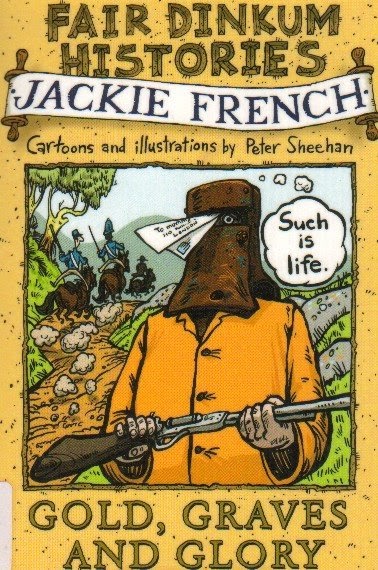
I don’t understand why the Fair Dinkum Histories haven’t been universally greeted with drum rolls and fanfares. These are the fourth and fifth books in the series, and like their predecessors they are lively and unpatronising accounts of parts of Australian history. They provide what the former Prime Minister demanded of history: a narrative thread. I don’t know what he would make of their attention to the dispossession of Aboriginal people, to class and cultural diversity, to the role of women and children, and so on, but they’ll do me.
Gold, Graves and Glory tells the story from 1850 to 1880, and as you’d expect from the title and the cover, is about goldrushes and bushrangers. There’s also quite a bit about explorers. What you might be surprised by are the account of Chinese miners on the goldfields, including the racism they endured, the attention to Aboriginal dispossession, the detail about underpaid ‘Afghan’ camel handlers who accompanied the explorers, and the expansion of the story beyond the south-east of the mainland, including the beginnings of the sugar industry in Queensland. On an idiosyncratically personal note, it was nice to see Edward John Eyre’s Journals of Expeditions of Discovery in the Recommended Reading list – Eyre’s story doesn’t feature in the narrative, so presumably it’s there because Jackie French recognises it’s a good yarn. My aborted MA thesis in the 1970s was to have made that point at great length.
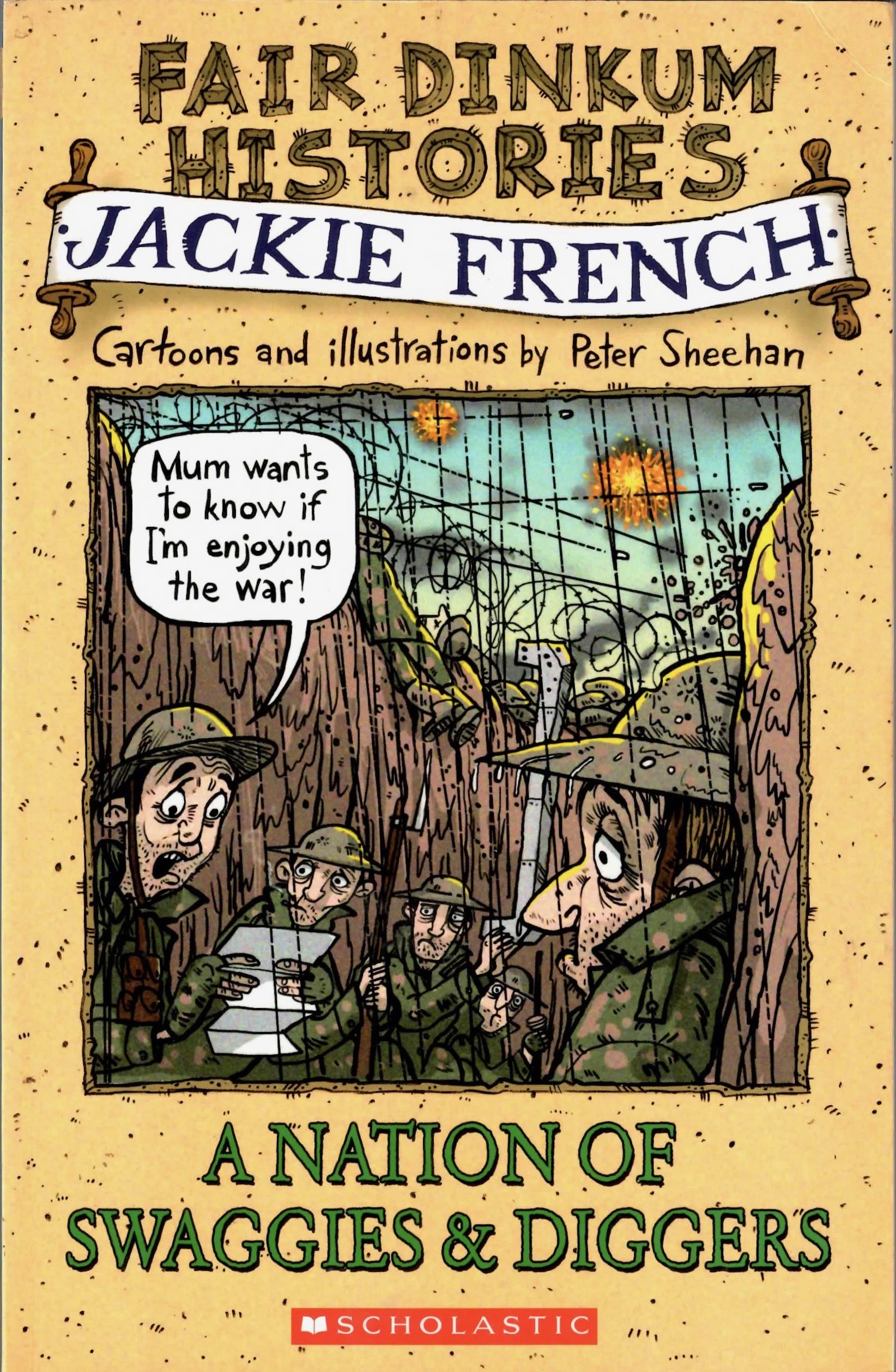
A Nation of Swaggies & Diggers is harder going than any of the others in the series so far: covering the period 1880–1920, it deals with things I remember as being acutely boring in my primary school days – the importance of gold and wool to the developing economy, the conferences leading up to Federation, the Depression of the 90s – and it doesn’t entirely manage to break that childhood curse. The mandatory thumbnail sketches of the first prime ministers don’t help. And even the account of Australians going to war is somehow flat – perhaps because of the unresolved contradiction between horror at what actually happened and the role the glorifying/sentimentalising myth has played.
But even here Jackie French’s text and Peter Sheehan’s cartoons maintain a light tone (the latter mostly with satisfyingly groan-worthy puns) without resorting to bum jokes. The account of how domestic life was changing, complete with recipes, is particularly delightful. And suddenly in the first years of the last century I was recognising things from my own childhood: the mint at the back steps, the lemon tree in the yard, sponge cake and lamingtons, blocks of ice wrapped in hessian for the ice chest. [Full disclosure: my copies of both these books were given to me by Peter Sheehan, who is a friend of mine; and the series was originally commissioned for Scholastic by Margrete Lamond, also a friend.]
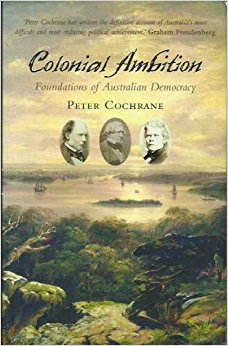
In the Fair Dinkum Histories, the story of the coming of independence and democracy to the Australia colonies is largely a matter of dates, and where the debates can’t be avoided, as in the lead-up to Federation, they are described in a chapter entitled ‘The Great Yack Attack’. And that’s fair enough: compared with exploration, slaughter, discovery of gold, romantic uprisings, and the struggles of Indigenous Australians, Chinese and women, questions of governance don’t obviously rate high on the child-friendly scale. Colonial Ambition was published too late to be useful in Jackie French’s research. Had the timing been different, she might well have found her way to delight child readers with the mid 19th century struggles conducted by a cast of extraordinary characters over the form of government that would prevail in the colonies. Peter Cochrane has certainly achieved that for adult readers.
It’s not bang-bang-kiss-kiss; it’s not bloodshed on a foreign strand; but it’s a great story full of comedy and heroism, big ideas and petty point-scoring, opportunism and integrity, and eloquence, eloquence, eloquence. In those days people didn’t watch sound-bites on the telly after dinner; they wandered up to Macquarie Street to see if here were any good speeches in the Legislative Council. In 1846 more than 3000 people met at Homebush Racecourse to protest against a proposal to reintroduce convict transportation; a year or so later more than 2000 met in the Royal Victoria Theatre in Haymarket to oppose a new constitution being foisted on the colony by Earl Grey. They gathered, they cheered the speakers, they prevailed. In the absence of universal suffrage, the ‘multitude out-of-doors’ did make its voices heard; in the absence of votes for women, a Ladies’ Petition was a significant political event.
The Art Student read this before me, and read great slabs of it aloud. It’s that kind of book: among other characters, it’s got a fiercely eloquent albino dandy, a faux-rustic oligarch with a chip on his shoulder, a dapper Regency blade who is devastated when he kills his wife in a carriage accident, a rocking-horse maker who becomes known as the Father of Federation. The committee advising John w Howard on the inaugural Prime Minister’s History Prize recommended this book for the prize. The then PM only partly accepted the recommendation, and decided the prize should be shared with Les Carlyon’s history of the First World War. One result of this decision is that the two books are placed side by side as alternative foundation narratives: Australia achieved true nationhood when thousands of its young men were slaughtered in a European war (and did some killing of their own), or Australia achieved nationhood through the less glamorous but arduous business of arguing, rallying, orating, lobbying, writing, imagining, organising … thinking. There was very little violence, and though Peter Cochrane uses the metaphor of war and his characters refer frequently to the American War of Independence and the French Revolution, there was no war.
On 30 March 1858 Charles ‘Slippery Charlie’ Cowper introduced a bill to amend the Electoral Law in New South Wales, the bill that was to establish manhood suffrage and make the colony a ‘democracy for men’ (Cochrane’s phrase) and who even remembers that date? ‘The introduction of democracy in New South Wales,’ says Cochrane, ‘ was as matter-of-fact as a handbook for a customs clerk.’ But of course, that quiet moment came as the culmination of years of struggle.
Posted: Sat – March 1, 2008 at 01:00 PM


 Me fail? I fly!