Tag Archives: Philip Larkin

2024 End of year list 5: Blog traffic

In case you’ve had just about enough of my end of year lists, be reassured: This is the last one, and I don’t expect you to read it – it’s mainly so I’ll have a record.

Here are the posts that attracted most clicks on my blog in 2024:

  1. Claire Keegan’s Small Things Like These (October 2023, 1618 clicks)
  2. The Book Club and Paul Murray’s Bee Sting (April 2024, 775 clicks)
  3. Ocean Vuong’s Time is a Mother (March 2023, 744 clicks)
  4. Ellen van Neerven’s Throat (July 2020, 625 clicks)
  5. Mary Oliver’s Twelve Moons (January 2019, 597 clicks)
  6. Anne Enright, The Wren, the Wren, the book club, page 77 (March 2024, 533 clicks)
  7. Trent Dalton’s Boy Swallows Universe (July 2019, 412 clicks)
  8. Robert Alter’s Psalms (September 2020, 365 clicks)
  9. Jenny Erpenbeck’s Kairos and the Book Club (April 2024, 364 clicks)
  10. Rebecca Huntley’s Italian Girl (April 2022, 357 clicks)

Ocean Vuong’s book was at the top of the list for most of the year, and then news of the movie of Small Thiings Like These sent a lot of clicks to that post. Shirley Hazzard’s The Transit of Venus dominated the list for years, but has now dropped off altogether. Mary Oliver, Ellen van Neerven and Robert Alter are the stayers.

One more bit of nerdiness. Here’s WordPress’s list of my all-time top ten posts. Apart from changing positions, the main change from last year is that Philip Larkin got bumped by Claire Keegan:

  1. Travelling with the Art Student (November 2014, 3558 hits)
  2. The Book Group and Shirley Hazzard’s Transit of Venus (June 2018, 2721 hits)
  3. (Re-)reading Kevin Gilbert’s poetry (April 2012, 2430 hits)
  4. Mary Oliver’s Twelve Moons (April 2020, 1841 hits)
  5. Bran Nue Dae (January 2010, 1805 hits)
  6. Mary Oliver’s House of Light (April 2020, 1784 hits)
  7. Claire Keegan’s Small Things Like These (October 2023, 1676 hits)
  8. The book group’s Harp in the South (February 2011, 1431 hits)
  9. Jasper Jones at the Book Group (May 2010, 1352 hits)
  10. Contemporary Asian Australian Poets (June 2013, 1236 hits)

That’s it. Thanks to everyone who has contributed to those statistics. Some of you I know IRL, some I’ve met through email etc, some only in the comments section, some I know only as anonymous clickers. I’m happy that you’ve visited the blog. Come again.
End of year list 5: Blog traffic

Thanks to kind help from Sue at Whispering Gums, I can now find out which of my blog posts have received most hits in the last year. It’s hard to know what these figures mean. Maybe a lot of people visited the post for a second or so, long enough to realise that there was nothing useful there about the subject of their interest. Maybe the post is on a school reading list somewhere, and has been semi-plagiarised by hundreds of students over the year. Maybe this is an indication of which of my posts is most brilliant. Maybe none of those. Anyhow here’s the list for 2023:

  1. The Book Group and Shirley Hazzard’s Transit of Venus (June 2018)
  2. Mary Oliver’s Twelve Moons (January 2019)
  3. Ocean Vuong’s Time is a Mother (March 2023)
  4. Mary Oliver’s House of Light (April 2020)
  5. Ellen van Neerven’s Throat (July 2020)
  6. Ellen van Neerven’s Comfort Food (also July 2020)
  7. The Book Group on David Mitchell’s Utopia Avenue (February 2021)
  8. Robert Alter’s Psalms (September 2020)
  9. Ruby Reads 29: Gift (December 2021, about The March of the Ants, by Ursula Dubosarsky and Tohby Riddle)
  10. Abdulrazak Gurnah’s Afterlives at the Book Group (April 2020)

It looks as if my posts on poetry generate most traffic, though the one on The Transit of Venus, mysteriously to me, is way out ahead of the rest. The book group makes three appearances, which is probably an indication that we choose books that have a lot of social capital. I suspect the post on Robert Alter’s translation of the psalms is visited so often because it includes an embedded video of Boney M singing ‘Rivers of Babylon’.

Having learned how to find these statistics, I’ll try your patience a little by giving you the all-time top 10 posts:

  1. Travelling with the Art Student (November 2014)
  2. The Book Group and Shirley Hazzard’s Transit of Venus (June 2018)
  3. (Re-)reading Kevin Gilbert’s poetry (April 2012)
  4. Bran Nue Dae (January 2010)
  5. Mary Oliver’s House of Light (April 2020)
  6. The book group’s Harp in the South (February 2011)
  7. Jasper Jones at the Book Group (May 2010)
  8. Mary Oliver’s Twelve Moons (January 2019)
  9. Contemporary Asian Australian Poets (June 2013)
  10. Philip Larkin, The Whitsun Weddings (April 2010)

Someone lifted a close-up photo of a painting by Brian Rutenberg from ‘Travelling with the Art Student’ and put it up on Pinterest, and hordes of people came looking for more – sadly it was the only photo in the post. Shirley Hazzard has otherwise been consistently in the lead, and Book Group books and poetry have pulled in the crowds. I think my post on Kevin Gilbert’s poetry was on a school reading list somewhere for a time – it gives a brief account of what can go wrong when a well-meaning whitefella edits a First Nations book.

I don’t know what to make of the absence of any posts I’ve written since 2020.

That’s it for my 2023 round-ups. Thank you all for swelling my statistics, for your likes and comments, and your silent, lurking presences.

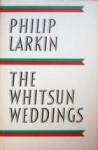
Philip Larkin, The Whitsun Weddings

Philip Larkin, The Whitsun Weddings (© 1964, Faber & Faber 1977)

This slim volume was published seven years before Philip Larkin’s most famous poem, ‘This Be the Verse‘, and a couple of years before I studied Eng Lit at university. It’s possible we read some of Philip Larkin’s poems in our eminently forgettable third year elective on Post War English Poetry. But in effect I’ve just met what Wikipedia says is one of Britain’s most popular poets for the first time.

According to Wikipedia again, Larkin said that deprivation was for him what daffodils were for Wordsworth. I found that comment illuminating – most of the poems here are performing a kind of wretched isolation, sometimes mocking people who are in relationships, at other times wistfully celebrating the possibilities, or the might-have-beens, of love. The quality of performance stops them from being just plain dispiriting. A paraphrase of ‘This Be the Verse’ would go something like, ‘Parents ruin their children’s lives so we might as well let the human race die out,’ but each time I read the poem it has a weirdly cheering effect, which I think is because its meticulous formality and obvious pleasure in language are so not gloomy. That poem isn’t in this book, but there are others just as gloomy and just as cheering, ‘Mr Bleaney’, say, or ‘Nothing to Be Said’, or … most of them.

Anyhow, I don’t have much to say, except that I enjoyed these poems a lot and expect to enjoy them many times – the sheer formal pleasure of them, but also the complex musings they embody.

The student who left her marks here (and I know it was she because her name, Allison XXXXX,  is on the fly leaf) was more attuned to the poetry than he who annotated my copy of Immigrant Chronicles. (Click the image for a bigger version.)

Mind you, her notes on ‘Afternoons’ seem almost completely wrongheaded: I don’t see why the recreation ground prompts the comment ‘consumerism’, where the idea comes from that the mothers who set their children free are ‘still trapped’, or why it is ‘bleak’ that the women have husbands behind them. But Allison’s pencil seems to grasp ‘An Arundel Tomb’ well enough. At least, I found the poem completely lovely, and felt quite companionable toward her as I read it: ‘Yes, Allison, it is nice the way the word link occurs at the start of the fifth stanza after that big enjambement,’ ‘But is the tomb undated, Allison, or just the snow?’

The final lines of the poem remind me of one of my favourite movie moments, the declaration of love at the end of Ingmar Bergman’s Scenes from a Marriage. I can’t find the Bergman line, but here’s the Larkin:

0000000The stone fidelity
they hardly meant has come to be
Their final blazon, and to prove
Our almost-instinct almost true:
What will survive of us is love.