Tag Archives: Quarterly Essay

Kate vs Inga – it’s still going on

Kate Grenville was interviewed on the most recent Guardian Books Podcast, a good choice of guest as the subject was historical fiction, and her last three books – The Secret River, The Lieutenant and Sarah Thornhill –  have been tales of the early years of the colony of New South Wales.

It must be irritating to Ms Grenville that every time a journalist talks to her about her colonial novels, they raise the matter of the ‘attacks’ on The Secret River by ‘historians’. And that’s what happens in this podcast. Asked about the response to The Secret River, KG says in part:

We all kind of knew that things had happened, but people of my generation were brought up with this illusion that, you know, the reason there were no Aboriginal people left in many parts of Australia was that they all got measles, and had no resistance to it. We all kind of knew that this was wrong and The Secret River gave people a way of starting to think about it, I think. And because it’s fiction, it wasn’t too confronting. With fiction you can always reassure yourself that after all this is just made up. …
A couple of historians, with The Secret River, were cranky that I was writing something that they felt was their territory. You know, this is hard stuff to think about. Here we are as white Australians living incredibly privileged lives and we’re doing it on the back of 2oo years of oppression and misery and murder, basically. To actually look that fact in the face is extremely confronting, very difficult. So I think when those historians really diverted the debate away from what I’d been writing the books about, which is the massacre and what  the beneficiaries of it do with that knowledge, I think they felt that this was a chance to divert the debate into something more comfortable – which is the debate of is it history, is it fiction, how far should novelists go in writing historical fiction.

OK, the only reason for a novelist to appear on the Guardian podcast is to promote her own work, and the dismissal of any number of other novelists who have tackled the subject (Thea Astley comes immediately to mind, and surely there are others) can be forgiven as loose talk. It’s absolutely true that the subject of ‘massacre and what  the beneficiaries of it do with that knowledge’ is difficult and confronting and, I would add, of high priority (though it’s an open question whether the book actually goes to the question of the beneficiaries). It may even be that the criticisms of The Secret River had the effect of diverting attention from that question. But really ….

The only historian I’ve read on this subject is Inga Clendinnen, who made some astringent and, yes, cranky remarks about The Secret River in her Quarterly Essay, Who Owns the Past? But her gist, as I remember it, was that on many points the novel distorts the history – for instance, by moving a key incident from the first years of the colony to a couple of decades later – and in general it lacks any sense of actual engagement with the times she was writing about. Clendinnen herself could hardly be described as ‘heavy duty’ in the sense of inaccessible. And it would be hard to read her writing about the early colony as comfortable.

Evidently Kate Grenville is still smarting from the criticism, but this is fighting dirty. Inga Clendinnen is not Keith Windschuttle, yet anyone learning about her criticisms from this podcast would assume she was near allied.
Andrew Charlton’s Man-Made World

Andrew Charlton, Man-Made World: Choosing between progress and planet (Quarterly Essay No 44, 2011)

Andrew Charlton has a good eye for a quote. He  was in the room at the Copenhagen Climate Conference when Barack Obama arrived, late, at the meeting of world leaders that had been hastily convened to avert a complete breakdown of the conference. It was definitely a behind-the-scenes gathering: the leaders, Charlton tells us, ‘hunched in plastic chairs around a rectangle of contiguous small tables’. When Obama arrived, Hilary Clinton said, ‘Mr President, this is the worst meeting I’ve been to since the eighth-grade student council.’ Apart from flaunting the teller’s insider status, the anecdote’s clear subtext is that the insiders, the powerful elite, are just as flummoxed by global warming as the rest of us.  More than anything else in the essay, it drives home the point that the planet’s current environmental crisis will be resolved, if at all, by human beings bumbling forward as human beings have always done.

The other stand-out quote, which Charlton says is famous, is from Sheikh Yamani, former head of OPEC. When someone asked him when he believed the world would run out of oil, he replied, ‘The Stone Age didn’t end because the world ran out of stone,’ memorably encapsulating a key point of this essay, namely that technological innovation and the discovery of new materials and sources of energy have led to great leaps in human progress in the past, and we can hope will do so again.

Charlton argues that the failure of Copenhagen was caused not by non-cooperation from the US or Europe or muscle-flexing sabotage by China, but by a failure to address ‘the central dilemma of our century: the choice between progress and planet’, the apparently intransigent conflict of interest between the world’s rich minority who can afford to talk about scaling back consumption and the vast majority for whom increased consumption means emerging from grinding poverty:

These two global challenges –poverty and the environment – are the twin imperatives of the twenty-first century. One ravages billions of people alive today; the other threatens billions yet unborn.

Because of this conflict of interest, he argues, ‘our global approach ot climate change has failed:

we have failed to establish a globally binding treaty, we have failed to effectively bring the developing countries into a global solution, and we have failed to develop new technologies sufficient to reduce emissions rapidly.

Like everybody else in the known universe, he doesn’t hold out much hope that ‘market mechanisms’, such as Australia’s price on carbon and further down the track emissions trading scheme, will achieve the necessary targets, and that’s even if they survive assault from Tony Abbott and his buddies.

He calls for a Plan B, which has thee elements: to rethink the key goal, from raising the cost of fossil fuel energy to making clean power cheap; to reverse the relationship between rich and poor countries, so that rather than trying to persuade the developing world to reduce emissions the west works with them to develop breakthrough technology to deliver cheaper energy to the world’; to pay a lot more attention to back-up plans in case of disaster.

The essay is well worth reading, but I don’t know if it moves us forward significantly. At times Charlton’s experience as senior economic adviser to the Australian Prime Minister works against him, as he moves into polemic mode when the subject calls for careful persuasion: his figures occasionally slip from comparative to absolute when the argument requires it, he sometimes jeers at an opposing argument when engagement is needed. This background may also account for the fact that while he argues that reducing Australia’s emissions by even 5 per cent by 2020 is ‘all but unachievable through domestic efforts’, he  ignores grassroots, science-based initiatives such as Beyond Zero Emissions, a detailed plan to reduce emissions to zero by 2020 using existing technology, or Zero Carbon Britain, a similar plan for Britain (the link is to a YouTube talk by the eminently persuasive Peter Harper of the Centre for Alternative Technology in Wales). I can’t tell whether he would see these plans as examples of his Plan B or whether he includes them in the ‘glib rhetoric’ he attributes to ‘green groups’.

But this is all good and necessary argument, recognising that there’s a real problem and searching for a solution, which is immensely refreshing compared to the fake debate set up by those who believe – or pretend to believe – that ‘science is crap’.

Speaking of which, I’ve already had my tuppence worth about the correspondence about Robert Manne’s essay on the Australian at the back of this Quarterly Essay.
—–
(Posted during the Wikipedia blackout over the PIPA/SOPA legislation but by no means in opposition to it.)

Robert Manne and the Australian

Robert Manne, Bad News: Murdoch’s Australian and the shaping of the nation (Quarterly Essay N0 43, 2011)

These days I keep up with the Murdoch commentariat mainly at second hand, most regularly by way of the delightfully caustic Loon Pond, where someone identifying as lapsed Catholic ‘Dorothy Parker’ from Tamworth holds a satiric mirror up to their venomous name-calling, impassioned defence of the rich and powerful, and self-serving illogic.

I guess everyone knows what kind of beast the Australian is, though it’s striking how reluctant people are to say so in public. On the Book Show just last week, for example, someone said that it was perceived ‘rightly or wrongly’ to be right wing, and Chris Mitchell, editor-in-chief, describes it as centre right. Robert Manne’s essay grasps that nettle and at the same time demonstrates that people have good reason to be cautious in calling a spade a spade in this matter. He has done a careful analysis of a number of case histories: its impassioned promotion of Keith Windschuttle, an amateurish historian with an agenda, to a major player in Australian culture wars; its unremitting support for the invasion of Iraq, and complete failure to acknowledge having got so much wrong; the bullying of Media Watch and the ABC until Australia’s only major non-commercial source of news and opinion was running scared; the bizarre attack on science and reason in its coverage of climate change; its elevation of itself to key political player in first supporting and then campaigning against Kevin Rudd; and, most appallingly of all, its sustained attacks on individual tweeters, one for correctly reporting a negative public comment from a former Australian employee, the other for what was manifestly a joke that would have been cleared up by a simple apology if the Australian hadn’t made it the subject of no fewer than five front page stories.

I had to stop reading every now and then to go out and get some fresh air.

This wouldn’t matter so much in, say, the Green Left Weekly, though I doubt of the GLW would ever be so vicious in attacking someone who wasn’t a high-profile millionaire. But Rupert Murdoch controls a huge percentage of the Australian print media, and the Australian is his heftiest newspaper. I learned in this essay that at some press conferences in Canberra more than half the journalists are from the Australian, that the members of what Robert Manne calls the political class read it without fail, that it is influential out of all proportion to its actual circulation.

People who depend on the Australian for their national and international news in print (and it is after all the only major national newspaper we have) need to read this essay. As always, Manne’s writing is lucid, his tone judicious even at his most combative – and he does get combative. I believe there have been no fewer than eight vigorous replies in the newspaper. I read only one, and if the others distort Manne’s arguments as blatantly as that, it’s all the more important that readers of the Australian read the actual essay.

Strikingly, one line of attack has been to say that Manne is arguing for censorship, for closing down debate. Yet Paul Kelly, the Australian’s editor-at-large, pulled out of a scheduled debate at Melbourne’s Wheeler Centre last week, and no one from the Australian could be found to stand in for him. So actor Max Gillies read the bulk of Kelly’s published response. You can see the Slow TV of the ‘debate’ here. You can read Manne’s ‘deconstruction’ Kelly’s published response on Manne’s blog, here. I have no idea why Kelly and the rest declined a debate, but if my arguments had been taken apart so very deftly I would probably remember a previous engagement too. All the same, it’s a bit rich to accuse someone of wanting to shut down debate and then refuse to engage in a debate with them outside the protective confines of Rupert Murdoch’s flagship. Even more striking is the Australian‘s report on the Australian‘s no-show – at this point I weaken and give you a link: the journalist seems to be suggesting either that this was an excellent prank on the part of Kelly and Co, or that it would have been completely unreasonable to expect Kelly and/or others to actually face the big bully, who threatened to use reason at them.

This must be the most vigorously discussed Quarterly Essay yet. I wonder what editor Chris Feik will do for the correspondence section in the next issue. I imagine he will need to allow some space for the Australian‘s apologists (though they may well decide to ignore that opportunity as well). I hope he will also find space for comment along the lines of Tad Tietze post on the Overland blog, which while appreciating Manne’s careful accumulation of evidence, goes on to offer interesting observations from a left perspective.

Quarterly Essay on the country and the city

Judith Brett, Fair Share: Country and city in Australia (Quarterly Essay 42)

Judith Brett has an admirable capacity for seeing beyond the surface of ugly or bizarre utterances to the valid concerns or at least genuine pain that has given rise to them. In this essay, for example, she resists (or perhaps doesn’t even feel) the pull to mock or repudiate Bob Katter’s extreme language when he’s arguing for his constituency. And she doesn’t indulge in the city dweller’s revulsion from book-burning when she discusses the farmers who burned copies of the Murray–Darling Basin Authority’s draft plan last year – no snide comment about people who condemn and burn documents they haven’t had time to read.  That is to say, she side-steps the kind of point-scoring that tends to pass for debate in the press these days. Instead, she addresses her subject seriously and respectfully. Even as she argues that ‘economic rationalism’ brought havoc to rural Australia, charts the rise and fall of the Country/National Party, or notes the impact of Pauline Hanson, she avoids cheap shots.

It’s an excellent, thoughtful essay. This paragraph comes close to encapsulating its argument :

City and country in Australia share a history, a long history both of interdependence and of watchful suspicion. The understanding of that interdependence was strong in the first two centuries of Australia’s European settlement, and the attempt to build a vibrant and self-sustaining countryside was a major political preoccupation. The country made claims on the city for support, and by and large the city attempted to meet them as part of a compact in which Australians shared the cost of living in a big country. This understanding has waned rapidly since the neoliberal 1980s. Since then the country has seemed to be in a perpetual state of crisis: dying towns, depressed and ageing farmers, unproductive farms carrying too much debt, environmentally unsustainable irrigation schemes, droughts and flooding rains, crisis-ridden marketing schemes like the wool stockpile and the Australian Wheat Board, and so on. The picture is of irreversible decline. Yet, as Tony Windsor reminds us, over 30 per cent of Australians live outside the big cities. What is their role in the nation? And what are we to do with all that land beyond the ranges and the thinly settled coastal strip?

My two cents worth: read it – you’ll see the world a little better!

As usual, this Quarterly Essay includes correspondence about the previous issue. The contributors here are all but unanimous in their appreciation of David Malouf’s The Happy Life, calling it variously ‘beguiling’, ‘characteristically delicate’, ‘elegant and humane’, ‘thoughtful and courteous’. They are also all but unanimous in finding that he didn’t say anything definitive about happiness. A Russian scholar argues that his reading of A Day in the Life of Ivan Denisovich is simplistic an uninformed. A psychiatrist invokes the academic literature about happiness. Several others push their respective barrows with varying degrees of elegance and insight.

David Malouf does not rejoin the conversation. I read his silence as signifying that he’s perfectly happy for other people to have their say, to correct him where needed, to have their own crack at the subject. After all his piece differed from most Quarterly Essays by being in the tradition of the essay as a crack at a subject rather than a tightly argued thesis. Sometimes the appropriate response to an essay is not to argue with it. Maybe Marieke Hardy got it right on the First Tuesday Book Club last night. She said she felt as she was reading The Happy Life that she was sitting on David Malouf’s lap resting her cheeks on his bald head and letting him read to her.

David Malouf and the Happy Life

David Malouf, The Happy Life: The search for contentment in the modern world (Quarterly Essay 41)

If I ever need to be reminded of the depths of my ignorance, I need only read an essay by David Malouf, any essay. In this one, he draws for his argument on Plato, Heidegger, Jefferson, Montaigne, George Herbert, Solzhenitsyn and Condorcet, gives illustrations from Chekhov, Rembrandt and Rubens, and refers in passing to Dostoievski, Horace, Marvell, Shelley – there are cameo appearances by at least twenty writers and artists we know by a single name, that is to say, key figures in European cultural history. He’s not Wikipeding. Nor is he showing off. You know that these writers are part of his mind’s living furniture, that he needs to refer to them if he is to lay out his own thinking. At the same time he realises many of his readers won’t share his erudition, so he becomes a tactful and gracious teacher, elegantly spelling out Heidegger’s interpretation of the Platonic story of Epimetheus and Prometheus, for example, or explaining Condorcet’s pivotal role in the history of ideas. It’s quite a change of pace from the electoral politics of even-numbered Quarterly Essays.

It’s a change of pace in another way too. At least the way I read it, it’s not so much a thesis, a marshalling of evidence and argument to convince the reader of something, but an essay, as in the French essai, an attempt at its subject, a reflective chat with past thinkers and makers, a teasing away at a question and a stab at partial answers. Here’s the question – I should preface it by saying that by us here, he means ‘the new privileged, those of us who live in advanced industrial societies’. (‘The truth is,’ he writes, ‘ that though we are all alive on the planet in the same moment, we are not all living in the same century.’)

How is it, when the chief sources of human unhappiness, of misery and wretchedness, have largely been removed from our lives – large-scale social injustice, famine, plague and other diseases, the near-certainty of an early death – that happiness still eludes so many of us?

He explores the question down many interesting paths – because of course the question of happiness has been addressed by great thinkers for millennia – with excursions into art history He reflects on elements of the modern world from the effect of seeing our planet photographed from space to the way we think of our bodies has changed since his childhood in the 1940s (this is as close as he gets to the personal note that is a key element of the classic personal essay). Insofar as he arrives at an answer, it seems to be that ‘we’ need to slow down, shrink our horizons, accept limits. I won’t give any more detail: it’s beautifully argued, by means of a compelling image from a great piece of fiction, and I don’t want to spoil the reading for you. I do want to argue, though, that while this ‘answer’ may appear formally as the essay’s conclusion, it doesn’t resolve the argument. So much of the rest of the essay is arguing for something much more zestful, for the value of restlessness that the reader is inclined to think, ‘Well, if that’s the way to happiness, I’ll stick with my discontent, thanks.’ It’s a subtle, elegant, shape-changer of an essay, not easy to pin down, but very easy to enjoy.

There is one major perspective that makes an appearance only by virtue of an explicit exclusion. While it’s clearly legitimate to ask a question about happiness for the ‘new privileged’, leaving the happiness of the rest of humanity for a different essay, the rest of humanity must surely figure in the answer. No privileged elite is an island, entire of itself, and so on. My crude thought, which amounts to a central article of faith, is that none of us can be content while we don’t challenge and actively oppose the monstrous disparities covered by the notion that we are not all living in the same century. Didn’t we (and I think I mean David’s we) feel a surge of joy when the crowds in Tahrir Square had their moment of exultant hope recently, as if a weight had been lifted from our shoulders? And don’t we sleep less soundly knowing, even while we push it to the backs of our minds, that Aboriginal people in this country are still living in a different century from us, as the result, not of some geological time slip, but of ‘our’ forebears’ deliberate policies, and that ‘we’ all benefit personally from those policies? Someone said, ‘No one can be free until all of us are free.’ I think a corollary of that is that none of us can be happy as long as we are indifferent or ineffectual in the face of the misery of others. I can’t say I’m an unqualified fan of Alice Walker, but the banner that unfurls at the end of Possessing the Secret of Joy comes to mind: the secret of joy is resistance.

That is to say, this is a terrific Quarterly Essay, one that makes ya think.

Trivial Pursuit

The new Quarterly Essay, Trivial Pursuit by George Megalogenis, has this quote in bold type on the back cover:

Rudd, Gillard and Abbott sought power in 2010 on the same dangerous premise, that no sacrifice is required to secure our future. Government on this basis is never worth it because the promise of painless change can never be kept. The voters knew it, which is why they spared themselves the inevitable let-down by hanging the parliament.

Um, George, that’s not how this kind of democracy works. The ‘voters’ didn’t get together to thrash out the issues and arrive at a consensus, or even a majority vote, to hang the parliament. No one decided to hang the parliament. A certain number of voters decided they wanted their local representative to come from one side of politics. Another certain number decided they preferred the other side. And again a number of voters decided to call down a plague on both their houses. The aggregate entity known as ‘the voters’ doesn’t have motives, or make decisions. It’s like fate, or the hidden hand of the market, or God. Its ways are not human ways.

Given that the essay was capable of such theologising, I decided not to read it.

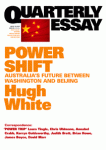
Quarterly Essay 39: China powers on

Hugh White, Quarterly Essay 39: Power Shift: Australia’s Future between Washington and Beijing (Black Inc Sept 2010)

As with every Quarterly Essay, I turned first to the back of this issue for correspondence on the previous one. Timing was unusually poignant in this case: QE38, David Marr’s Power Trip, came out just days before its subject Kevin Rudd was ousted from power; the responses to it here were mostly written when the election campaign of Julia (‘the ouster’) Gillard was foundering, and I read them just after hearing that she will be leading a minority government. There are no fireworks in the correspondence: a couple of journalists add corroborating anecdotes about Rudd’s leadership style (David Marr describes these as symptomatic of ‘a new, and welcome, spirit of indiscretion’; I read them as a bit of a pile-on). Kerryn Goldsworthy deftly despatches whole swathes of attack on the essay and dispenses a little relevant information about literary forms while she’s at it. James Boyce corrects and enriches David Marr’s understanding of Dietrich Bonhoeffer and his probable significance for Rudd. In responding, David Marr replies almost entirely to criticisms that were made elsewhere: perhaps it would have been polite to give those critics the right of pre-reply here (he quotes Sylvia Lawson and Allison Broinowski and gives them a one-word reply: rubbish).

From David Marr’s Power Trip to Hugh White’s Power Shift. Appropriate as the title would have been for an essay on the recent election, we have to wait for QE40 for George Megalogenis to give us that (Power Brakes?). This one is about something other than personalities and politics as horse race:

Our leaders, and by extension the rest of us, are assuming that Asia will be transformed economically over the next few decades, but remain unchanged strategically and politically. It is an appealing assumption because the past forty years have been among the best times in Australia’s history, and it has been easy to believe that American power would continue indefinitely to keep Asia peaceful and Australia safe. That has been a cardinal mistake.

Perhaps the assumption is also appealing because its obvious knee-jerk alternative is a revival of Yellow Peril rhetoric. Tomorrow When the War Began (John Marsden’s series of YA novels and now a film based on the first book) demonstrates, incidentally, that the complacency Hugh White sets out to prick hasn’t been absolute, but it does give strength to his arm in seeking to get people to think about Australia’s relationship to China rather than explore violent fantasies, however earnestly packaged.

While Kerryn Goldsworthy says, quite correctly, on page 85 that an essay can be ‘an expedition into the unverifiable: memories; theories; hitherto unexplored veins of subject matter or uninhabited point of view’, this one proceeds with the logical clarity (though not the  soul-destroying aridity) of a PowerPoint demonstration. ‘Since 1788,’ he says, stating the obvious but unsettling truth, ‘Australia has always enjoyed a very close and trusting relationship with the world’s strongest power, and we just take that for granted.’ Well, not for much longer – and we need to think about this. The main history of our times, he proposes, may not be in the place that’s getting the most attention:

The day-to-day management of the [US–China] relationship gets a lot of detailed attention, but presidents and other senior figures avoid substantial analysis of America’s long-term intentions towards China. One reason is 9/11. For almost a decade, America’s political leaders have convinced themselves that a small group of fugitives on the run in Pakistan poses a bigger challenge to America’s place in the world than the transformation of the world’s most populous country. Future historians will find that hard to explain.

To be fair to White’s argument, he goes on immediately after this to acknowledge that Barack Obama signalled that the blinkers were coming off after his visit to China in November last year. All the same, Muriel Rukeyser take a bow.

It’s a very interesting essay, which I recommend as an antidote for the personality-preoccupied, narrative-driven writing that accounts for most political commentary in our newspapers these days.

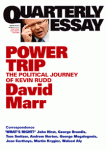
David, Kevin, Rage. So?

David Marr, Power Trip: The political journey of Kevin Rudd (Quarterly Essay 38)

In Quarterly Essay 36, Mungo MacCallum explored the miasma of myth and collective emotion that, he argued, accounted for Kevin Rudd’s popularity. Rudd’s recent plummet in the polls suggests that the popularity may actually have been based on more concrete factors, such as his promising stand on global warming, but the essay was a good read nonetheless. Two issues further on, the series once again addresses (I nearly said ‘attacks’) the Rudd phenomenon. David Marr asks not what we see in Rudd, what we hope of him, what he stands for, not centrally whether his leadership is effective or his policies correct, but ‘Who is he?’ It’s a fair enough question. There is something oddly impersonal in his media persona, a sense not so much that he’s hiding something as that he doesn’t know how to show himself. There have been baffling moments, especially his odd, televised disregard for Kristina Keneally.

The question is fair enough, but I’m not sure the answer gets us anywhere much. A cruel short version would be: ‘Kevin Rudd yelled at me when I told him he was an all round disappointment, so now I know that rage is at his core.’ David Marr writes well, and he marshalls biographical facts into a coherent story, sifting through the hostile and hagiographic scuttlebuck alike, for which much thanks. But in the end, the essay is unsatisfying. His strategy of beginning with Rudd’s use of expletives about the Chinese at Copenhagen and ending with a moment when Rudd sets his diplomat’s blandness aside and tears strips of the writer (in private, quietly, in response to provocation) may be structurally satisfying, but the conclusion that anger is Rudd’s ‘juice in the machine’ is a wee bit tenuous. Perhaps I identify with Rudd, as a mostly mild-mannered Catholic man from rural Queensland who uses four-letter words and gets cranky when personally attacked. I imagine David Marr himself swears occasionally and has the odd tantrum – at least I hope he does for the sake of his mental equilibrium.

Tellingly, Kevin Rudd’s response, as reported by the ABC,  was a verbal shrug: ‘Commentators, writers, analysts – they will draw their own conclusions.’

But a distinctive feature of the Quarterly Essay series is that it promotes discussion. No doubt all manner of responses will be aired in Nº 39. Here, the title essay accounts for roughly two thirds of the book, leaving the remaining 40 odd pages to discussion of Waleed Aly’s essay last quarter on conservatism. As a first, a number of voices from the neo-right have appear in these pages, many of them doing their usual polemic attack on straw men. Jean Curthoys (not from the right) suggests that Aly really needs a dose of social democracy. Martin Krygier’s piece makes me decide that if I ever make him cross I’d better lay low. And Aly responds to all comers with precision, grace and – in one or two cases undeserved – respect.

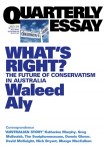
Waleed Aly on conservatism

Waleed Aly, What’s Right: The future of conservatism in Australia (Quarterly Essay 37)

In the 1950s my parents subscribed to The Saturday Evening Post. I habitually started reading it from the back, because there were no cartoons in the front half. There are no cartoons at all in Quarterly Essay, but I usually start up the back here too, because that’s where I find responses to the previous issue, in this case 30 pages about Mungo MacCallum’s essay on Kevin Rudd, Australian Story. Katharine Murphy, national affairs correspondent for the Age, wins the Me Fail I Fly ‘I Wish I’d Said That’ Award for this:

The problem with Mungo is you can’t read anything he writes without feeling the need to agree with it on the spot, and wish you’d written it yourself. Reading Mungo is like resisting the pull of a great seducer.

That’s so much more grown-up and articulate than my own post-reading ‘Hmmm … But I enjoyed the ride.‘ Indeed the opening sentence of Mungo’s response to the correspondence does command assent:

The most interesting thing about all the correspondence my essay has provoked is the hugely different ways in which different people see Kevin Rudd.

[Editor Chris Feik and his Board apparently agree that the multiplicity of views on Kevin is interesting: QE 38 promises to give us yet another essay on the man, this time by David Marr.]

He then goes on to characterise each of the respondents: one ‘presents the standard view from the Right’, another is ‘a Labor insider’, a third speaks ‘from his position on the ideological Left’. This mode of analysis is fortuitously held up to a harsh light on page 1 of Waleed Aly’s essay, which of course I read after Mungo’s page 140. According to Aly, the terms Left and Right, ‘in spite of their ubiquity … are utterly meaningless and should be abandoned by anyone interested in having a substantial political conversation.’ The great seducer interrupted in flagrante?

Waleed Aly’s rejection of Left and Right as terms for political debate is not of course in response to Mungo MacCallum’s use of them. As he says:

For a long time I have been intrigued by the fact that I find myself in agreement with much conservative political philosophy, yet in consistent disagreement with politicians and commentators who call themselves conservatives.

The essay sets out to reclaim the ground currently occupied, one might say infested, though Waleed Ly is far too polite and reasonable to put it like that, by  neo-liberals and neo-conservatives. These politicians and commentators, he argues, have moved a long way from the conservative philosophy first articulated by Burke, and are in fact progressives in the sense that they are committed to moving towards an ideal world, albeit one from which most people who actually think of themselves as progressives would recoil in horror. I won’t try to summarise the argument. Much of it might be either glaringly obvious or obviously specious to anyone who has studied political philosophy, but to the general reader (that’s me!) it’s an education, and a pleasurable one.

Aly does a job in this essay that has needed doing for some time. He exposes the contradictions and fallacies in the utterances of the likes of John Howard, Tony Abbott, Nick Minchin or Kevin Andrews, but from a conservative perspective. He hoists them, as it were, on what they claim to be their own petard. ‘The conservative, ‘ he writes for example,

would certainly not run immigration at record levels (as the Howard government did) and then lecture its migrant population on what their values should be. That is especially true when it is done pursuant to a neo-liberal plan, where individuals are encouraged to use their mobility for entrepreneurial reasons, not cultural ones. The conservative takes the world as it is, not as she or he wishes it to be. And it is a world in which pluralisms in culture, politics and identity within a society are an inescapable and irreversible fact of life.

After taking his scalpel to the neo’s on multiculturalism, he moves on to the climate change ‘debate’, which he describes as ‘a fight to the political death’:

Of course, it is possible that climate-change activists are motivated more by their ideological commitments than by their trust in the scientific consensus. It is conceivable that staunch opponents of capitalism may leap on the opportunity climate change provides to argue for the destruction of the market’s political dominance. But it is also conceivable – and probably much more common – for climate-change believers to take their position based on trust in what they perceive to be conventional wisdom. Climate-change denialism on the part of non-scientists, by contrast, is always an ideological or an emotional process. The intellectual lengths required to sustain it are only feasible for those who have pre-existing reasons for wanting to deny it. That may be because its implications are devastating for one’s present livelihood – as might presently be true of certain farmers, or people working in high-emissions industries – in which case the response is probably emotional. Or it might be because it counters one’s deeply held views of the world, in which case the response is ideological.  … The simple fact is that neo-liberalism is incompatible with the politics of climate-change response. In order for neo-liberalism to be preserved, climate change must, in the first instance, be denied.

As you see, Waleed Aly is not a great seducer. He’s not out to win our assent by charm, or standover tactics, or appeals to team loyalty. On the contrary, he invites us to think with him.

It’s a quick read – just 105 pages. I recommend it.

Added on 30 March: Irfan Yusuf has an excellent review of this Quarterly Essay on New Matilda.

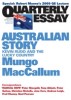
Mungo on Kevin

Mungo MacCallum, Australian Story: Kevin Rudd and the lucky country (Quarterly Essay issue 36, 2009)

Mungo MacCallum is now, according to the blurb of this Quarterly Essay, one of Australia’s most influential political journalists. He was probably already influential all those years ago when he was telling Nation Review readers how well Prime Minister Gough Whitlam filled a pair of swimming trunks, but now he is an elder. Mercifully, he is also still a bit of a smart Aleck.

There are no hints here about Kevin Rudd’s physical endowments – the essay’s main interest is in the nature of his appeal to voters. The essay quotes poetry, mainly bush verse, including a savage parody of ‘Clancy of the Overflow’:

He was poisoning the water when he chanced upon a slaughter
So he joined in patriotically to massacre and rape
And he sees the vision splendid of the native problem ended
and a land made safe for cattle from Tasmania to the Cape.

The essay takes the odd potshot at contrarian right-wing columnists. It produces some fabulous quotes, including for example a definition of a modern progressive as ‘a fella that stumbles forward every time somebody shoves him’. (Sadly there are no footnotes, so we often don’t know what wits are being quoted – I’m guessing Mungo himself did the Paterson parody.)

That is to say, there’s a lot to enjoy in this essay. It also has substance – of an airy sort. It deals with policy, that’s true, and Kevin Rudd’s largely successful response of the GFC, but mainly it argues that he taps into some deeply held myths about what it means to be Australian – egalitarianism, fairness, the larrikin–dutiful citizen dichotomy, that reluctant progressiveness, ‘fervent, if understated, nationalism’. ‘For all his nerdiness and prolixity,’ he concludes,

there is something very Australian about him, and the voters recognise it. In a totally unexpected way, Rudd has given them back their Lucky  Country – and this time not in a spirit of irony, but one of self-belief.

Hmmm … But I enjoyed the ride.

This issue also includes the 2009 Quarterly Essay Lecture, ‘Is Neo-Liberalism finished?’ a search for the meaning of what he calls the Great Recession by the chair of the editorial board, Robert Manne. The lecture isn’t as much fun as the title essay, covers some of the same ground, occasionally manages to be incomprehensible when explaining (yet again) how the Great Recession came about. Where MacCallum takes cheerfully bitter potshots, Manne eviscerates in earnest.

And then there’s correspondence about Noel Pearson’s Radical Hope. A number of the correspondents join in Pearson’s left-liberal bashing, and there’s a certain amount of jockeying for position from politicians and activists. Voices from the old Howard Government era talk of Pearson’s pre-eminence as an Aboriginal public voice on the national scene, without mentioning that the deliberate dismantling of ATSIC had destroyed any more organised and representative voice. Christine Nicholls, former principal of Lajamanu School in Yuendemu, is the only educationalist to write a substantial response, and she does a brilliant job of respectfully taking Pearson to task for his straw-man arguments against ideologically driven educationists. The only Aboriginal voice is that of Chris Sarra, who gently chides Pearson for dismissing elements of his own educational work without having ever visited it. Over all, the correspondence confirms that Pearson’s conversation is mainly with conservative white leaders, but it also shows him as eager to do more than simply pontificate as a lone voice.