Tag Archives: Rebecca Huntley

2024 End of year list 5: Blog traffic

In case you’ve had just about enough of my end of year lists, be reassured: This is the last one, and I don’t expect you to read it – it’s mainly so I’ll have a record.

Here are the posts that attracted most clicks on my blog in 2024:

  1. Claire Keegan’s Small Things Like These (October 2023, 1618 clicks)
  2. The Book Club and Paul Murray’s Bee Sting (April 2024, 775 clicks)
  3. Ocean Vuong’s Time is a Mother (March 2023, 744 clicks)
  4. Ellen van Neerven’s Throat (July 2020, 625 clicks)
  5. Mary Oliver’s Twelve Moons (January 2019, 597 clicks)
  6. Anne Enright, The Wren, the Wren, the book club, page 77 (March 2024, 533 clicks)
  7. Trent Dalton’s Boy Swallows Universe (July 2019, 412 clicks)
  8. Robert Alter’s Psalms (September 2020, 365 clicks)
  9. Jenny Erpenbeck’s Kairos and the Book Club (April 2024, 364 clicks)
  10. Rebecca Huntley’s Italian Girl (April 2022, 357 clicks)

Ocean Vuong’s book was at the top of the list for most of the year, and then news of the movie of Small Thiings Like These sent a lot of clicks to that post. Shirley Hazzard’s The Transit of Venus dominated the list for years, but has now dropped off altogether. Mary Oliver, Ellen van Neerven and Robert Alter are the stayers.

One more bit of nerdiness. Here’s WordPress’s list of my all-time top ten posts. Apart from changing positions, the main change from last year is that Philip Larkin got bumped by Claire Keegan:

  1. Travelling with the Art Student (November 2014, 3558 hits)
  2. The Book Group and Shirley Hazzard’s Transit of Venus (June 2018, 2721 hits)
  3. (Re-)reading Kevin Gilbert’s poetry (April 2012, 2430 hits)
  4. Mary Oliver’s Twelve Moons (April 2020, 1841 hits)
  5. Bran Nue Dae (January 2010, 1805 hits)
  6. Mary Oliver’s House of Light (April 2020, 1784 hits)
  7. Claire Keegan’s Small Things Like These (October 2023, 1676 hits)
  8. The book group’s Harp in the South (February 2011, 1431 hits)
  9. Jasper Jones at the Book Group (May 2010, 1352 hits)
  10. Contemporary Asian Australian Poets (June 2013, 1236 hits)

That’s it. Thanks to everyone who has contributed to those statistics. Some of you I know IRL, some I’ve met through email etc, some only in the comments section, some I know only as anonymous clickers. I’m happy that you’ve visited the blog. Come again.

SWF 2023: My third day

I’m not exactly live blogging the Sydney Writers’ Festival. It’s now Sunday and my festival is over, but the blog is still at Thursday.

On Thursday, we arrived an hour or so before any of our booked events and caught up with friends over lunch, then we were off.


2 pm: Climate Hope

This was billed as: ‘a trio of environmental experts examine promising developments, signs of hope and viable solutions for a greener, more sustainable future.’ It delivered on that promise.

Simon Holmes à Court, founder of Climate 200 (tagline ‘climate proofing politics’), was the chair. Other panellists were a scientist, an engineer and a community activist: Joëlle Gergis (Humanity’s Moment: A Climate Scientist’s Case for Hope), Saul Griffith (The Big Switch and the Quarterly Essay The Wires that Bind), and Claire O’Rourke (Together We Can: Everyday Australian’s doing amazing things to give our planet a future).

There was an awful lot to digest, or even grasp as it flew by. I hope it will turn up as a podcast – I recommend it.

Here are some of my takeaways:

Jöelle Gergis described how, after helping to write the IPCC report on the state of the climate, she was filled with despair. Technological solutions are pretty much all there, but there is little political will to implement them. This is no longer a scientific problem; it’s a social, cultural and political one. She found hope in looking to history. Many times in the past when there has been a major crisis, people have come together and created solutions. She gave a number of examples, but what I remember is Saul Griffith’s amplification of her point by mentioning Dunkirk: the Allied forces had been roundly defeated, and then Winston Churchill, who can be criticised on many fronts, inspired what could have seemed an irrational hope with his rhetoric (‘We will fight them with teaspoons’ – not an actual quote as far as I know), and the people famously rallied.

The motto ‘Reduce, Re-use, Recycle’ doesn’t point to the way out of the climate emergency. It puts the onus for action at the individual level, when what is needed is systemic change (though individual initiatives are important to achieve that). It can be paraphrased as, ‘If we just sacrifice a little, the world will be a little bit less fucked.’ (Numerous apologies for swearing were made to Saul Griffith’s mother who was in the audience, though if she’s anything like women I know who are mothers of people Saul Griffith’s age, she swears quite a bit herself.) in reality, if we do this right, we can get a good outcome and not sacrifice any of our standard of living.

Claire O’Rourke is already active in the social movement space. She gave example after example of ordinary people who have taken action and organised to bring about change at local and regional levels.

There were some great quotes:

Claudia Rankine (link to my blog post about her Citizen): ‘Every state of emergency is also a state of emergence.’

Bill McKibben (link to my 2007 blog post discussing his Deep Economy): ‘Winning slowly is losing.’

Rebecca Solnit (link to my blog post about her Hope in the Dark): ‘People today will determine the future of humanity.’

Saul Griffith recommended that each of us makes six big decisions about our lives in the next year in order to bring about systemic change: decisions about home heating, cooking, cars, nutrition and so on. Just a handful of major decisions, he means, not the hundreds of decisions involved in ‘lifestyle changes’.

Claire O’Rourke mentioned systems theory, said change happens most effectively through networks and recommended the All We Can Save Project.

Jöelle Gergis had the last word: The missing piece is a social movement.


I rushed off to arrive late and sit at the edge of the space set aside for ‘curiosity Lectures’ and ‘Beginnings’, the latter being sessions where people read the beginnings of books to the audience:

3 pm: Benjamin Gilmour on Taking Tea with the Taliban.

Among other things, Benjamin Gilmour is notable for the extraordinary film Jirga (2019), which he wrote, directed and shot in a tribal area of Afghanistan. He recently revisited Afghanistan for a new film documentary project, which if I heard correctly is to be called Taking Tea with the Taliban. In this Curiosity Lecture he told about interviews with members of the Taliban government and his time with villagers who told him of terrible brutality at the hands of Australian soldiers.

It was disturbing stuff. He relayed the Taliban’s protestations that the way they are portrayed in the western press is self-serving propaganda, that their treatment of women is misrepresented, and that it’s hypocritical for the west to condemn the Taliban for mistreatment of women when USA and Australian forces have destroyed so many Afghan lives, of women and children as well as men.

I couldn’t help thinking of those Australians who visited Stalin’s Russia and came back with glowing reports of happy workers at times when, it was later revealed, the gulags were filling up. All the same, he made a strong argument for governments to engage with the Taliban. ‘I did,’ he finished his talk, ‘and I’m just some guy.’

Benjamin Gilmour has a special place in my heart: we published a number of his poems in The School Magazine in the 1990s, when I was editor and he was a teenager. I introduced myself and we had a photo taken together. I’d share it here but I made the mistake of lowering my mask instead of taking it off altogether, and I look mildly deranged.


Then straight on to 4 pm: George Monbiot: Regenesis

A giant George Monbiot on video chatted with Rebecca Huntley. This was a brilliant talk. Monbiot’s ability to marshal facts and present a clear argument is breathtaking.

His central message was that the global food supply system is at risk of catastrophic failure. Not only that, but farming is contributing hugely to global warming. Second only to the urgent need to keep fossil fuels in the ground is the need to stop farming animals. It’s as if the scientists who have been researching this area have been shouting and waving their arms about, but have been doing it from behind plate glass, inaudible to the rest of us.

Although world hunger fell steadily from about 1960, in 2014 it began to rise again, and has been rising steadily ever since – even before the shocks to the food supply system that were Covid-19 and Russia’s invasion of Ukraine. This is because the food distribution system now works in such a way that even small shocks to the system can cause disproportionate price hikes in vulnerable communities.

He gave us a brief introduction to systems theory. Complex systems, such as the climate or the global food supply system, take a lot of understanding (and after this talk, I’m keen to learn more). There are six elements required for a complex system to be resilient:

  • diversity
  • asynchronicity
  • redundancy
  • modularity
  • circuit breakers (in this case regulatory constraints)
  • back-up systems

I imagine his book Regenesis spells out how the food system scores on these elements. From the talk I understood that concentration of the control of food in about four massive corporations makes for low resilience. Industrial farming likewise. Redundancy is so limited that if the Ever Given had been stuck in the Suez Canal a year earlier, when Covid was at a different stage, the result would have been disastrous.

It’s not a question of tightening our belts. He sees hope in technology, in what he calls a technoethical shift: when something becomes amendable it becomes intolerable. That is to say, if a food can be developed that has the nutritional value of meat and it’s flavour, texture and general appeal, we will be able to face the reality of what our meat-eating has been doing to our relationships with other animals and to the planet.

The technology that he favours is ‘precision fermentation’, in which single cell organisms are used for food: we already do it with yeast, and many other species are being explored. A naturally occurring pink microbe has been discovered in Europe that when grown in a culture looks, feels and tastes like sausage. He himself was the first person to eat a pancake grown from microbes – ‘One small flip for a man’ – and it tasted like a pancake. He surmises that this will lead to a culinary revolution as radical as the one produced by the development of agriculture. And food produced in this way uses a tiny fraction of the earth’s resources.


We went home for a vegan dinner, then caught public transport into town for our one event not at the Carriagework:

8 pm: Storytelling Gala: Letters to the Future

Not to cast shade on any of the readers or organisers but this ‘gala’ was a bit of a dud. A stellar line-up of writers got to read to a packed Sydney Town Hall. They had evidently been given the title ‘Letter to the Future’. Most of them gave us a piece that began, ‘Dear Future’, and too many wrote what could be summarised as: ‘Dear Future, we have fucked up the world. I expect Earth is posthuman/a disaster where you are. Please forgive [or forget] us.’ After hearing someone say in the 2 o’clock session that people find it easier to imagine a disastrous future than one where the problems have been solved, it was dispiriting to hear so many people take the easier path as if they were doing something serious.

There were exceptions.

Anthony Joseph (about whom more tomorrow) read two poems in a form known as the Golden Shovel, where the last words of the lines spell out a quotation. His first one took Kierkegaard’s ‘Life can only be understood backwards; but it must be lived forwards’: I was too busy trying to spot the line breaks to follow the poem, but it sounded great.

Shehan Karunatilaka spoke elegantly about the impossibility of the task and told a fable about a child refusing a hug to her father, thereby setting of a chain of events leading to disaster.

Nguyễn Phan Quế Mai wrote an imaginary letter from her ten-year-old self, bookended by fabulous a cappella song.

Jason Reynolds also read a letter from his past self: I found it hard to follow, but his performance was fabulously musical.

Nardi Simpson rejected the idea of the future, saying that as a First Nations person she has responsibilities to Now. It was striking how she echoed Alexis Wright’s talk on the opening night.

Tabitha Carvan got the only laughs of the evening with a comic bit about a leadership course where on the first meeting the participants wrote a letter to their future selves.


It was a day full of excellent things, and things that will bear thinking about and acting on for some time.

Rebecca Huntley’s Italian Girl

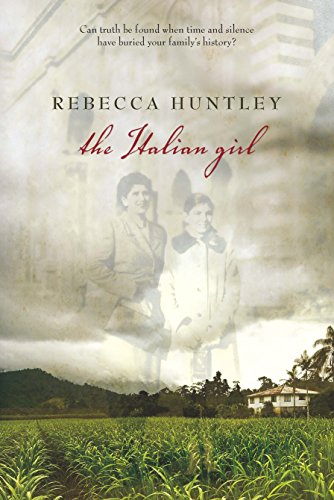
Rebecca Huntley, The Italian Girl (UQP 2012)

It was a comment by Lisa Hill on one of my earlier blog posts that led me to The Italian Girl. Lisa thought I might like it. She was right.

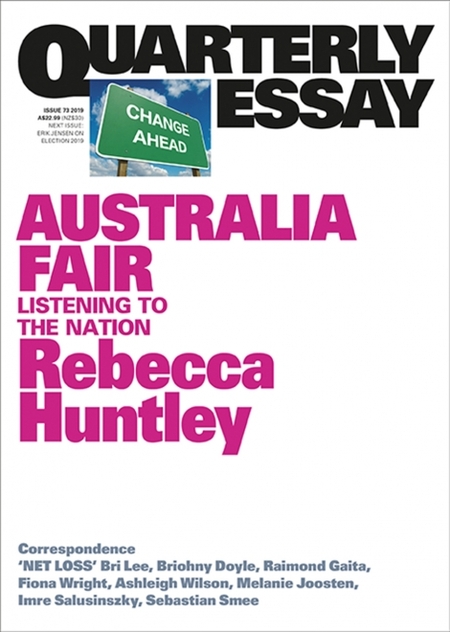
Rebecca Huntley is probably best known as a social researcher and broadcaster. Her 2019 Quarterly Essay, Australia Fair: Listening to the Nation (the link is to my blog post), demonstrated among other things that the predictions of social researchers can be wildly inaccurate. When she humbly acknowledged her wrongness with defiant optimism in the following issue, I became a bit of a fan.

As a young adult, Huntley pondered shedding her Anglo-Celtic family name and adopting her mother’s birth name, Ballini. Her mother, fearing that an Italian surname would invite discrimination in her daughter’s chosen field, emphatically discouraged the move. Rebecca abandoned the idea and picked ‘Huntley’ at random from the phone book. In The Italian Girl, written 20 years later, she reverses that emblematic abandonment. The book is the story of her investigating her Italian–Australian family’s history, mainly in Innisfail and surrounding sugarcane country, focusing mainly on her grandmother, her much-loved nonna, Teresa Ballini, and the internment of Italian-heritage men during the second world war.

On a visit to Innisfail after her nonna‘s death, Rebecca tells her uncle Frank that she’s sorry to have disappointed her nonna by not having married while she was still alive:

‘She never got to see me in a wedding dress,’ I tell him. Frank laughs in his gentle way and shakes his head ever so slightly.
‘You didn’t really know your nonna, did you? She was a feminist before we knew what feminism was. When the men were interned during the war, it was your nonna who ran the farms. She kept everything going until they came back. She wasn’t waiting for you to get married. The proudest day of her life was when you graduated university.’
… My nonna, a feminist trail-blazer? It didn’t fit with my image of her who had no greater ambition in life than to cook, clean and care for others.

(Page 23–24)

That was the spark that led to the publication of this book twelve years later. Who doesn’t resonate with that impulse to find out more about the people you saw so one-dimensionally in childhood?

The author makes several more trips to Innisfail – a north Queensland town where she has never lived, but where her great-grandfather Luigi settled when he came out from the Italian island of Elba; where he worked as a cane cutter before acquiring and running a number of sugar farms; where her nonna Teresa was born and married, lived most of her life and eventually died. On her research trips, she interviews elderly relatives, quizzing them about her great-grandparents, nonna and nonno, about the family fortunes, and (most interestingly to this reader) about the wartime internment of Italians in north Queensland as enemy aliens.

She supplements these conversations by enlisting the help of a research assistant, and reading extensively, including Jean Devanney’s novel Sugar Heaven and roughly 50 other works listed at the back of the book. She creates a vivid sense of Innisfail itself – its location, its tropical climate, its history, its difference from the stereotype of an Australian country town. Each time she visits, she gives some detail of the journey – the first time by train, a journey of several days from Canberra, and subsequently simpler plane trips from Sydney. She strolls the streets, visiting the Taoist Temple, the marble canecutter statue, the Good Counsel Church, the preserved art nouveau buildings, the local history museum. This is my childhood home, and I was fascinated to have places familiar from my childhood described by someone who has an emotional investment but who is all the same not a native. (I responded with a kind of benign tolerance rather than my usual copy-editing irritation to tiny errors, such as misnaming East Innisfail as South Innisfail, or referring to Goondi as a small town between Cairns and Innisfail, whereas it’s really an outlying part of Innisfail – or it was when I lived a couple of miles further west, at what is now Shaw’s Corner.)

The history the book uncovers is interesting and important in many ways. For a start, the story of Innisfail puts the lie to the version of Australia as drearily monocultural until the 1970s. The Italians in this story may have been largely intent on assimilating, but they were always distinctly Italian, and they were only one of many non-Anglo groups.

I’m writing this a couple of days after Anzac Day, so I can’t help but reflect on this book in that context. In public discussions of past wars at this time of year, there’s very little mention of the Australian citizens who were interned because of their Italian, German or Japanese origins. Yet these internments are part of this nation’s long history of incarceration. Huntley doesn’t tell the story of the internment of her grandfather and great-grandfather, so much as the story of trying to find out about it from conversations and documents. It does seem that there was an arbitrary quality to it: men (and some women) who had done nothing wrong were detained, in some cases, for more than three years. Sound familiar? Some, including Huntley’s father, Oreste, almost certainly belonged to Fascist organisations; others were detained despite plenty of evidence that they had turned their backs on their Italian heritage and identified as British subjects. It seems that the ethos of least said soonest mended prevailed once the war was over, and none of Huntley’s elderly informants remembered the returning internees carrying a grudge or saying very much about the experience. Unlike people seeking refuge who have been detained by current and recent Australian governments, they seem at least to have been fed well.

For me (of course) the book feels personal. I’m probably about the same age as Huntley’s mother. I was a 12-year-old spectator at the unveiling of the canecutter statue in 1959. The inscription on the statue reads, ‘To the pioneers of the sugar industry donated by the Italian community of Innisfail district on the first centenary of the State of Queensland 1859–1959.’ What it doesn’t say, and what I remember from the speeches of the day, was that the statue, created by an Italian sculptor in Italian marble, was a grand gesture of reconciliation from the Italian community, and an assertion of the role Italians’ back-breaking work of cutting cane had played in building the industry. The Latin motto, UBI BENI IBI PATRIA, translated for us on the day as WHERE YOUR GOODS ARE, THERE IS YOUR HOMELAND, surely refers indirectly to the internments that happened less than two decades earlier. Certainly, I got the impression that the statue was somehow rectifying a great wrong.

Rebecca Huntley writes about her unsettling discovery that she has Fascists in her family tree. The Italian Girl adds heft to a piece of my own family lore that is at least as unsettling. My mother’s father, Arthur Aitken, served as Police Magistrate in Innisfail in the 1920s. My poem about his role in an earlier episode in Australian–Italian relations is in my book Take Five. My mother told us that, because he had learned the language, he was recalled from Brisbane during the war to oversee the internment of Italians. He isn’t mentioned in The Italian Girl, and we haven’t been able to find any documents to verify Mum’s throwaway line, but I’ve got no reason to doubt her, and I’m grateful for the work Rebecca Huntley has done in unearthing so much of the experience on the other side of that coin.

Rebecca Huntley’s Advance Australia

Rebecca Huntley, Australia Fair: Listening to the Nation (Quarterly essay 73)

This Quarterly Essay confirms me in my decision to delay reading each QE until the following issue has appeared. That way I get to read the correspondence while the original essay is fresh in my mind. With this issue, it has an extra advantage. Rebecca wrote Australia Fair in the lead-up to the recent Federal election, challenging Bill Shorten and his team – who she expected to win – to be bold enough to revivify Australian social democracy. The ALP lost, emphatically, and no one expects a Scott Morrison government to be interested in social democracy. So I read the essay shorn of its immediate persuasive goal, and it turns out to be a very interesting argument about where the majority of Australians stand on a number of key issues

Rebecca Huntley is a social and market researcher, involved, as she says, ‘in the “dark arts” of focus groups, polling, surveys, and strangers who ring you in the middle of dinner’. Her husband, when asked what his wife does for a living, replies, ‘She’s an expert in the opinions of people who don’t know what they are talking about.’ She’s been at it for many years, and can speak with some authority about general community attitudes on a number of topics.

She argues in this essay that the mainstream Australian population is much more progressive than our politicians. After some pages discussing the term ‘social democracy’, and research from many sources into community understandings of the role of government in a democracy, she comes to the conclusion that fairness – both for individuals and the collective – matters more to Australians than freedom (the reverse of what we generally believe to be the case in, say, the USA):

The point of democratic government is to do things for people, not to prevent government from doing things to people

(page 17)

She goes onto some detail on housing and homelessness; the environment and climate change (‘the defining issue for voters judging a prime minister’s leadership skills and character’); immigration, refugees and asylum seekers. On each of these subjects she demonstrates – though less clearly on the last mentioned than the others – that the majority of us, as in the case of the postal survey on same-sex marriage, want change for the better in ways that our political leaders simply don’t represent. And politicians are held in very low regard, seen as in thrall to their donors and not committed to the public good.

She pleads with Bill Shorten to step up boldly and restore a robust social democracy, winning back our respect for the parliament in the process. Who knows if he would have done it? On the strength of Anthony Albanese’s recent caving in on the Morrison government’s tax legislation, it seems unlikely. What emerges from the essay, then, is an optimistic view about the Australian population in general, and a deep pessimism about the current state of our democracy.

The correspondence is all dated post election. None of the correspondents takes a pot shot at the pollsters for getting it so wrong, but they all grapple with the paradox of a generally progressive population having voted for a nakedly reactionary government. They are all interesting. I’ll just mention James Walker’s final point. He cites Walter Lippmann (‘one of the pioneers of opinion research’) who warned that we should be wary of ‘the phantom public’. There is no single public out there, but any number of emergent entities, ‘continually evolving in response to political action and representation’. Walker goes on to quote one of Tony Abbott’s most striking pieces of feral poetry:

Thus Tony Abbott, always ready with simplifying binaries, articulates the crucial factor in how belief around climate change was mobilised in the 2019 campaign: ‘Where climate change is a moral issue, we Liberals do it tough. But where climate change is an economic issue the Liberals do well.’ The responses Huntley records might well be construed as answers to a normative question: ‘What should we do?’ But the actions of voters on the day can be thought of as an evaluation of economic interests. The Coalition, in successfully mobilising climate action as an economic issue, created a countervailing ‘public’ to that which Huntley and others thought representative of the zeitgeist.

(Page 80)

Rebecca Huntley’s response to corespondents is elegant, a little mea-culpa-ish but unbowed. ‘The conclusion to draw,’ she writes.

is not that Australia is no longer progressive or no longer cares about equality or is becoming like America, or that all social research lacks credibility. The conclusion is that the lack of trust the electorate has in politicians has undermined its belief that structural reform – whether that be economic, social or environmental – is something that can be delivered by the politicians running the show …
The challenge is to take what the majority of Australians want and connect that with a government they feel comfortable electing. The alternative is a race to the bottom.

‘I remain,’ she concludes, ‘a defiant optimist. Just one who now recognises the scale of the challenge ahead.’

Australia Fair is the thirtieth book I’ve read for the 2019 Australian Women Writers Challenge.