
J D Salinger, Franny and Zooey (1961, Bantam 1964)
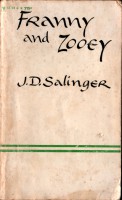 According to the little red notebook I kept at the time, I read Franny and Zooey in 1962, when I was 15. My eldest brother, Michael, who was then 24, introduced us younger ones to much that was sophisticated, including classical music (played loud ‘so you can hear it properly’), rock and roll (danced with a slack-jawed deadpan expression I’ve seen nowhere else), Mad magazine, Jules Feiffer, sick jokes (‘Mummy, why do I keep walking in circles?’ ‘Shut up or I’ll nail your other foot to the floor’), and J D Salinger. So where other people found in Holden Caulfield a mouthpiece for their own teenage alienation, I read him dutifully in the footsteps of my luminous big brother. I moved on to Franny and Zooey in a similar mode, and what I remember is mainly that I was very pleased with myself for having read such a sophisticated book. Kerryn Goldsworthy blogged recently about how significant Franny and Zooey was to her as a 16 year old. The one moment that I retained, revelatory to me in its own way, was in ‘Franny’. Lane has been going on about his brilliant seminar paper. He pauses for Franny’s response. She says:
‘You going to eat your olive, or what?’
Lane gave his Martini glass a brief glance, then looked back at Franny. ‘No,’ he said coldly. ‘You want it?’
I couldn’t have told you why, but I felt I’d been allowed into a great secret at that moment. I had no idea what Lane was talking about – Flaubert, ‘capital-F Freudian’, the mot juste were droppings from the inscrutable world of adult discourse. But I understood that Franny found his olive more interesting than his monologue, and that his coldness was full of unspeakable emotion. The door to understanding the adult world was creaking open for me.
When I read it just now, I realised that the book had been much more influential than I realised. Everything I wrote from the age of 16 to 30, at least when I was trying to appear intelligent, aspired to sound like Buddy Glass (‘Zooey”s narrator) – the complex syntax, the self-deprecating hi-falutinness, the over-use of words like ‘rather’, and so on. Though I’d forgotten it, Zooey’s tirade about the importance of not moulding Jesus to fit one’s own psychological needs ranked with Dostoevsky’s Grand Inquisitor (I read The Brothers Karamazov two years later) as a major outside perspective on my intensely held Catholic faith.
As I started ‘Zooey’ this time, I doubted whether I’d actually ever read it. maybe I’d listed it in my notebook as a bit of wishful thinking. But from the scene where Zooey sits in the bath and first reads a very long letter from his brother and then has a very very long, snitchy conversation with his mother, through the conversations with Franny who is in the middle of a nervous breakdown, I was amazed at how intensely personal it felt. It’s not as if I remembered individual passages –more like I was reopening old neural pathways, as if the book hadn’t been remembered in a normal way but somehow stored at a cellular level. That is to say, I have no idea what I’d have made of it if I’d read it for the first time today.
It’s embarrassing. I’d thought all those people who talked about how Salinger’s work had changed their lives were, um, a bit phoney. Now I discover that if I’d kept closer – or perhaps smarter – track on myself, I would have been one of them.


 Me fail? I fly!