
I had just two sessions on the last day of the Festival. The Emerging Artist came down with a heavy cold, but I was ruthless enough to leave her languishing at home today. One pleasant surprise was that, even thugh the SWF website says there is a no-refunds policy they are happy to give a credit – so we have prepaid for three sessions of next year’s festival (she also missed out on Sebastian Barry on Saturday night – rewatching some of Derry Girls from her sickbed.)
Sunday 26 May
12.30: Fragile Democracy
This was one of those panels where I’m interested not so much in the books written by the participants as in what they have to say about the world. As the Festival program put it:
Donald Trump and his attacks on the US electoral system have raised red flags about the strength of American democracy. But in an age of disinformation and civic decline, signs of fragility are visible elsewhere and Australia is no exception.
Former host of ABC’s Insiders Barrie Cassidy chaired this discussion. The formidable participants were:
- Bruce Wolpe (Trump’s Australia), Senior Fellow at the United States Studies Centre who has worked with the Democrats in Congress during Obama’s first term and on the staff of PM Julia Gillard
- Rosalind Dixon, Professor of Law at UNSW and co-author of perhaps the least easily spoken title of any book at the Festival, Abusive Constitutional Borrowing Legal Globalization and the Subversion of Liberal Democracy
- Nick Bryant (When America Stopped Being Great: A History of the Present), who has a 30 year career in journalism, much of it as a foreign correspondent for the BBC.
The panellists were pretty much in furious agreement that there is currently a wold wide battle between autocracy and democracy. Naturally, most of the tie was spent on how this battle is being fought in the USA. ‘The beacon of democracy,’ Nick Bryant said, ‘is looking like a dumpster fire.’
We were reminded that the authoritarian tendency in the USA isn’t new – FDR, correctly seen as progressive and, in US terms, ‘liberal’, was applauded when he said in his inauguration speech: ‘ I may have to bend the rules of the Constitution to what I want to do.’
There was some discussion of the possibility of civil war in the US if Trump loses the election. It wouldn’t be like the last one, but even if there is no civil war, there won’t be civil peace.
All the panellists agreed that Australia’s institutions are strong: compulsory voting, preferential voting, ease of voting (there were some horror stories about how hard it can be to vote in the US), an independent Electoral Commission, and courts that aren’t as subject to political pressure. But we still need to be vigilant: for instance, Peter Dutton recently tried to introduce voter ID processes to make voting harder.
Someone said, ‘Australian democracy is a lot stronger than its politics.’
1.30: David Wengrow: The Dawn of Everything
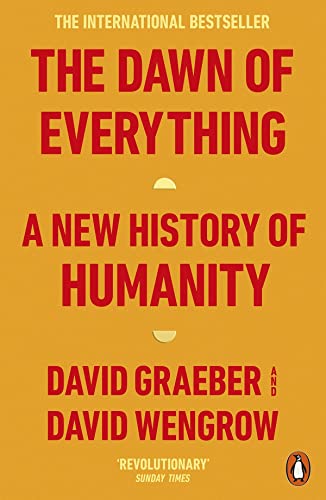
Richard Fidler was in conversation with David Wengrow, co-author with the late David Graeber of The Dawn of Everything: A New History of Humanity (2022). David Graeber was an anthropologist who played a leading role in the Occupy movement. When he and Wengrow, a British archaeologist met during the Occupy movement they had long conversations, not about politics but about archaeology. As Wengrow told him about current state of knowledge of the ancient past, he kept asking, ‘Why don’t I know this? Why isn’t this being taught?’
They decided to write a pamphlet, something without footnotes and scholarly paraphernalia, presenting current knowledge in a readable, integrated form. It turned out that this was harder than they thought, partly because of the extreme specialisation of archaeology: experts in ancient rock art don’t know what experts in ancient stone tools are doing or finding out. In the end, they had to write a substantial book.
The conversation touched on the opposing views of human history put forward by Rousseau (early humans were blissfully innocent, perhaps slightly imbecilic creatures who were corrupted by the formation of societies) and Hobbes (the war of all against all constrained by civilisation). wengrow observed that both these narratives are fantasies in which the early humans aren’t like any humans we know anything about. Likewise, he says archaeological findings disprove the narrative of Sapiens, which he assumed we have all read but I haven’t, and of Steven Pinker.
As to what those findings are: they are rich and complex, much more so than anyone has ever though was the case with early humans.
He argued that the luminaries of the enlightenment – Diderot, Voltaire, Rousseau – were influenced by what they heard from Indigenous people from colonised nations who visited Paris and were sharply critical of teh inequalities and other manifestations of monarchy that they saw there. He spoke respectfully of Bruce Pascoe’s work, but seemed to be unaware that Mungo Man and Mungo Lady were buried with ritual elements tens of thousands of years ago – which as I understand it only reinforces his argument.
This session was recorded for the ABC’s Conversations program. I plan to listen when it’s broadcast as there were a lot of specifics to his argument that I know I’ll get wrong if I try to write them now. [Added later: The Conversations program is already online at this link.]
The festival is over for another year. What little I saw of it was terrific.
The booking system means that there are no longer terrible queues for the sessions with no guarantee of getting through the door.
There is a new approach to questions: you go to a website and put your question there. This has the great advantage of stopping people from getting up to tell their life story or promote their own world view. I think there may have a disadvantage: sometimes if the person on stage can actually see the questioner they can tailor their answer appropriately – as for example if the questioner is a young person.
I do wish there was more than one place selling coffee, as even though I’m not a coffee drinker I was pained to see the apparently permanent size of the queue.
And most of all I wish there was more poetry. Just one whose drawing power depends on his published prose isn’t enough. Surely there is a small room somewhere at Carriageworks that could be devoted to poetry – one where an event doesn’t need a big crowd to justify itself. There are at least half a dozen places in Sydney that organise regular poetry readings, there ar e a number of small publishers who specialise in poetry, and there are any number of fine poets who live locally.
But long live the SWF. I’ve come away with a swag of actual books and a list of others.


 Me fail? I fly!