Tag Archives: science fiction/fantasy

The Book Group and The City and the City

China Miéville, The City and the City (Macmillan 2009)
Before the Book Group meets:
We decided to read some science fiction. Rather than opting for someone’s idea of a classic (Asimov, Heinlein, early Gibson or Stephenson) we decided to pick something current. I’d loved China Miéville’s Perdido Street Station and heard interesting things about The City and the City – among other things it had been nominated for a Hugo [and now has tied with Paolo Bacigalupi’s The Windup Girl for Best Novel]. I suggested we take it on, and the suggestion carried the day.

So I was suffering a mild case suggester’s anxiety when I started reading. What response would the book get from Groupers who’ve read even less science fiction than I have? Would the meticulous world-building strike them as so much tedious scenery-painting? Would they see the elegant police procedural plot as something from a by-the-numbers TV show, the characters as two-dimensional, the tantalising central conceit the equivalent of a one-joke comedy? I’m pleased to report that after a while I stopped caring and was absorbed in the book’s world and its story.

The City and the City is hard to write about because it really is an extended exploration of a single conceit. I would infinitely prefer to have had it revealed  to me by the narrative itself, and don’t want to have a hand in spoiling it for anyone else. In a Book Show interview, Miéville went as far as saying that the story is set in two cities that share an unusual relationship to each other, which is true but doesn’t give anything away. Not until the end of the first chapter is there any hint that the world, or at least the cities, of the book are in some sense science fictional/fantastic. I would love to know how a reader who wasn’t forewarned would understand that first jarring moment, and how long it would take to grasp the full situation. Of course, in one sense, the full situation isn’t clear until the very last pages: as in Kafka and Raymond Chandler, to whom Miéville acknowledges indebtedness, the narrative at one level concerns itself with solving a single crime, but it also unfolds the deeper political realities of the world of the novel.

Pushing the spoiler envelope just a little, I had an insight into the book when out walking recently with the Art-Student. As we approached a small group boys riding their scooters in the street, one of the boys momentarily lost control and wheeled directly into our path. He pulled up short and called over his shoulder to his friends, ‘I’ll try that again.’ He had carefully avoided hitting us, but otherwise acted as if we dog-walking old people weren’t even there. He had ‘unseen’ us. Then I remembered noticing on my last visit to Cairns that though there were plenty of Aboriginal people in the streets, the non-Aboriginal people generally behaved as if they weren’t there, and vice versa – another case of mutual unseeing. The City and the City takes this common phenomenon to impossible extremes, and much of the joy of the book lies in how consistently and thoroughly he has imagined it. Miéville succeeds to the extent that every now and then a reference to the world as we know it – to Coke, or Madonna, or a Google search – brings one up short: oh, this is all happening in the world as I know it! The climactic point of the story consists of four people walking briskly down a street in close physical proximity – and it’s totally thrilling, not just because one of them is carrying a gun. That’s all I’m saying.

After the meeting:
It was a small meeting, but all of us had enjoyed the book. The group meeting had been postponed for six weeks or so, so quite a bit of time had passed since most of us had read the book. And even though in the intervening weeks one had reread it and another had read Perdido Street Station, our memories weren’t generally fresh enough to generate much detailed discussion. I needn’t have worried about the appeal of the world building: everyone enjoyed it. And my curiosity about how the setup was revealed to the unspoiled reader was gratified: the consensus seemed to be that the odd word (‘crosshatched’) created a sense of unease, enough to alert rather than alarm, and there was pleasure as more of the workings of the cities was revealed, until one felt (several times over), ‘Ah, now I get it!’
Brian Aldiss’s Hothouse

Brian Aldiss, Hothouse (1962, Baen Books 1984)

What a luxury to read a book where a child dies  horribly in the first couple of pages, where the earth’s temperature has risen to the point where almost all mammals are extinct and small groups of humans cling to a precarious existence, where women lead those human groups and the men are protected and pampered because reproduction depends on their survival, and where none of these things is weighed down by real-life concerns about child protection, anthropogenic global warming or hegemonic patriarchy. Hothouse was first published in 1962 (and a year earlier as a five-part serial in a science fiction magazine), when gender politics and ecological anxieties were dots on the horizon for most people, and it was possible to approach in a spirit of joyful play subjects that are now matters for earnest, urgent and often acrimonious discussion.

You can’t argue with a book that rewrites the laws of physics to allow vast spider-like plants to tether the moon to the earth with silken cables. You can’t get too gloomy over a dying Earth scenario that involves incredibly [sic] vicious vegetable species with names like killwillow, trappersnapper, wiltmilt or oystermaw.  You can only sit back and enjoy the ride when human intelligence is explained as the product of symbiosis between ape-like mammals and a ratiocinative fungus.

This book won a Hugo when it was first published. It’s listed as one of David Pringle’s Best 100 Science Fiction Novels since the Second World War. It’s a wildly inventive odyssey in which the hero Gren meets more evolutionary monsters than any one story has a right to. There’s plenty of terror, romance and comedy, much physical and moral heroism, enough philosophy to keep the mind engaged, and a pinch of charming bawdry.

I was at boarding school in 1962,  thirsting for genre fiction and making do with what slim pickings the school library had to offer. Hothouse and the 14-year-old me were meant for each other. We’ve met up nearly 50 years too late, but that’s much much better than never. I’ve just read on the Official Brian Aldiss Web Site that Penguin republished it in 2008 – may it bring joy to myriad  readers, of whatever age.

China Miéville at Kinokuniya

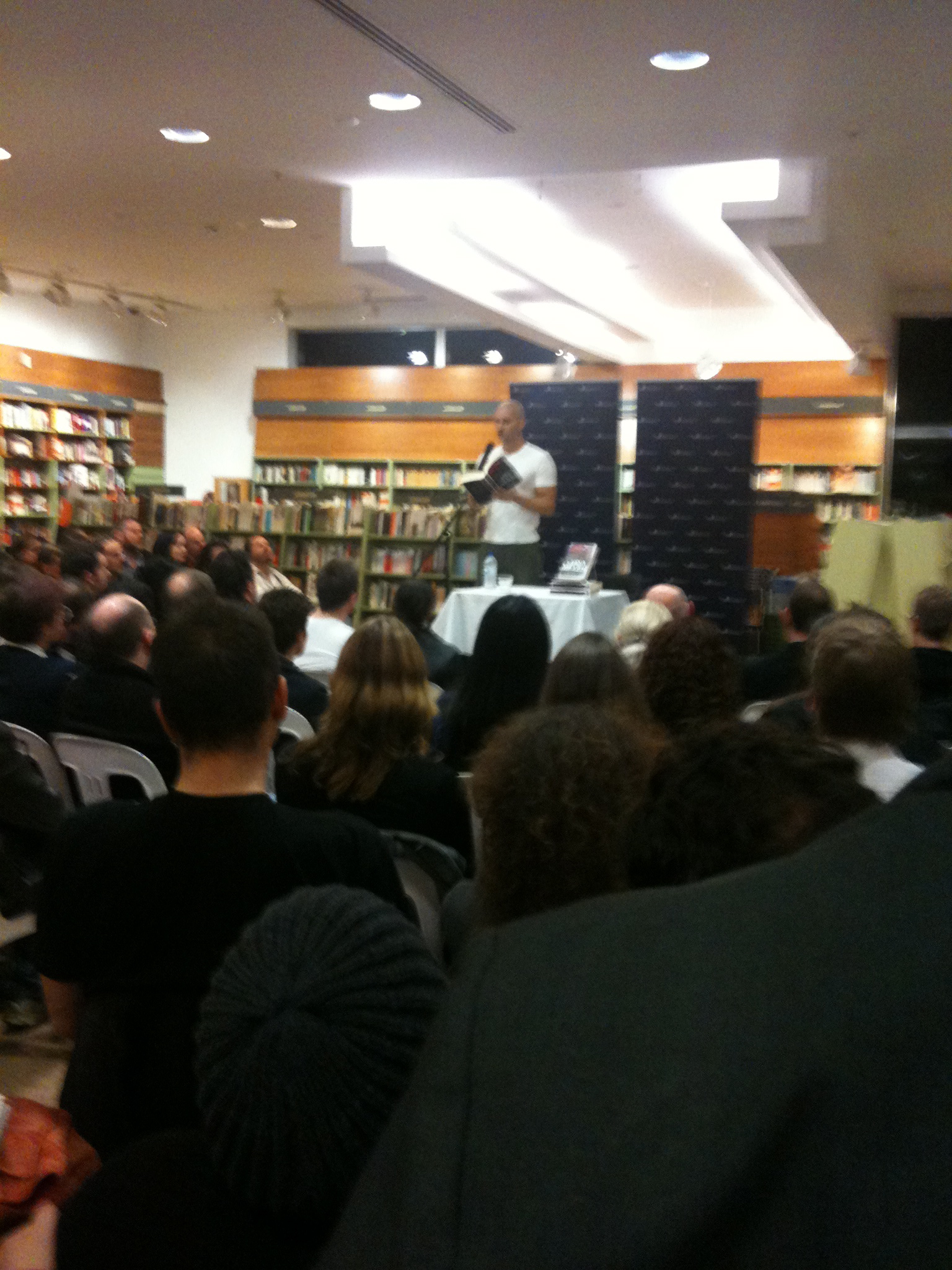
There are wordy conflagrations in Melbourne around about now that are sending occasional sparks up Sydney way. The Melbourne Writers Festival is letting Val McDermid do an evening at Gleebooks, and last night China Miéville, in Australia for AussieCon 4, made an appearance at Kinokuniya. There was a bit of a Neil Gaiman rockstar feel to the event, with a pec hugging white T shirt in place of Neil’s trademark black jacket.

The Miévillians

After a brief introduction, China M stood on the tiny stage by himself for an hour, reading and fielding questions.

He read a chapter from his latest book, Kraken, pretty much a self-contained short story that was very funny, though more to be savoured than guffawed at. I loved the term retro eschatonaut: if you can figure out what it means you’ve got the bulk of the story.

An earlier plan to have a fishbowl Q&A session having been ditched, CM chaired the question time deftly. You could tell we weren’t at a Writers Festival because all the questioners had clearly read at least some of his books, and he didn’t have to do any obvious mental gymnastics to come up with interesting answers to dim questions. I noted down a couple of gems.

On atheism: After stopping the questioner in mid-sentence to prevent spoilers, he said, ‘I don’t think you choose whether you believe or not,’ and talked about CS Lewis’s account of his own conversion to Christianity: he had convinced himself that he had to believe, and knelt and prayed, the most dejected and reluctant convert in all England. ‘I like the idea of an atheistic character who resents his lack of belief.’

On film adaptations: Any book involving a secondary world invites the collaboration of readers. A film destroys all the readers’ mental worlds – and the author’s – and replaces them with the director’s.

Advice to young writers: Start from an assumption that nothing you write will be worth publishing. Then falsify that assumption.

On writing a book set in an already established universe: Every book you write in someone else’s world is one less you can write in a world you make up yourself. He won’t ever be writing a Star Trek or Star Wars tie-in, but if he gets a phone call asking him to do a Doctor Who script, he’ll drop everything. (That last was delivered with a pinch of salt.) He wondered aloud what would happen if a publisher approached a distinguished author, J M Coetzee for example, asked them to write a Star Trek novel, and kept putting more money on the table until they said yes. (‘Star Wars by Coetzee?’ I muttered to the man standing next to me. ‘Better than Lucas,’ he muttered back. Someone should write it.) It would be a win-win: the Nobel laureate expands his readership, the publishing house cashes in on the controversy, the literati get to read some science fiction and/or enjoy their outrage, etc.

The role of politics in his work: He’s a socialist, and if his fiction introduces people to political ideas he’s thrilled, but a 500 page fantasy novel is a hugely inefficient vehicle for propaganda. ‘If you’re a Red, the Paris Commune is a very inspiring story. If you’re not a Red, it’s still a very exciting story.’ The revolutionary politics is there in his books because it gives their worlds texture, makes them more realistic.

I left, a happy camper,  as the audience was transmogrifying into a huge queue for the book signing. My Book Group is currently reading The City and the City (the book of his that he would most like to see made into a movie), so I’ll be posting about China Miéville again in a couple of weeks.

Joanna Russ’s Adventures of Alyx

Joanna Russ, The Adventures of Alyx (1976, Baen 1986)

I believe Joanna Russ carried the flag for uncompromising feminism in the science fiction/fantasy community in the 1970s. Apparently she invited James Tiptree Jr out of a fanzine symposium on women in science fiction because as a man Tiptree had no business speaking on the subject (for those who came in late, Tiptree was really Alice Sheldon lurking behind a male persona, and she responded graciously, in role, to the disinvitation). So it’s no surprise that Alyx in these stories is a strong female character. There are three short stories featuring Alyx, little more than active character sketches really, and a much longer narrative, then a final short story that, as far as I can tell, doesn’t have anything to do with Alyx.

Alyx the adventuress from ancient Tyre is a marvellous character, so the sketches – in which Alyx respectively helps a young noblewoman escape a potentially lethal marriage, escapes her own marriage to take up with a pirate, and deals with a gross man who claims to have created the world – hold up well. The first two happen entirely in a version of earthly antiquity. So does the third, though the nasty patriarchal figure has the language and paraphernalia of a time traveller rather than those of a demigod. In the fourth and longest piece, ‘Picnic in Paradise’, Alyx is transported by the Polysyllabic Agency for Temporal Gobbledygook (or something like that) to a future where her skills – and her lack of knowledge of technology – equip her perfectly to shepherd a group of tourists out of a war zone. In this piece the book well and truly transcends the ‘of historical interest’ niche. It’s funny, touching, and sexy in an over the top way. It points vicious satire  at the Prozac generation before the name. Then, just as one is thinking of Alyx as a kind of moral touchstone, one who keeps her head when all around are losing theirs, a role model even, she confounds all expectations by going so far off the rails it’s hard to understand how the story manages to keep us sympathising with her. She’s a real hero, and the story brilliantly refuses to be neat.

Then the last, short story, as far as I can tell, is not an Alyx story at all. A teenage girl in rural USA in 1925 is visited by a strange woman who turns out to be a descendant from the distant future. The young heroine (and we with her) understands only a fraction of what her strange visitor is up to. She helps her to kill another visitor from the future, but we’re left with only glimpses the relationship between the two visitors. And there’s more. It’s a tantalising narrative in which all the huge world-changing events happen offstage and/or in a language we don’t understand. Yet it’s also a satisfying coming of age story. After all, what teenager understands the world s/he finds him/herself part of.

I don’t have fond memories of Joanna Russ’s The Female Man, which I read (in 1970 something) as an undisciplined scream of rage. This book suggests strongly that I may have got it wrong.

If you want a proper, informed, intelligent discussion, I recommend you have a look at Niall Harrison’s review at Torque Control.

The Blue Star

Fletcher Pratt, The Blue Star (©1952, Ballantyne Books 1969)

These days I get my genre fiction – science fiction, fantasy, crime and romance – mainly on screens. I’ve learned that Lynda La Plante and Steven Bochco are for external application only (ie, as novelists they suck), and I prefer my J K Rowling that way as well. All the same, even though the number of books I’ll get to read before the lights go out is shrinking daily, I’m not prepared to give up the pleasures of reading genre just yet. The Blue Star predates The Lord of the Rings: it’s fantasy from an earlier era – no dwarfs, elves or Celtic myths, and what magic there is is only slightly less abstract than the sex.  Actually, the 1969 edition I acquired via BookMooch is labelled adult fantasy, and one of the unexpected pleasures of the book is discovering just how chaste adult fantasy could be back then.

A prologue promises an alternative universe where magic occupies the place that science occupies in ours. If that promise creates an expectation of something like Terry Pratchett’s Discworld, then the book will disappoint. In fact, the practitioners of magic are a tiny, proscribed minority. Our young hero starts out as an idealistic member of a revolutionary group in a land ruled by a queen (who remains an abstraction) and a repressive social order. Following orders from the Central Committee he seduces a young witch and promises fidelity in order to gain control of her Blue Star, an amulet that gives its wearer telepathic powers. There’s a love story, then, and a political story: will the seduction lead to true love? can a revolutionary movement with such a utilitarian attitude to young love really lead to freedom? The playing out of these questions is diverting enough, and the subversively anti-romantic politics are engaging, especially the section about the Amorosans, who talk the talk of everything being done in love, but in the place where they hold power they are just as repressive as their enemies. On the whole, though, this is not a landmark book. If you can imagine a Lord of the Rings where Bilbo decides that there are more important things than destroying the ring and that the Return of the King and the defeat of Sauron, for good or bad, will happen (or not) without his help, you have some idea of the impact.

A word of warning: skip Lin Carter’s spoilerish introduction, or at least save it for after you’ve read the rest of the book. You might also want to skip the prologue, which seems to be there to justify the fantasy mode, and doesn’t do it very well.

Beyond Apollo

Barry N Malzberg, Beyond Apollo (1972, Pocket Books 1974)

In the real world, the Apollo moon program lasted from 1962 to 1972. Beyond Apollo, first published in 1972, tells what happened next: a failed attempt to land men on Mars in 1976, and then the Venus project in 1981. The immediate aftermath of the latter is the book’s present moment.  Malzberg’s future is our past. If he had been aiming for accurate prediction, he failed miserably. But this isn’t that kind of book.

James Tiptree Jr said of Barry Malzberg: ‘Everybody and everything hurts, for no known reason.’ She could have been giving us an abstract of this book. The main character, Harry Evans, has returned to earth after failing to land on Venus. His fellow-traveller, the Captain, died out there. Evans is probably deranged by whatever happened out there, although possibly his derangement out there led to whatever happened. He gives his debriefers – and us – about ten different versions of events, none of them cheery. Some are obvious fantasy, some probably lies, none is obviously true. He remembers (or fantasises) a lot of unpleasant sex with his wife, and possibly with the Captain. Actually, I probably approached this books thinking I should have read it when I was 14 – science fiction’s ideal reader is supposed to be a 14 year old boy, right? Well, no! I would strongly discourage any 14 year old boy, and a fortiori any 14 year old girl, from reading this. I read the horrible marital rape scenes as somehow parallelling the  mechanistic, soulless nature of the Venus project (Venus//sex, OK?), but they sure weren’t fun to read.

This is probably a very good book. Though there are aliens (possibly invented by Evans, possibly real, who is to know?), the book is not the romp with sexy aliens promised by the lurid cover. Nor is it an easy read. Everybody hurts, including the reader.

SOS from three worlds

Murray Leinster, SOS from Three Worlds: Super-Medic for Interstellar Catastrophes (Ace Books 1966)

This book contains three stories in which interstellar medic Calhoun and his cute furry alien sidekick Murgatroyd visit farflung planets and foil evil or foolish plots involving major medical crises. They are straightforward space adventures with a touch of comedy and just enough space-tech stuff to reassure. The story is the thing. I suspect they’re the kind of stories that were killed by television, supplanted in the lives of young readers by the likes of Star Trek and Doctor Who. I mourn their passing.

According to the blurb, Murray Leinster (real name Will F Jenkins) had been writing science fiction since the early 1920s, and his work had appeared in many magazines, ‘both slick and pulp’. There are signs that he wrote quickly and was paid per word, but he wrote well, with a spring in the step. This little bit of technical writing from the first paragraph of the first story (variations on which recur regularly) is an accurate indication of the narrative’s cheerful engagement with technical matters:

The Med Ship did something equivalent to making  a hole, crawling into it, and then pulling it in after itself. In fact, it went into overdrive.

On the basis of the cover and the blurb, I was expecting a museum piece, but actually the book is great fun. My sorrow at its being out of print since 1966 was mollified when I discovered that Leinster wrote a total of eight Super-Medic stories, and in 2001 all eight were collected into an omnibus, Med Ship, edited by Eric Flint. There are lots of bits of Calhoun and Murgatroyd online if you want a taste.

Star Songs of an Old Primate

James Tiptree Jr, Star Songs of an Old Primate (Del Rey Books 1978)

0345254171Somewhere in the course of reading this book I realised it was a first edition, indeed an only edition, and that it’s been out of print for close to 30 years. You can’t even buy a copy on e-Bay. There is one collection of Tiptree’s stories still in print, Her Smoke Rose Up Forever, from Tachyon Publications in 2004, which contains eighteen stories compared to this volume’s eight, so perhaps there’s no big deal. Still it’s a shame that the fabulously self-promoting title of this collection has gone from the bookshop shelves. James Tiptree Jr/Alice Sheldon is the old primate in question, and a depressive old primate s/he is – I wouldn’t recommend these stories to anyone prone to letting grim prognoses for the planet take them on a nose dive. For all her feminism, her stories here feature an unhappy biological determinism, and even way back in 1978 she was terribly aware tht if nuclear war didn’t get us, then global warming or some terrible pandemic would.

I was glad to have Meet Me at Infinity still to hand, because Tiptree’s own comments on these stories, especially ‘Her Smoke Rose Up Forever’ and ‘Houston, Houston, Do You Read?’, greatly enriched the reading experience for me. Those comments make it clear that part of her project was to introduce what she calls software into hardware science fiction – she was au fait with cutting edge and out-on-the-edge psychological research of her time, and found in it the stuff of poetry.

Speaking of Meet Me at Infinity, I don’t care if F R Leavis said the artist’s biography was irrelevant to the work of art, ‘The Man Who Wouldn’t Do Awful Things to Rats’ gains tremendous resonance from its relationship to Alice Sheldon’s own history. Like her, Tilly Lipsitz is a researcher in psychology whose interests are at odds with the dominant mode of his place of employment. Like her, he is exhilarated by biological research; and their fields of enquiry are similar. Here’s a paragraph from the story (first published 1976):

He will never outgrow the thrill of it. The excitement of actually asking, after all the careful work of framing terms that can be answered. The act of putting a real question to Life. And watching, reverently, excited out of his skin as Life condescends to tell him yes or no. My animals, my living works of art (of which you are one) do thus and so. Yes, in this small aspect, you have understood Me

and one from an interview published in Contemporary Authors in 1983:

It takes time and work to learn how to ask a meaningful, unambiguous question of nature. For instance, you have to learn everything that has already been asked in your field, and what the answers were and the statistical techniques. And after you are qualified, there is still a period where you stand, as it were, in the great Presence, dejectedly hearing it grumble, ‘No … no … garble in …’ But you try and try, until one great day the needed cunning comes. And Everything-That-Is responds majestically, ‘Yes. You have truly grasped one of the hidden dimensions on which My creatures live and move.’ Time will never blur the wonder of that moment for me.

In the story, but hopefully not in the life, this thrill is overshadowed by the grim academic environment, strapped for cash even then and engaged in hideously cruel practices. That overshadowing grimness is characteristic of the stories, so even though there’s much that is rich in this book, I don’t see it becoming a favourite.

—–

And a niggle from a Down Under editor: It’s nice that Tiptree made Australian women the main surviving humans in ‘Houston Houston Do You Read?’, and gave the humanity of the future an Australian accent (‘date’ is pronounced ‘dyte’), but I wish she or her editors had checked the spelling of ‘Woomera’. I just checked in Google Books, and see that it wasn’t corrected for the 2004 edition either. Hooston, do you read?

Pamela’s Full Circle

Pamela Freeman, Full Circle (Orbit 2009)

Did I mention in my post about James Tiptree Jr’s Meet Me at Infinity that it’s full of quotable bits? Here’s Tiptree on High Fantasy, in 1975, a year or so before she was outed as a woman:

I’ve been reading a mess of Tolkien, C. S. Lewis, Wm Morris, and T. H. White. And I find extraordinary the unspoken assumption that the greatest boon a people can achieve is – a king. The King Has Returned! Well, perhaps in the feudal state of things one can understand some of that. But I suspect it is largely a male contribution.

It led me on to think that women are supposed to be more dependent, to slide easily into and adjust gratefully to domination. […] But who are the real dependents? Who insist on a captain, a boss, a Great Leader? Who have evolved lunatic systems of authoritarianism in every known activity except maybe solo farming? Who gratefully accept being beaten up and then faithfully follow the bully?

Three guesses. And don’t say guppies.

Full CircleI don’t for a minute believe Pamela Freeman intended the Castings Trilogy, of which Full Circle is the final book, as a feminist tract; I’d be mildly surprised if she’s read that bit from Tiptree; I’m sure she shares Tiptree’s bemusement at the persistence of monarchist ideology in fantasy; and there are moments in the narrative where I found myself thinking subliminally of guppies – though some of the characters who inspired that response were able to grow beyond their grateful adjustment to domination.

I ought to declare that Pamela is a friend of mine, in the facebook sense as well as the english-language sense. So I’ll content myself with saying that this is a most satisfactory conclusion to the trilogy: there is an army of the dead, the living world as we know it is under threat of extermination, the web of comradeship and betrayal, love and loss, heroism and cowardice, filial piety well placed and misplaced, vengeance and forgiveness, violence and tenderness, epic sweep and intimate gesture is as complex as anyone could hope for. As an added fillip, things happen in the climactic scenes that make one want to go back to the start and graze one’s way through the whole 1000+ pages.

Satisfied though I am, I’m nevertheless pleased to know that a further, stand-alone novel set in this same world is nearing the end of its first draft.

Herovit’s bygone world (with addition)

Barry N Malzberg, Herovit’s World (Pocket 1974)

HerovitI picked this out from my huge Science-Fiction-Books-To-Be-Read cache because it’s very thin, and because James Tiptree Jr/Alice Sheldon mentioned Malzberg as one of her favourites (though she did characterise him somewhat deterringly as a writer ‘in overt pain’, so that ‘Everybody and everything hurts, for no known reason’).

This is almost certainly not a book that Barry Malzberg reputation rests on. It’s hardly science fiction at all, in fact, rather a grimly comic tale of a hack sf writer’s disintegration after writing 92 novels and 51 pages, plus innumerable magazine stories in little more than 22 years. It’s a prolonged self-hating in-joke, or possibly a prolonged in-joke about self-hatred. After much anguish, the writer, Jonathan Herovit allows his much more practical pseudonym to take over his own life, but when the latter fails miserably to deal with the real world, he is replaced by the even more man-of-action but even less cluey main character from Herovit/Poland’s SF series. It’s a book that has dated severely, as the science fiction world it satirises is (I imagine) no longer with us, and because its sexual politics are repulsive. Even allowing for irony, the portrayal of sex/sexism is strikingly unreconstructed. Herovit rapes his sleeping wife at one point; waking up, she makes it clear that she’s not a willing participant and that he’s hurting her. No one ever calls it rape: it seems to be just one of a series of terrible sexual experiences all round. A couple of days later Herovit’s wife leaves him. It’s not the rape that was the final straw, however, but an episode of impotence. Clearly, for the staunchly feminist Tiptree to have seen Malzberg as a favourite, his writing elsewhere must offer something extraordinary to offset this horror. It’s true, though, that in this book everybody and everything hurts, including the reader.

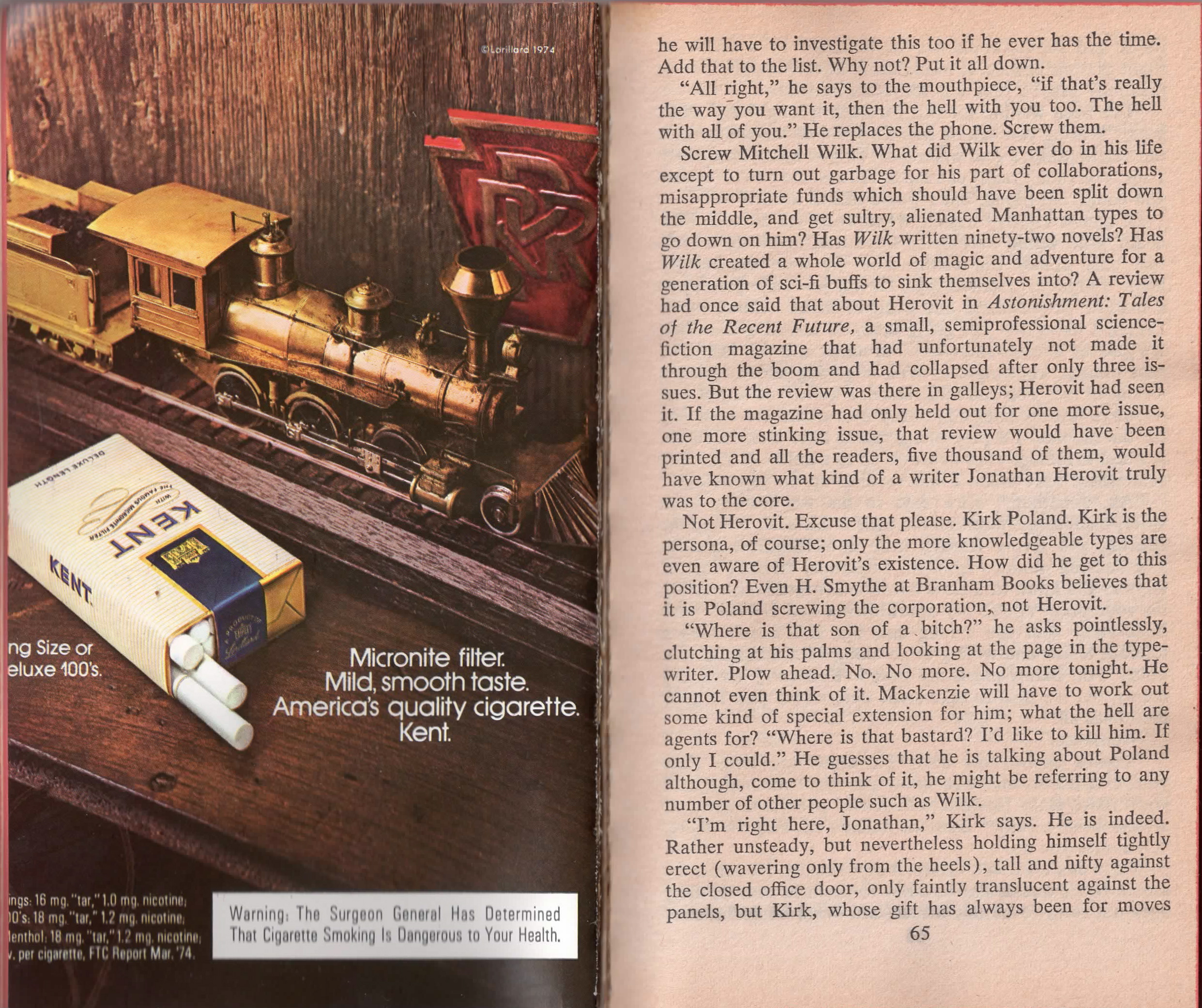
There is a lighter note. I’m notorious for failing to respect books as physical objects (Hi Judy!). But considered as an artifact, this cheap US paperback from the early 1970s is a thing that even I could appreciate. Look at this spread:

EPSON001

The narrow margins suggest that the publishers really want to give you maximum wordage for your dollar, and then the ad takes even less of the burden of cost from the reader’s shoulders. I’m grateful that there are only two ads altogether, both for the same brand of cigarettes. This one is clearly for the romantic, the one on the reverse page features an elegant model steam train, clearly for the man’s man.

Added later by request, the other ad:

EPSON001