
Claire Keegan, So Late in the Day (Faber & Faber 2023)
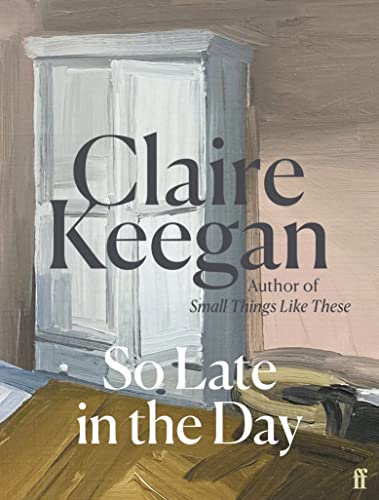
This book consists of a single short story by Claire Keegan. The story appeared in The New Yorker in February 2020. It was one of four short stories that made up the collection So Late in the Day: Stories of Women and Men (February 2022). Keegan’s French publisher first issued it in standalone form in May 2022 under the title Misogynie. Faber followed suit in 2023 with this attractive little front-counter hardback, perfect for a small gift – and it came into my possession as such a gift.
The story follows its protagonist, Cathal, through a lacklustre afternoon at work in an office in Dublin, the bus journey home, and an evening alone (not counting the cat) with his thoughts and memories, or avoiding them, in front of whatever happens to be on the television (mainly a documentary on Diana Spencer), eating whatever happens to be in the fridge. It’s a picture of desolation, the cause of which gradually emerges. It’s a self-inflicted disaster brought on by habitual and socially endorsed – not a spoiler because the French title gives it away – misogyny.
This isn’t the only fiction created by a woman that purports take us inside the head of a man behaves in ways that enrage women, but few can have done it so elegantly. Claire Keegan does a brilliant job of leaving her own rage out of the picture. (‘The first rule of writing fiction,’ Sebastian Barry said at the Sydney Writers’ Festival on the weekend, ‘is don’t write angry.’) Even the rage of the main female character is left to be deduced from what Cathal remembers of conversations with her. He catches a fleeting glimpse of where he has gone wrong, and even surmises how things might have been different back in his teenage years. Whether that glimpse and that surmise will lead anywhere or sink back into the deadly routine of work and television is a question the story doesn’t go into.
On page 7*:

Cathal is on his way home from work in a bus and all we’ve had is hints that he’s not happy. He sits next to a large woman who slides closer to the window to give him room. She’s on for a chat about the weather, opening brightly, ‘Wasn’t that some day.’ On second reading we know how painful that sentence is for Cathal, but all we get on the surface is, ‘ “Yeah,” Cathal said.’ Each for their own reason, neither Cathal not Claire Keegan needs to spell out the undercurrents.
Further down the page:
‘How about you?’ she said. ‘Any plans for the long weekend?’
‘I’m just going to take it easy,’ Cathal said, threading the speech into a corner, where it might go no further.
He’s civil, and well versed in avoiding real communication. And the unobtrusive metaphor sewing metaphor reminds us that the narrator is seeing more here than the character is showing. The story is full of such quiet, sharply observed moments.
You can hear Claire Keegan reading the story on the New Yorker website. Click here if you’re interested. She reads it beautifully, and it only takes 45 minutes.
I wrote this post on the unceded land of Gadigal and Wangal of the Eora Nation, finishing it on a day when the lorikeets in the gums nearby are still rowdily celebrating the dawn at 8 o’clock in the morning.
* My arbitrary blogging practice is to focus on the page of a book that coincides with my age, currently page 77, or for books with fewer pages than that, on the year of my birth, 47. This book ends on page 47 and it would be a bit bad to give away the last lines, so I’m picking page 7.


 Me fail? I fly!