
Robin Gerster, Travels in atomic sunshine: Australia and the occupation of Japan (Scribe 2008)
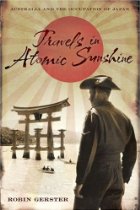
Thousands of Australian soldiers and their families were part of the Occupation of Japan from February 1946 until early 1952. They formed the bulk of the British Commonwealth Occupation Force, generally overlooked in the shadow of the much larger and better equipped US occupation forces. While the US occupiers, with headquarters and amenities in Tokyo, set about imposing democracy by decree and using military might to change a militaristic culture to a peaceful one, insisting on freedom of the press except for stories that might make trouble for the occupiers, the Australians – whose generals led the BCOF – were stationed near the devastation of Hiroshima and seem to have managed without any sense of themselves as Liberators. They are scarcely mentioned by any of our otherwise zealous military historians, and barely appear in the Canberra War Memorial. Sneered at by the British, discounted by the US, at home they are ‘the forgotten Force’.
At the time, thanks to reports of atrocities in the Burma–Siam Railway and Changi Prison as well as the bizarre White Australia Policy, anti-Japanese sentiment was fierce in Australia, and the occupationnaires were in a bind. If they enacted the home sentiment, as many did, they were likely to be brutal, even criminal, in their dealings with the already shattered population, and there are plenty of stories of rape, sexual exploitation, black marketeering (‘wogging’) and careless disregard for human life. If they were open to Japanese culture and the humanity of the people, as again many were, they were likely to be shunned as ‘Jap-lovers’: there were plenty of headlines at home to that effect, and when people returned it was to even less acknowledgement than the troops who served in Vietnam. Governments still deny that their high incidence of cancer might be connected to the time they spent at nuclear ‘Ground Zero’.
If someone wanted to make a serious war movie, they could do a lot worse than mining this book. The movie would run very little chance of feeding adrenaline addiction the way so many well-intentioned anti-war movies do. It would have trouble being read as a tale of Good vs Evil. It would leave a number of received True Stories looking decidedly tatty. After so many movies about the horrors of the Japanese prisoner of war camps, how refreshing to show those liberated Aussies as occupiers of post-War Japan – some acting out their racism-boosted vengefulness on the civilian survivors of Hiroshima, others coming to appreciate the culture and even falling in love. The book seethes with potential story lines. Here’s the tale of the young Australian signalman, John Henderson:
In early 1948, immigration minister Arthur Calwell had reasserted the government’s position that no Japanese woman would be permitted to enter Australia, irrespective of whether she was he wife or fiancée of an Australian serviceman … Henderson had married a young university graduate, Mary Kasahi Abe, by Shinto rites. With his wife pregnant, and worried about the legality of the Shinto ceremony, he sought to be married by the battalion chaplain, the well-known BCOF identity Padre Laing. Laing’s duty was to inform military command, and Henderson was peremptorily repatriated. The officer given the task of putting the order into effect related, 40 years later, that someone at BCOF HQ had decided to make an example of him. This was easily achieved, as he was a low-ranking, demoralised youngster of no consequence. A ‘thin, frail-looking lad’, Henderson was reduced to tears upon hearing the news. Accompanied by the padre and two MPs, he was put on the Kanimbla and locked in the brig to be returned to Australia, the father of a baby daughter whom he never got to see.
… During the debacle, and while his family was receiving abusive anonymous mail for supporting their son, the papers were full of photographs of radiantly smiling British migrant families arriving in Sydney … [Immigration minister] Arthur Calwell played to the crowd, stating that, while there were living relatives of the men who suffered at the hands of the Japanese, ‘it would be the grossest act of public indecency to permit a Japanese of either sex to pollute Australia or Australian-controlled shores’. What an irony: John Henderson had himself suffered, directly and not vicariously, from Japanese wartime brutality. He had laboured on the Burma–Thailand Railway, no less, and later in the coal mines in Japan. There, he had been befriended by a guard who handed him food, including small gifts from his sister, treats such as sweets, and rice cakes. The very reason Henderson decided to volunteer to BCOF after the war was that he wanted to meet his benefactress. He did, they became strongly attached, and they married – and now his own government had decided that her presence would ‘pollute’ Australia.
… Despite his promises, Henderson never returned to his Japanese family. He had asked a couple of his army mates remaining in Japan to keep a friendly eye on his wife in his absence; in the meantime, his parcels and letters stopped after some months. Years later, in late 1953 or early 1954, one of them returned to Kure after completing his service in Korea, and met the woman, by chance, downtown near the railway. She was with her pimp, having been reduced to prostitution, with a mixed-race child, in order to survive.
Travels in Atomic Sunshine won the 2009 NSW Premier’s History Award. It should also have a chance in the Literary Awards.


 Me fail? I fly!