Monthly Archives: Dec 2009

Mungo on Kevin

Mungo MacCallum, Australian Story: Kevin Rudd and the lucky country (Quarterly Essay issue 36, 2009)
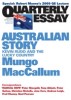
Mungo MacCallum is now, according to the blurb of this Quarterly Essay, one of Australia’s most influential political journalists. He was probably already influential all those years ago when he was telling Nation Review readers how well Prime Minister Gough Whitlam filled a pair of swimming trunks, but now he is an elder. Mercifully, he is also still a bit of a smart Aleck.

There are no hints here about Kevin Rudd’s physical endowments – the essay’s main interest is in the nature of his appeal to voters. The essay quotes poetry, mainly bush verse, including a savage parody of ‘Clancy of the Overflow’:

He was poisoning the water when he chanced upon a slaughter
So he joined in patriotically to massacre and rape
And he sees the vision splendid of the native problem ended
and a land made safe for cattle from Tasmania to the Cape.

The essay takes the odd potshot at contrarian right-wing columnists. It produces some fabulous quotes, including for example a definition of a modern progressive as ‘a fella that stumbles forward every time somebody shoves him’. (Sadly there are no footnotes, so we often don’t know what wits are being quoted – I’m guessing Mungo himself did the Paterson parody.)

That is to say, there’s a lot to enjoy in this essay. It also has substance – of an airy sort. It deals with policy, that’s true, and Kevin Rudd’s largely successful response of the GFC, but mainly it argues that he taps into some deeply held myths about what it means to be Australian – egalitarianism, fairness, the larrikin–dutiful citizen dichotomy, that reluctant progressiveness, ‘fervent, if understated, nationalism’. ‘For all his nerdiness and prolixity,’ he concludes,

there is something very Australian about him, and the voters recognise it. In a totally unexpected way, Rudd has given them back their Lucky  Country – and this time not in a spirit of irony, but one of self-belief.

Hmmm … But I enjoyed the ride.

This issue also includes the 2009 Quarterly Essay Lecture, ‘Is Neo-Liberalism finished?’ a search for the meaning of what he calls the Great Recession by the chair of the editorial board, Robert Manne. The lecture isn’t as much fun as the title essay, covers some of the same ground, occasionally manages to be incomprehensible when explaining (yet again) how the Great Recession came about. Where MacCallum takes cheerfully bitter potshots, Manne eviscerates in earnest.

And then there’s correspondence about Noel Pearson’s Radical Hope. A number of the correspondents join in Pearson’s left-liberal bashing, and there’s a certain amount of jockeying for position from politicians and activists. Voices from the old Howard Government era talk of Pearson’s pre-eminence as an Aboriginal public voice on the national scene, without mentioning that the deliberate dismantling of ATSIC had destroyed any more organised and representative voice. Christine Nicholls, former principal of Lajamanu School in Yuendemu, is the only educationalist to write a substantial response, and she does a brilliant job of respectfully taking Pearson to task for his straw-man arguments against ideologically driven educationists. The only Aboriginal voice is that of Chris Sarra, who gently chides Pearson for dismissing elements of his own educational work without having ever visited it. Over all, the correspondence confirms that Pearson’s conversation is mainly with conservative white leaders, but it also shows him as eager to do more than simply pontificate as a lone voice.

No, really, what does fortuitous mean?

Mungo MacCallum has coined more than his share of memorable phrases. He quotes poetry and can work up an excellent bush ballad. His prose is generally witty and lucid. He’s not an academic, he’s a writer. In the current Quarterly Essay, which I’ll say more about in a day or two, he writes this:

From the start [non-Indigenous Australians] showed a preference for the young tree green of a new land over the old dead tree of Europe, which was in any case so remote as to be, for all practical purposes, irrelevant. Geoffrey Blainey’s ‘tyranny of distance’ was frequently seen not as a curse but as a blessing. Australia was fortuitously and proudly girt by sea.

I can’t make that fortuitous mean `happening by chance’, whether to one’s advantage or not. The word has clearly taken leave of its dictionary meaning. As in the example I quoted a couple of weeks ago, it seems to be a kind of intensification of fortunate, almost an equivalent of providential for those of us who no longer believe in Providence.

What do you think? Mungo, are you there?

Niece news

I don’t suppose many people would see an item about youth suicide in Queensland as a good news story, but this story in today’s Sydney Morning Herald marks my niece Kym’s first byline in a major newspaper. They’re a talented lot, my nieces.

Coetzee’s Youth

J M Coetzee, Youth ( 2002)

This is the second of three (so far) novels in Coetzee’s Scenes from Provincial Life series, which are fiction, but also by strong implication unsparing autobiography. It takes up our hero as an 18 year old student and aspiring poet living in a one-room flat in Capetown and drops him again as a 24 year old computer programmer living in an upstairs room in a house in the depths of the Berkshire countryside, convinced that he is a total failure.

It’s the 1960s. The young Coetzee is committed to escape being defined by his family, trapped in the dullness of colonial life, and torn apart in what he sees as the impending revolution in South Africa. He aspires to the status of poet, and theorises endlessly to himself about how he should live (as opposed to write) to achieve that aim. He agonises over his incompetence in relationships with women, over which writers and artists he should emulate (Ezra Pound presides over his pantheon, and Beckett the novelist is a late apparition), over how to shake off his colonial identity. He rationalises his moments of appalling behaviour and then berates himself for his rationalising, and for his general coldness. He aspires to Angst, but realises his sole talent is for ‘misery, dull, honest misery’.

I loved this book. There are two possibilities: either Coetzee’s interior life as an adolescent/young adult was uncannily like mine, or he has turned a searing light onto his experience of that time of his life and laid bare something essential about the collision of adolescent romanticism with the demands of reality. Given that the externals of his life weren’t noticeably similar to mine, and I never had his overarching sense of destiny, I’m guessing it’s the latter. Young Coetzee’s misery, confusion about sex, self castigation, romantic theorising and bitter disillusion are all presented without commentary, but with a gentle irony – which may derive partly from the reader’s knowledge that this pathetic youth went on to win the Nobel Prize (and possibly that an idea that comes and goes on page 138 was the seed of his first novel), but which also simmers in the prose, bubbling to the surface as humour often enough to suggest, without invalidating the character’s intensely felt experience, that an older, wiser head is constantly there, shaping the story. My favourite bubble pops up when young Coetzee, who lives alone and feeds himself with classic adolescent male incompetence, is ruminating on Ford Madox Ford:

Ford says that the civilization of Provence owes its lightness and grace to a diet of fish and olive oil and garlic. In his new lodgings in Highgate, out of deference to Ford, he buys fish fingers instead of sausages, fries them in olive oil instead of butter, sprinkles garlic salt over them.

We do wonder if he misses the point about so much else by quite so wide a mark.

Young Coetzee was writing an academic thesis on Ford. The paragraph after the one I just quoted describes the thesis as involving ‘the task of reducing his hundreds of pages of notes in tiny handwriting to a web of connected prose’. My sense is that this book has achieved something very like that: whether Coetzee has drawn on actual diaries from the period or on the virtual pages of his recollection, he has created from the material a shiny, elegant narrative web.

Early in his stay in London, young Coetzee hears a BBC talk about the Russian poet Joseph Brodsky and is enraptured by his poetry. He reflects on what Brodsky and a handful of other poets mean to him:

they release their words into the air, and along the airwaves the words speed to his room, the words of the poets of his time, telling him again of what poetry can be and therefore what he can be, filling him with joy that he inhabits the same earth as they. ‘Signal heard in London – please continue to transmit’: that is the message he would send them if he could.

If in my early 20s I could have received this book as a signal, I would have responded, I’m sure, with a very similar joy. As it is, confident though I am that J M Coetzee won’t be reading my blog, I’m sending him a belated message on behalf of my younger self:  ‘Signal heard in Sydney 40 years later – please continue to transmit.’
—-
I read Youth in a library copy. A previous reader had ‘corrected’ the text:

  • on page 53 s/he fixed a simple typo, inserting be in ‘It would nice to write’ (‘Thank you,’ I thought)
  • on page 72 s/he altered pay to pays in ‘But none of the girls on the trains pay him any attention’ (‘Hmm, you are an old-fashioned pedant, but at least you left that But alone’)
  • on page 85 s/he changed oneself to one’s self in the sentence ‘Only love and art are, in his opinion, worthy of giving oneself to without reserve” (‘Someone please take the pen away from that person’)
  • on page 95 s/he changed the phrase to eat packet soup, possibly because one doesn’t eat soup, then – sensibly – scratched  out the alteration
  • thereafter, s/he presumably resigned themselves to the probability that Coetzee and his editors were competent after all.