Monthly Archives: May 2010

Heat 22: The Persistent Rabbit

Ivor Indyk (Ed), Heat 22: The persistent rabbit (Giramondo May 2010)

This issue of Heat has much that is wonderful. The title, following tradition, is a phrase chosen apparently at random from the contents, in this case from πO’s exuberant nonsense poem ‘Rabbit Proof Fence’:

The average person blinksoooo22 rabbits a minute.
Burke & Wills went into the desertoooowith a dozen rabbits
Obsession isooooa persistent rabbit.
The causes of a rabbitooooaren't clear.

Perhaps Ivor Indyk, the editor, is quietly suggesting that the seemingly  miraculous persistence of Heat owes not a little to obsession.

I understand Heat to be about diversity, about presenting a version of literary Australia that is open to the whole planet. It often includes, for instance, travel writing, translated pieces, news from abroad, and fiction, essays or images that grow from places where cultures intersect. In this issue there are examples of each of these – respectively, Barbara Brooks’s self-styled fictional memoir ‘Lost in the House’ (which powerfully combines tales of travel, dementia, memory and intergenerational relationships); Stuart Cooke’s ‘Two Mapuche Poets’ (the Mapuche people are indigenous to parts of Chile and Argentina); Priya Basil’s ‘My Home is Our Castle’ (about a communal housing project that won a major architecture prize in Berlin last year); Michelle Moo’s colonial historical fiction, ‘New Gold Mountain’ (white women and Chinese men on the Australian goldfields); Barry Hill’s ‘Ezra Pound: The tragic orientalist’; and the centre section of art by Guan Wei, ‘Longevity for Beginners’. (The last three provide a nice example of the kind of counterpoint that Edward Said recommended.)

Apart from Barbara Brooks’s memoir three pieces stood out for me.

Brendan Ryan (whose book of poetry, Why I Am Not a Farmer, I am now actively seeking) has a gripping personal essay on the 1983 Ash Wednesday fires in western Victoria, which is enough by itself to justify the price of the journal. Sadly, not even part of it is up on the Heat website.

Lee Kofman’s essay, ‘Revisiting the Geography of My Body’, just as gripping and as intensely personal, includes incidental elements of a migration story, but is mainly about scars, particularly scars on a woman’s body, and their almost complete absence from literature and visual arts: wounds, scars as something to be healed, scars on men (she doesn’t have to mention Coriolanus), but scars as such, particularly on a woman’s body, reside ‘outside the linguistic and public realm’. By sheer chance, I happened to walk past this piece of graffiti in Newtown just as I finished reading the essay. I hope Ms Kofman would enjoy it:

I said I wouldn’t whinge any more about proofing errors in this Heat, but there is one good old-fashioned belly laugh in this essay. The pursuit of bodily perfection, it tells us, ‘can be traced back to Pluto’s ideal of human beauty as the “natural”, unmarked body’. Roman myth, presumably, rather than Disney.

Of the poetry, Kate Middleton’s poems on a Hansel and Gretel theme stand out for me. They are billed as excerpts from Where Dingoes Tread. I look forward to seeing the whole thing:

Remember when hunger
was simple?
ooooooooooooThere was nothing
and we ate nothing. Then plenty returned
and I turned
to austerity.

SWF: Inside the Westside Writers Group

One of my highlights from last year’s Sydney Writers Festival was a staged reading in Bankstown Town Hall by members of the Westside Writers Group. Naturally, we trekked west in the rain to see what they were putting on this year.

A big room in Bankstown Youth Development Headquarters had been set up with a couple of sofas, cushions, a standard lamp and a coffee table for the group and seats for the audience in the rest of the room. They proceeded to have a meeting like the ones they’ve been having every fortnight for years: each member of the group read a piece she or he had been working on – some brand new, some reworkings or extensions of things the group had heard before.

It was a risky idea, and could have failed in any number of ways. But it was great. All the writers have been trained in reading to an audience, and as their mode of working is to read to each other rather than circulating printed copies of their work, they have all become skilled listeners. So we were treated to a lovely range of readings, and then some tender but forthright exploration of what made each one tick and where it could be improved. Luke Carman and Michael Mohammad Ahmad were the stand-outs for me, the former with another of his strangely surreal monologues/stories, the latter with a vignette (a word evidently much discussed by the group) of life in a small ethnic community in the western suburbs. Nothing was dull: sestinas by Lachlan Brown, other poems by Fiona Wright, Lina Jabbir and Rebecca Landon, stories by Susie Ahmad, Sam Hogg, Felicity Castagna and Peter Polites (the dark-haired man on the couch in the pic, shaven headed and unrecognisable on the night), and video in the making from Bilal Reda. All this with the delicate, respectful probing and prompting of Ivor Indyk, resident literary guru.

And you know, from where I was sitting none of these young writers seemed at all fazed by having an audience of roughly fifty people watching and listening from the shadows as they exposed the fruits of their imagination to one another’s critical gaze.

Later addition: I can’t believe I forgot to mention that Alexis Wright was there as a special guest, putting her two cents worth into the discussion and reading what may end up as the start of her next book. When she’d finished her reading – an unsettling piece involving a personification of drought, a young woman carrying a not-quite dead swan in her arms – Ivor Indyk challenged the group: ‘Anyone want to take on a Miles Franklin winner?’

NSWPLA dinner

There’s a quote from James Tiptree Jr I’ve been wanting to sneak into my blog for some time. When an editor asked her to write an afterword to her short story, ‘The Milk of Paradise’ she wrote that some authors are ‘walkie-talkie writers … who are named Mailer and Wolfe when they are good’ and went on:

But the rest of us, poor carnivores whose innards meagrely condense into speech. Only at intervals when the moon, perhaps, opens our throats do we clamber up on the rocks and emit our peculiar streams of sound to the sky. Good, bad, we do not know. When it is over we are finished, our glands have changed. Push microphones at us and you get only grumbles about the prevalence of fleas and the scarcity of rabbits.1

That, in short, is why I’ve become a dedicated paying guest at the annual  NSW Premier’s Literary Awards Dinner. I love to see those poor carnivores clamber up onto the podium to be honoured, even the ones who can’t manage any more than ‘Thank you’.

I nearly didn’t go this year, fearing that the dreaded PowerPoint’s incursion, begun at the shortlist announcement, would continue. I was also trying to think like a grown-up about the expense, and then there was the Dîner des Refusés precipitated by the nul prize for a playscript. But here I am again, home from the Art Gallery, out of pocket but flush with the inside dope, even though the on-the-spot tweeters and newspapers (with self-promoting or surprise-upset hooks) have beaten me to publication.

It turned out, no surprise, to be a pleasant evening. The company was convivial, the setting brilliant, the food excellent. There was no PowerPoint as such, but sadly the dinner has become an Event, the creation of Events Organisers, with glossily impersonal results. There was a would-be witty typewriter centrepiece on each table. Two huge television screens told us who was talking to us at any given moment, threatening but thankfully not quite managing to distract us from the mere humans on the stage between them. And the pause between the announcement of each winner’s name and their arrival at the microphone – that is, the time it took them to reach the stage, be photographed kissing the Premier and cross to the mike – was now filled, not just with applause and a buzz of conversation, but with a blast of fanfare from the sound system. I hope someone whispers to the Organisers that this isn’t the Oscars, still less the Logies.

Auntie Sylvia Scott welcomed us to country. As last year, she told us she was an avid reader, and revealed that though Nathan Rees had promised her a pile of books, she never saw any. As she left the stage Carol Mills, Director General of Communities NSW and MC for the evening, promised her a pile this year. She was gracious enough not to look sceptical.

Richard Fidler gave the address. He was funny, and with enough meat to be satisfying, with quotes ranging from Neil Gaiman (about the joys of being a writer), by way of Stalin (writers are the ‘engineers of the soul’) to the unnamed Bush aide (‘probably Karl Rove’) who derided the ‘reality based community’. He advise women in quest of a man to look to their bookshelves – men don’t care so much about appearances, it’s the books that count: ‘Ladies, if we see a copy of a book by Deepak Chopra or Erich von Daniken, we’re out of there.’ He recommended The Moth podcast, and inveighed against Twitter as the ruination of literature – all those writers being witty in 140 characters instead of being at work: ‘Get back to your desks you Gen Y bastards!’ (At that point I saw my Baby Boomer friend misrule discreetly tweeting.)

On to the awards:

The UTS Glenda Adams Prize for new writing: Andrew Croome – Document Z
I started to read this a while back but couldn’t bear to read yet another book on the subject. Perhaps seduced by the sub-Oscaresque music that accompanied him to the mike, Andrew Croome gave a straightforward thank you speech, an example followed by most of the award recipients. In particular he acknowledged his debt to University creative writing courses. The book started out as a PhD – ‘But that doesn’t mean it’s boring.’

The Community Relations Commission Award: Abbas El Zein – Leave to Remain: A Memoir
A lovely book. He said, ‘I never thought I’d shake hands with the Premier and be paid for it,’ introducing another recurring motif of writers responding to Kristina Keneally’s physical presence.

The NSW Premier’s Prize for Literary Scholarship: Philip Mead – Networked Language: Culture and History in Australian Poetry
I hope to read this hefty volume some day. The very tall Philip Mead (nickname ‘Tiny’) commented that it was lovely to stand next to someone of normal height. The Premier leaned over to his mike and said it was lovely to stand next to someone who was taller than her. He went on to thank, among others, independent Australian publishers, who are like tussocks: ‘we do everything we can to destroy them and they keep coming back.’

The Play Award: Controversially not awarded

The Script Writing Award: shared by Jane Campion for Bright Star and Aviva Ziegler for Fairweather Man
Jane is abroad. In accepting the award for her, the film’s producer Jan Chapman threw us the pleasing tidbit that in the absence of any letters from Fanny Bryce to Keats, Jane looked for inspiration on her character to her own teenage daughter. Aviva spoke about the ways writing a documentary is of its nature so much more a collaboration than other forms of writing.

The Kenneth Slessor Prize for poetry: Jordie Albiston – The Sonnet According to ‘M’
I bought the last copy of this on my way home.

At this point in the evening, the main meal was served. I was the only one at my table vulgar enough to want to trade fish for meat. One of my fellow guests was gracious enough to do so. The steak and mushroom and mashed potato was delicious, though it didn’t look a bit like the way my mother used to do it. Then on with the show:

The Ethel Turner Prize for young people:Pamela Rushby – When the Hipchicks Went to War
Pamela Rushby wins the Me fail? I fly! award for the best acceptance speech. She may have been the only recipient who began with the formal ‘Distinguished guests’, but she recovered from that slightly distancing moment by telling us she had pitched the book to publishers as Apocalypse Now meets A Chorus Line. Apart from giving us some little known information about young women who went to the Vietnam War as entertainers, she thanked her family, ‘without whose support the book would have been finished in half the time’.

The Patricia Wrightson Prize for a children’s book: Allan Baillie – Krakatoa Lighthouse
Allan writes with remarkable precision, but he speaks with difficulty – so he can be difficult to follow. I thought he said that on this project his wife had to endure more than most writers’ wives because he’d been carrying on with an orang utan. I probably misheard, but he does have an unsettling sense of humour. He definitely did say that his wife climbed Son of Krakatoa with him.

The Douglas Stewart Prize for non-fiction: Paul McGeough – Kill Khalid: Mossad’s failed Hit … and the Rise of Hammas
‘Madame Premier, Ms Premier?’ ‘Kristine.’ He mainly thanked his editors, and said very little about the book.

The Christina Stead Prize for fiction: J.M. Coetzee – Summertime
Unsurprisingly JMC wasn’t there. Meredith Purnell (?) from Random House read a brief note: ‘Whether I deserve to hold my head up with the esteemed previous winners is something only time will tell.’ So Summertime!

The People’s Choice Award: Cate Kennedy – The World Beneath
‘I can’t believe my luck that all this has come about from just telling stories.’

Book of the Year: Paul McGeough – Kill Khalid
This time, without notes, he spoke about the vulnerability of writers in these late-capitalist times (my term), and daringly drew a parallel with the Taliban, a ragtag collection of warriors holding at bay the great technological firepower of the USA, the closest the evening came to ‘the prevalence of fleas and the scarcity of rabbits’.

The Special Award: The Macquarie PEN Anthology of Australian Literature
This may have been an inevitable award, but it was sad that we didn’t get to honour an ageing lion, who would have responded memorably.

I didn’t realise until this morning how many of the writers receiving awards were born and partly educated outside Australia: Abbas El Zein of course, but also Jane Campion, Aviva Ziegler (I’m guessing from her accent), Allan Baillie, Paul McGeough and J M Coetzee. That’s at least six out of eleven. Does this mean, as a friend of mine insists, that Australians can’t write? I don’t think so. Does it mean anything at all? I don’t know.

The main pleasure of the evening for me, and I suspect others, was catching up with friends. I was sitting with people I didn’t know well, and that was another pleasure, especially as the three people I could talk to most easily were judges who managed to be gloriously indiscreet about some of this year’s processes. It’s often said that literary awards are given to compromise candidates, books that are no one’s favourites but that no one objects to. It seems this was not the case with these awards. There were sharp divisions of opinion over a couple of them, and my impression is some of the uncontroversial decisions had their share of anguish.
——
1From the collection, Meet Me at Infinity, edited by Jeffrey D Smith, 2000, p 238

Why, how or what?

This is the last of these posts for a while, I promise. Mireille Juchau isn’t an easy writer, but she is rewarding. ‘Habitat Group’, her story in the current Heat, compresses a great complexity of relationships into an astonishingly small span. But it  begins:

Josie looks out from the treehouse, across the roofs and conifer spires to the grand home hovering in shreds of fog. Through its high window she sees a framed picture changing form – now a plane of radium green, now a dappled mercury lake. Pain knives her belly.

Why knives rather than the accepted usage, knifes? I can’t think of a reason why someone would make that choice deliberately, unless perhaps to say subliminally about spelling conventions what a recent commenter here said explicitly about syntax: ‘your correct syntax is […] synthetic and immutable and already outmoded.’ I don’t believe this story is intended to make any such statement, even though there’s a tremour a couple of pages later. There is no why, no meaning-making intent.

How did it happen? None of three spellcheckers easily available to me rejects knifes (though WordPress rejects both gages and pavo). It could be a typo, as v is very close to  f on the qwerty keyboard. It could be a moment’s inattention on the writer’s part or a product of an education that didn’t insist on relentlessly testing spelling, backed up by similar moments of inattention or educational deficits in the copy editor and everyone else who read the text on the way to publication. However, it’s almost certainly accidental, and accidents will always happen.

What effect does it have? It’s immediate effect on me is to throw me into proofreader mode, so unless I lay the book aside and come back to it with a fresh mind in a couple of days, I read on, distracted by every instance where I would have made a different judgment on the commas. Fourteen pages later, for example, in John Mateer’s poem, ‘Pieta’, a prostitute smiles ‘discretely’ at her customer, and I’m irritated that my first response is to think it’s a misspelling – when in fact it’s a finely judged and unusual use of the word. This immediate effect is what prompts me to blog about these things. But there are other, more serious effects, of which three come to mind. First, Heat is a serious, often groundbreaking literary journal, and the routine occurrence of these and less obvious errors makes it look amateurish and second rate. Second, these errors are likely to spread confusion among young readers. I realise this is not as big a deal as it would be in a children’s magazine, but it is still a consideration. Third, they contribute to a general falling off of precision in the use of language and in thinking, of which it is a symptom.

Haven’t I got better things to do with my time, you might ask, than blog about other people’s spelling mistakes? Well, yes, I have. I will pass over any remaining errors of the sort in this issue of Heat in silence. The silence will also apply to eccentric, inconsistent and North American use of commas and other punctuation. Sydney is hosting the Biennale, the Writers Festival and – soon – Vivid. I’m sure I’ll find something to write about there.

Another tiny adventure in reading

At the risk of making it absolutely clear that I’m a total pain in the neck, here’s another little confused-reader moment. John Bryson’s essay, ‘Panama, a Pantomime‘, in the current issue of Heat, is structured as a conversation a Panamanian bar in 1990. This is our introduction to the bar:

The place is well known to cab drivers as El Parvo Real on Calle 51, set between the hotels and office blocks of Via Espana and the classy condominiums of Campo Alegre. But to those inside the bar it is called the Royal Peacock.

My knowledge of Spanish is minuscule, but it was enough to set me wondering just what point was being made here. Parvo has something to do with smallness; real means royal. Perhaps the taxi drivers nicknamed the place because it was tiny but opulent.  But wait, pavo (in Latin) means peacock. I looked it up, and sure enough the Spanish for peacock is pavo real. So perhaps the taxidrivers here represent the Spanish-speaking majority of Panamanians, the Parvo is a misspelling, and the point of the two different names is that those inside the bar are English speakers. The next sentences remove all doubt:

A barmaid pulls brown ale from the keg. Ayrshire roses stands in a window vase, and someone can tell you the result of the soccer draw between Crystal palace and Manchester United.

The bar is a haven for the British/English, then. But what about that misspelling? Is it a subtlety – those English speakers, including the narrator, know the bar’s Spanish name only from the taxi drivers (possibly the only Spanish speakers they deal with) and disdain to read the name as written over the door. If so, this single misplaced r sends ripples through the whole story: we no longer take the narrator’s voice to be that of the author; the conversation in the pub, an effective device for conveying some of the complexities of the 1989 US invasion of Panama, now resonates with the silence of the absent, disdained majority population, and the essay invites us to be wary of the point of view of the wealthy expat characters, as well as that of the narrator and his excursions into history.

Or is it just a slip of the pen that slipped through the editorial net? Given the gage/gauge slip a few pages earlier, this seems the most likely reading. But it makes me sad.

Is it just me?

How do you respond when you read the following? It’s wrenched out of context here, but I’ve tried to include enough so you have a sense of what’s going on.

Susan, Bessie calls out, Susan, the plums are spoiling and splitting and there’s flies all over. […]

The only gauges in the district says Stan. Stan has his eye on the girl; the bench lined with jars, the plums in pails repelling the water. They are barely outlined in the dark kitchen, Stan and the Dimboola girl, Stan and Susan.

Never mind the idiosyncratic punctuation, how about them gauges? I’m genuinely interested. Did you:

a) Take it in your stride, thinking something like, ‘I have no idea what gauges he’s talking about, maybe he’s got railways or shotguns on his mind and we’ll find out about it in a minute’?

b) Read as a child reads, accept that there are some things you won’t understand in any piece of writing, and move on?

c) Worry at it for a bit, realise Stan is talking about the plums and referring obliquely to Susan as the only available female in the district, and think in passing that the author can’t spell.

d) Same as c), but wonder if perhaps the author got it right only to have the copy editor introduce the confusing error?

e) Understand the meaning and read on without breaking stride, perhaps unaware that a gage is a plum and a gauge is something to do with measurement, or possessed of an enviable ability to read with the working assumption that the words as written may occasionally be mere approximations of the words intended?

See, what I don’t know is how atypical my response is. I was somewhere between c and d, and the whole story (‘New Gold Mountain’ by Michelle Moo in Heat Nº 22 – it’s a good story) ground momentarily to a halt.

Jasper Jones at the Book Group

Craig Silvey, Jasper Jones (Allen & Unwin 2009)

The fourth paragraph of Jasper Jones begins:

This is the hottest summer I can remember and the thick heat seems to seep in and keep in my sleepout.

‘Keep in’? That’s awkward, I thought, and it chimes oddly with ‘seep in’ and ‘sleepout’. The paragraph continues:

It’s like the earth’s core in here. The only relief comes from the cooler air that creeps in between the slim slats of my single window. It’s near impossible to sleep …

Seep in, keep in, sleepout, creeps in and sleep, all in five lines: this is definitely odd, but – along with the heat, the relief and those slats, which are slim for no reason other than alliteration – it’s clearly deliberate.

Over the next pages, while the story had my attention from the word go – thirteen year old Charlie Bucktin, the narrator, is woken in the night by the town’s bad boy Jasper Jones and led to a secret place in the bush where he’s faced with a terrible spectacle and an equally terrible dilemma – I had a weather eye out to see if anything would come of this stylistic oddity. Nothing did, in the sense that if you didn’t notice it you weren’t missing a vital clue to the book’s meaning. But Charlie is in love with language, and bursts of assonance and alliteration for their own sake amount to something of a stylistic signature. I did a quick scan before returning the book to the library, and noted, from many examples, ‘a bundle of lonely bones tied to a stone’ (page 123), ‘Pored over it, taking little portions’ (page 128), and this, in one of Charlie’s reflective moments:

Sorry means you feel the pulse of other people’s pain, as well as your own, and saying it means you take a share of it. And so it binds us together, makes us as trodden and sodden as one another. Sorry is a lot of things. It’s a hole refilled. A debt repaid. Sorry is the wake of misdeed. It’s the crippling ripple of consequence. Sorry is sadness, just as knowing is sadness. Sorry is sometimes self-pity. But sorry, really, is not about you. It’s theirs to take or leave.

Like the frequent references to Charlie’s reading – To Kill a Mockingbird, Batman, Breakfast at Tiffany’s (which he hasn’t read, but Eiza, the love interest, has, and seen the film), Huckleberry Finn, The Wizard of Oz – this fascination with words is important in establishing Charlie’s character and the tone of the book. It’s been described as an Australian To Kill a Mocking Bird, but I doubt if Harper Lee’s book was anything like as intertextual as this. The description is OK as a sales pitch but I’m surprised that reviewers have echoed it.

Anyhow, it’s a terrific, fast moving, undemanding read: a coming-of-age romance cum mystery cum homage to Mark Twain cum historical drama (the Vietnam War is on, and the Beaumont children are mentioned towards the end) cum tale of pre-adolescent friendship (with a substantial nod towards the movie Stand By Me). There’s a beautiful description of a cricket match in which Charlie’s best friend, a very short Vietnamese boy (‘Jeffrey Lu on debut’) makes a splash, in a way that reminded me of Ruth Starke’s brilliant book for younger readers, Nips XI.

One thing I don’t understand is what makes the book ‘mainstream’ rather than ‘young adult’. There’s some pretty intense swearing, I guess, but sex is treated with great tact; even when sexual abuse is described explicitly in a letter that’s crucial to the plot, we don’t get to read the letter. The story is told from a thirteen-year-old’s point of view, and there’s no hint that he’s in any way an unreliable narrator: we don’t know any more than he does and we’re not invited to make judgments that differ from his – we learn about the world with him. In fact, Charlie’s angry mother is treated with less adult-sympathy than similar mothers in many a YA title. I’ve heard that the classification was a policy decision on the part of the publishers – that they were invited to submit the book for the Children’s Book Council Awards, but declined. The mainstream classification seems to have paid off in adult readership and award nominations – always assuming that a Miles Franklin shortlisting is more prestigious than one from the Children’s Book Council, and that being on the New South Wales Premier’s Literary Awards shortlist alongside David Malouf’s Ransom and Coetzee’s Summertime is more dignified than being named in the same breath as Justine Larbalestier’s Liar (not a view I share: I’m looking forward to Justine’s book as keenly as I am to David’s, and who in their right mind would want to compete for a prize against Malouf and Coetzee?). I hope this taxonomical decision hasn’t discouraged the young people who are the book’s natural readership. [Since writing that I’ve seen an online  trailer that is clearly aimed at teenagers, so it looks as if the pubisher is having two bob each way, and a good thing too.]

I wrote that much a number of weeks ago. The Book Group met last night.

With one exception, we were lukewarm. No one actively hated the book, but different people saw different things as gaping flaws. One man said he found Charlie’s decision at the very start to help conceal a crime highly implausible, and intolerably hackneyed – from then on he read with very little pleasure. Another was irritated by the banter between Charlie and Geoffrey (though one man said he thought that was the best thing in the book). Others found the narrative voice, and the characters’, wildly inconsistent – perhaps especially in beautifully written passages such as the aria on ‘sorry’ I quoted from above. I think we were unanimous in finding the characters’ emotional responses to crises (a grisly death, the acrimonious departure of a parent, the discovery of a grandparent) lamentably one-dimensional. I’m sorry to say that as we talked the book’s charms diminished. I proposed a reading that transcended these concerns for consistency, verisimilitude and psychological realism. Perhaps we ought to see the book as akin to the startlingly discontinuous novelitas of César Aira that I’ve just been reading about in the current Heat. But that didn’t wash. Its one defender said it reminded him vividly of things he had felt when he was an adolescent, and he wasn’t howled down.

Sorry, Craig.

Glebe Annandale Balmain elegies

David Brooks, Urban Elegies (Island Press 2007)

‘Ars Poetica’, the first poem in this lovely collection, begins

When I woke first I imagined it was starlings
mid-demonstration on the galvanised roof,
a thick forest of chirpings,
claws like the scratching
of a thousand sharp pencils

then, waking again, thought
swallows
perched for a briefing
before launching out over Annandale
like a hundred miniature scimitars

but of course it was the Rainbow Lorries
fresh over from Manly
unable to contain their Springfulness

He had me, as they say, at ‘Annandale’. After that he’d have had to do something terribly wrong for me not to love this book. He didn’t. I did.

Robert Adamson says in his intro that he read the book in one sitting. I almost read it in one dog walk. It’s not difficult poetry, but its appeal goes well beyond the pleasure of recognising places and events from Sydney’s inner west – the apartments built on the site of the old Children’s Hospital, street names, the two local giveaway newspapers, a rat in the compost, headlice in a child’s hair. The pieces that most hit home for me are those that touch on the numinous. ‘Flying Fox on Wire’, for example, begins:

A human poet, trying to remove
a fallen powerline from his roof, accidentally
touching the cable and surviving the
J-U-D-D-E-R-I-N-G shock of it
might think it is as if
he’s grasped a tendril of his Al-
mighty God

and draws a comparison to a flying fox on overhead wires

completing a
circuit it could
never have imagined – what
vast
grids and
networkings of night, what
chittering labyrinths of
tree and
air, what
soundless shrieks of
pain or
joy or
prophecy are
there?

Out of the Box

Michael Farrell and Jill Jones (editors), Out of the box: Contemporary Australian gay and lesbian poets (Puncher and Wattmann 2010)

I approached this anthology with suspicion. Does it really make sense, I wondered, to read David Malouf’s or Pam Brown’s poetry in a context that draws attention to the poet’s sexuality? Wouldn’t it skew, and narrow, the reading? My suspicion wasn’t allayed by having recently read editor Michael Farrell’s ultra-skewing assertion in Jacket Magazine 39 that he has ‘always read Judith Wright’s “Woman to Man” as referring to the experience of gender transfer’. But … well, once again the Book Club has dragged me from the path of least resistance.

Of Michael Farrell’s introduction and its use and abuse of the Concise Oxford Dictionary, I can reasonably say I didn’t find it congenial, and his readings of poems strayed too far into hip idiosyncrasy for my taste. Jill Jones, his co-editor, gives a nice potted history of identified gay and lesbian writing in Australia since the late 70s, and provides some useful orientation to the lesbian poems – I mean of course the poems written by identified lesbians, because as the book’s subtitle makes clear it’s the poets, not the poems, that have sexual identitites.

The poems are wonderfully diverse. They belong together not because of shared themes or concerns or formal qualities, but because their creators are contemporary (ie, alive?), Australian and gay or lesbian. A number of the poems are outed by the context – that is, poems I would elsewhere have read as heteroerotic I here read as homoerotic. That’s probably a good thing – my heteronormative mentality is being challenged. Others shrink: Pam Brown’s ’20th Century’ (‘And as we were the tootlers / we tootled along’) here tends to read as referring to the Gay and Lesbian Mardi Gras rather than something more global. I don’t know that that’s so good. At times I caught myself approximating a Beavis and Butthead snigger: ‘Hur hur! He said fist!’ Definitely not cool, though I plead in mitigation that Michael Farrell’s introduction does something of the sort more than once, and a handful of poems seem to be intent on a kind of high-culture gay Beavis-and-Buttheadism.

A good bit of the time while reading these pages, I got to feel very straight – not necessarily in the sexual sense, but in the sense that I prefer my language syntactical, don’t warm to commas at the start of sentences or parentheses that don’t close, and hate it when I can’t tell whether something is a typo or deliberate wordplay (when Javant Biarujia’s ‘MappleTROPE’ gives us Mapplethorpe’s deathbed utterance as, ‘I just hope I live long / enough to see the frame’ – has he inserted that r into the last word as a piece of witty surrealism or is it just bad proofreading? I genuinely don’t know, and it bothers me).

There are wonderful poems by David Malouf (‘A History Lesson’), Dorothy Porter (‘The Ninth Hour’), Pam Brown (‘Peel Me A Zibibo’), Martin Harrison (‘About the Self’), Peter Rose (‘Plague’), Kerry Leves (‘the escape’ – I’ve known Kerry mainly as a children’s writer, and he is definitely not that here) and joanne burns (‘aerial photography’), among others. I was delighted to be introduced to Stephen J Williams (‘Museums of beautiful art’), Andy Quan (‘Oath’, possibly the single poem that touched me most directly) and Tricia Dearborn (‘Life on the Run’) among others.

It probably doesn’t make sense to talk about a book of poetry without quoting any, but every poem I wanted to quote turns out to feel like an all or nothing proposition. I guess if you’re interested you’ll just have to find the book.

An acquisition

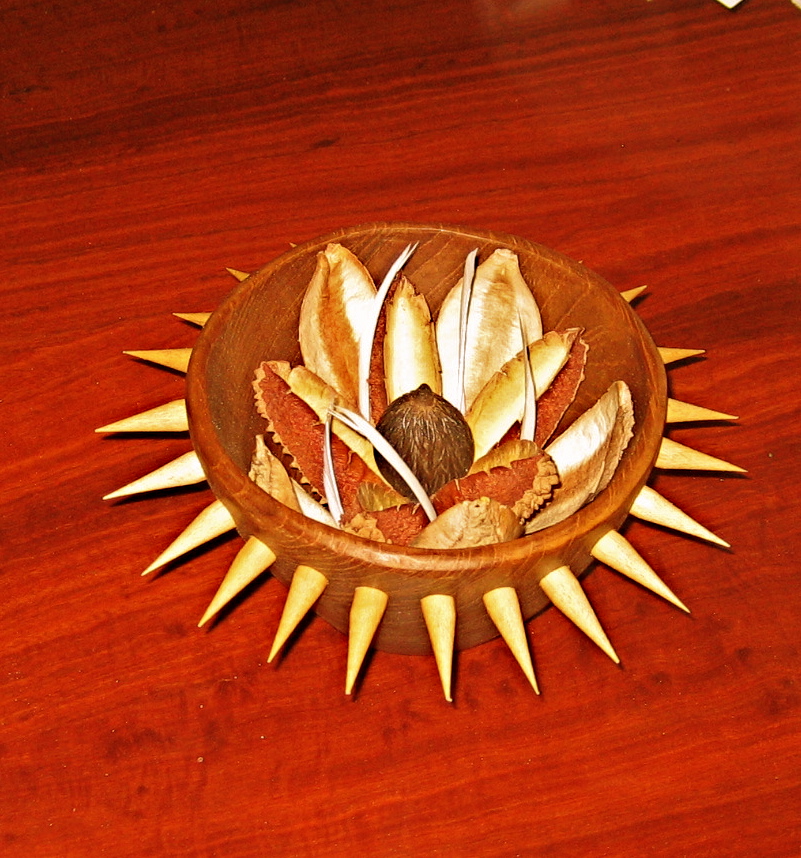
I dropped in at Little Queen Street today to pick up Steven Vella’s small bowl, which we bought a couple of weeks ago.

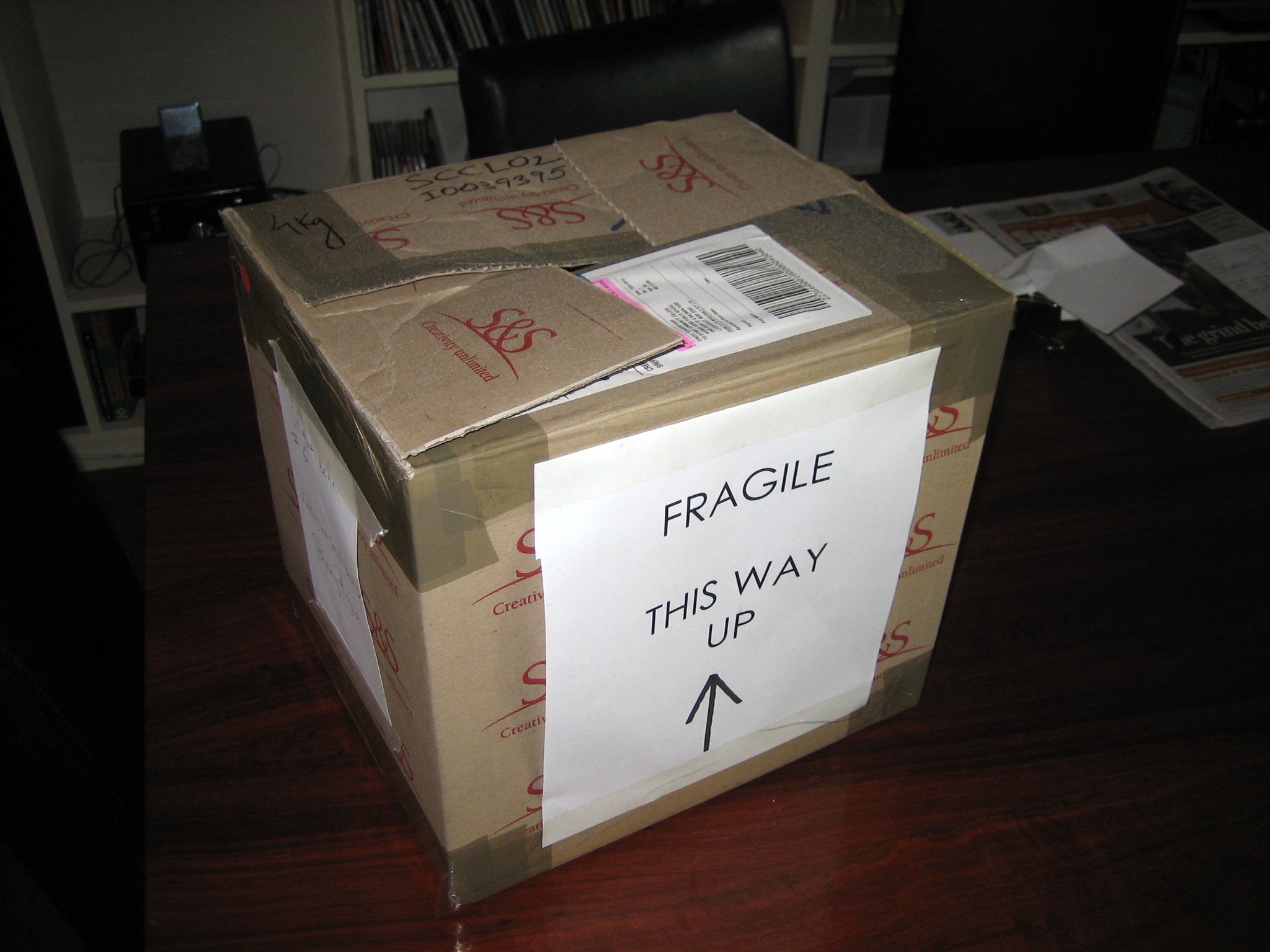
Here it is nestling in its bed of polystyrene:

Out of the box:

On the wall, though we have yet to find a place where its shadow is as dramatic as in the gallery: