Monthly Archives: Apr 2011

A near immersive art experience

The one formerly known as the art student (TOFKATAS) and I are just back from a short weekend in Canberra – overnight in a wotif mystery hotel, and most of the rest of the time at the National Gallery.

The gallery’s new Aboriginal and Torres Strait Islander rooms are just fabulous, and I hope to spend a lot more time in them. From early Papunya boards to the work of urban Aboriginal artists, the collection is dizzyingly rich, and the presentation is superb. And occasionally it got personal. Tony Albert’s ‘Ash on Me‘, for one tiny example, consists of the words ‘Ash on me’ painted on the wall and, as you might not be able to tell from the photograph at the link,  decorated with actual ashtrays, most of them with images of Aboriginal faces or figures, some with Australian flora or fauna. It’s a powerful statement in anyone’s terms, but I was grabbed by the throat when I saw this on the S:

In  case you can’t see, it’s a kookaburra with the words ‘Innisfail Qld’. It was borne in on me that this was an object from my Innisfail childhood, that ashtrays just like these with cute, noble, comical or otherwise stereotyped Aboriginal figures were an unquestioned part of the world I grew up in. I was implicated.

We also spent time with James Turrell’s ‘skypace’ Within Without, which from the outside looks like an artificial grassy hill with a rock dome rising from the middle of it, approached by a path between expanses of water. Inside, it’s an ochre pyramid with a huge basalt stupa in the middle, surrounded by eerily turquoise water. The space is filled with the sound of water overflowing. You walk across a flat bridge to enter the stupa – around its inside wall is a bench that seats about 20 people. The bench, it turns out, is heated. There’s a large oculus (a word I know from the Pantheon in Rome) in the middle of the roof, and a patch of coloured stone in the middle of the floor. If I hadn’t been introduced to Turrell’s work on Naoshima in Japan a couple of years ago, I might have had a quick look and moved on, because nothing much was happening. But we sat for at least an hour, and watched the oculus as its patch of sky grew deeper and deeper blue until it was pitch black against the whiteness of the inner wall, which we gradually realised has its own light source, and wasn’t somehow trapping light from outside. The sky couldn’t really be as black as it looked to us, I thought, and announced that I was gong to take a stroll around the inside of the triangle. I walked out the door of the stupa and, looking up at the deep blue, starry sky, took a step to the right – up to my calves in now invisible water. Fully shamefaced, I went back to my place on the heated bench, took my shoes and socks off and endured the amiable mockery of what had become a small community of Turrellites.

If you’re in Canberra, I do recommend that you spend time in the Aboriginal and Torres Strait Islander Galleries, and that you let the James Turrell space work on you – but take seriously the signage saying that the work of art does not meet Australian Safety Standards for Buildings.
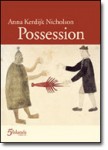
Anna Kerdijk Nicholson’s Possession

Anna Kerdijk Nicholson, Possession (5 Islands Press 2010)

I picked this up because it’s shortlisted for the New South Wales Premier’s Literary Awards. I’m pleased to report, however, that I read it without Barry O’Farrell in mind, not even a bit.

The subtitle, ‘Poems about the voyage of Lt James Cook in the Endeavour 1768–1771’ seems to promise a book that’s squarely in the Australian Explorer Poem Tradition (AEPT). Kenneth Slessor’s ‘Five Visions of Captain Cook‘, James McAuley’s Captain Quiros, some of R D Fitzgerald’s poems dealt with sea exploration, and used to be studied at universities, and land exploration has grabbed the attention of many of our poets, notably Francis Webb (in whom I’m currently immersed). The book’s apparatus seems to confirm this promise: the page before the table of contents quotes from the Lords of the Admiralty’s instructions to Cook to ‘proceed to the southward in order to make discovery’ of the fabled Great South Land, and the poems are followed by a seven page chronology, beginning with his birth and ending 56 years after his death, with the death of his widow Elizabeth.

It’s true the book engages with Cook’s voyage of ‘discovery’, but it does so with a postmodern, post-colonial sensibility. There is a sense of overall unity, but no grand narrative, no unifying point of view, certainly not an unambiguous sense of Cook as hero. Unlike the main works of the AEPT, it doesn’t shy away from the less than honorable episodes of the voyage, or from the devastation it brought to many people – peoples, in fact. The 31 poems fall roughly into three kinds: most of them are addressed to Cook, with headers giving place and date, referring to incidents on his voyage (‘You imagine the scent of South Sea fruit on your fingers / and the lustful smells of fresh roast pig and cocoanut.’). A second kind are set in the early 21st century, mainly in Kangaroo Valley in New South Wales, and feature the poet, sometimes but not always with her mind on James Cook. And then there are half a dozen with the page header ‘Extracted from notes on a lost manuscript’, which are generally more elusively reflective: the first of these has the look of a found poem – a dictionary definition of ‘explore’, with etymology, not as dull or as neutral as you might expect.

I’m enjoying the book so far. It’s like a music album, that you need to play a few times before you’ve absorbed it, and maybe you’ll go back to it from time to time and find something new each time. I’m still at the absorbing stage. For example, the acknowledgements page tells us that the titles of individual poems ‘make reference to the poetries of’ five poets. None of the titles rang any bells for me, and Google shed no light, so evidently they aren’t direct quotes from those poets. Maybe one day I’ll come across the references, but for now I’m happy to stay in the dark, for the titles to remain a tease. That dictionary definition poem, for example, is titled ‘Each object we name and place leads us’ – I have no idea whose poetry that makes reference to, but it sits in nice tension with the poem.

This teasing intertextuality – which is echoed in the often oblique relationships between the modern and historical poems – is hardly in line with the cafe poet-in-residence program described in today’s SMH, which aims to ‘demystify the work of poets and deliver it to a broader audience’. But it’s fun – probably even more fun for people who get the references. I look forward to hearing Anna Kerdijk Nicholson read and perhaps talk at the Sydney Writers’ Festival next month.

Shall I come baby…

My brother in law got me to download a wonderful phone app that takes dictation, thereby saving lots of typing. Early the other morning I read a sonnet to it, and got results that would thrill the heart of any post-human poet. I read the same sonnet again, articulating as clearly as I could, though softly, so as not to wake the household. Here’s a conflation of the two results, with some punctuation by me, plus rollovers to remind you of the original if you want:

Shall I come baby to a summer’s day,
though I’m more lovely, and tempo
wins to shake the valentine’s day
and summer’s movie’s at all too short a date?
Sometime too hot here and show hello
is off. This is God to confession of everything.
Compare some time playing iTunes.
A chance … Tension course
and the guy isn’t till summer, shall not say
on this position of that fear. The boasts
with your shopping bag and wondrous thing
someone interesting to share with you,
so I was thinking peas, or eyes can see
too long lunch time at Christ a fee.

The Brothers Size at the Stables

On Friday night we went to Imara Savage’s production of Tarell Alvin McCraney’s The Brothers Size at the Stables Theatre. Let me say up front that I’ve known Imara since she was a baby, and it’s fair to say I’ve been a fan of her theatrical productions since she was two years old. But I’m perfectly capable of a tactful silence, and this production made me want to shout from the rooftops.

Close to forty years ago, theatre critic Katharine Brisbane observed that drama being produced by African Americans at the time was in some ways strikingly similar to contemporary Australian drama – something to do with coming out from under racism and the legacy of slavery in their case, and a colonial past and the cultural cringe in ours. If she was right the almost complete absence of African American writing from our stages in recent years is our great loss. And even if she was wrong, if this play is any indication it’s been our great loss anyhow.

The play was first performed in 2007 in New York and London. It’s a three-hander: Ogun Size (played by African American Marcus Johnson) has a small car repair company, his younger brother Oshoosi (played by Indigenous Australian Meyne Wyatt) is recently released from gaol, and Elegba (played by Tongan-heritage Anthony Taufa) who befriended Oshoosi in prison, became a brother to him, turns up. The Stables’ tiny stage is completely bare, the walls painted black, with a lighting design that seems to accentuate the darkness. A woman (Marian Lieberman) plays a drum – I don’t know anything about African drumming, but it felt to me that drum’s function was to summon up the action rather than merely to accompany or punctuate it. Once you know who the characters are, you more or less have the plot: Oshoosi is pulled in opposite directions by his two ‘brothers’, with tragic results. But that’s a framework for a wonderful 75 minutes in the theatre. For one thing, the dialogue is richly poetic, rising at times to operatic intensity, and the performances are absolutely up to the challenge. It seems to me that in some Australian productions of US plays, a focus on getting the accents right results in wooden performances – at least that’s my guess at what made Philip Seymour Hoffman’s production of True West at the STC last year so deadly dull in spite of the great talents at work in it. That wasn’t a problem here. As in the Nimrod’s legendary Tooth of Crime in this same theatre in 1972, the accent-work generated a stylistic rhythm, a music that was completely engaging. The bare stage allowed the language to fill the space.

But I’m making it sound like the equivalent of a concert performance of an opera. It wasn’t like that at all. One of the things that made it so powerful was its intense physicality. The director’s note says someone has described the play as a choreo-poem, which might sound wanky to anyone who hadn’t seen it, but isn’t a bad description at all. One of my companions said she couldn’t help wondering who this young woman was, to be able to direct such a testosterone-charged show, yet with such a nuanced take on possibilities for tenderness.

Sometimes, though rarely, shows transfer from the Stables to larger venues, and it seems a shame that the size of the space limits the number of people who see this. On the other hand, it gives a great sense of privilege to see such excellence at such close quarters.

If you can get to it, do. If not, make a note of the names I’ve mentioned. If there’s any justice you’ll be seeing a lot more of all of them.