
Richard Powers, Orfeo (Atlantic Books 2014)
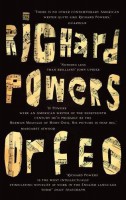
Margaret Atwood, no less, is quoted on the cover of this book as saying, ‘If Powers were an American writer of the nineteenth century he’d probably be the Herman Melville of Moby-Dick. His picture is that big.’ That’s probably taken out of context, and it’s a wee bit over the top, but, you know, only a wee bit. If Melville had been writing about the music scene rather than the whaling industry, he might have written this book. The digressions are just about as long as the ones in Moby-Dick, and for my money at least as interesting; the quest at the centre of the story is as doomed and self-destructive; the frame of reference as global.
Peter Els, a 70 year old composer who has had very little popular or critical success, calls 911 when his dog dies. The police who come to his door have their security-threat detectors set off when they see that he is a DIY biochemist, and soon he is on the run with the full might of Homeland Security behind him. The story of his flight, which becomes a kind of Thelma-and-Louise flavoured 12-steps amends-making pilgrimage, is told in counterpoint with his back story. Folded into one story is the world of Homeland Security vigilance about real and imagined terrorist threats, media panics and the surveillance state; and into the other the history of 20th century US cutting-edge music in its broader world political context.
It’s a gauge of how well Powers writes that just as Els’s flight is reaching a critical moment, he stops off to give a lecture in an old people’s residence, and everything stops while we are told the story of the composition and first performance of Olivier Messiaen’s Quartet for the End of Time – and it’s so interesting that 17 pages later, when we return to the main narrative (‘That was the story Els told his eleventh-hour pupils … ) we do so as if waking up from a vivid, satisfying dream. There are other, shorter digressions, in which Els listens to a piece of music, and we are taken through it moment by moment: this is a book to be read, not just with Google on hand to chase up interesting references, but with access to a music library to listen along with Els to Mahler, George Rochberg, John Cage, Harry Partch, and on and on. And yet it has the pace and suspense of a thriller.
I scored (no pun) Orfeo at my book-swappng club. Since I’d had Powers’ Galatea 2.2 on my TBR pile for some years, I decided to read it first. If the creative and life crises depicted in the earlier book when author and character, both called Richard Powers and in their mid 30s, were based in reality, it seems that they passed. Six novels and 19 years later, I don’t know that Orfeo is any more cheerful than Galatea 2.2 but if Galatea 2.2 contemplated the abyss, then Orfeo is gloriously, operatically, romantically over the cliff.
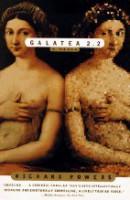 The narrator of Galatea 2.2 is a 35 year old ‘humanist in residence’ at a massive, cutting-edge scientific research centre somewhere in the USA. Recently returned from years in The Netherlands, he is still hurting from the end of his first great love relationship. When an odd, misanthropic scientist invites him to collaborate in a project to develop an artificial entity capable of producing literary commentary that will pass for human, he accepts the challenge. They are doing it for a bet, and start out thinking of it as an elaborate scam. The novel’s reference to the story of Pygmalion, the sculptor who fell in love with his statue Galatea, which then came to life, sets up clear enough expectations.
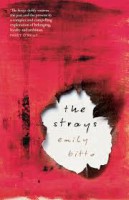 This is a novel about a fictional artist’s colony in Victoria in the 1930s. Though the colony bears some resemblance to the Heide group, and a couple of historical figures, notably Bert Evatt, are mentioned or make brief appearances, it would be a mistake to read it as a roman à clef. At least, I hope so – if not, Heide was quite a bit nastier than I’ve heard.
 This is the seventh book I’ve read for the 2015
 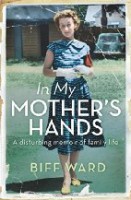 When my Book Group were picking our next book, someone asked about In My Mother’s Hands, which was on my teetering to-be-read pile. ‘It’s a misery memoir,’ I said, and we moved on to other possibilities


 Me fail? I fly!