I’m constantly in catchup mode with my reading of literary journals. I tend to start each one with a sense of taking on a burdensome duty – after all, these journals are invariably dancing on the edge of the precipice of financial ruin. By about the third page I’m usually engrossed and remember why they’re worth supporting.
Evelyn Araluen and Jonathan Dunk (editors), Overland 241 (Summer 2020)
(The content is online at overland.org.au, and I’ve included links)
Each issue of Overland currently (that is to say, a year ago, which is where I’m up to) is a three-parter.
Taking up the first two thirds is the articles section, a platform for marginalised voices and for arguments from outside the Overton window. The stand-out article in this issue is ‘No longer malleable stuff‘ by Jeanine Leane, an uncompromising contribution to the current conversation about who has the right to tell whose stories:
Australian fictionists may and most likely will still fossick over the stolen lands of the nation but we – First Nations peoples, Peoples of Colour – are no longer the ‘malleable stuff’ of the unchecked settler imagination. Perhaps there wouldn’t be a point in talking about an author’s identity if they were all the same. But this is no longer the case. We’re not dead. And, we’re not white. We write. Our identities matter.
Also in this issue, Mammad Aidani, whose writings have been banned in his native Iran, argues that it would be wrong of him to allow his writing to be published there (‘300 words for truth‘); Sam Altman sketches the ‘wholesale collapse of Earth’s planetary systems that sustain life as we know it’ (‘Prepare for collapse‘); Lisa Stefanoff promotes the movie In My Blood it Runs (‘The Australian government is not listening: education justice and remote Indigenous futures‘); Jinghua Qian and Liz Crash promote their virtual multimedia tour of the Melbourne suburb of Footscray (‘Underfoot: history from below‘); Angelita Biscotti reflects on her work as a nude photographic model, which she has come to see as sex work, and quotes the book I haven’t read whose ideas fascinate me most, The Managed Heart by Arlie Russell Hochschild (‘On the fantasy work that makes life bearable‘).
Second, there’s the 12-page poetry section, edited by Toby Fitch. From a strong and varied field, it’s again a first Nations voice that grabs me: ‘Mnemonic 2020‘ by Yeena Kirkbright walks us in 13 sections, each named for a colour, through the rough year that has just been (this issue was published at the end of 2020). Here’s section 8:
8. _______Purple
After the Jacaranda blooms we go into lockdown.
We are locked in together on Gadigal land.
I work from my bedroom and feel more trapped than ever.
A manager tells me she heard an Aboriginal woman
on Sky News say blak breathlessness isn't a problem.
Not in Australia.
I am livid. I can't argue. I need to pay bills.
Third, the fiction section, edited by Claire Corbett, comprises four short stories, all terrific. ‘Frog song‘ by Magdalena McGuire has a mother and small child in sweltering Darwin weather: ‘It shocks them to discover the sun is not a thing of beauty.’ In ‘Smoke and mirrors‘, poet Samuel Wagan Watson tells a story of loss and grief with a (spoiler alert) twist I didn’t see coming. ‘The white sea‘ by Alistair Kitchen is an unsettling fable in which the sea turns white ‘in the way milk is white – thick and full and opaque’. With Jane Turner Goldsmith’s ‘Smoke road‘, we’re back in naturalistic mode with a taut, understated tale of leaving an abusive relationship.
It looks as if the print edition of Overland no longer publishes the results of the literary competitions listed on the website. This seems to have resulted in a cleaner through-line for each issue. The absence of regular columns has a similar effect, but I do miss the cameo appearances of Alison Croggon, Tony Birch, Giovanni Tiso et al.
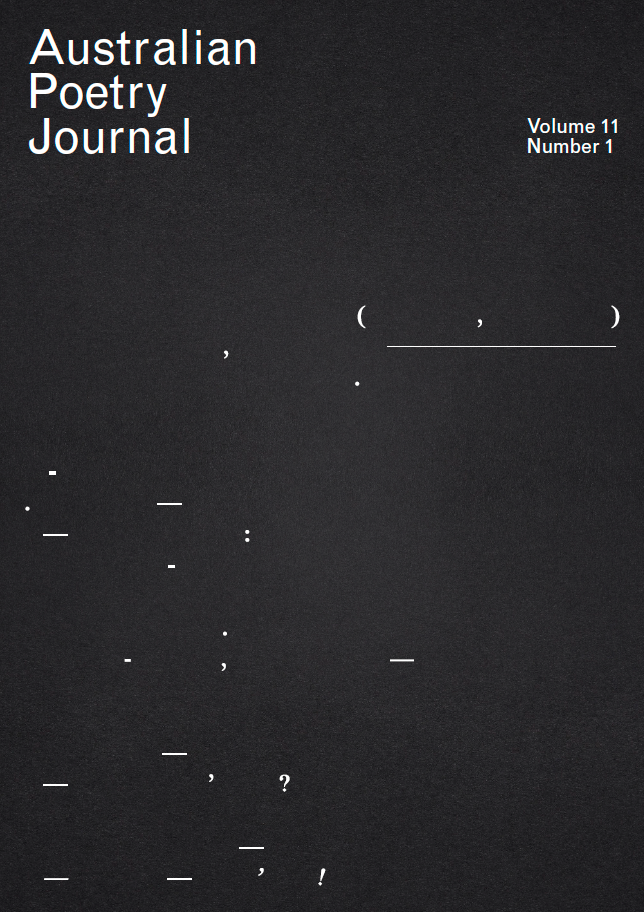
Stuart Barnes & Claire Gaskin (guest editors), Australian Poetry Journal Volume 11, Number 1: local, attention (2021)
As promised, this issue of APJ includes a further instalment of Jacinta LePlastrier’s ‘New Series’, which pairs poems with commentary. But first there are 60 pages of poems that reflect the theme ‘local, attention’. The guest editors’ Foreword quotes Mary Oliver: ‘Attention is the beginning of devotion.’ They’re suggesting, perhaps that this collection of poems that pay attention to the local in as many ways as there are poems might be seen as a post-religious devotional book.
It’s a nice thought, and I can’t tell you it’s wrong.
I turned down the corners of four pages. This doesn’t mean the poems on those pages are somehow superior to the others or even that they struck me more strongly – it’s just that I remembered to mark them at the moment of first reading them. They are:
‘Falling’ by Gavin Yuan Gao, which starts out observing that
____+++++++___ despite years of dogged
____++practice, English is still the slick
winged serpent the dull flute of my tongue
has failed to charm
and develops, by way of a consideration of the use of ‘fall’ when ‘you mean to say you’re in or out of love’, into a celebration of first love.
‘Quantum Vacuum Noise’ by Alicia Sometimes, in which life with small children in lockdown is seen as problematic for quantum computers (I think):
We have been creating in this space
forts on top of desks on top of kitchens

the fluctuating energy of us laughing would
distort any signals or information encoded
I probably marked ‘Slowly, Here in Esssaouira’ by Matt Hetherington because it’s pretty much a sonnet. It evokes a state of lassitude which, the title informs me via DuckDuckGo, is happening in a town in Tangiers:
a peace is descending upon me
the noisy children don't bother me so much
and things get done, one at a time
‘The Ibises’ by Greg Page won me because I’m fond of those birds and quietly resent their ‘bin chicken’ nickname. Greg Page is a First Nations man, and the poem’s serious turn is a delightful surprise:
Hated, like us Kooris
Told they don't belong
Moved on from their homes
Making do on the fringe
There are eight poem–commentary pairs in the ‘New Series’ section. Though every pairing is interesting and instructive, I was especially interested in two where the commentator is the English translator. Both Dong Li (on Song Lin’s ‘Near) and Stephanie Smee (on Joseph Ponthus’ ’31. from “Part two”, On the line’) shed brilliant light on a translator’s relationship to the original work and its author.
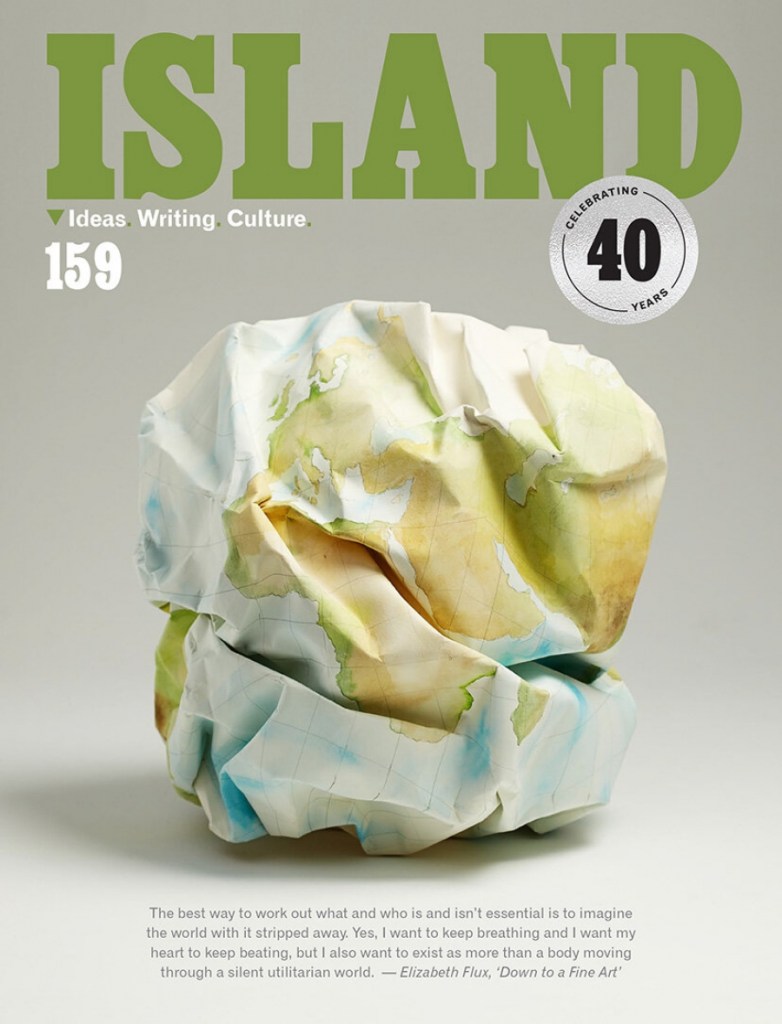
Vern Field (editor) Island 159 (2019)
This issue of Island is upfront about financial difficulties. In 2019, according note from Geoff Heriot, Chair of the Island Board, the journal managed three issues instead of the usual four – but it ended the year in the black so they managed ‘to keep the doors open’.
Elsewhere, the sense of struggle recedes. There are four interweaving elements: nonfiction edited by Anna Spargo-Ryan, fiction edited by Ben Walter, poetry edited by Lisa Gorton, and arts features edited by Judith Abell.
The arts features are beautifully illustrated essays on works by three Tasmanian artists – Lucienne Rickard’s Extinction Studies, Julie Gough’s Tense Past and Selena de Carvalho’s Beware of Imposters (the secret life of flowers) – that bear witness to the island’s vital art scene.
Ten poems are interspersed among the other contents. The poem that spoke most directly to me is ‘Ash in Sydney‘ by Jake Goetz. It’s a wonderful evocation of the experience of being in Sydney during the bushfires of summer 2019–2020, which begins:
ash in falling on the Lidcombe line
on Carriageworks and Regents Park
it's falling on planes of closed-up houses
where Greg thinks his summer's fucked
and it's blowing in from morning westerlies
and it's blown back by arvo southerlies
You can read it and a number of other poems from this issue on the Island website at this link.
There are five pieces of fiction whose subjects range from international adultery to futuristic crime thriller. If I have to single out one, it’s Pip Smith’s ‘Starter Culture’, in which the 70-year-old narrator endures the slights that come her way from her granddaughters and other young women, and eventually wreaks satisfying vengeance (no young people being harmed in the making of said vengeance).
Among the excellent nonfiction pieces, it speaks volumes of Katerina Cosgrove’s ‘Death in the Garden‘, that I found its account of grief and resilience powerful even after it said that Epicurus ‘founded a school of thought championing the pursuit of hedonism’, which would have made my high school Latin teacher apoplectic. In ‘Principles of Permaculture‘ Sam George-Allen reflects on six months living alone on ‘a quarter-acre oblong island in a sea of golden grass, wedged between two improbable paddocks on the edge of a rundown country town’, and – though she doesn’t claim it for herself – describes a kind of solitary engagement with the earth that, through her beautiful writing about it, becomes a form of activism.
I interrupted the writing of that last paragraph to collect my mail. Sure enough, there was another literary journal hot off the press.
It’s like painting the Harbour Bridge.





 Me fail? I fly!