Yearly Archives: 2021

500 people: Week 32

See this post for a brief description of my 500 People challenge.

Lockdown continues. I have been communicating with people on line, including some new people, but it’s been slim pickings in the non-virtual world. Unlike the lockdown last year, there’s very little camaraderie amid the social distancing this time round: people seem to be much more stuck in their own worlds, as if wearing a mask makes you invisible. Nevertheless:

1. Sunday 19 September. The elderly woman ahead of me at the checkout (probably younger than me) chatted animatedly for a couple of minutes in an East Asian language. When it was my turn I asked the woman behind the till what language they had been speaking. ‘Vietnamese.’ Another employee, white, joined us and said what a hard language it was to learn. The three of us chatted for a bit about tonal languages, the pronunciation of phở, and where excellent phở can be found in Marrickville. sadly I didn’t make a note of the recommendation, but I’m happy with Great Aunty Three in Enmore, and miss their phở terribly during lockdown.

2. Still Sunday, the Emerging Artist and I passed a man and a woman who were packing up their gear beside an inflatable kayak. I paused in my walk to ask the woman how much the kayak cost, a question that had arisen with us a couple of days before, but really I asked for the sake of human contact. She looked at a loss and passed me on to her male companion. He told me how much, ‘but it was second hand.’ We chatted a little bit about the joys of kayaking on the Cooks River.

3. Wednesday morning, we were out of our Local Government Area and more than 5 kilometres from home, but it was legal because the EA had an eye specialist’s appointment, and dilating drops meant she couldn’t drive herself home. We arrived early and ordered a take-away coffee. While we were waiting in the otherwise deserted coffee shop, a woman came in with a dachshund on a lead. It sniffed the bottom of my trousers, and when it came back for a second sniff, I offered it the back of my hand, whereupon it barked ferociously. Now we understood that its owner hadn’t left it outside the shop because she knew it would bail up any passers-by. During all this, the dog owner and I managed to communicate quite a lot without benefit of words mouths or noses.

4. Thursday, we were walking on the bank of the Cooks River beside the Marrickville Golf Club when we had a classic old-style Australian exchange. A group of men in their 60s or so were teeing off. We must have looked as if we were interested as the one who was second in line said, ‘Don’t bother watching him’ – his friend who was about to swing his club – ‘you won’t learn anything.’ The EA knew the correct response: ‘We should wait to see how you do it.’ Of course we didn’t.

5. Saturday morning, on our morning walk past the Enmore Tafe College, we came upon a man on a step ladder reaching up into a mulberry tree that overhangs the footpath. Standing beside the ladder was a woman holding a dessert bowl. There was a lot of red fruit on the tree, and a couple of black ones in the bowl. ‘Ripe already!’ we said. ‘Yes,’ he said, ‘we’re saving the footpath from being stained.’ Trying hard not to imply that he might not have been motivated only by civic mindedness, I thanked him for his service to the community.

6. Saturday afternoon, just an hour or so ago, we were in the socially-distanced queue for one of the few toilets in Sydney Park. (The park was busy; picnicking groups abounded, at appropriate distances from one another and mostly made up of the permitted five or fewer people.) The masked woman ahead of us said something about how thrilling it was to be out in the world and about to go to a public toilet. As the queue moved slowly we chatted, mainly about the fact that we were chatting in a toilet queue, and finding it weirdly liberating

Running total is 221.

Journal Blitz 9

I’m still way behind with my journal reading. Here’s a quick catch-up.


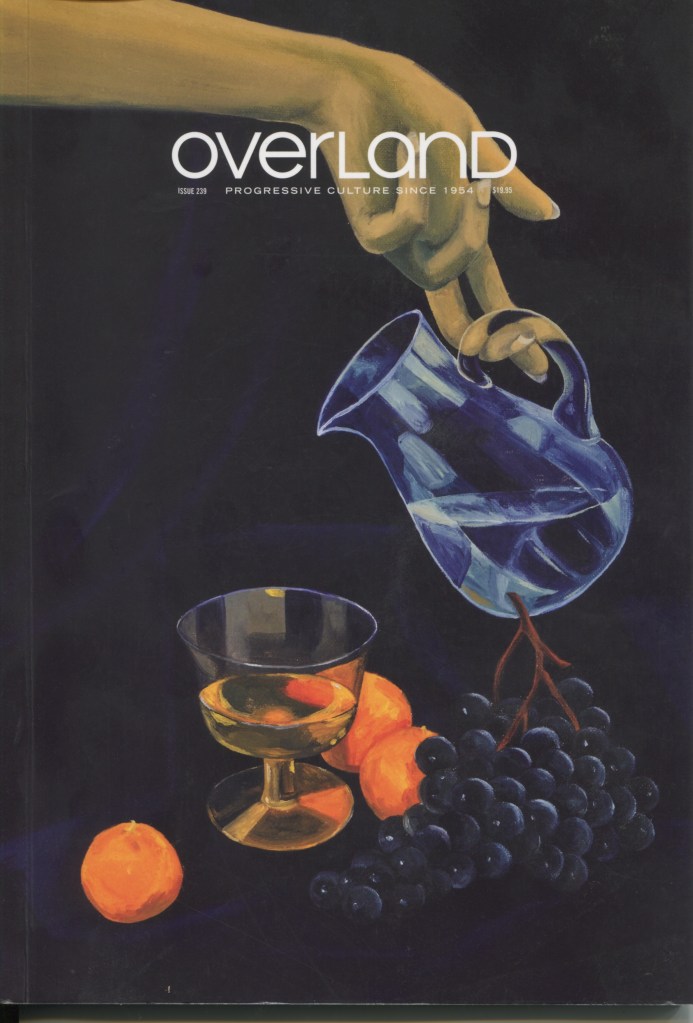
Evelyn Araluen and Jonathan Dunk (editors), Overland 239 (Winter 2020), with links to the articles at overland.org.au.

As with every issue, this Overland is full of reminders of things the mainstream media would prefer us to forget, and offers perspectives that are mostly unseen in those media.

Most strikingly, there’s ‘Ignorance is bliss?‘, an article by Sam Lieblich, psychiatrist and neuroscience researcher, on what he calls ‘ the mental health business’. His thesis is that psychiatry ‘pathologises the normal problems of human life, enforces highly constrained paradigms of thought and behaviour, and insufficiently values patients’ autonomy’. He goes on:

There is still, however, a lot of confusion about the status of the things that psychiatrists treat. These are by no means illnesses, and the medications doctors use to treat them are by no reasonable measure effective.

These are fighting words, and he backs them up with solid references scientific papers that go mostly unreported and remain uncontradicted in scientific circles. The pharmaceutical industry, preying on the desperation of patients and doctors, has ‘insinuated itself into the state and into academia so thoroughly that to find a research project or piece of regulation untouched by their money is almost impossible’. Even so-called mental health advocacy organisations such as Beyond Blue, he argues, ‘act as de facto pharma advertisers’. His discussion of the changing definition of Major Depressive Disorder in the Diagnostic and Statistical Manual of Mental Disorders (DSM) is an entirely convincing demolition job.

No doubt this essay, like the many books and article it cites and like, say, Gail Bell’s Quarterly Essay The Worried Well and Robert Whitaker’s Anatomy of an Epidemic (links are to my blog posts), will be dismissed out of hand, all evidence to the contrary, by the vested interests it challenges. But I hope it’s widely read. I do wish Sam Lieblich had allowed space for hope with more than a passing mention to ‘the emancipatory and compassionate potential within psychiatry’, but that’s probably another essay.

This Overland‘s theme is ‘Health’. There are other articles on mental health, including the misery caused by Australia’s offshore detention regime (‘Behrouz Boochani and the Penal Archipelago‘ by Dashiell Moore), and a manifesto-like piece on hospitals as places of oppression (‘On hospitals‘ by Vanamali Hermans).

Overland showcases new poetry, short fiction and visual art, all worth paying attention to. I’ll mention just one piece from each category.

Philip Neilsen’s poem ‘Cockatoo‘ tells a comic tale of cockatoos disrupting a football game that widens out beautifully. Who can resist a poem that includes this:

Horns are honking, people are shouting, the cockatoos are shouting
back, with an intensity that is winning the contest. 

Freya Cox’s short story ‘A murmur of resistance‘ evokes the moment of the Russian invasion of Czechoslovakia in 1968 as experienced by a mostly non-political young Czech woman.

May Day 2020: Organising in the Pandemic‘ is a spread by comics artist Sam Wallman, whose distinctive pieces have appeared in Overland regularly for some time. This one is a witty, concise account of the way ‘some of the more staunch segments of the union movement’ found ways to celebrate May Day under lockdown conditions in 2020 that is, and a pleasure to read.

Occasionally, there are signs that Overland‘s writers and editors want us to know they’ve been to university, and that loss of funding has meant cutting back on copy-editing. The editorial, for example, laments that under Covid ‘we forego almost all the habits of flourishing and eudaimonia’, managing a spelling error and a ten-dollar word in one short clause. But maybe you have to be a copy editor to care about such things, and the pain they cause is vastly outweighed by the good stuff that surrounds them.


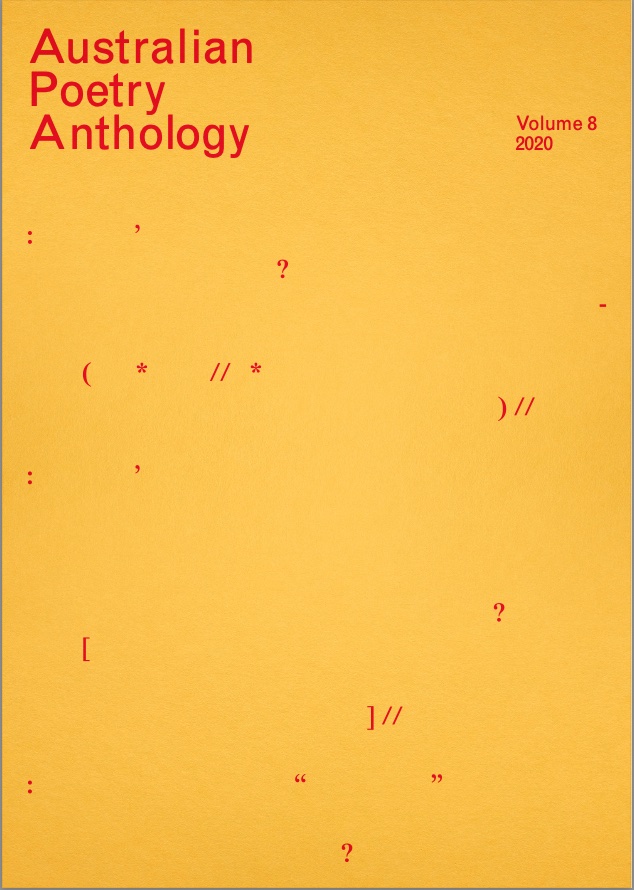
Sara Saleh and Melinda Smith (editors), Australian Poetry Anthology Volume 8 (2020)

Each year the Australian Poetry Anthology focuses on a different state or territory. Of the 120+ poets in the 2020 anthology, 23 are from the ACT. A more perceptive reader than I am might be able to distinguish locality-based differences in the poetry, but I couldn’t tell who comes from where without checking the biogs up the back of the journal.

Not that there’s any kind of dull uniformity here. The foreword puts it nicely:

Arguably our duty as artists is to bear witness to all of it – from the looming catastrophes of runaway climate change, epoch-making bushfires and a deadly global pandemic, to ever-present entrenched societal injustice, to the smaller griefs, puzzles, and epiphanies that enter every human life. If we ignore the big picture we become irrelevant, if we ignore the small things we ignore the beauty, complexity and mystery of what it is to exist; of what it is we stand to lose. It is in allowing us to play (and hear) many notes at once – to encompass contradictions without being destroyed by them – that the strength of poetry lies.

That range and variety is the strength of poetry, and it’s the strength of this anthology. There’s something here for everyone, and for a wide range of moods and concerns. I enjoyed the presence of many poets whose work I know and love, and many who are new to me. There are indeed poems about climate change and other aspects of ‘the big picture’. There are (of course) poems that didn’t speak to me at all; others that took the words right out of my mouth – or from wherever they were before they got to my mouth – and made them shine; and others still that came from a whole other paddock and made me laugh or, once or twice, cry.

I could list the poems that stirred me, but I’m pretty sure your list would be different from mine. I’ve marked about a third of them for rereading when I pick up this book again, and probably should have marked more. They range from Shastra Deo’s ‘Orichalcum’, which begins:

I don't know what will happen to my body
afterwards, but I want to return 
to the reservoir outside our hometown
where we caught catfish in the summer
my father close to kneeling
at my feet.

to Jennifer Compton’s ‘Late and Soon’, which deals with anxiety about climate change and ends:

Ha ha ha ha ha
____________________________________ha ha.

Regular readers of this blog know that I’m fascinated by translation, of which there are a couple of fine examples here. I want to say a bit about Paul Magee’s poem on page 61, whose title tells us everything we need to know: ‘Seneca, ‘Omnia tempus edax depascitur’ (‘Time eats everything up’)’. If you’re interested, you can see the original Seneca poem with a close translation at this link. Magee, who is one of the featured Canberrans, renders it like this:

Time eats everything up – it snatches it all 
from the root. Nothing's for long here.
Rivers lose heart. The beach is desert. 
Exiled, the sea. Tallest mountains fall. 
Why chatter? The giant sky’s beauty
will burn to a cinder again. Suddenly 
not as punishment but law everywhere 
death insists. And away with worlds.

Like Seamus Heaney’s 9/11 poem ‘Anything Can Happen‘, which is a translation of a poem by Horace, this speaks directly to the present moment – it summons up images of thousands of dead fish in the Darling/Barka last year, horrendous bushfires, and the dire warnings of climate scientists. The tone of Seneca’s original is a kind of stoic (or Stoic) resignation: ‘Everyone dies; everything come to an end sometime.; that’s just how it is.’ This translation has the same content, the same images; just two words that aren’t there in the original create a key difference: ‘again’ and ‘Suddenly’. We can no longer think of the sky on fire as a fanciful imagining of doom – it has already happened; we can no longer think of global destruction as something that will happen in the distant future – it’s happening now. The poem’s key thought that this is not punishment but a law of nature might in other contexts be somehow consoling, but here it’s chilling. I don’t read it as despairing, but as insistently grim: this is real, we’d better face it.

Someone said that one of the aims of poetry is to slow the reader down. Magee’s little poem does that. Sara Saleh and Melinda Smith have put together a collection that will slow its readers down, open us up, broaden us, deepen us, and I hope strengthen us.

500 people: Week 29-31

See this post for a brief description of my 500 People challenge.

Lockdown continues. I have been communicating with people on line, including some new people, but it’s been slim pickings in the non-virtual world. Unlike the lockdown last year, there doesn’t seem to be any camaraderie amidst the social distancing this time round: people seem to be much more stuck in their own worlds, as if wearing a mask makes you invisible. Nevertheless:

1. Sunday 29 August. On our daily walk, we went into unfamiliar territory, still inside our 5 k radius. We came across a young man who seemed to be training his dog to run up very steep slopes to place and then retrieve its lead. The dog, a bull terrier, was an enthusiastic learner. We – the humans at least – exchanged greetings

2. Thursday, we were having lunch on the grass in Callan Park with the granddaughter. Just like a couple of weeks earlier, there were two people doing extraordinary things on a low rock overhang – a woman and a man this time. Again I approached them for a brief conversation. My opening gambit was to ask how long they’d been doing it. ‘About five years,’ the woman said. Just like the two young men the first time, they assumed I might want to have a go: ‘The best place to start is in a gym,’ the man offered. I said I was quite happy to watch, hoping I didn’t sound too much like Chance the gardener (as in this movie).

4. Wednesday or Friday that week. Near the Marrickville Metro there are sections of footpath that are paved rather than concrete. This is generally very attractive, but vulnerable to disruption by tree roots and other underground forces. Over the last couple of weeks some rough patches have been under repair. On this day, I passed a man who had pulled up 50 or so pavers that had bulged up in a line stretching from the base of a small fig tree. I stopped to chat, and he happily explained that he wasn’t doing anything to the root – no harm would come to the tree. He was covering the root with sand to create a level surface, then relaying the pavers on that. Next time walked that way, there was no sign of the former trip hazard.

3. Sunday 12 September. While almost all the encounters I’m recording in this series, this conversation was with a new person who I can reasonably expect to see more of. On a carefully orchestrated walk, where there were only ever two of us together at the same time, the Emerging Artist and I met up with one of our sons and a woman he has recently got close to. He had primed her well, and with social eptitude far outstripping mine she drew me into conversation about, among other things, this challenge. We talked about the way ubiquitous mobile phones have drastically reduced serendipitous encounters. She had read a book about dating that said the first rule for successful dating in the offline world (which, as she said, used to be called ordinary life) was to turn off your phone.

5. Thursday morning the car had a very flat tyre. I couldn’t budge the nuts on the wheel so called NRMA Roadside Assistance. The chap arrived in good time, jacked the car up, removed the tyre and replaced it with the spare in no time at all. He did all this without saying a word, remaining pretty much inscrutable behind his Covid mask. He wasn’t rude or hostile, just businesslike in the way he steadfastly ignored my feeble attempts at small talk (‘I haven’t jacked it up because I knew you’d have a pneumatic jack,’ etc.). Finally, though, as he was leaving, I said, ‘I hope all your calls today are as straightforward as this one,’ and he unbent enough to say, ‘Yeah.’

6. Saturday, on our morning exercise outing the EA and I went to the Sydney Fish Market, where a long section of footpath is currently closed because of the new, bigger, better market under construction. As we arrived back at the lights with our fish, there was some kind of kerfuffle. I happened to catch the eye of the the traffic control warden on duty Assuming I’d seen what just happened, he said, ‘There’s always one,’ and we had a pleasant chat about human folly and the need for safety regulations. (He had his mask around his neck.) I hoped he was getting time and a half. He said, ‘That’s the least of my worries. I’m pretty much retired and this gets me out of the house. I’ve only got so much I can talk to my wife about.’ (Pause.) ‘And vice versa.’

Running total is 215.

The Book Group and Mark McKenna Return to Uluru

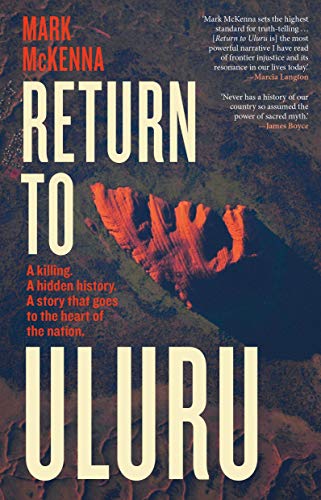
Mark McKenna, Return to Uluru (Black Inc 2021)

This was a very welcome birthday gift in March this year, but somehow I didn’t get around to reading it until it became the September title for the Book Group.

Before the meeting: It’s a terrific, powerful history that reads partly as a thriller and partly as a prose poem.

Mark McKenna has previously written two books that focus on the history of particular places: Looking for Blackfellas’ Point (2002) and From the Edge: Australia’s Lost Histories (2016). His recent Quarterly Essay, Moment of Truth: History and Australia’s future (2018) takes its readers on a visit to Cook’s landing place at Kurnell. Return to Uluru similarly has a place for its main subject. It tells many stories about Uluru: stories from settler Australia that change radically over the decades, stories from Aṉangu culture and from First Nations people more generally, culminating in the Uluru Statement from the Heart.

The central strand is a compelling narrative, what McKenna calls the ‘biography of one moment in one man’s life, a moment that encompassed the entire history of the centre and went straight to the heart of the nation’s long struggle to come to terms with its past’ (page 25).

The man in question is Bill McKinnon, a legendary Territorian policeman, who travelled in the steps of the explorers in the 1930s, taking camels on long journeys through what non-Indigenous Australians saw as the harsh and inhospitable terrain of central Australia, climbing what was then called Ayer’s Rock and adding to the cairn at its highest point, dealing with hostile ‘Blacks’ and doing the heroic work of bringing murderers to justice in the face of enormous odds. He was celebrated in newspaper articles and by writers like Frank Clune. A representative of an heroic Aussie type, a Crocodile Dundee without the comedy, he was also accused of brutal mistreatment of Aboriginal people, and in particular of the unlawful killing of one prisoner.

That killing is the moment that the book revolves around. It happened in a cave near Kapi Mutitjulu, a waterhole at the southern end of Uluru. McKinnon claimed that he fired blind into the cave where an escaped prisoner was hiding, and that he did so in self defence. An official enquiry found that he had done no wrong, but Aṉangu witnesses – and some non-Indigenous people – said different, and in the course of writing this book McKenna stumbled on some damning evidence written in McKinnon’s own hand. The image of the legendary outback bushman evaporates in front of our eyes to be replaced by something much darker. Deeply gruesome details emerge.

There is a story that is left mainly untold: the story of the man shot by McKinnon, whose name was Yokununna. In whitefella versions of the story he was a murderer who was captured by McKinnon, escaped, and was killed while resisting recapture. The murder of which he was accused, we are told, was a matter of tribal law. In an endnote, McKenna explains that he has ‘refrained from reproducing these details due to their ongoing cultural sensitivity’, but we are left in no doubt that Yokununna was no criminal, and that when he died he was drawing McKinnon’s attention away from his fellow escapees. The book ends with some of his remains being returned to his descendants.

My copy is a hardback, and its many photos are reproduced with wonderful clarity. Beautiful though they are, they serve as more than decoration. They including the view of Uluru from the International Space Station on the cover, many photos taken by Bill McKinnon, and others by the book’s author. So there’s a pictorial dialogue that spans the decades. We get a sense of how McKinnon saw himself. We feel the romance of the centre (in 1932, McKinnon commissioned a dozen mulga wood plaques from Albert Namatjira, making him one of the first whitefellas to encourage, and pay, Namatjira for an artwork). And we see the descendants of the men brutalised by McKinnon, now back on country. We see Uluru’s senior custodian, grandson of one of the men arrested along with Yokununna, pointing to the opening in the rock that McKinnon fired through.

At the meeting: I had expected this to be one of those meetings where we are united in appreciation of the book and spend the time reminding each other of bits we made special note of. But it was much more interesting than that.

For some, the central idea of the book – that the killing in the cave could be taken as telling the tale of central Australia in miniature – just didn’t hold up, and the telling of it was irksomely longwinded and repetitive. They would have preferred more about people who made cameo appearances, such as Ted Strehlow, Charles Mountford and Olive Pink, and perhaps more about early non-Indigenous encounters with Uluru in the 19th century.

The descriptions of Uluru and the surrounding countryside, some felt, was uninspired. At times, the reader was expected to share assumptions and accept generalisations that some of us just didn’t accept or share – for example, at one stage ‘the Commonwealth was deeply embarrassed’ by McKinnon’s behaviour, but we aren’t told who ‘the Commonwealth’ was or what the evidence was for their emotional state. (This didn’t bother me, partly because I gave a lot of weight to McKenna’s brief account of the Coniston massacre and subsequent exoneration of the perpetrators, so understood that Canberra administrators of the Northern Territory didn’t want further bad publicity.)

One man said he read the book as a foreword and three short stories, which he enjoyed. The aim, as he saw it, was to write a whitefella myth of Uluru, and while he felt the appeal of that (we’re all whitefellas in our group), he was uneasy – I think I heard this right – that there may be some coopting of Aṉangu culture.

Those of us who had got that far all agreed in being moved and impressed by the passages where McKenna meets with the families of McKinnon and Yokununna. At least one man found the most powerful moment in the book to be when McKenna tells McKinnon’s grandson what he has discovered and says he understands the distress this may cause to the family if he publishes it. The grandson, for whom McKinnon has been a family hero, gives his blessing: ‘All of the family, Mum included, are on board for reconciliation, we wouldn’t want anything else.’ Even those who felt that the ‘reconciliation’ offered by the book is largely illusory (I’m not one of them) were moved by this. The passages where Yokununna’s skull is returned to his family and they have their version of events vindicated are equally powerful.

In an inspired moment this month’s Book Selector had invited us all to bring our own photos of Uluru, so the evening ended with a bit of show and tell. The images ranged from a picture of someone’s friend at the top of Uluru in the early 1980s, a photo very like one of McKinnon’s from the same time, to a photo, also from the 1980s, of the photographer’s family posing cheerfully in a burnt out landscape with a number of old Aṉangu women holding up prize goannas.

Brian Azzarello’s 100 Bullets

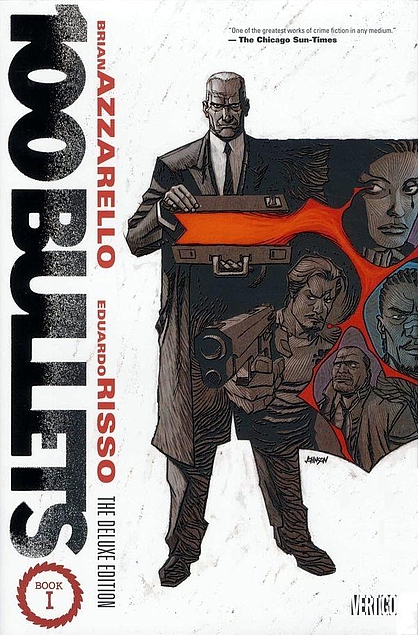
Brian Azzarello and Eduardo Risso, 1OO Bullets, Book 1 (DC Vertigo 2014)

A man calling himself Agent Graves approaches someone and gives them an attaché case containing absolute proof that a particular person has done them a great wrong. The case also contains a gun and a hundred bullets, which Agent Graves asserts can be used with complete impunity to kill the one who has done the wrong.

Will the person receiving the case take revenge, or will something other than fear of the legal consequences stop them?

That’s the set-up for the first issues in this series of 100 comics that were published from 1999 to 2009.

This book is a compilation of the first 20 issues, and it turns out, as you would expect, that this fairly crude moral dilemma broadens out in unexpected directions. Is Agent Graves a supernatural figure and does this turn out to be in the horror genre? Well, no, at least I don’t think so at this stage. This is one of those stories where a hidden cabal wields huge power in the world, and Agent Graves is somehow either their enemy or their enforcer. A group called the Minutemen is involved and perhaps the attaché case is a recruitment device …

It’s stylishly done, with too much traditionally ‘sexy’ female flesh on display. For my taste, it’s more interesting than superhero comics, and I may read on …

Alan Finkel’s Getting to Zero

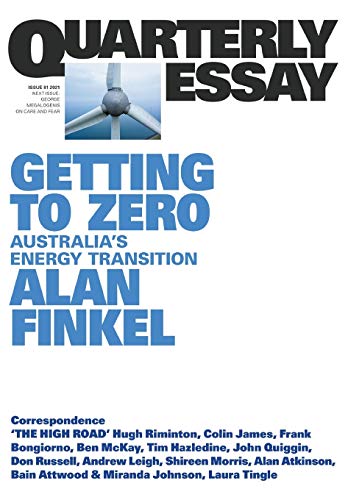
Alan Finkel, Getting to Zero: Australia’s Energy Transition (Quarterly Essay 81, 2021)
– plus correspondence in QE 82

Alan Finkel was Australia’s chief scientist from 2016 to 2020, and among other things he is currently special adviser to the Australian government on low-emissions technologies. So an essay on ‘Australia’s energy transition’ written by him carries a certain weight.

On the face of it, it’s hard to believe that the current Australian government is serious about taking effective action about the climate emergency. It’s not so long since Scott Morrison brought a lump of coal into parliament to make puerile mockery of concerns about fossil fuels’ contribution to climate change, and he now conspicuously refuses to commit to a zero-emissions target by any given time. The Minister for Resources is a fervent advocate of the Adani coal mine in Queensland. The Minister for Energy and Emissions Reduction want to spend vast sums to keep coal-fired generators open. A gas led recovery or a hydrogen valley sound more like amateurish marketing slogans than indicators of any serious policy. So when one of their key advisers writes an essay whose title implies a goal (getting to zero) and a plan (transition) it inspires hope that he will spell out whatever seriousness lies behind the politicians’ sloganeering and obfuscation.

Ian McAuley says in the correspondence in QE 82:

With a little editing – if he replaced his personal anecdotes with the language of bureaucracy, for instance – this essay could serve as the government’s green paper on ‘Australia’s Energy Transition’ – that is, if our government were willing to engage with the public on difficult public policy problems through the traditional green paper/white paper process.

This may be so, but Finkel makes it clear that he has very little to say about politics, policy or politicians. He writes as an engineer: ‘Just as technology has got us into trouble through its propensity to generate carbon dioxide emissions, it is technology that will save us.’ He does acknowledge that technology doesn’t live in a vacuum:

It lives in the policy-driven world of markets, fiscal settings, taxes, government decisions and consumer preferences. This essay is about the technology, not the policies, which are for our democratically elected political leaders to determine. Governments have to balance competing priorities across economic growth, scientific advice and community values.

(page 27)

The essay delivers on that promise. After a very readable outline of the science, it outlines the technological challenges (‘The task is, quite simply, immense’) and the processes already well under way to meet them: the huge uptake in solar energy, progress by way of batteries, hydrogen generation and other means to making wind and solar dependable, electric cars, and so on. He clarifies his modified support for continued use of gas as part of a transition to zero-emissions; he champions hydrogen as the hero of the story. He emphasises that the challenges are huge (‘a mountain to climb’) but is optimistic. He ends with these words:

We can do this, but it will take considerable effort and will take time. So remember: be ambitious; be patient.

(page 97)

I was heartened to read Finkel’s lucid, careful, methodical argument that the challenge of the climate emergency can be met – with difficulty, but successfully, and without significant sacrifice (‘No trade off, no dichotomy. Prosperity and low emissions.’). I was also uneasy. Surely something has to change as well as our technology. There was a herd of elephants in the room. The essay starts with a quote from Buckminster Fuller:

You never change things by fighting the existing reality. To change something, build a new model that makes the existing model obsolete.

I imagine the ‘alternative society’ enthusiasts of the 60s and 70s who had Buckminster Fuller as a kind of guru would consider it close to blasphemy to invoke him in this way.


This Quarterly Essay demonstrates the brilliance of the series’ practice of including in each issue extensive correspondence on the previous one. And it confirms me in my practice of postponing my reading of each issue until the next one arrives.

Alan Finkel can be read, roughly, as explaining the government’s position on the transition to a zero-emissions economy. The correspondence in Quarterly Essay 82 is appropriately heavyweight. Starting with Tim Flannery (Finkel ‘tragically fails’ to identify the real problem, which is ‘that unless we take timely action and view cost as a secondary consideration, we seem destined to precipitate a new, dangerous climate that will threaten our global civilisation’), Scott Ludlam (‘This is a fight that won’t be resolved by reasoned argument alone’) and Ross Garnaut (‘Public expenditure on technological development is wasted unless it is accompanied or followed by a carbon price or by regulation mandating its use’), the line-up of scientists, scholars, researchers and activists engage respectfully and forcefully with that position. If Black Inc were to publish the essay with the correspondence in a single volume, it be a useful, and very readable, overview of the state of climate politics in Australia.

A new IPCC report has been published since the essay and responses were written. Who knows what Alan Finkel would write now?


Added much later, Alan Finkel’s carefully reasoned case has trouble holding its own against the Juice Media’s version of things:

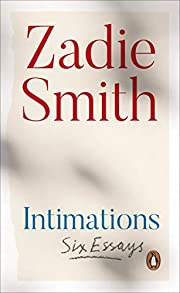
Zadie Smith’s Intimations

Zadie Smith, Intimations: Six Essays (Penguin 2020)

This tiny book was written in the first half of 2020, when Covid-19 was running wild in New York City, where Zadie Smith teaches creative writing. It comprises six personal essays, which their author describes in her foreword as ‘small by definition, short by necessity’. They are written in the spirit of what she learned from the stoic philosopher Marcus Aurelius: ‘Talking to yourself can be useful. And writing means being overheard.’

It’s a tiny book, but it’s not slight. As I read it, I could feel my personal understanding of the word ‘intimations’ changing to include an element of intimacy. These essays ruminate intimately on life, art and relationships in the middle of a pandemic. The first essay, ‘Peonies’, sets the tone:

Just before I left New York, I found myself in an unexpected position: clinging to the bars of the Jefferson Market Garden looking in. A moment before I’d been on the run as usual, intending to exploit two minutes of time I’d carved out of the forty-five-minute increments into which, back then, I divided my days.

She was transfixed by the sight of a bed of garish tulips, wishing they were peonies. That moment leads into reflections on the concept of a ‘natural woman’, the nature of creativity (‘Planting tulips is creative. … Writing is control’), the ‘global humbling’ that was to happen a few days later, on creativity and submission. She quotes a parable from Kierkegaard about the difference between how we actually are in the world and the stories we tell about ourselves in the world. You can make them peonies in a story, but they are still tulips in the real world. With the lightest of touches, the essay takes us into the deep challenge that April 2020 – ‘an unprecedented April’ – presents to our sense of ourselves.

The second essay ‘The American Exception’, also has a brilliantly enticing first line: ‘He speaks truth so rarely that when you hear it from his own mouth – 29 March 2020 – it has the force of revelation.’ We know exactly who she means. Paradoxically, the truth he spoke is that before that date ‘we didn’t have death’. The essay goes on to justify the paradox beautifully.

All the essays tackle big themes, and do it lightly. The longest, ‘Screengrabs (After Berger, before the virus)’ is the one where the author brings her gifts as a novelist most strongly to bear. I think the Berger in brackets is John Berger, and there may be a reference to his famous quote, in Understanding a Photograph: ‘I have decided that seeing this is worth recording.” The essay offers six portraits, mostly of people peripheral to Smith’s New York life, though one, subtitled ‘An Elder at the 98 Bus Stop’, is someone who has known her since childhood back in London. Each of the portraits has a twist at the end, as the pandemic leads the person to reveal something unexpected about themselves. After the portraits, there’s ‘Postscript: Contempt as a Virus’:

‘The virus doesn’t care about you.’ And likewise with contempt: in the eyes of contempt you don’t even truly rise to the level of the hated object – that would involve a full recognition for your existence.

The brief essay-within-an-essay ranges over racist micro-aggressions, Dominic Cummings’s cavalier violations of Covid restrictions, and, most compellingly, the look on Derek Chauvin’s face as he murdered George Floyd.

I haven’t read anything by Zadie Smith before this. I haven’t even seen White Teeth on TV. I’ve enjoyed her brother Ben Bailey Smith’s occasional stints on the Kermode and Mayo’s Film Review, but that’s as close as I’ve got. I brought this book home from the Book(-swapping) Club, and Im very glad to be introduced to this fine writer.

500 people: Week 26-28

See this post for a brief description of my 500 People challenge.

Lockdown continues. I’ve restrained myself a number of times from yelling at chin-mask wearers, and I’ve been sharply reminded to put my own mask on twice. None of these count as warm communication with strangers. I have been communicating with people on line, including some new people, but it’s been slim pickings in the non-virtual world.

1. Saturday 21 August. There’s a circular patch of grass in the grounds of our complex of 43 units. Nothing much else can grow there because there’s just a shallow layer of soil on top of the cement roof of the garage. As I went out for my state-sanctioned daily walk to the shops, I passed two young women reclining on the grass, playing cards and chatting. Seizing the moment, but keeping my mask on, I stopped and said how good it was to see the space being used. ‘Yes,’ one of them said. ‘It seemed a pity not to take advantage of it.’ It would have felt rude to prolong the conversation, but this was warm and neighbourly.

2. Monday in Callan Park, which is just inside our 5 k radius, we passed two young men doing extraordinary feats on a low overhanging rock, probably what’s called bouldering. While one of them clung to the underside of the rock and found handholds and footholds to pull himself along, gecko-like, the other moved a couple of thick mats to catch hm if he fell. Then they swapped roles. The Emerging Artist and granddaughter weren’t diverted from their mission to find the little beach, but I was transfixed. In a break in the action I expressed my awe. One of the young men invited me to have a go. He may not have been joking, but there was no way. I again expressed my awe, and one of them said, ‘There are a lot who are better than us.’

3. Tuesday afternoon – I don’t know if I should count this – I had my first session with a cardiologist. (Nothing to be alarmed about, as far as I know.) We managed some non-transactional chat, partly because that’s clearly her approach as a medical specialist, but also because I was open to it. She commented on my bright striped socks. I said I mostly wore them to please my granddaughter. She, on the other hand, changes into woolly socks as soon as she gets home from work, partly because they’re comfortable and partly because they were a gift from one of her teenage children and she wants (needs?) to show her appreciation.

4. Thursday morning, as the Emerging Artist and I were walking in Newtown, we were hailed by a man emerging from a house across the narrow street. Because of mask-related hearing impairment, I wasn’t sure what he said, and thought perhaps he’d mistaken us for someone he knew. As I moved towards him questioningly, he said, ‘I said buon giorno, good morning,’ and was hunting around with German-sounding words when I said ‘Buon giorno’ back to him. Then I said, ‘Buona giornata,’ and he gestured to indicate that he was pleased I understood enough Italian to muster a reply.

Running total is 209.

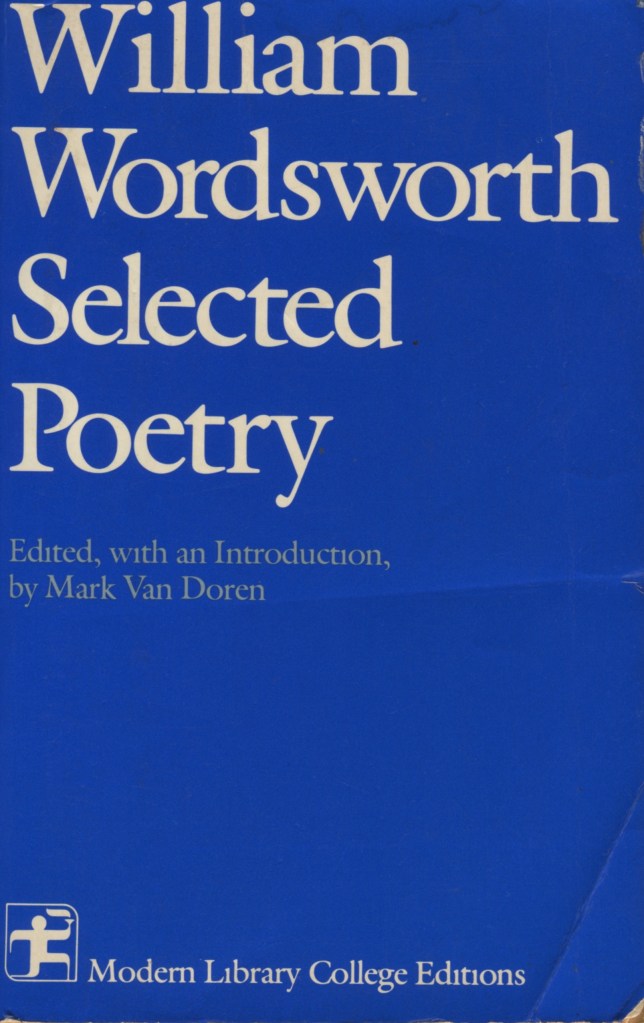
The Prelude Progress Report 2

William Wordsworth, ‘The Prelude, or, Growth of a Poet’s Mind’, in William Wordsworth Selected Poetry, edited, with an Introduction, by Mark Van Doren (Modern Library College Edition 1950), Book Fourth line 339 to Book Seventh line 618.

I’ve now been reading ‘The Prelude’ for two months, 70 lines first thing in the morning every day except one, when an an early doctor’s appointment messed things up.

It has been a pleasurable enterprise – nothing like a dose of beautifully crafted language to start a day well. The first four books dealt with Wordsworth’s childhood, his school days, his time at Cambridge, and a summer vacation from Cambridge. At the end of Book Fourth, after pages about the pleasures of summer holidays, these lines struck a chord when read during our Covid lockdown:

When from our better selves we have too long
Been parted by the hurrying world, and droop,
Sick of its business, of its pleasures tired,
How gracious, how benign, is Solitude;
How potent a mere image of her sway;
Most potent when impressed upon the mind
With an appropriate human centre—hermit,
Deep in the bosom of the wilderness;
Votary (in vast cathedral, where no foot
Is treading, where no other face is seen)
Kneeling at prayers; or watchman on the top
Of lighthouse, beaten by Atlantic waves

The next three books – Fifth, Sixth and most of Seventh – are handily titled ‘Books’, ‘Cambridge and the Alps’, and ‘Residence in London’. He constantly plays off the natural and rural worlds against the urban, busy or frivolous world. There are some satirical passages, but the best bits are the ones that celebrate the beauties of the natural world or works of the imagination. When he was about 20, he took time off from Cambridge for an epic walk across France to the Alps early in the French Revolution: Book Sixth documents the joy that filled the countryside at that time, and leads to some wonderful passages about the Alps.

And now, he’s in London, enjoying the theatre, including music hall, and being less than impressed by the way language is wielded in parliament (‘Words follow words; sense seems to follow sense’), in the pulpit, and all around him (‘Lies to the ear, and lies to every sense’). But he is struck by ‘individual sights / Of courage, or integrity, or truth / Or tenderness’, and my reading this morning finished with such a sight – a working man sitting in the sun with a sickly baby on his knee:

Of those who passed, and me who looked at him,
He took no heed; but in his brawny arms
(The Artificer was to the elbow bare,
And from his work this moment had been stolen)
He held the child, and, bending over it,
As if he were afraid both of the sun
And of the air, which he had come to seek,
Eyed the poor babe with love unutterable

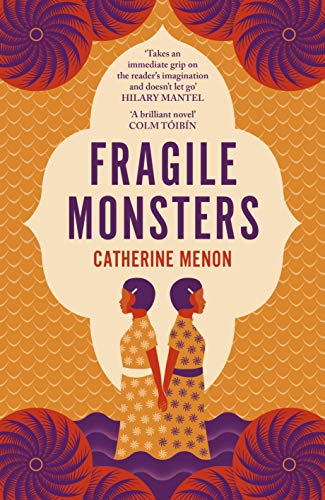
Catherine Menon’s Fragile Monsters

Catherine Menon, Fragile Monsters (Viking Penguin 2021)

It’s 1985. Durga’s relationship comes to an end when her lover returns to his wife. She leaves her job as a maths lecturer in a Canadian university and takes her wounded heart back to her native Malaysia where she gets a job at a university in Kuala Lumpur. When the novel opens she has left KL for Diwali to visit her cantankerous grandmother in the village of Kuala Lipis where she grew up. A gift of fireworks goes badly awry, the roads are shut by floods, she stays in the village much longer than expected, and while she’s there confronts the ghosts – fragile monsters – of her past.

In alternating chapters we read the story of Mary, Durga’s grandmother: her childhood, her experience of the Japanese occupation in the 1940s, the Malayan Emergency, her relationship with her daughter Francesca, who was Durga’s mother.

The two narratives come together in the climactic final chapters. Durga makes some deeply disturbing discoveries about her family history, and the great miasma of stories that she grew up with are resolved into some kind of reality.

Throughout, there’s a contrast between Durga’s world view and her grandmother’s. Durga is thoroughly westernised, and loves the world of mathematical exactness and consistency. Her grandmother is a wild woman who tells stories that differ with each telling. Durga finds herself being drawn back into her childhood world of ghosts and half-truths.

I’m glad I read this book. The characters, especially the grandmother in the present time, feel real, and there are rich insights into Malaysian traditional culture and history. (The university in Kuala Lumpur is an offstage presence that tries to pull Durga back to westernised, mathematical reality, but without a lot of success.) But it didn’t sweep me away. It was as if I could always feel the work that was going into the writing – a symptom of this is the occasional reflection on mathematical concepts. These feel like scaffolding the helped the writer create the work, but needed either to be more fully integrated or designated as darlings to be killed.