
This post continues my experiment of taking page 76 – because it happens to be my age – and writing whatever comes to mind. For a book as vast and challenging as Praiseworthy the approach would be inadequate for a thorough review of the book but it’s appropriate for a modest blog post.
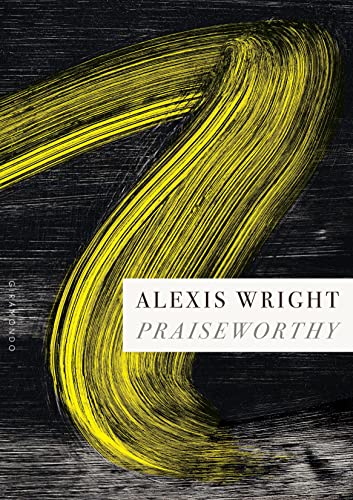
Alexis Wright, Praiseworthy (Giramondo 2023)
Page 76 of Praiseworthy is almost exactly a tenth of the way into the book. If this was a movie, it would be the moment for the first turning point, the ‘opportunity’. And maybe it is.
Tommyhawk has just been introduced. He is a pudgy eight year old, the youngest member of the family at the centre of the story. His father, Cause Man Steel (also known as Planet and Widespread), has a vision of ensuring that Aboriginal communities and culture thrive in the climate catastrophe by creating a global transportation conglomerate using feral donkeys (the book gets pretty surreal). His mother, Dance (called ‘moth-er’ for the first time on this page), has a mystical connection with moths and butterflies, and is often surrounded by millions of them. His older brother, Aboriginal Sovereignty, is to take on a weird allegorical significance as the tale unfolds.
Depending on your point of view, Tommyhawk is the book’s villain or its tragic hero. The real villains are the colonisers, who are described on the very first page as ‘land-thief criminals’ and referred to frequently as ‘the national Australian government for Aboriginal people’, but who are almost completely offstage. (All but two ‘onstage’ characters are Aboriginal.) Assimilation is the great moral evil in this book. Other characters, including the albino Major Mayor of the community of Praiseworthy, have assimilationist goals, but for Tommyhawk, as we begin to understand on page 76, it’s personal.
Tommyhawk has done well at school and has been given a bunch of electronic devices, which he uses to listen to mainstream media, and becomes entranced by the version of Aboriginal people he hears, especially a much repeated assertion that Aboriginal men are paedophiles.
On this page:
Tommyhawk became convinced that these good white righteous people were speaking to him in particular, and not to other Aboriginal children, because he was special, and this made him most at risk. He believed they were speaking directly to him, and what they were saying ran through his mind in sleepless nights this way and that while he tossed and turned in the heat until he became wholeheartedly convinced that he had not been placed on this Earth to be stuck with dangerous people. Even!
Even like his parents. They were a danger to him. That Cause Man Steel person could kill him. And Dance, the moth-er, she only noticed him, took pity when she had mistaken him for a butterfly, or as a cocooned baby being cared for by butterflies flying among the reeds, pandanus fronds, mangrove leaves, drifting in from the sea, like the story of Moses. Hatred was not a word strong enough for how he felt about his parents.
The radio voices are Tommyhawk’s equivalent of Macbeth’s witches. Where Macbeth is tempted to kill the king, Tommyhawk is called away from his Aboriginal family and culture. He decides, soon after this page, that he wants to be adopted by the Minister for Aboriginal Affairs (whom he sees as an apparition in the sky) and be taken to live in the palace of Parliament House in Canberra. It’s absurd, comic and tragic all at once. I won’t spoil it by saying if he succeeds.
I can imagine a Reader’s Digest Condensed version of Praiseworthy that was about a third as long. Such a version would capture the whole plot and and lose almost everything that makes the book interesting. The same can be said of this page. If you read it simply for what moves the story forward, what follows the paragraphs I just quoted adds almost nothing.
But you don’t read this book just for the story. Alexis Wright appeared at the recent Sydney Writers’ Festival in conversation with Ivor Indyk, her publisher. For me, the most revelatory moment of the session was when she talked about the relationship between her writing and music. While writing, she listens mostly to classical Indian music and yidaki. Both those musics have a kind of pulse to them, and she tries to create something similar in her prose. It’s the pulse of country, she said: ‘We say that we’re of one heartbeat with the country.’
The second half of page 76 is far from the most ecstatic passage in Praiseworthy. It doesn’t defy punctuation conventions or twist language in a way that so discombobulates people like me who can’t lay their internal proofreader aside (see my blog posts on Carpentaria and The Swan Book), but it’s a good example of the way Alexis Wright’s prose circles around itself in long, looping sentences, repeating motifs (‘the Australian government for Aboriginal people’), using words that aren’t technically accurate but create the right effect (‘smithereens’), tossing in an awkward cliché (‘plain as day’), making an acute observation (‘passionately, or indifferently’), all in a seemingly unstoppable flow. It’s prose that needs to be heard.
Try reading this aloud, exclamations and all. What I hope you’ll hear is the rhythm of the prose, its weirdness, and – now that Wright has given me the word – its pulse.
So! Very well then! Tommyhawk’s endless deciphering of the barrage of voices on the radio went on through the night and continued as relentlessly as the haze-loving mosquitoes buzzing around him, but neither the activity of squashing blood-bloated mosquitoes to smithereens, or growing his monstrous brain from listening to what was being said on the radio passionately, or indifferently, about the Aboriginal world, was without success. All was gained, and while Tommyhawk had initially wondered why these people were talking the way they did about Aboriginal people like himself, he finally broke the code. He knew the plan as plain as day, that his national Australian government for Aboriginal people was actually speaking directly to him through the voices of random bigots on talkback radio, or in the news, or whatever running commentary he was listening to where anyone was having a good go, giving it all about what they thought of Aboriginal people. This was how he always found the message that the government was trying to get to him. Mostly it was about how the government was trying to tell him, You must escape your black parents
Added on 16 June: Mykaela Saunders has a brilliant long review of Praiseworthy, ‘Think of the Children!’, in the Sydney Review of Books, which you can read at this link.


 Me fail? I fly!
Pingback: Combined reviews: Praiseworthy (2023) by Alexis Wright | ANZ LitLovers LitBlog
Pingback: Best books of 2023 | list the first – This Reading Life