
Julianne Schultz, The Idea of Australia: A search for the soul of the nation (Allen & Unwin 2022)
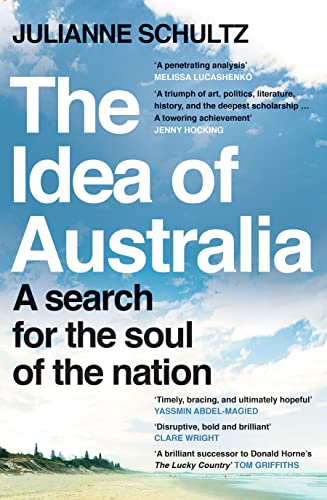
Julianne Schultz is best known as the founding editor of Griffith Review, where she made a substantial contribution to Australian literary culture over 15 years, publishing and engaging with the work of a vast array of writers (including more than one piece by my niece Edwina Shaw), facilitating a rich and complex conversation about things that matter.
The Idea of Australia was originally imagined, according to Schultz’s Acknowledgements, as a meditation, a short volume about Australia, ‘one that floated lightly over the past to make sense of the present to distil a rich, multilayered identity’. That’s not how it turned out. It’s a shaggy, baggy monster of a book, part history, part memoir, part polemic, part reportage, part Covid opus. It’s as if the process of writing that short, light mediation was disrupted by the hundreds, even thousands of voices from the Griffith Review days, each of them with a compelling case for inclusion. Add the sound journalistic and academic practices of quoting sources meticulously, and the project got right out of hand.
There are wonderful things. The twenty-page chapter on the Australian Constitution, ‘Small Brown Bird’ (as opposed to the American eagle) is a brilliant account of how the Constitution was created, and why it is so little read and so hard to change. The impact of John Howard’s time in office on the national consciousness is rendered with heartbreaking vividness in the chapter ‘Soul Destroying’. If you’re looking for a concise and engaging account of Rupert Murdoch (for whom Schultz worked for a time as a journalist) you’d have trouble finding better than the chapter ‘Power Players’. Schultz has interesting things to say about Yassmin Abdel-Magied, Kath Walker, Henry Reynolds, Bernard Smith, Alexis Wright, Mary Gilmore, Galarrwuy Yunupingu and more.
The book turns a critical eye on the idea of Australia as the land of the fair go, including well known stories of exclusion (the White Australia Policy, the dictation test, the ‘offshore solution’ and so on), and doesn’t turn away from the monstrous history of genocidal white supremacy. It is full of riches.
But too often digressions pile upon digressions; there are alarming time switches – from the early days of the Sydney colony to the late 20th century in a single sentence; the elements of memoir and family history aren’t well integrated. It looks as if the book began with the idea of Covid producing an X-ray that shows up the fault lines of our society, but that idea pretty much disappears after a couple of pages to resurface occasionally like the ghost of a discarded structure. And – this may be just me – there are some strange tics in the language: Australia is assigned the pronouns ‘she/her’; and eighty-three years, say, is regularly phrased as ‘four score years and three’. Either the copy editor was overwhelmed or her/his suggestions were overruled. The effect is weirdly alienating.
I’d be lying if I said this book is a must-read. If you know nothing about the history of Australia it is more likely to bewilder than illuminate. If you are already well-informed, depending on who you are, it will either infuriate because of its left-liberal point of view or frustrate because of the its out-of-control elements – or both.


 Me fail? I fly!