
Has there ever been a more infuriatingly pro-stupid slogan than ‘If you don’t know, vote no’?
I want to shout, ‘If you don’t know, find out!’ or, ‘My mother used to say that wilful ignorance is a sin!’
I’ve just trawled through nearly 20 years of posts on this blog and see that, by good luck as much as by virtue, I’ve been doing quite a lot of finding out. I haven’t read any books specifically about the Voice referendum, though Megan Davis’s Quarterly Essay, Voice of Reason, is my next cab off the rank. Not all my learning has made it onto the blog, but here – for anyone interested – is a retrospective tour. There’s a lot, and I’m pretty sure I’ve missed some.
The Uluru Statement from the Heart needs to be first named. It’s a tremendously weighty document that’s worth reading and re-reading, then reading again.
There’s a scattering of personal reminiscence about non-book learning:
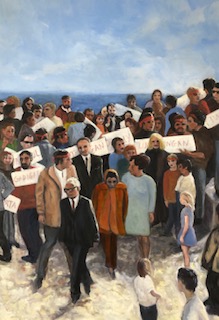
- In The Two Mrs Williamses (10 February 2006), I describe my mother’s friendship with an Aboriginal woman as I observed it as a small child. It turns out that what I thought I remembered of the contents of their conversation can’t actually have happened, but I do recall the relaxed, respectful back and forth of their talk.
- In March 2009, discussing my niece Paula Shaw’s book, Seven Seasons in Aurukun, I reminisced about my brief time in Willowra, a Warlpiri community in the Northern Territory, and how it unsettled my sense of what it means to be Australian: Australia is not a European country, but an Aboriginal country where a European outpost was established.
- In I didn’t go to the Vigil today … (June 2020) I recalled the March to La Perouse in 1970 on the anniversary of Cook’s landing, and the poem read on that day by Oodgeroo Noonuccal (then known as Kath Walker)
There are moments at Sydney Writers’ Festivals:

- In 2010 the extremely charming Boori Monty Prior struck home when he said, ‘This is the only country in the world that mines a culture and sells it off to the world but doesn’t want to know about the people who produce it.’
- in 2016 Zelda la Grange described how working for Nelson Mandela i South Africa dissolved the bubble of white privilege that had so terribly narrowed her world; and right on topic, mother and daughter Tammy and Lesley Williams described the huge undertaking it was to reclaim wages taken from Lesley under the Queensland Act
- in 2019, Nayka Gorrie reminded a packed Sydney Town Hall that White lies about Black truths have been repeated in curriculums, literature and political speeches until they have become generally accepted as truths
- In 2021, Tony Birch and Evelyn Araluen talked about the way language constrains the way non-Indigenous people can see and respond to Australian realities; and there was a brilliant a panel of Nayuka Gorrie, Melissa Lucashenko and Nardi Simpson, from which my takeaway was the contrast between extraction and reciprocity as ways of relating to Country
- Again in 2021, Bruce Pascoe and Tagalaka man Victor Steffensen spoke about the danger of losing traditional First Nations knowledge that may be crucial in the age of climate change
- This year (2023) Alexis Wright and Nardi Simpson, in separate sessions, talked about First nations ideas of time as quite different from western ideas.
I’ve blogged about non-fiction by First Nations people:
- In Southerly Volume 74 Nº 2 (2014), Jim Everett, a plangermairreener man of north-east Tasmania, explains why he refuses to identify as an Australian citizen
- Lesley and Tammy Williams’ Not Just Black and White (2015) tell the story of Lesley’s exploitation under the Act in Queensland: Lesley is about my age!
- Alexis Wright, Tracker (2017) is a multi-vocal portrait of a great man
- In Overland 230 (2018), Tony Birch’s column sheds a powerful light on the concept of Aboriginal sovereignty. Sovereignty in general, he writes, ‘is an imposed colonial concept’. Then he cites Jack Charles with a possible understanding of what true Aboriginal sovereignty might mean: ‘He could not walk by a person in need – any person in need – as an Aboriginal man claiming the right to Country.’
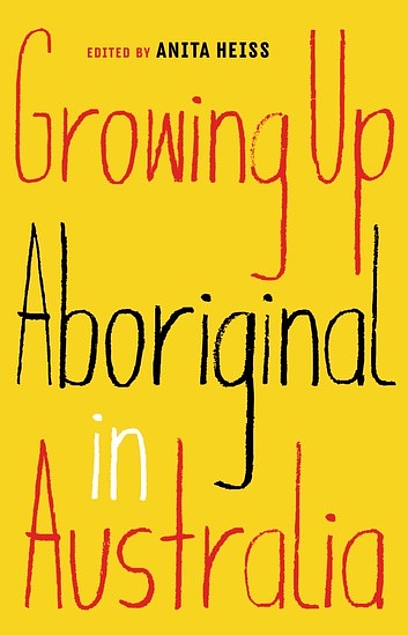
- Growing Up Aboriginal in Australia (2018), a collection of essays edited by Anita Heiss, showcases a huge diversity of First Nations voices, experiences and stories
- A swathe of articles in Overland Nº 240 amount to an impressionistic history of First Nations activism from the 1960s Referendum campaign and the Gurindji walk off from Wave Hill to Blak Lives Matter and Indigenous hip-hop
- Chelsea Watego’s Another Day in the Colony is a powerful contribution to the conversation about First Nations relationship to institutional power in Australia
- Ruby Langford Ginibi is best known for her memoir, Don’t Take Your Love to Town. The book I’ve read, Haunted by the Past (1999), could have been written to expand on the paragraph oof the Uluru Statement from the Heart’s paragraph on the incarceration of First Nations youth. I had the good fortune to share a table with this extraordinary woman at the 2005 NSW Premier’s Literary Awards (blog post here).
I’ve read a lot of history:
- T G H Strehlow, Journey to Horseshoe Bend (1969) is a personal account of a major incident in the life of a whiteman who spent his life working with the Arrenrnte people of Central Australia – how much settler Australians don’t understand!
- Heather Goodall’s Invasion to Embassy (1996) spells out the long, painful process of dispossession of First nations people in New South Wales, and deafness to Aboriginal arguments up to and including the Mabo and Wik judgements
- Kay Anderson’s Race and the Crisis of Humanism (2007) brings a coldly analytic eye to 18th and 19th century humanist European writing that set out, shockingly to our ways of thinking, to define colonised peoples as less than human
- Marilyn Lake and Henry Reynolds’ Drawing the Global Colour Line (2008) introduced me to the horror story of the racism around Australia’s foundation as a nation, and in particular the role Prime Minister Billy Hughes played in preventing the League of Nations from including a clause on racial equality in its covenant
- Grace Karskens The Colony (2009) is a fabulously readable book that leaves its readers in no doubt that at its heart the settlement of New South Wales was a genocidal project, acknowledged as such at the time in all but the actual word (which wasn’t coined until more than 150 years later)
- Mike Smith, The Archaeology of Australia’s Deserts (2013) is full of technical discussions of dating techniques, but it gives substance to often-repeated statements about how very long people have lived in Australia, and the conditions they dealt with
- Tom Griffiths, The Art of Time Travel (2016) tells the fascinating story of how the mainstream understanding of Australia has been transformed over the last three quarters of a century, mainly through the acknowledgement and inclusion of First Nations voices and perspectives
- Historian Humphrey McQueen’s essay in Overland 233 (2018) it gleefully explodes the false outrage over proposals to change the date of Australia Day
- Cassandra Pybus Truganini (2019) had my Book Group ‘staring into the abyss of our nation’s foundation story’. I also heard it discussed in a session of the 2020 Sydney Writers’s Festival, where Jakelin Troy a Ngarigu woman from south-eastern Australia offered an approving First Nations perspective on it
- Mark McKenna Return to Uluru (2021) is a wonderful study in how the settler versions of history can be turned upside down by evidence, and no one loses from the process
- Dean Ashenden’s Telling Tennant’s Story (2022) is history at its passionate best, written partly in response to the Uluru Statement from the Heart.
Other non-fiction:
- Ross Gibson Seven Versions of an Australian Badland (2002), a meditation on the so-called horror stretch, country north of Rockhampton in central Queensland that has a reputation as the setting for terrible events, forced my ears and eyes open to the horrific history of Native Police and enslavement of Melanesians in my North Queensland home. ‘Sooner or later,’ he writes, ‘any society that would like to know itself as “post-colonial” must confront an inevitable question: how to live with collective memories of theft and murder. Sooner or later, therefore, acknowledgement and grieving must commence before healing can ensue.’
- Deborah Bird Rose’s Reports from a Wild Country (2004), includes this: ‘Reconciliation draws our attention to the war against Indigenous people, and shows us the legacy of conquest: this great divide on one side of which are the survivors of this undeclared and untreatied war, and on the other side of which are the descendants of those who waged the war … The project of reconciliation demands of us that we acknowledge the divide and the violence, but it simultaneously demands that we explore the entanglements of memory, connection, and commitment.’
- Eve Vincent and Timothy Neale (editors), Unstable Relations (2016) is a collection of essays about the relationship between First Nations people and environmentalists, insisting on the complexity of forming alliances between the two groups. Monica Morgan, Yorta Yorta activist, is quoted: ‘However much non-Indigenous people say they are committed, in the long run they are committed to their society.’
- Saltwater (2016) is Kathy McLennan’s memoir of her time as a lawyer for the Townsville and Districts Aboriginal and Torres Strait Islanders Corporation for Legal Aid Services. More than any other book I’ve read and discussed on this blog, It has become the subject of controversy – In an article by Russell Marks in Overland 237 (2019), and then in Chelsea Watego’s Another Day in the Colony (2021)
- Mark McKenna, Moment of Truth (Quarterly Essay 69, 2018) is one of the first sustained responses to the Uluru Statement from the Heart that I read. It’s still worth reading
- Jess Hill See What You Made Me Do (2019) is a brilliant book about domestic abuse. One insight in particular is relevant here. She argues, with evidence, that domestic abuse was more prevalent and tolerated to a greater extent in eighteenth- and nineteenth-century England than in pre-invasion Australia
- An excellent summary-essay by Jeff Sparrow, ‘That’s what drives us to fight’: labour, wilderness and the environment in Australia‘, in Overland 246 (2022) is a solid account of the relationship between settlers and First Nations people in Australia with an eye to environmentalist concerns
Of course I’ve read novels:
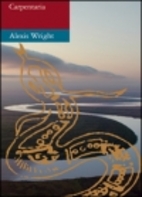
- Alexis Wright’s Carpentaria (2006), The Swan Book (2013) and Praiseworthy (2023) are vast, challenging works from a First Nations perspective
- Kim Scott, That Deadman Dance (Picador 2010). I was struck by his description of the desecration a a grave as ‘deliberate and careless all at once’. (‘If you don’t know, vote no’ is surely an exhortation to be deliberately careless.) His Taboo (2017) may be less revelatory, but it’s also a brilliant novel.
- Melissa Lucashenko, Too Much Lip (2018) is just wonderful.
- Tara June winch, The Yield (2019) ends with an appeal to the reader to make the effort of hearing a First Nations word, and to say it
- Julie Janson Benevolence (2020) brings a knockabout theatre quality to the early days of colonisation
And lots of poetry:
- When I blogged about Lisa Bellear’s Aboriginal Country in 2019, I did a brief round-up of First Nations poets I had read, including Oodgeroo Noonuccal, Kevin Gilbert, Lionel Fogarty, Ali Cobby Eckermann, Samuel Wagan Watson and Evelyn Araluen. Since then I’ve read:
- Two books by Ellen van Neerven – Comfort Food and Throat. For me, her poetry is solidly grounded in a common humanity, and then takes the reader with her to what is specific about her experience as a First Nations person
- Australian Poetry Journal, Volume 10, Number 1: modern elegy has a whole section edited by Ellen van Neerven featuring the work of First Nations poets
Added a day later: As I expected, there were some big omissions in that list. The Emerging Artist reminded me of:
- Kim Mahood’s Position Doubtful (2016), which, I said in my blog post, ‘will grip anyone interested in Western Desert art, or the question of how to live awarely as a non-Indigenous Australian’.
- Archie Roach’s warm, generous autobiography, Tell Me Why (2019)
There are sure to be others. I’d welcome your additions and recommendations in the comments section.


 Me fail? I fly!
What a wonderful collection of links (so much good information there) – and I couldn’t agree with you more. Thank you!
LikeLiked by 1 person
Thanks, Maggie.
LikeLike
Gosh, I think I’ve kept up, but I’m not in your league.
LikeLiked by 1 person
If you looked back, I’m pretty sure you’d find a list a lot like mine!
LikeLiked by 1 person
Wonderful listing Jonathan. Thank you.
Plus I would add Kim Mahood. Wandering with intent In her splendid style.
LikeLiked by 1 person
Thanks, Suzanne. That book is high on my TBR list. Penny loved it
LikeLike
Great list. I wonder if it’s a problem that having tried to inform and expand our knowledge via such texts, we have been lulled into believing that things would be different in the future?
LikeLiked by 1 person
Yes, something about class maybe?
LikeLike