
Megan Davis, Voice of Reason: On Recognition and Renewal (Quarterly Essay 90, 2023)
– plus correspondence in Quarterly Essay 91
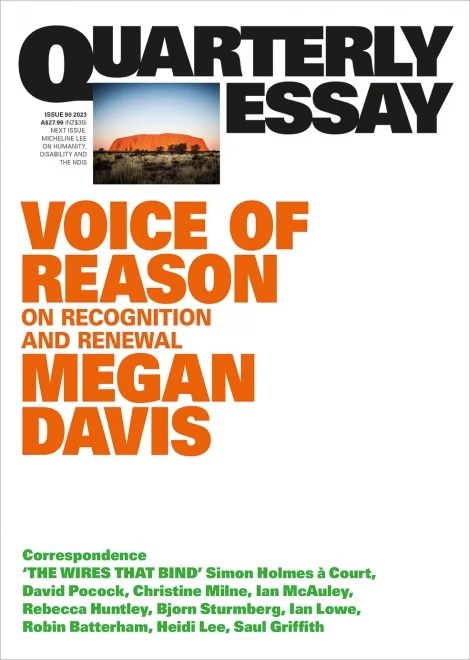
As we approach voting day on the Indigenous Voice to Parliament, bad-faith arguments multiply and I don’t intend to add to the clamour. But I can recommend this Quarterly Essay by Megan Davis, one of the architects of the consultation process that led to the Uluṟu Statement from the Heart.
It’s short – just 66 pages. It’s personal – Ms Davis gives enough of her story that we know who she is. It’s instructive – she tells how the proposal for the Voice evolved through several official processes under several Prime Ministers. It’s respectful – it understands why some First Nations people might vote against the proposal, and argues the case with them. It has heroes and villains – John w Howard and Tony Abbott feature as wreckers; Yunupingu as a leader. It’s not into blame and rage. It has hope. And it’s utterly convincing.
If the referendum fails, as current polls suggest, this essay will bear re-reading for decades to come, though it will have to be read through tears.
You don’t have to buy a copy. At least for now you can read it on the Quarterly Essay website, beginning at this link.
My blog practice is to look a little closely at a single page. Usually it’s page 76 (my age). As there is no page 76 in this essay, here’s a little about page 47 (I was born in 1947).
In 2015, there was apparently bipartisan parliamentary support for constitutional change acknowledging that Australia was first occupied by Aboriginal and Torres Strait Islander peoples, recognising their continuing relationship to the lands and waters, and expressing respect for their ‘cultures, language and heritage’. That is to say, it looked like all systems go for symbolic recognition: nothing about non-discrimination, and no structural change. A group of 40 First Nations leaders met with Prime Minister Tony Abbott and Opposition leader Bill Shorten, and explained that such a change ‘would not be acceptable to Aboriginal and Torres Strait Islander peoples’ (the quote is from the Kirribilli statement). This meeting led to the consultation process that produced the Uluṟu Statement from the Heart and the proposal for an Indigenous Voice to Parliament. (It also proposed a Makaratta / Treaty and a truth telling process, but those aren’t on the table just yet.)
On page 47, Megan Davis hits the pause button in her recount of the history:
The thing I could not shake from my head was watching the prime minister and Opposition leader sit at the head of the table while forty people from forty communities spoke about the structural problems their communities faced. What is it like to be the leader of a nation and encounter a polity that is profoundly unhappy?
At this time, as one of the main Indigenous lawyers working on constitutional reform, I found it difficult to understand why politicians failed to hear what First Nations leaders and community members were saying. I had a textbook idea about how political and law reform work, but none of it applied to our people.
There were two challenges I saw. One is that politicians meet with Aboriginal leaders on a myriad of issues, but often First Nations do not feel heard and politicians and advisers do not listen.
The second is the impact of telling your story over and over again and not being heard – what effect does this have on health and wellbeing?
Which comes close to being the heart of the argument for a constitutionally enshrined Indigenous Voice: it’s not that First Nations people haven’t been speaking, it’s that the necessary people haven’t been listening – because, as Megan Davis argues elsewhere in the essay, they don’t have to.
That’s just a tiny part of the essay. The whole thing is worth reading.
The correspondence in QE 91 includes some big names, in particular historians Mark McKenna and Henry Reynolds, and some brilliant fleshing out of the issues by First Nations and other writers. Megan Davis acknowledges them all as ‘worthy and inclusive commentary on the essay and on this historic moment that we are barrelling towards’. She singles out the joint contribution from Sana Naka and Daniel Bray, a Torres Strait Islander woman and a man of European heritage who write about the way their family is constantly negotiating intercultural complexity. She gives them the last word in her response. Following her lead, I’ll end the blog post with the same quote from them:
Structural injustice exists because that is how our political system is structured. We are getting exactly what the system was designed to deliver. A Voice to Parliament alone cannot specifically redress every injustice, but it will connect people to power in a way that currently does not happen. Democracy demands nothing less.


 Me fail? I fly!