Monthly Archives: Jan 2024

David Marr’s Killing for Country at my Book Groups

David Marr, Killing for Country: A Family Story (Black Ink 2023)

I’m a member of two book groups. This month, they both focused on Killing for Country.

Before the meetings: An ‘ancient uncle’ asked journalist David Marr to explore their family history. As Marr complied, he came upon a photograph of one of his ancestors in the fancy uniform of the Native Police, the infamous organisation in which white officers led Indigenous men in extrajudicial killing sprees in lands that are now known as northern New South Wales, Queensland and the Northern Territory. Marr realised that this was a significant project and set about writing the interwoven stories of his forebears and the Native Police.

I imagine most of the book’s readers will know the broad outline of genocidal massacre that was instrumental in taking possession of the land in these parts of Australia, as elsewhere. Most of us now know that the euphemistic language of ‘dispersal’ and ‘punitive expeditions’ covers terrible atrocities. For me, Ross Gibson’s 2002 book Seven Versions of An Australian Badlands was a turning point. Rachel Perkins’s monumental TV series, The Australian Wars (2022), did heroic work in dispelling any residual beliefs that Australia was settled peacefully, and the Native Police featured in the third, heartbreaking episode. Anyone wanting to cling to such beliefs is advised to stay away from Killing for Country.

Marr follows the thread of his own family’s story through the complex history. He doesn’t try to be comprehensive. He makes no mention, for instance, of the punitive expeditions led by Sub-Inspector Robert Johnstone in Mamu country, the part of Australia that I come from. And professional historians will no doubt find fault with his work – he is too concerned to push his agenda, perhaps, and not judicious enough in checking his sources for sensationalist or other motivations, the kind of criticisms made of Robert Hughes’s The Fatal Shore. It certainly won’t please the columnists of Quadrant or commentators on Sky News at Night. But, as Marcia Langston says on the front cover blurb:

If we want the truth, here it is told by David Marr.

Told by David Marr means told well. I attended one of the many public talks Marr has given about the book, and on that occasion I was struck by the heavily ironic way he spoke of the perpetrators and justifiers of colonial violence as profoundly respectable men. It felt wrong, somehow, to praise them, even in mirthless, defensive jest. The book does none of that. In writing it down, evidently, Marr had no need for such defences. But the reader, this one at least, needs to take frequent breaks.

This is a key part of White Australia’s foundation story: brutal mass killings, including breathtakingly callous first-person accounts, followed by pseudo-euphemistic newspaper accounts (‘with the usual results’ is one memorable phrase to indicate many deaths) or political justifications. When I was reading the book, I watched Prosecuting Evil, a TV documentary about Nazi murders of Jews, and some of the horrific footage was an exact match for scenes described in this book.

There were people at the time who named what was happening in terms we can recognise, and many of those voices are also present here.

This isn’t history that can be comfortably consigned to the distant past: Marr is writing about his own family, and about history that constantly chimes with the present, or perhaps has never gone away. ‘Let no one say the past is dead,’ Oodgeroo wrote. ‘The past is all about us and within.’

It’s my custom on this blog to have a close look at Page 76. Weirdly perhaps, that page, chosen arbitrarily because it’s my age, often shows a lot about a book.

In Killing for Country, page 76 is the beginning of Chapter 7, ‘The Creeks’, which deals with two massacres, at Waterloo Creek and Myall Creek, and their aftermaths – the first a whitewash, the second a major scandal and a court case spearheaded by Attorney General John Plunkett, one of the settler heroes of the book, leading to the execution of seven murderers, but also leading, as Marr points out, to secretiveness on the part of later murderers of Indigenous people.

This page is pretty much the full treatment of the Waterloo Creek massacre. The Native Police, the main subject of the book, have yet to be established, but this brief account of a massacre by white troopers is something of a template for much of what is to follow.

Governor Richard Bourke, having tried without success to limit the activities of the squatters in their treatment of convicts and the traditional owners of the land they claimed, resigned and sailed back to England . In December 1837. His successor George Gipps was to take office in February 1838. In the meantime:

Reports had reached Sydney of fresh depredations by the Kamilaroi.

It’s worth noting here that Marr take great care with names. While his sources, such as the quote from the Sydney Herald below, refer to ‘Blacks’, ‘tribes’, and so on, Marr himself always specifies which First Nations are being talked about, in this case the Kamileroi. This simple act has a powerful cumulative effect, as nation after nation comes into conflict with the military, with vigilante convicts, and with the Native Police.

The Herald was baying for blood.

THE POOR BLACKS- Letters have been received from the Northern parts of the Colony, which state, that the Blacks are murdering the shepherds and stockmen with impunity. These letters also inform us, that the same tribe of Blacks are destroying the cattle by hundreds.

‘Baying for blood’ may be the kind of thing that professional historians would steer clear of, but I like the way it spells out what the newspaper leaves unspoken (these people are murderers and mass destroyers of cattle, therefore …). Elsewhere, Marr quotes newspaper correspondence and other contemporary sources pointing out that the ‘murders’ and ‘destruction’ are perpetrated by people defending themselves against an invasion or avenging atrocities committed against them. Such arguments are roundly mocked by the mainstream as sentimental wailers ‘desirous of acquiring a reputation for humanity’ – the tone isn’t so different from some of our current media talking about virtue-signalling latte-sippers.

While waiting for the new Governor to arrive, the Colony had been left in the hands of Colonel Kenneth Snodgrass, a capricious veteran of the Napoleonic Wars, who gave Major James Nunn of the 80th Regiment a free hand to deal with trouble on the plains. ‘You are to act according to your own judgement,’ said Snodgrass, ‘and use your utmost exertion to suppress these outrages.’

The fabulously named Kenneth Snodgrass, deftly characterised and contextualised in seven words, makes no other appearance in this story, but his instructions foreshadow the vague instructions given to officers of the Native Police. Without fail, the politicians giving the orders retain deniability. Their intentions are clear, but they consistently refuse to give explicit instructions to kill. All the Native Police massacres were illegal, and directly counter to general policies emanating from distant Britain, but no one was ever held accountable for them. At Waterloo Creek, the troops and mounted police were white, and so even less likely to face legal consequences.

At Waterloo Creek on 26 January 1838, Nunn’s troops and Mounted Police drove a large number of Kamilaroi into a swamp and slaughtered at least fifty.

One of my difficulties with the book is that I often lose track of dates. For example, I kept waiting for the moment when the narrative would intersect Melissa Lucashenko’s novel Edenglassie, in which the Native Police play a role. But 1854, Edenglassie‘s year, comes and goes without being named. So the explicit dating of this incident stands out. Serendipitously, I’m writing this on 26 January, a public holiday when fewer people each year choose to celebrate Australia Day. I’m guessing that Marr was struck by the significance of the date and left it there as a grim easter egg. The Waterloo Creek massacre happened on the 50th anniversary of Arthur Phillip raising the Union Jack on Gadigal land. A hundred years later, William Cooper declared the date to be a day of mourning. Today there’s a struggle over whether it’s Australia Day or Invasion Day.

Afterwards, Nunn found a few bits and pieces in their camp which convinced him he had punished blacks involved in the murder of Cobb’s shepherds on the Gwydir, a crime for which hundreds had already been killed. Back at Cobb’s head station, Nunn boasted to the appalled squatter of ‘popping off with his holster pistols the Blacks whenever one appeared from behind a tree’.

Again, this foreshadows how things will go. Where killings had to be accounted for, the commanding office would find or fabricate some dubious evidence to justify it. When Gipps presented Nunn’s account of the massacre to his Legislative Council, according to Marr he knew it to be a whitewash, but nothing more seems to have been done about it. Nunn’s boast was reported years later, according to a note, by Lancelot Threlkeld, another of the book’s settler heroes. Again and again, we see private boasting recorded in memoirs or letter, as opposed to public justifications.

I kept thinking of the last line of Bob Dylan’s ‘The Lonesome Death of Hattie Carroll’: ‘Bury the rag deep in your face, for now’s the time for your tears.’

After the first group’s meeting, Friday night: For this group, we had ambitiously agreed to read and discuss two books, Killing for Country and Debra Dank’s We Come with this Place. I wrote about Debra Dank’s book a while ago, here.

There were five of us. Only two had read all of Killing for Country. Of the others one said she gave up after 10 or so pages because she wasn’t interested in the wool industry and early colonial politics, another read about the same and decided she needed to read something more relevant to her life plans, and the third is still reading it, though she’s suspicious of it because she’s also rereading solid works of history like Heather Goodall’s From Invasion to Embassy and Grace Karskens’s The Colony.

All the same, once the slackers had been duly reprimanded (not by me, I hasten to note), we had a terrific conversation. While acknowledging the huge amount of work that went into the book, and that it had opened her eyes to a history that just hasn’t been told, the other completer said she found it unsatisfactory: leaping from place to place with maps that didn’t always help, likewise leaping from character to character, lacking a solid analytical context. She and the history-reader saw as bugs the things that I was content to note as mildly inconvenient features that resulted from the basic decision to follow the careers of particular David-Marr-related individuals.

There was some discussion of David Marr’s decision not to include Indigenous voices. I think he gave a good account of that in his final chapter:

This is a white man’s view of this history. I’ve drawn on rich Indigenous resources to write the bloody tale of Mr Jones and the Uhrs, but I found it was not my place to give the Aboriginal view of this tangled history. I asked Lyndall Ryan, veteran of so many academic battles on the frontier, which Indigenous scholars I should read. Indigenous scholars, she said, research particular incidents in their country. ‘But they don’t work on the frontier wars. The topic is whitefella business.’ An Indigenous colleague I’ve known for years put it this way: ‘You mob wrote down the colonial records, the diaries and newspapers. You do the work. You tell that story. It’s your story.’

(Page 409)

Others still felt that there was a glaring absence in the book.

The non-readers were appropriately contrite and asked productive questions.

We had all read and loved We Come With This Place. The mood lifted as we discussed it. Smiles came back to our faces, and we found ourselves flipping through the book to quote bits.

After the second group’s meeting, Tuesday night: This is my much loved, long-running, all male group (I’m the only man in the other).

I had a runny nose on Saturday night and a positive RAT on Sunday morning, so was stuffed with antivirals on Tuesday and couldn’t be there for this discussion. In the WhatsApp chat ahead of time, one man said he couldn’t read the book: ‘It was too brutal and depressing.’ Another sent us a lnk to The Australia Institute’s webinar with David Marr. After the even the WhatsApp reports said there was at least an hour’s worth of animated discussion.

I guess I’ll watch the webinar when I’ve had a little lie-down.

Ken Bolton Starting at Basheer’s

Ken Bolton, Starting at Basheer’s (Vagabond Press 2018)

I’ve come late to Ken Bolton’s work. He has been a presence on the Australian literary scene for half a century. His Wikipedia entry lists 20 books under the heading ‘Poetry: Collections and Chapbooks’, beginning with Four Poems in 1977, with a print run of just 300 copies. He has published more than one small magazine, operated a small press and written art criticism as well as poetry.

Before Starting at Basheer’s, I’d read only one book by him, London Journal London Poem (2015). That book consists mainly of one long poem in which the poet and his partner Cath (writer Cath Keneally IRL) visit their son Gabe and his partner Stace in London. When Gabe appears in Starting at Basheer’s, he is in London while the poet is mostly at home in Adelaide, working, people-watching in cafes, or staying up late at night. The poems have what looks like an easy spontaneity, so they are something like what New York School poet Frank O’Hara describes as ‘I do this I do that’ poems. (This isn’t just me showing off what I learned in the ModPo course I did last year. O’Hara crops up a number of times in this book; if you’re interested you can read a little about him and ‘I do this I do that’ here and here.)

On first reading, I just loved this book. It felt as if I was invited to share relaxed moments with someone who just happens to have a lot in common with me demographically. We’re both middle-class white Australian men in long-term relationships with women, with sons we admire and love. We were born two years apart, and may even have been at Sydney University at the same time. Friends are occasionally mentioned by first name only, and sometimes I know who they are (‘Pam’, for example, is the poet Pam Brown, ‘Laurie’ is Laurie Duggan, and ‘John’ is probably the late John Forbes). Further readings left me feeling less of an insider, but enjoying the poetry no less. Bolton knows a lot about poetry and art and movies, and wears his knowledge so lightly that you don’t notice that you’re learning things or being challenged until you hang around a bit. It’s his erudition that has stood out more on subsequent readings.

It’s always handy when a poet give us a phrase describing what they’re up to. Bolton does that a couple of time in this book. ‘Up Late (August Mute)’ on page 103 has these lines:

_________But I am
'up-at-night',
again

___ ... proving I'm here, alive
taking stock of things
registering the moment:

me, the hum from the
fluoro light, the mess

– relative – I keep
this room in

‘POEM (“I reach”)’ ends:

And I write a poem today myself:
not very good, of that I'm sure –
but it marks the moment.

These poems are generally about registering or marking the moment, including whatever is going through his mind and the incidentals of his surroundings. There’s often a spontaneous, unrevised feel (the poem may not be ‘very good’), but I can promise you it’s not easy to get that casual feel and still be readable, let alone as enjoyable as these poems are.

Sticking to my practice of writing about page 76, here it is (click to make large and legible):

Read out of context, the page amounts to an almost self-contained piece of chat about an old movie. In context, it’s a lot more interesting than that.

It’s part of a long poem (131 lines), ‘Dear Gabe,’ (the comma is part of the title), one of two poems framed as letters to Gabe in London. The poem has the informal feel of a tossed-off letter: the syntax and spelling can be loose, and even the line breaks feel relaxed. It’s written the day after a phone conversation, and Bolton, or the speaker of the poem, visualises where Gabe was calling from, using his recent photo of Gabe and his partner Stacey. He paints a picture of the family home where he was during the call, and then:

It would be good to have you back home –
or to be over there with you is the
alternative.

Which leads to the possibility of meeting up in Rome for a couple of weeks. Turn over to page 76, and the mention of that possibility has sent the poem/letter ricocheting in a different direction. It’s not exactly a digression, because the whole thing is a post-phone-call rumination with no main thesis or agenda or narrative thread (‘I think this I think that’, if you like):

Two Weeks in Another Town was a not very good novel 
& a bad & unintentionally funny
film: an American in Europe, up against all its
shocking amorality, venality & corruption:
Kirk Douglas playing a guy brought in to
save a falling director, get the movie back in production,
on budget, & quickly in the can.

You don’t need to have read Two Weeks in Another Town (Irwin Shaw 1960) or seen Vincente Minelli’s 1962 movie to understand and enjoy these lines, but as a dedicated blogger, I rented the movie from a streaming service. (I’m not dedicated enough to read the novel, sorry!).

That plot summary is as good as you’re likely to find.

on budget, & quickly in the can. Italy. You can 
imagine. Well, you can't. I can.

Of course, the reason for the plot summary is that the letter-writer doesn’t expect his son to have seen the movie, and in these lines he realises that he is speaking across the generations. He may also be realising that he has been to Italy and Gabe hasn’t.

imagine. Well, you can't. I can. The world is 
spared, today, much exposure to Kirk
at full throttle. It was possibly an attempt
to make something like La Dolce Vita, but
understandable-for-Americans, & with a 'clear
moral point of view' – as they used to say,
the duller critics.

That’s funny and spot-on. ‘Kirk / at full throttle’ made me particularly glad I’d seen the movie: near the end, Kirk Douglas’s character, eyes bulging, drives a car at breakneck speed through the Italian countryside scaring the living daylights out of the woman in the passenger seat, all somehow establishing that he’s not crazy. Ken is right to assume that Gabe and I (and probably you) don’t need to have the reference to Fellini’s La Dolce Vita spelled out for us. I don’t know if I’ve actually seen that whole movie, made two years before Two Weeks, but Fellini’s general use of carnivalesque images contrasts marvellously with the weird, frozen faces of the ‘decadent’ Romans in the final scenes of the Kirk Douglas movie.

the duller critics. America has slipped a bit 
in the innocence ratings. But Italy ... Berlusconi
might have stepped right out of Kirk Douglas's
nightmare.

Well, yes. There’s no date on this poem, but if it was written after Trump’s (first?) election, ‘slipped a bit’ is a delicious understatement. The Berlusconi reference could have been made anywhere over a stretch of decades. The date really is immaterial: the same observations could have been made any time in the last 20 (even 40?) years.

Back to the proposal to meet up:

___________ That said, Shall we go?

(It may be that we won't. The duller critics
are back! One of the dullest now runs things
in the Australia Council – so, no money for me
in the foreseeable future. No travel. No Italy.)

A bit of literary gossip that would surely delight those in the know, but sadly no names. I went so far as to look up recent heads of the Australia Council (which became Creative Australia last year), but I have no way of telling who the dullest of critics is/was. A footnote identifying him or her might have gratified a lust for scandal, but wouldn’t have made a difference to the poetry, which is after all what I’m reading for. (Relaxed though their style may be, these poems don’t hesitate to pick a fight. There are other similarly non-specific snippets of gossip – notably the mention of legal issues with Les Murray’s estate in ‘In Two Parts, a Letter’, the other letter to Gabe which also, incidentally, includes insightful chat about a film, in that case Les enfants du paradis.)

Then the poem turns again:

There is no news: I mean, you're up-to-date –
nothing to tell of news from here.

It’s a letter, you’re supposed to give some news. But this is a letter following so soon after a phone call, so nothing new to say. All the same, the writer is called on to say something about himself:

nothing to tell of news from here. It seems so ridiculous 
to be my age, that, tho I feel okay, one can't
help thinking about it. I would certainly like
to see you more

It’s as if the whole poem has been circling around something, and now hits it with the word ‘it’, only to recoil immediately. The speaker, with no matter-of-fact news to give, almost accidentally mentions a persistent preoccupation. I love the elegant way the verse communicates that though he ‘can’t help thinking about it’, he has trouble talking about it. He prefaces the reference by describing it as ridiculous, he says he feels okay (clearly intended to be the opposite of ‘it’), he uses the pronoun ‘I’ everywhere else, but here uses ‘one’. Nor can he explicitly say what ‘it’ is.

(Lest you think an explanation is to come on page 77 – nah! Those lines spell out how much he’d love to see his son, and the poem ends with a description of the circumstances in which he’s writing – alone late at night, with jazz playing – and what he imagines is happening at Gabe’s end:

And school kids soon will start walking up Jermyn Street
& young mums will appear & you will play guitar a bit,
& then get to work

Note the absence of a full stop. This correspondence will continue.)

So what is ‘it’ that can barely be mentioned and must not be named? There’s no mystery really. All that has gone before – the cross-generational movie talk, the reference to duller critics of the past who are back again, the changing status of the USA, and earlier reflections on the way the family house has changed over the years, all this has been quietly and persistently marking the passage of time. It would probably be going too far to say that ‘it’ equals death. But I do read it as referring to mortality. He’s not saying, ‘I’ll be dead soon, so I’d like to see you.’ In fact, he’s carefully not saying that: ‘I feel okay … I would certainly like to see you more.’ He quickly moves back to the question of catching up with each other, but the glimpse into the abyss, however brief and hedged about, remains, and the poem has done its work.

These lines from another poem – ‘Poem (“this notebook’s”)’ (page 118) – are relevant:

something serious
or something that 'becomes serious' –
that old trick. Is there
a name for that sudden
pounce or 'descent'
into gravity?

Maybe what I’ve just been describing is exactly such a sudden pounce or descent, and a release or ascent that is just as sudden.

The book is full of such unspectacular, but deeply human moments.

Reading with the grandies 33: The Skull and Madeline

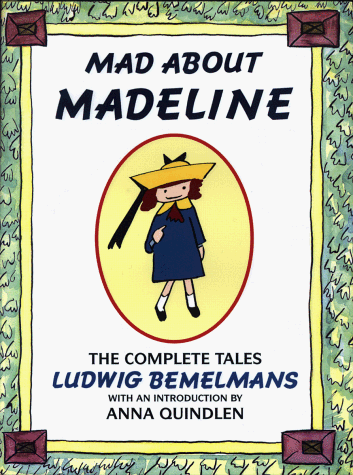
This blog couldn’t possibly keep up with my grandchildren’s reading. The other day, the six-year-old pleaded to go to the library, and in the very small time we had there she chose a book about a girl called Paris who visits Paris. A little later a friend saw this book and offered to lend us her Madeline compendium. After I’d calmed down from reciting the first 10 pages or so of Madeline (which the Emerging Artist claims never to have heard of, so who knows how, when and where I got to know most of it off by heart), we accepted her offer.

Meanwhile, the grandies’ father brought home a new book by Jon Klassen, a writer and ilustrator of a very different kind.


Ludwig Bemelmans, Mad about Madeline: The complete tales (Viking 1993)

This huge volume includes all six Madeline books, in order of appearance here:

  • Madeline (© 1939)
  • Madeline and the Bad Hat (©1956)
  • Madeline’s Rescue (©1951, 1953)
  • Madeline and the Gypsies (©1958, 1959)
  • Madeline in London (©1961)
  • Madeline’s Christmas (©1956)

We read the first story to the three-year-old. The six-year-old was interested in other things, but her ears pricked up in the course of the reading – it may have been the insistent rhymes, or the sense of danger (‘To the tiger in the zoo / Madeline just said pooh-pooh’), but she joined us and then asked for that story to be read two, or maybe three, more times right then. She listened with intense concentration. Her little brother was interested in why Madeline said ‘pooh-pooh’, but her focus was a lot less scrutable.

In case you don’t know, Madeline is the youngest and boldest of 12 little girls (‘in two straight lines’) who lead a regimented life in an old house in Paris all covered in vines. In just a few lines of verse per beautifully illustrated page the story unfolds of her having her appendix out. When the other girls see the treats she receives in hospital, and the scar, they want to have theirs out too. The illustrations, meanwhile, amount to a guided tour of Paris’s famous sites. (The three year old didn’t care about Montmartre or the Eiffel Tower, but he loved the ambulance every time.)

That’s the first book. Of the others, I most enjoyed Madeline’s Rescue, where Madeline falls into the Seine. In the first book, the text ‘Nobody knew so well / How to frighten Miss Clavell’ accompanies an image of Madeline balancing precariously on a wall above the river. That’s repeated in Madeline’s Rescue, but the facing page image shows her falling, with the text, ‘Until the day she slipped and fell.’ She is saved by a dog, who then goes home with the little girls. There’s a riot in the dormitory over who the dog will sleep with. In the end, the dog, whose name is Genevieve, has twelve puppies and everyone is happy.

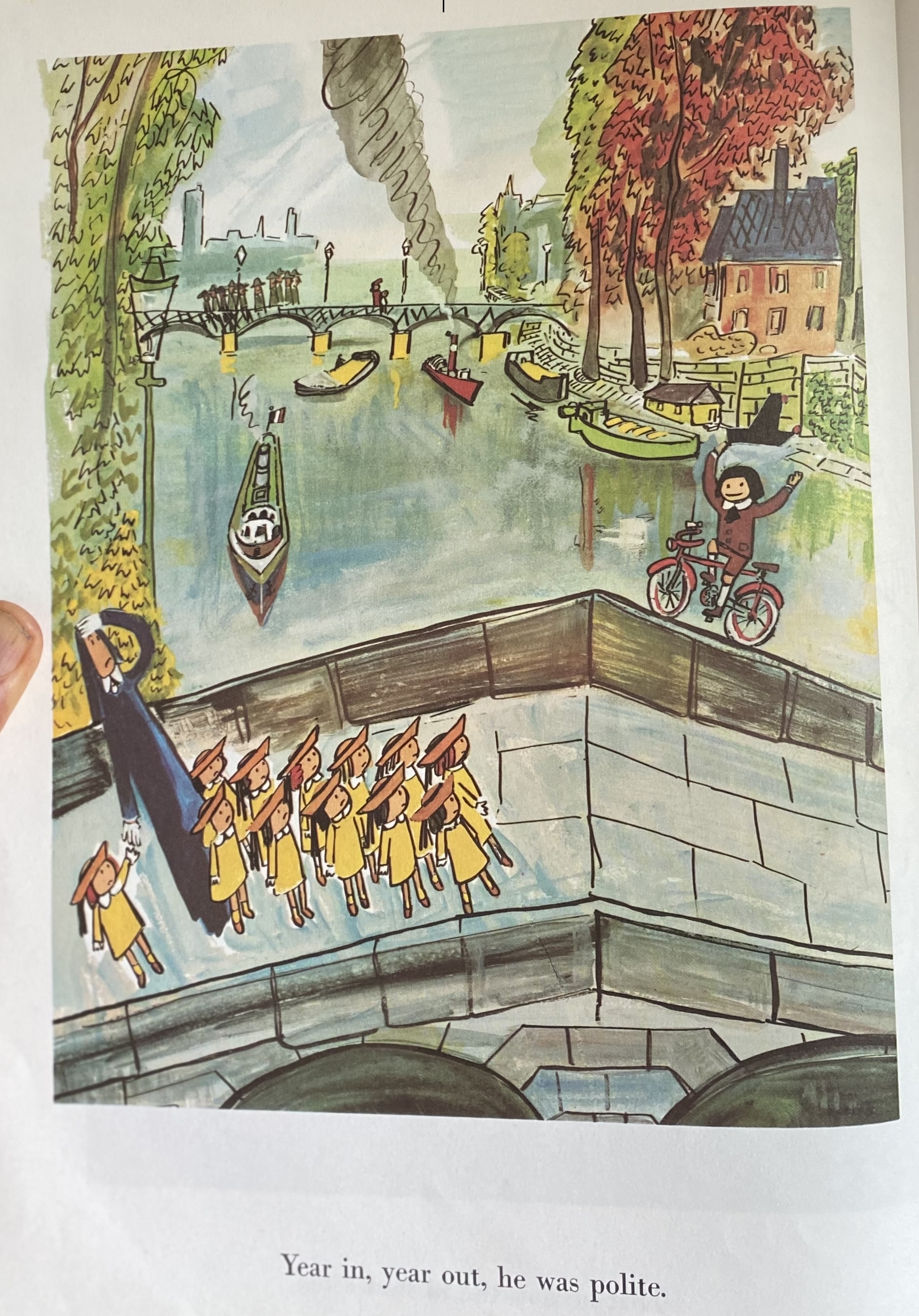
Page 76 falls in my least favourite of the books, Madeline and the Bad Hat, in which Pepito, who lives next door to the girls, behaves abominably. He is cured of his wicked ways in the end, but we didn’t get there in our group reading, as the six-year-old didn’t see why she should persist with the tale of misbehaviour – and the three-year-old had his own reasons for not being interested in someone else’s bad choices (a phrase heard too often at his childcare centre). But page 76 is a lovely example of Ludwig Betelmans’ artwork (click to enlarge), and the way it plays with the text:

Pepito is riding dangerously on the edge of the bridge, causing Miss Clavell to clutch her brow (she does a lot of that, and she is often seen slightly off balance as she is here, holding Madeline’s hand) and alarming the little girls. However, as the text points out, he is raising his hat politely. Most of his bad behaviour, in fact, is seen in the images but either ignored or downplayed in the text – so we know he is sneakily bad, and mostly avoids adult retribution. On the next page, for example, the text reads, ‘He was sure and quick on ice,’ and we see him running rings around all the little girls at a skating rink, knocking them off balance. I begin to understand my granddaughter’s concentrated attention.

That’s all happening in the foreground. The background (gouache, I think) is where the charm of these books lies: the bridge itself, of course, is beautiful, then there is the other bridge across the Seine, the boats and the trees with their autumn colours.

This is one from the past that has survived the passage of time brilliantly.


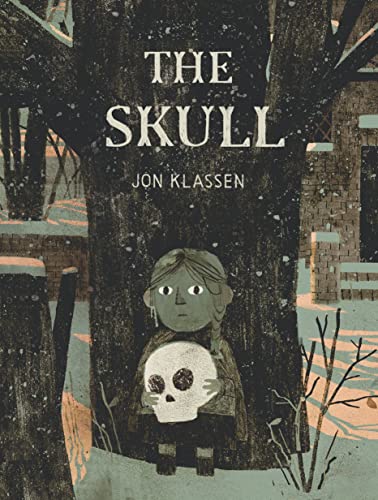
Jon Klassen, The Skull: A Tyrolean Folktale (Walker Books 2023)

John Klassen is a favourite in our family. See, if you like, my blog posts on I want My Hat Back (2011), This Is Not My Hat (2012) and We Found a Hat (2016).

This book is less minimalist than those earlier ones, but just as grimly comic. In the folktale that it’s based on, a little girl befriends a skull, and a headless skeleton demands that she hand it over. In Klassen’s version the girl, whose name is Otilla, refuses to surrender the skull, manages to outwit the skeleton and dispose of it in a gruesome way that ensures it will never return. She and the skull, it is implied, live happily ever after.

I wasn’t at alI sure how suitable this story was for my squeamish granddaughter and vulnerable grandson. I read it with them once, and moved on as quickly as I could. I can only assume that their father and/or mother read it to them a number of times before we next saw each other, because they both started chanting, ‘Give me my skull. I want my skull,’ and then roared with laughter when, on the fourth or fifth repetition, they fell silent after ‘my’. In the book, that’s the moment when the skeleton falls off the castle wall and is broken up. I guess Jon Klassen is a better judge than I am of what children will enjoy.

Page 76 is blank, before the start of a new chapter, so here’s the preceding spread, to give you an idea of the storytelling:

This is just after the terrifying encounter with the skeleton that ends with it falling off the wall. Otilla is about to gather up its bones, smash them, burn them and throw them into a bottomless pit. But first there is this still, intimate moment. The tenderness of the text – Otilla carries the skull quietly and pats it gently – is beautifully realised in the warmth of the candlelight, the way the blanket covers the skull’s mouth, Otilla’s calm expression.

These books are unlikely blogfellows, but there’s an unexpected echo of Madeline on this page from The Skull. Aficinados will recall the final moment of the first Madeline book:

And she turned out the light –
and closed the door –
and that's all there is –
there isn't any more.

Joe Biden and Heather Cox Richardson

I’m a free subscriber to historian Heather Cox Richardson’s daily Letter from an American. It’s a great source of information about US politics, putting current events in their historical context. I’ve learned a lot.

Recently she sat down to interview Joe Biden, and put the result up on YouTube. It’s just seven minutes, and Biden’s measured, clearly heartfelt conversation makes a brilliant contrast to the vicious bluster of the other guy. Have a look:

Micheline Lee’s Lifeboat

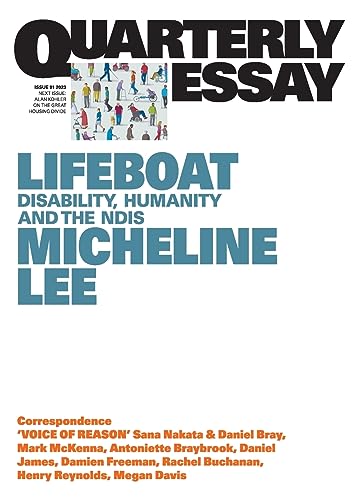
Micheline Lee, Lifeboat: Disability, Humanity and the NDIS (Quarterly Essay 91, 2023) – plus correspondence in Quarterly Essay 92

Micheline Lee is a novelist. In this Quarterly Essay and in her reply to correspondents in the following one, she demonstrates that she is a master of the killer last line. The essay ends with a personal story. When she was eighteen, anxious at the prospect of becoming increasingly disabled, she went travelling in Europe and Africa alone, without any support:

I remember Kamanja, a man I met in Kenya. He was one of many people who came my way and helped me through, who pushed me in my wheelchair and carried me when I was at a low ebb and battered. I started to thank him. He held out his hand for me to stop. ‘I help you because you need help,’ he said.

(Page 59)

Her reply to correspondents ends with a reference to Ann Marie Smith, who died in Adelaide in 2020 after years of extreme neglect while on a full time care plan with the NDIS:

If Ann Marie Smith had had one friend in the world, the abuse she suffered over three years that finally took her life would not have happened.

(Quarterly Essay 92: The Great Divide by Alan Kohler, page 122)

The essay lays out the origins of the National Disability Insurance Scheme, its underlying principles and goals, and the massive faults in its implementation, but it also offers sharp insights into lived experiences of disability – and the overwhelming importance of meaningful human connection.

The medical, or individual, model of disability defines disability as individual deficit or tragedy. The social model ‘demonstrates that the problems people with disabilities face are the result of exclusion and social and environmental barriers’. The activists whose lobbying led to the creation of the NDIS were proponents of the social model. The NDIS was intended to serve the needs of people who otherwise could not participate in society, and was to be one part of a whole ecosystem of support for people with disabilities.

The scheme was legislated in the last days of the Gillard Labor government, but it’s implementation took place under successive Coalition governments. Micheline Lee refrains from pointing the finger of blame, but she describes the way the rest of the ecosystem failed to materialise, much of the support that previously existed dried up as the NDIS was seen to be the only game in town, a narrowly market-based system was established that meant the ‘participants’ in the scheme have to negotiate complex application processes and regular reassessments of their disabilities. The individual model of disability reasserted itself in an economic rationalist environment.

My blog practice is to have a closer look at a single page. Usually it’s page 76 (my age). As there is no page 76 in this essay, I’ll talk about page 47 (I was born in 1947). As it happens, it’s a brilliant example of the feature of the essay that makes it not just informative but engrossing. Along with the trenchant analysis of the system, its potential transformative value and its actual flaws, the essay contains many startling glimpses of the realities of life with a disability, always in the service of the argument.

Page 47 is part of the longest of these glimpses. Micheline is travelling by plane to a writers’ festival. She decides to travel without a support worker because it would cost the NDIS 14 hours of the worker’s time, and she would have to pay their return air fare. Her preferred airline refuses to take her without a carer. The more expensive airline that will take her does so on a much longer flight, but she calculates that even with an hour’s delay she can hold off going to the toilet, which would raise impossible logistic difficulties. She arrives at security at Melbourne airport, and asks the officer if he could help lift her bag off the back of her wheelchair onto the screening table:

‘Where’s your carer?’ he asked. I told him I was travelling alone.
‘You should have a carer to help you with that,’ he said. I was taken aback; in the past, airport staff had always helped. The woman behind me in the queue muttered, ‘Unbelievable,’ and lifted my bag onto the belt. I could have kissed her.
Next, I met the wheelchair assistance officer at the boarding gate, and he asked me where my carer was. And similarly, on the plane, the fight attendant asked, ‘Who’s assisting you?’

The story continues:

I arrive at Sydney airport only to find that the connecting flight has been cancelled and the next one is four hours later. My heart starts pumping faster. I ask the airline assistant who is pushing me in an aircraft wheelchair if he can bring my electric wheelchair to me. He makes a call, then tells me that all the luggage needs to stay on the plane.
‘My wheelchair is not luggage,’ I cry out. ‘I can’t move without my wheelchair.’ The chair I am strapped into is what the airline uses to fit between the aisles in the aeroplane. It’s a thin wedge of a chair that is hard for me to balance on and you can’t push it yourself. He parks me on a square of carpet with a wheelchair symbol on it some distance from the service desk and the customer seating area. He tells me he’ll let them know at the service desk that I want my wheelchair. ‘Can you take me over so I can speak with them myself?’ I ask, but he has already walked off.

An hour later:

It’s a new person at the service desk now and I call out to get her attention. She is busy with customers and doesn’t hear. I call out to passengers passing by but they don’t look my way.

Reflecting on the episode o the next page, Micheline acknowledges that it wasn’t just the expense that made her decide to travel solo:

It has more to do with protest. I don’t want the NDIS to take the focus off the need for society to be more inclusive.

It’s not a tragic story, like that of Ann Marie Smith who was confined to the same woven chair for over a year, but in this one the readers are implicated. Would I be one of those passengers passing by, or would I be the woman who mutters, ‘Unbelievable’?

The essay, in the end, isn’t an account of another bureaucratic stuff-up like Robodebt that we can shake our outraged heads over. It’s a passionate, articulate appeal to our common humanity.


The correspondents in QE 92 include the current Minister for the NDIS, a commissioner of the recently concluded Royal Commission into Violence, Abuse, Neglect and Exploitation of People with Disabilities, and a number of disability activists. Often the Quarterly Essay correspondence includes argumentation, or correction, or defensiveness. Not here. These writers reinforce the essay’s account of things, coming from a range of perspectives and a range of lived experience. Taken together with the essay and Micheline Lee’s ‘Response to Correspondence’ they make a compelling case for change.

End of year list 5: Blog traffic

Thanks to kind help from Sue at Whispering Gums, I can now find out which of my blog posts have received most hits in the last year. It’s hard to know what these figures mean. Maybe a lot of people visited the post for a second or so, long enough to realise that there was nothing useful there about the subject of their interest. Maybe the post is on a school reading list somewhere, and has been semi-plagiarised by hundreds of students over the year. Maybe this is an indication of which of my posts is most brilliant. Maybe none of those. Anyhow here’s the list for 2023:

  1. The Book Group and Shirley Hazzard’s Transit of Venus (June 2018)
  2. Mary Oliver’s Twelve Moons (January 2019)
  3. Ocean Vuong’s Time is a Mother (March 2023)
  4. Mary Oliver’s House of Light (April 2020)
  5. Ellen van Neerven’s Throat (July 2020)
  6. Ellen van Neerven’s Comfort Food (also July 2020)
  7. The Book Group on David Mitchell’s Utopia Avenue (February 2021)
  8. Robert Alter’s Psalms (September 2020)
  9. Ruby Reads 29: Gift (December 2021, about The March of the Ants, by Ursula Dubosarsky and Tohby Riddle)
  10. Abdulrazak Gurnah’s Afterlives at the Book Group (April 2020)

It looks as if my posts on poetry generate most traffic, though the one on The Transit of Venus, mysteriously to me, is way out ahead of the rest. The book group makes three appearances, which is probably an indication that we choose books that have a lot of social capital. I suspect the post on Robert Alter’s translation of the psalms is visited so often because it includes an embedded video of Boney M singing ‘Rivers of Babylon’.

Having learned how to find these statistics, I’ll try your patience a little by giving you the all-time top 10 posts:

  1. Travelling with the Art Student (November 2014)
  2. The Book Group and Shirley Hazzard’s Transit of Venus (June 2018)
  3. (Re-)reading Kevin Gilbert’s poetry (April 2012)
  4. Bran Nue Dae (January 2010)
  5. Mary Oliver’s House of Light (April 2020)
  6. The book group’s Harp in the South (February 2011)
  7. Jasper Jones at the Book Group (May 2010)
  8. Mary Oliver’s Twelve Moons (January 2019)
  9. Contemporary Asian Australian Poets (June 2013)
  10. Philip Larkin, The Whitsun Weddings (April 2010)

Someone lifted a close-up photo of a painting by Brian Rutenberg from ‘Travelling with the Art Student’ and put it up on Pinterest, and hordes of people came looking for more – sadly it was the only photo in the post. Shirley Hazzard has otherwise been consistently in the lead, and Book Group books and poetry have pulled in the crowds. I think my post on Kevin Gilbert’s poetry was on a school reading list somewhere for a time – it gives a brief account of what can go wrong when a well-meaning whitefella edits a First Nations book.

I don’t know what to make of the absence of any posts I’ve written since 2020.

That’s it for my 2023 round-ups. Thank you all for swelling my statistics, for your likes and comments, and your silent, lurking presences.

Staples and Vaughan’s Saga 11

Fiona Staples and Brian K. Vaughan, Saga, Volume11 (Image 2023)

On Christmas morning, I found my granddaughter lying on the bedroom floor exercising her new reading skills on this book, a gift to me from her father.

‘Um,’ I said, ‘that book is really for grown-ups, not for kids.’ She took the hint, and went out to play with her tiny beads and figurines.

I did a quick check for any of the grossness that occasionally featured in the previous ten volumes. The elliptical text of the first chapter would bemuse any newcomer to the world of Saga, however practised at reading, and the one obscenity is tucked away discreetly at the bottom of a page. So far so good! And there was mostly no cause for alarm: conversations among odd-looking people (horns, TV screen faces, wings, a beak, a pig-snout, that kind of thing), a green cat, stars and planets, sundry science-fiction paraphernalia. But oh dear: a full-page nightmare figure with a horned skull and a hole blown through his chest; a naked man and woman side by side on a bed, the woman full frontal, the man face down, then more images of the woman as she gets up and dresses.

I don’t expect any lasting damage was done, but the Saga series is not for small children.

On the other hand, if you’re an ex-child looking for an introduction to the joys of comics/graphic novels, this series would be a great place to start. (Not if you’re looking for evidence that the comic form can be deeply serious. For that, you could try Art Spiegelman’s Maus, or Joe Sacco’s Palestine. Saga does have serious themes, but mostly I read it for fun. Even those moral-panicky images in the first chapter turn out to serve a comic narrative – the nightmare image really is someone’s nightmare, and the naked couple are about to be sprung by a young person who scathingly disapproves of their hooking up.)

Don’t start with this volume. The series has been going for more than a decade, over 66 single issue magazines. What started out as a kind of space-operatic interspecies Romeo and Juliet story, as narrated by Hazel, the daughter of the forbidden union, has expanded to include a vast gallery of weird characters, and at least half a dozen locales and plot lines that progress in parallel. This volume doesn’t bother with a Story So Far. I did remember major plot points such as the death of a main character and the destruction of a home, and I recognised most of the characters, including Hazel herself and her immediate family, the cute but lethal Ghüs, and the dangerous green cat that calls out any lie. Before I read Volume 12 (may it come soon), I’ll make a point of reading all the preceding volumes. But Hazel’s narrative voice is strong, and the sense of her jeopardy keeps me emotionally engaged in the midst of all the bewildering complexity, the occasional violent spectacle, and by this time almost safe-for-work sexual scenes.

Brian K Vaughan is a brilliant storyteller, and Fiona Staples, who does all the art (pencils as well as inks and lettering), is equally brilliant.

The pages aren’t numbered, but here’s what I take to be page 76*.

There’s a lot that’s not on this page: no Hazel, who is now a teenager, and none of her laconic, hand-lettered commentary; none of Hazel’s immediate family; none of the TV-faced characters whose screens reveal their true thoughts and desires if they’re not careful; no sex and only the implied threat of violence; no spectacular space vistas.

It’s the second page of chapter 64. You can see how it moves the story along: the dark-winged character, clearly some kind of vampire, is hunting for Alana, Hazel’s mother. Though we don’t learn for sure that the smart-mouthed frog is who the winged man thinks he is, Fiona Staples’s creation of the characters is so distinctive, and for that matter so is Brian K Vaughan’s dialogue, that we can be confident that he is lying when he denies being him. He’s one of the good guys, one of the many creatures who have Hazel’s wellbeing at heart. We guess, correctly, that his yarn about ‘the other guy’ will lead somewhere interesting.

There’s something fabulous about a frog complaining about racism, and Saga as a whole can be read as a fable about racism: Horns and Wings must not mix. It’s not one of those comics that panders to the readers who complain when there’s a Black character in Star Wars or Captain America is a woman, any more than it kowtows to the moral guardians who clutch their pearls at the sight of a naked penis.

And look at that glorious artwork. First we’re inside a diner out of 50s US television, then the outside ‘shot’ has us back in the space opera. The setting doesn’t distract from the action, but roots it in a particular place. There are details that raise narrative questions. For instance, whose is the backpack and almost empty plate opposite the frog, and why is there a trunk under the table? One of those questions is answered two pages later.

Saga may not be suitable for six-year-olds, but I recommend it for anyone at least three times that age.


* That’s my age. when blogging about a book, I sometimes focus on page 76 to see what it shows about the book as a whole.